
VI. AN EVENING’S TALK ON DYEING AND WEAVING
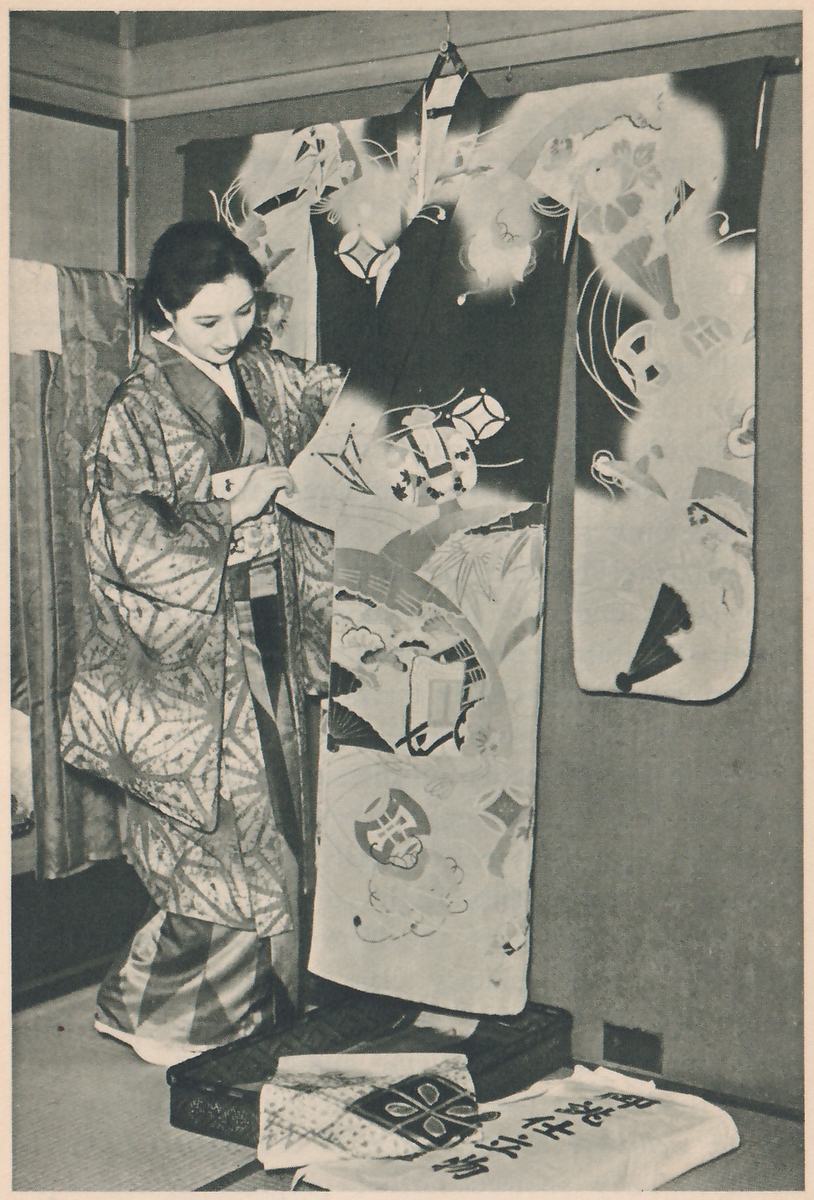
One spring evening, and in the light of the rose-coloured chandelier in Monsieur B’s room, a wealth of kosode, uchikake and obi glowed like a riot of flowers. Was the faint perfume in the air the exhalation of these garments, or the fragrance of flowers wafted from somewhere by the inappreciable zephyrs?
Monsieur B picked up an especially brilliant garment and said,
“About when was this kosode made? In superbness of design and colouring and.delicacy of workmanship, it is superior to any I have ever seen.”
Since he was by nature a sensitive artist and was at the same time rather well versed in Oriental art, his words hit the nail squarely on the head. The kosode he had picked up was a superior garment of the Keichō years (1596–1615) of the Momoyama Period, dyed purple above and white below, with a bamboo design done in fine spots on the white part. Not only was the technique of the dappled dyeing superbly admirable, but its excellent composition abounded in an artistry just a little beyond the power of words to express.
“Then shall we talk about dyeing and weaving tonight?
“In ancient times there were such woven materials as a striped cloth called shitori, a hempen cloth
and a mulberry cloth, and dyed goods very simply coloured without patterns with the juices of plants and flowers. But the first dyeing and weaving worthy of the name began in the Nara Period (646–794), when as a result of constant communication with China, then known as the Great Tang, the art of complicated and delicate dyeing and weaving was introduced and, under the protection and encouragement of the government, progressed rapidly and spread to all parts of the country.
The arts of dyeing and weaving first flowered into dazzling brilliance in the reign of the Empress Suiko and the Hakuhō (673–685) and Tenpyō (729–749) years of the Nara Period.
“Of fabrics there are exquisitely beautiful damask and brocade, silk gauze as light and thin and beautiful as a cicada’s wing, marvellous tsuzure brocade closely resembling gobelin and kasuri brocade with splashed patterns; of dyed fabrics a material called rōketsu, in the dyeing of which wax is used as in the dyeing of batik, kyōketsu, in which the design is carved on boards between which the fabric is pressed, and kōketsu, dapple dyed, and besides there are prints made with wooden blocks, pictures painted in natural colours and exquisite embroideries.
“These dyeing and weaving arts are all bold and free, showing the same lively strokes as paintings, and in the composition of the designs, most of which are symmetrical treatments of plants and animals and nature in the continental manner, and in the exquisite beauty of the spacing of the designs, is bound up the characteristic deep import of Oriental art, and consummate
beauty. It may not be too much to say that they are the most superb works of art of their kind on earth.
“Red, yellow and indigo were the fundamental colours used, and with them were skilfully employed green, black and white, and the dyes used were all native vegetable dyes, such as red flowers and purple plants.
“When I see the dyed and woven fabrics of this period, a tranquil scene in which maidens of the ‘Mannyō age,’ as bright as spring birds and aglow with fresh beauty, are gathering red and purple flowers in a sea of calm light and dyeing their colours into white silk, I fall to dreaming.”
Then Monsieur B, opening his eyes wide, exclaimed, “Are there still such dyed and woven fabrics in Japan? Glorious! Where?”
“There are many stored in the Shōsōin, the old Imperial storehouse in Nara, established in about the 8th century. Since they are kept in a wooden building of special construction called an azekura, some of them have of course been injured, but some of them are absolutely unsoiled and seem to preserve miraculously in both colour and design the vividness of the long-dead days when they were made.
“The special characteristic of the succeeding Fujiwara Period (897–1185) is a departure and development from the Nara fabrics in which continental elements predominated and the making of independent and purely Japanese materials.
“The designs of this period, called yūsoku designs, were instituted to make clear at a glance the standing and lineage of the nobility of the time, and were of
the nature of the heraldry of Europe in the middle ages. Besides, there were rules governing the colours and designs for the different official ranks and systematic distinctions for men and women, day and night, and the four seasons.
“These designs seem at first sight like armorial bearings, but all of them were based on the flowers and birds and objects of nature around us, which were skilfully given a new life through the symmetrical composition that was the essence of the preceding age. In systematizing, new departures were made from the good traditions inherited from that age, giving an entirely different impression.
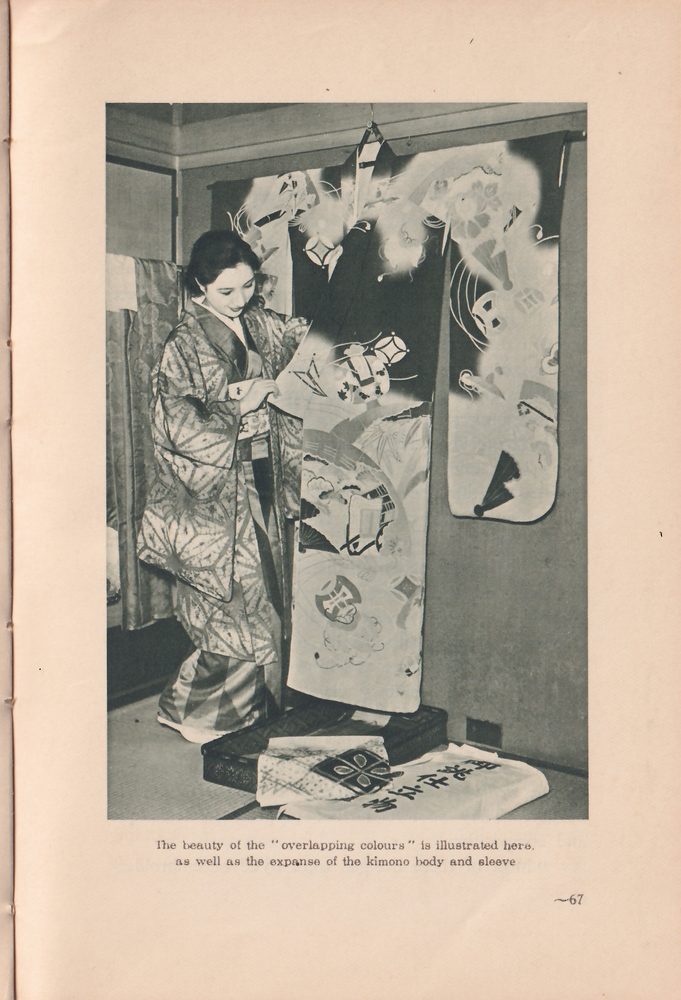
“The refinement in appreciation of colours was astonishing, and they invented a new law of harmony based on natural beauty called ‘overlapping colours.’ This was used principally in two-piece sets of women’s unlined garments worn one over the other, in which two tints of the same or different colours were harmonized and the feeling of the season of the year brought out, which really carried the arrangement of colours to a marvellous height.
“In the Kamakura and Muromachi Periods (1185–1573), when the military class arose anew and the centre of culture shifted to the military families, new fields opened again in dyeing and weaving.
“In the first place artistic designs were elaborated for the uchikake as an article of ornament for female beauty. They showed further progress in technique and composition.
“Most of these designs were dyed or embroider-
ed, but surihaku, printing on silk with gold and silver foil, was also popular. There are beautiful examples in which the basic design is printed in surihaku, with painstaking kanoko and hikita dappling beside it, overlaid with embroidered flowers and birds. None of these things had been seen in former ages.
“In the second place, Noh costumes came into being. Besides being purely Japanese and original, they are works of art in which all the elegant taste of the dyeing and weaving arts is combined.
“In the third place, with the growing popularity of the tea cult, ‘famous article cloth’ was born. ‘Famous article cloth’ meant cloth used as an ornament for treasures, and since some of the utensils used in the tea ceremony were wrapped up in sacks of woven material, this woven material came to be highly thought of as second only to the utensils themselves and an object of artistic appreciation.
“With the social changes in the Tokugawa Period (1615–1867), the taste of the townspeople came to have great influence, and there was a remarkable development in designs. The different kinds of designs may be tabulated as follows:
“1. Woven
“2. Dyed
“3. Embroidered
“4. Printed
“5. Painted
“6. Cut
“7. Sewed on
“1. Woven designs were those woven into the
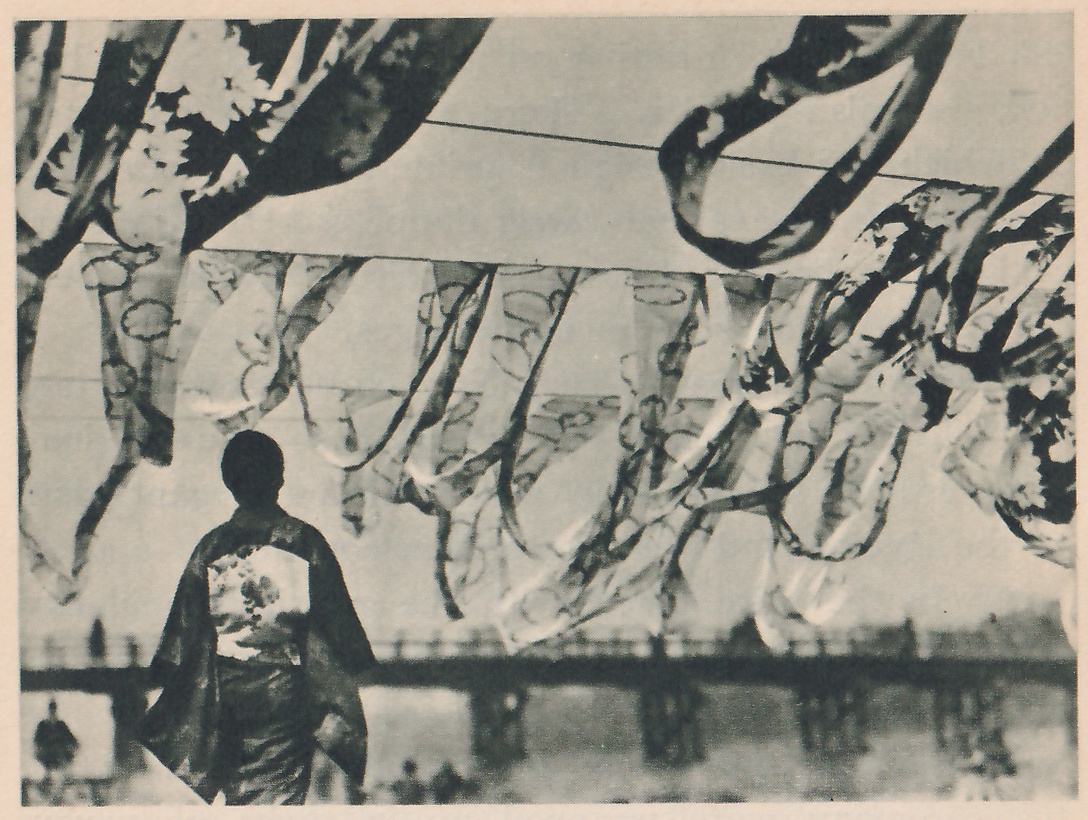
fabric itself, and some of them showed such patterns as the damask and the four noble plants, the orchid, chrysanthemum, plum and bamboo. Dyed and embroidered designs were added to these designs in the fabric.
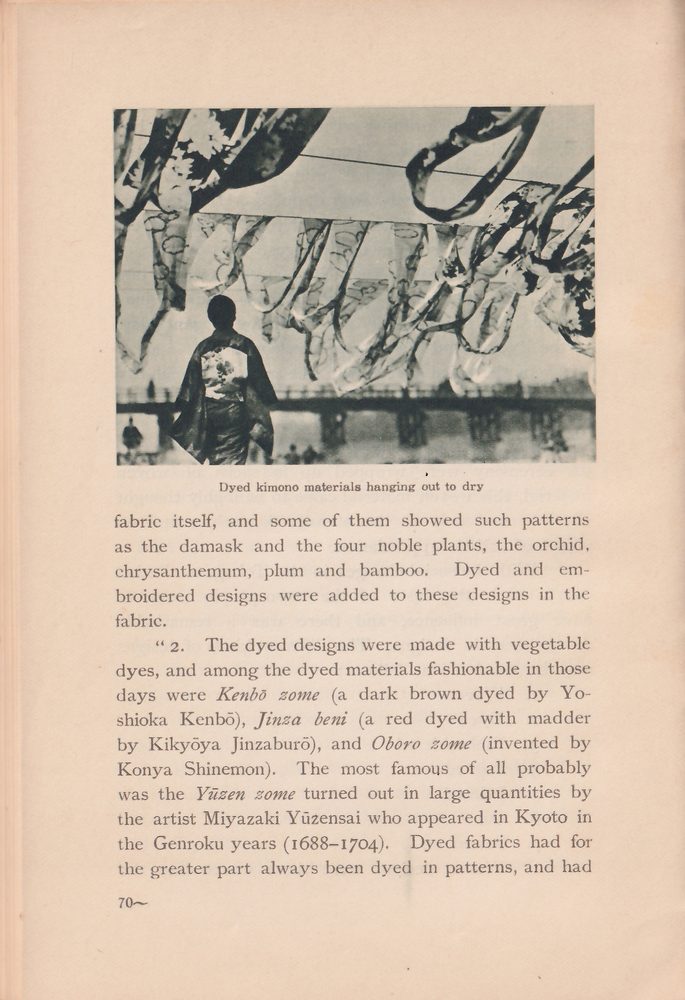
“2. The dyed designs were made with vegetable dyes, and among the dyed materials fashionable in those days were Kenbō zome (a dark brown dyed by Yoshioka Kenbō), Jinza beni (a red dyed with madder by Kikyōya Jinzaburō), and Oboro zome (invented by Konya Shinemon). The most famous of all probably was the Yūzen zome turned out in large quantities by the artist Miyazaki Yūzensai who appeared in Kyoto in the Genroku years (1688–1704). Dyed fabrics had for the greater part always been dyed in patterns, and had
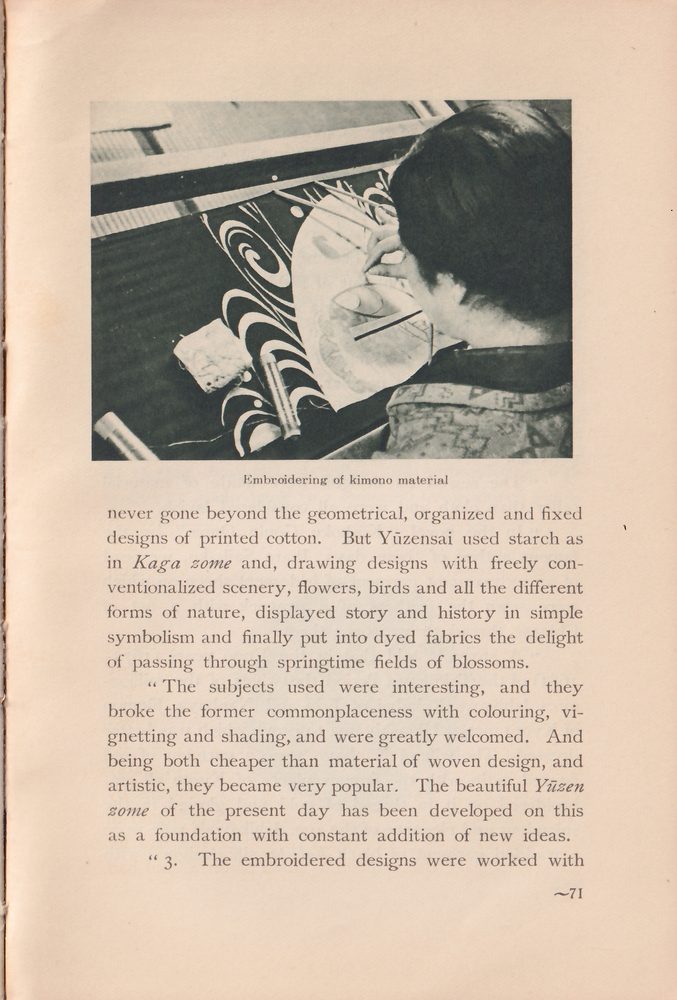
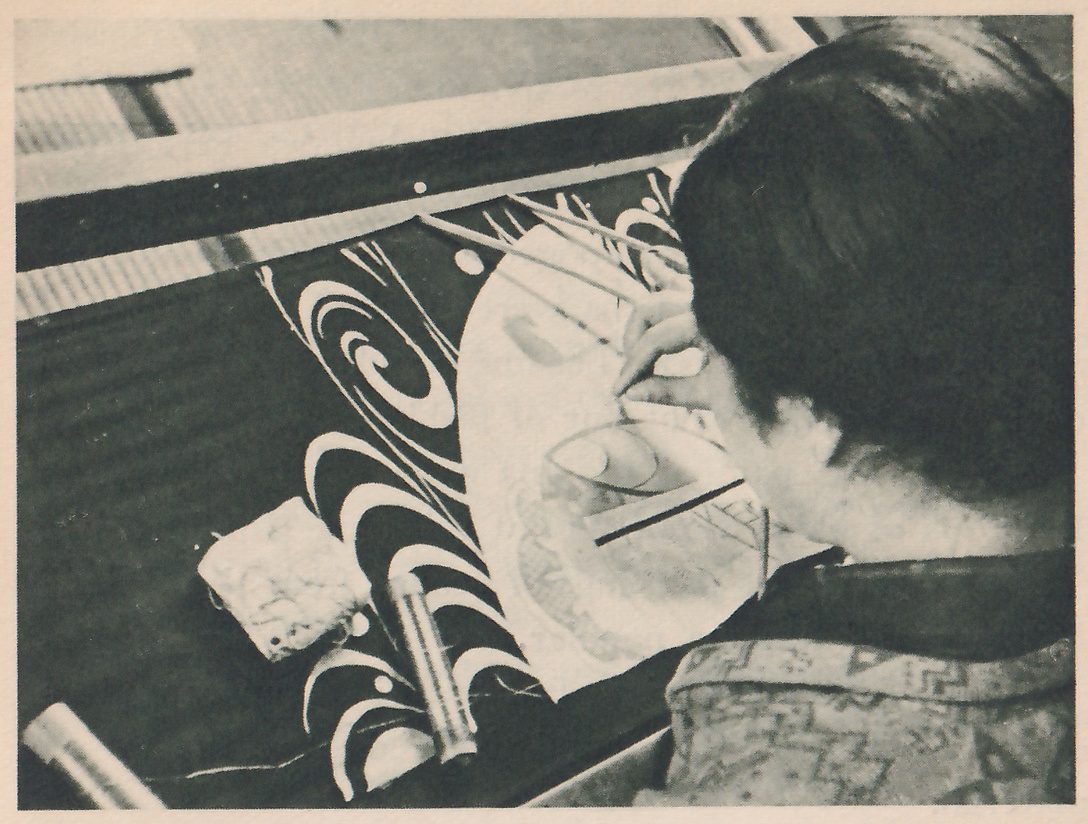
never gone beyond the geometrical, organized and fixed designs of printed cotton. But Yūzensai used starch as in Kaga zome and, drawing designs with freely conventionalized scenery, flowers, birds and all the different forms of nature, displayed story and history in simple symbolism and finally put into dyed fabrics the delight of passing through springtime fields of blossoms.
“The subjects used were interesting, and they broke the former commonplaceness with colouring, vignetting and shading, and were greatly welcomed. And being both cheaper than material of woven design, and artistic, they became very popular. The beautiful Yūzen zome of the present day has been developed on this as a foundation with constant addition of new ideas.
“3. The embroidered designs were worked with
twisted and single thread and used during the Tenshō years (1573–1592) of the Momoyama Period, but in the Kwanei years (1624–1644) of the Tokugawa Period the entire design was worked in gold thread, and under the name sunui, was the apogee of artistic embroidery.
“The printed designs were worked with foil, but as gold and silver thread became popular, these printed designs gradually went out of fashion.
“5. The painted designs were mostly pictures in India ink of olden times, but at this time paintings like Tosa pictures and paintings of scenes from the “Genji Monogatari” became popular.
“6. The cut designs fashioned in a separate piece of cloth were stitched around their edges to the woven material.
“The sewed on designs were made of material other than cloth and were all considered lavish.
“In the novel “Kōshoku Gonin Onna” by the famous author of those days, Ihara Saikaku, we read of an extravagant garment of iridescent sheen on which were sewn the feathers of a peacock with a net of Chinese thread thrown over them.
“A story is told that in the Enpō years (1673–1681) of the Tokugawa Period the wives of the millionaires Ishikawa Rokubei of Edo and Nanbaya Jūemon of Kyoto met at Higashiyama to prove which was better dressed. The wife of Nanbaya wore a garment of red figured satin with the famous places of Kyoto all embroidered on it in thread of gold and gloried in the splendour and elegance of the age. Ishikawa’s wife wore a wadded garment of black habutae silk designed with
red nandin berries. It looked at first as if the victory would go to her rival, but on close scrutiny, it was seen that the nandin berries on her garment were really selected beads of coral perfect in colour and lustre, and she won.
One story tells how in the Kyōho years (1716–1736) of the Tokugawa Period, the women of the family of Nakamura Kuranosuke of the Ginza (Edo) held a dress beauty contest at Maruyama, Kyoto, with the artist Kōrin as judge, and there is many another fascinating story proving that the Tokugawa Period was the golden age of ornament in dress.
Japanese kimono have finally appeared on the stage of world fashions. This is of course the valuable result of unrelenting experiments founded on superb technique in dyeing, weaving, dappling and embroidering with traditions going back two thousand five hundred years.