Fine Japanese Calligraphy

The Art of Master Japanese Calligrapher Eri Takase

[p. 56]

V. MONSIEUR B’S MEMORANDA ON THE HAORI, HAPPI AND YUKATA

Monsieur B always set down what I told him in detail in his note-book. One night he said, “I wonder if this is all right. Won’t you just look it over?” and handed me a note, which I will here make use of without alteration.

Jan. 6.

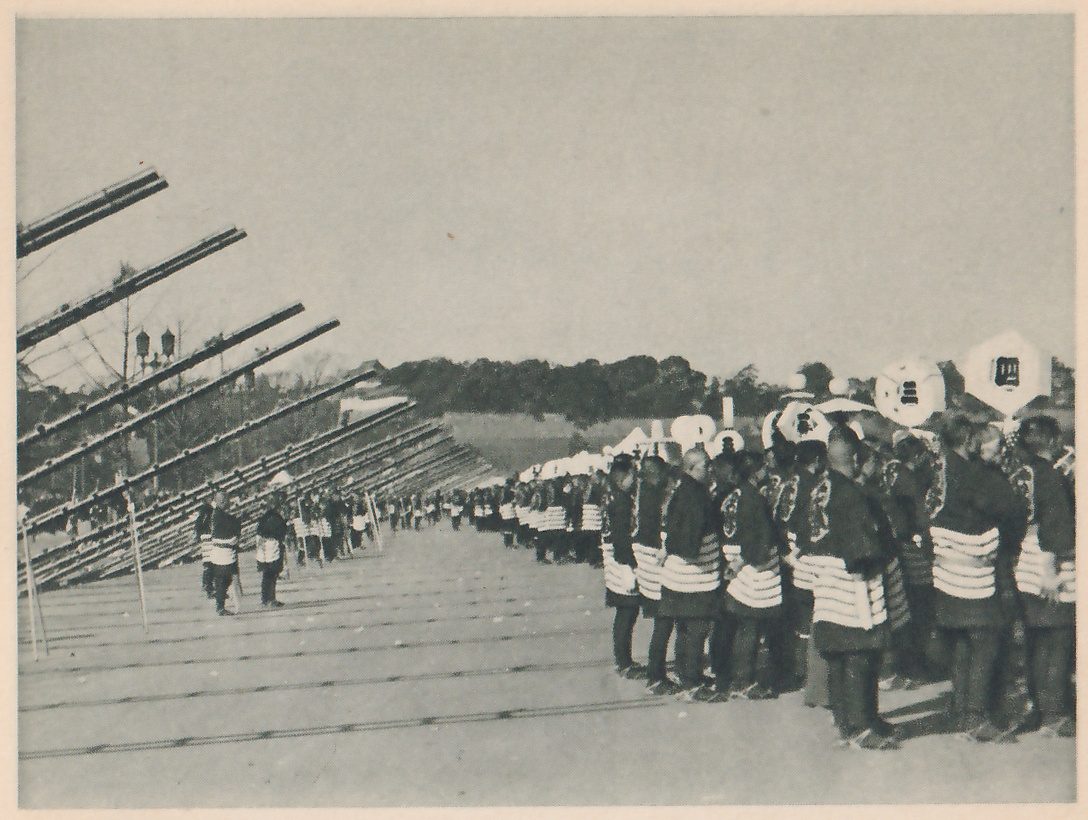
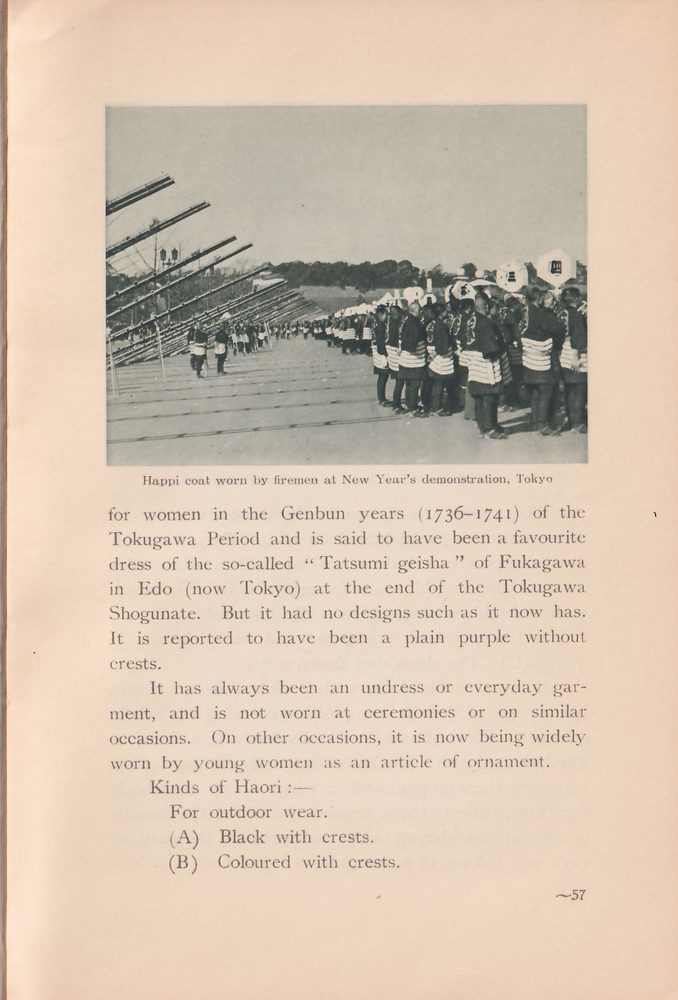
A morning of unusually white and brilliant frost. Having heard that there would be a New Year drill by the Fire Department in the boulevard in front of the Palace, I got somebody to take me there. Forty-eight companies of fire-fighters in new happi performed acrobatic feats on ladders.

In the evening I hear explanations of haori, happi and yukata.

I. The Haori

The haori is said to have developed from the jittoku worn by priests at the end of the Muromachi Period (1392–1573). It was a long-sleeved garment with a skirt sewed to the upper part used as a coat for outdoor wear to protect the robes.

Votaries of the tea cult and writers of seventeen-syllable verses wore it informally, but it was so far from a formal garment that they took it off when they had callers. In the Tokugawa Period (1615–1867), with the hakama, it became the proper formal dress for men.

The haori became an article of dress and ornament
[p. 57]

Black-and-white photograph of a wide open ground under a pale sky. At the left, many long poles lean at a slant in rows that recede toward the horizon, and two people stand apart on the ground below them. At the right a crowd of people stands in rows receding toward the left, in dark short coats with pale horizontal stripes at the hem, each coat with a large round mark on the back. Behind them, hexagonal and round pale signs carry characters in dark, and trees and low hills lie in the distance.
Happi coat worn by firemen at New Year’s demonstration, Tokyo

for women in the Genbun years (1736–1741) of the Tokugawa Period and is said to have been a favourite dress of the so-called “Tatsumi geisha” of Fukagawa in Edo (now Tokyo) at the end of the Tokugawa Shogunate. But it had no designs such as it now has. It is reported to have been a plain purple without crests.

It has always been an undress or everyday garment, and is not worn at ceremonies or on similar occasions. On other occasions, it is now being widely worn by young women as an article of ornament.

Kinds of Haori:—

For outdoor wear.

(A) Black with crests.

(B) Coloured with crests.
[p. 58]

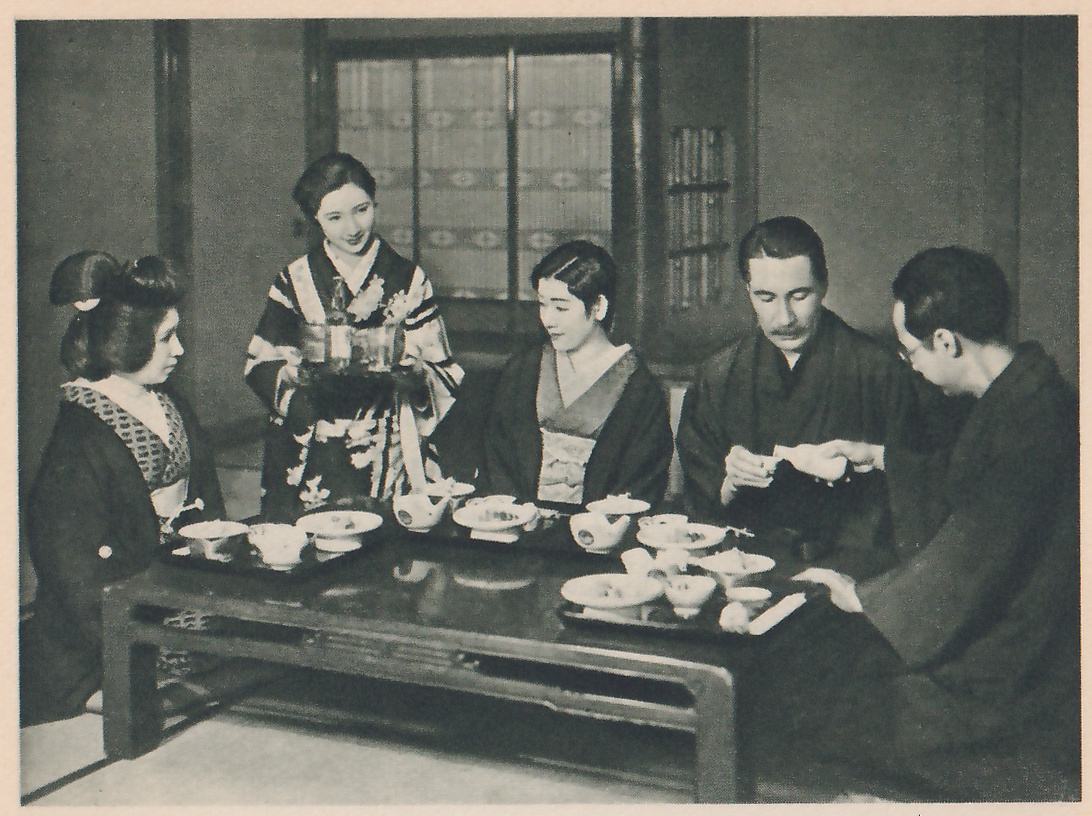
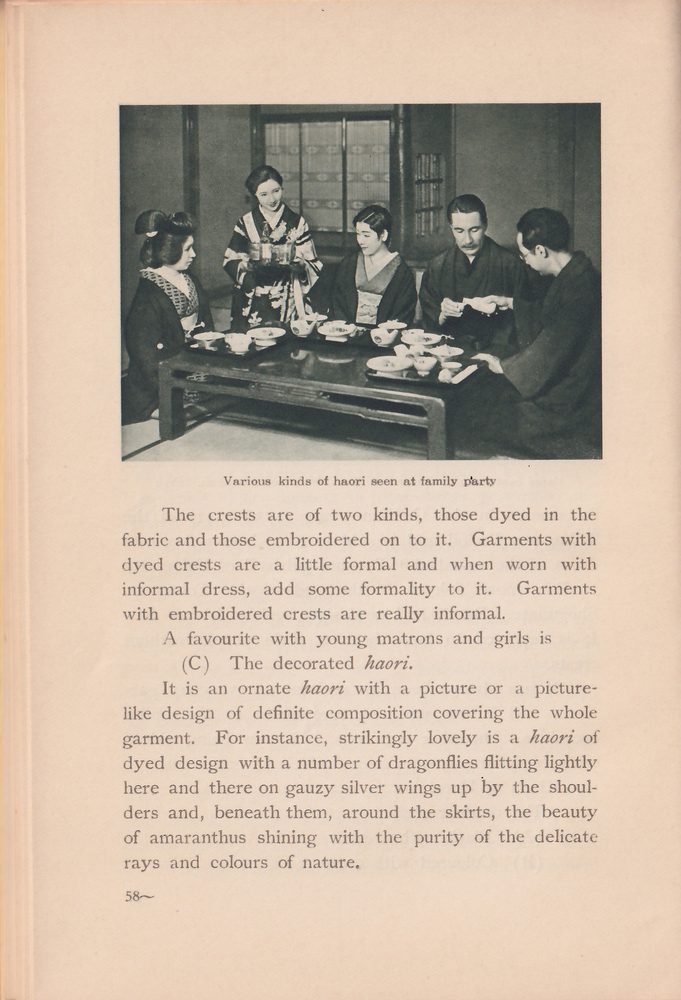
Black-and-white photograph of five people in a room with sliding windows of patterned paper panes, around a low dark table set with small bowls and cups on trays. At the left a person with the hair in a large wide upswept style with a pale ornament sits in profile in a dark patterned garment. Behind the table a person stands smiling and holds a tray with two glasses, in a garment with large flower patterns and wide pale stripes. Next sits a person with the hair waved back from a side parting, in a dark garment with a pale band, looking toward the standing person. Then a person with a moustache, in a dark garment, holds a small pale cup in both hands. At the right a person with glasses sits in profile, looking down.
Various kinds of haori seen at family party

The crests are of two kinds, those dyed in the fabric and those embroidered on to it. Garments with dyed crests are a little formal and when worn with informal dress, add some formality to it. Garments with embroidered crests are really informal.

A favourite with young matrons and girls is

(C) The decorated haori.

It is an ornate haori with a picture or a picture-like design of definite composition covering the whole garment. For instance, strikingly lovely is a haori of dyed design with a number of dragonflies flitting lightly here and there on gauzy silver wings up by the shoulders and, beneath them, around the skirts, the beauty of amaranthus shining with the purity of the delicate rays and colours of nature.
[p. 59]

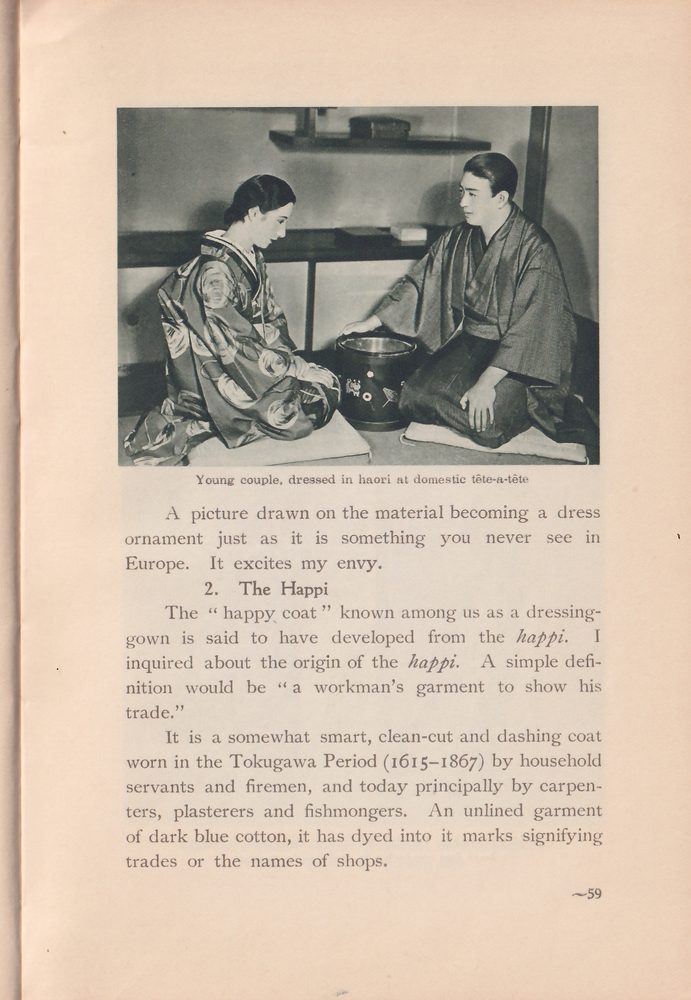
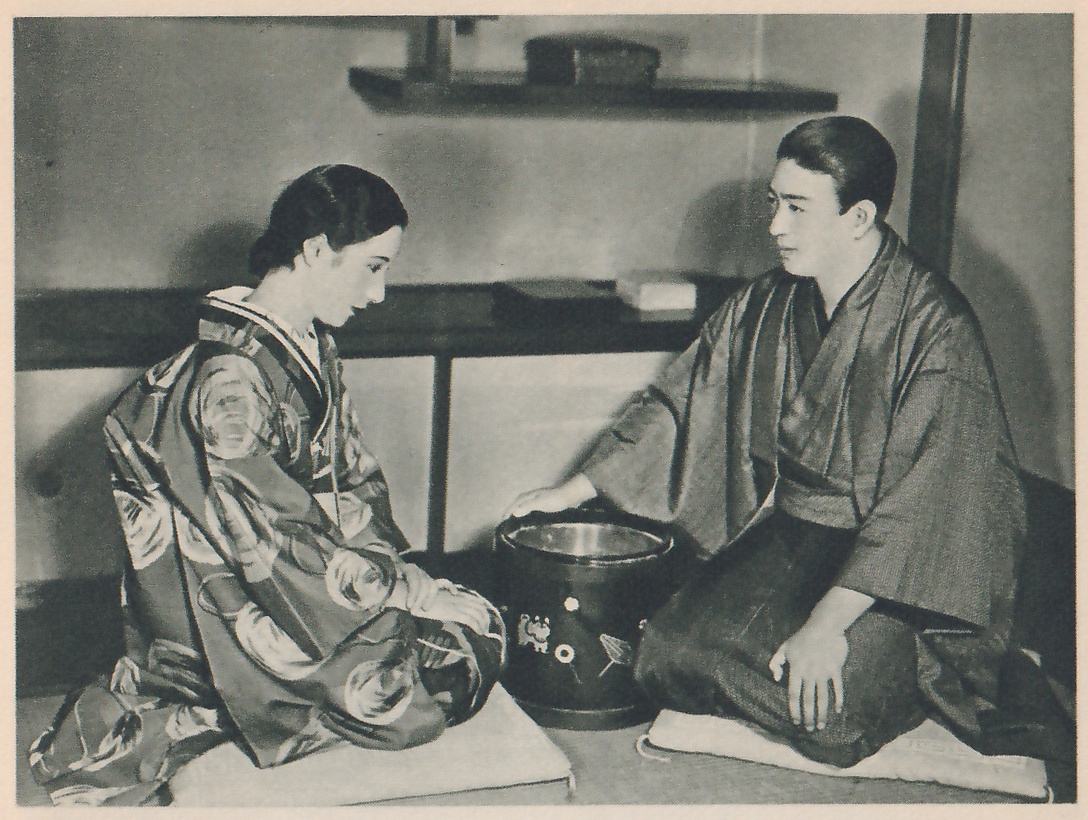
Black-and-white photograph of two people kneeling on flat cushions on a mat floor, facing each other across a round dark container with a shiny rim and a few small round designs on its side. At the left one has the hair drawn back in a low bun and wears a garment with large rounded shapes, the hands in the lap and the head bowed toward the container. At the right the other, with short smooth hair, wears a dark finely patterned garment and wide trousers, and rests one hand on the rim of the container and the other on the knee, looking toward the first. Behind them is a low cabinet with a shelf above it holding a flat box, and a dark post stands at the right.
Young couple, dressed in haori at domestic tête-a-tête

A picture drawn on the material becoming a dress ornament just as it is something you never see in Europe. It excites my envy.

2. The Happi

The “happy coat” known among us as a dressing-gown is said to have developed from the happi. I inquired about the origin of the happi. A simple definition would be “a workman’s garment to show his trade.”

It is a somewhat smart, clean-cut and dashing coat worn in the Tokugawa Period (1615–1867) by household servants and firemen, and today principally by carpenters, plasterers and fishmongers. An unlined garment of dark blue cotton, it has dyed into it marks signifying trades or the names of shops.
[p. 60]

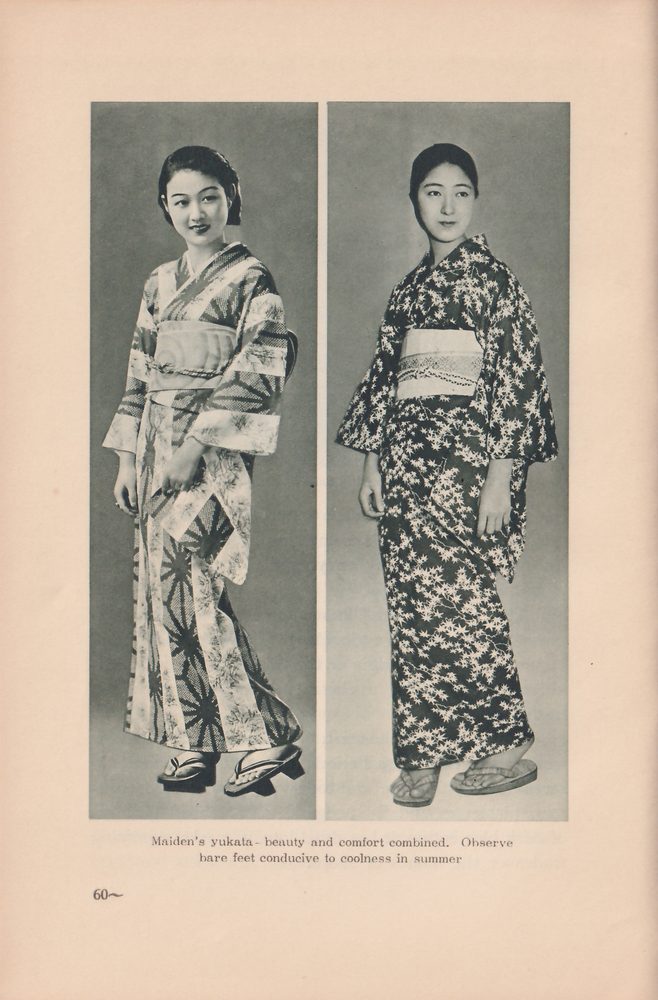
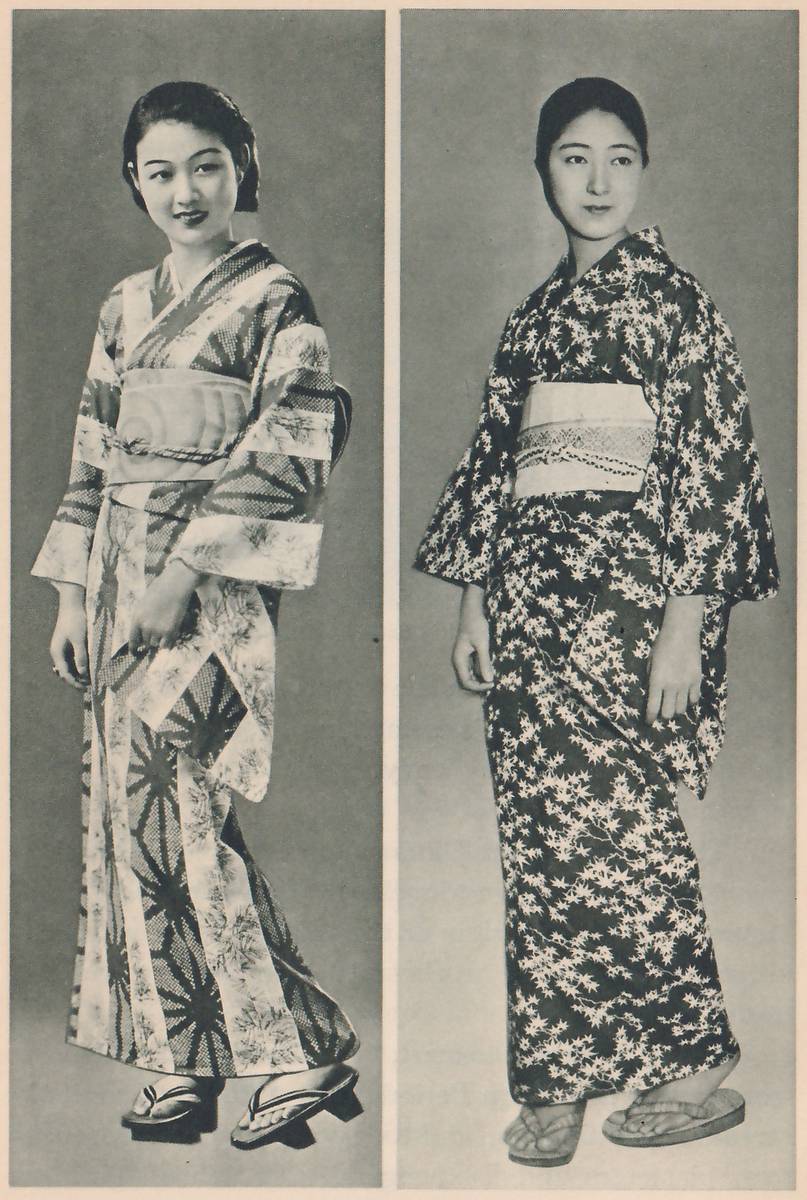
Two black-and-white photographs side by side, each of a young woman standing against a plain mid-tone backdrop. At the left she smiles toward the viewer with the head tilted; her garment is in wide vertical bands, some pale with flower sprays and some dark with star-shaped radiating patterns, with a wide pale band at the waist tied with a twisted cord, and she holds the garment at the hip with one hand. She wears sandals with dark thick soles. At the right she stands in three-quarter view, in a dark garment densely patterned with pale leaf shapes and a pale lace-like band at the waist; her toes show on the thongs of her sandals.
Maiden’s yukata- beauty and comfort combined. Observe bare feet conducive to coolness in summer

[p. 61]

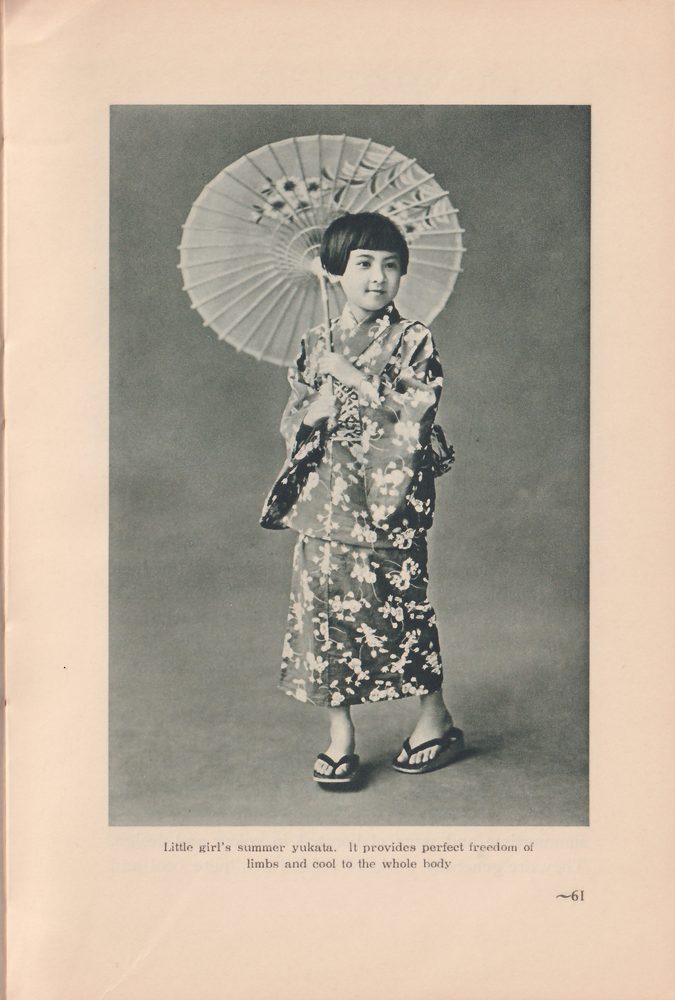
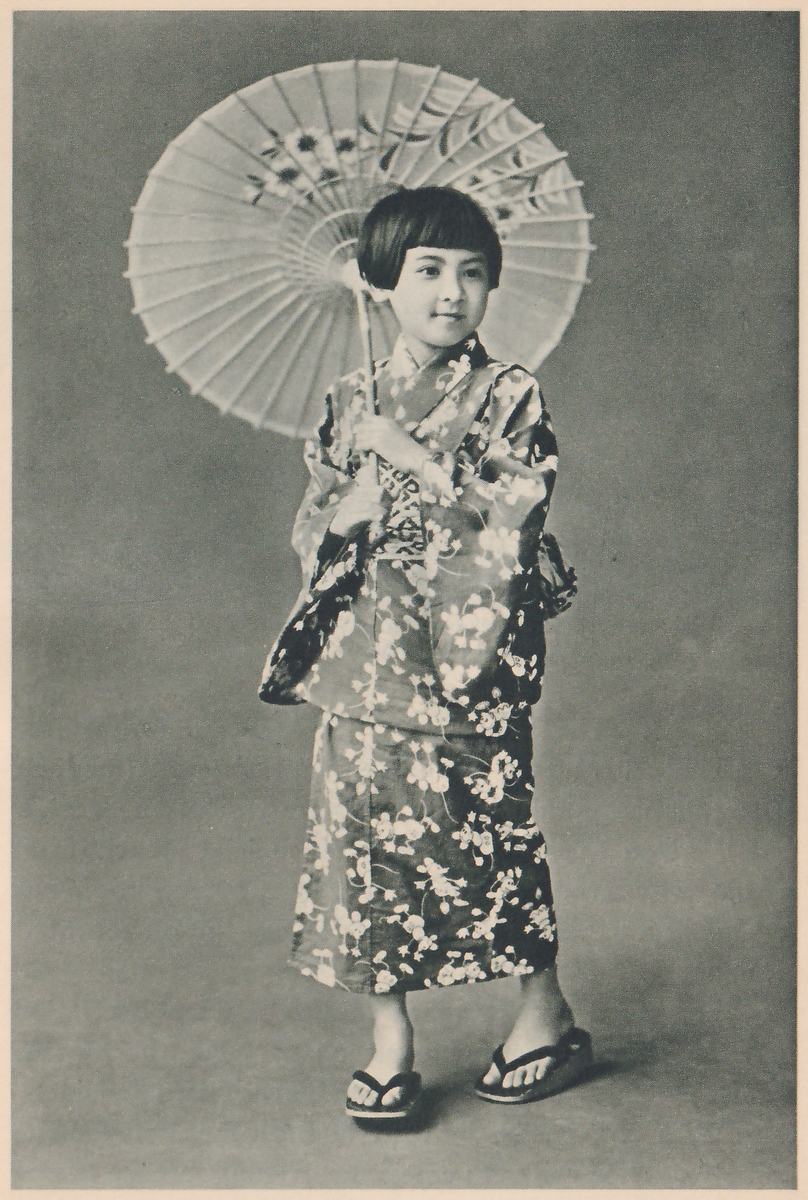
Black-and-white studio photograph of a girl with short straight hair and a fringe, standing on a plain mid-tone ground and looking to the right with a slight smile. She holds up a large open paper parasol with ribs showing and a painted pattern of flowers and leaves. Her garment is dark with pale flower shapes, with wide sleeves and a sash at the waist tied in a bow at the back. She wears sandals with dark thongs.
Little girl’s summer yukata. It provides perfect freedom of limbs and cool to the whole body

[p. 62]

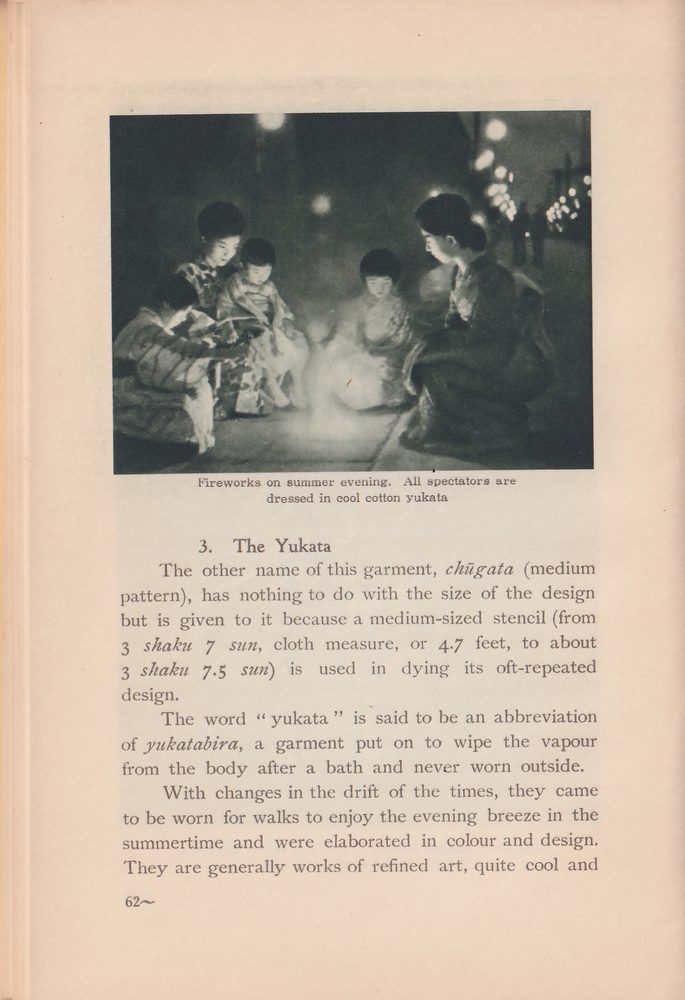
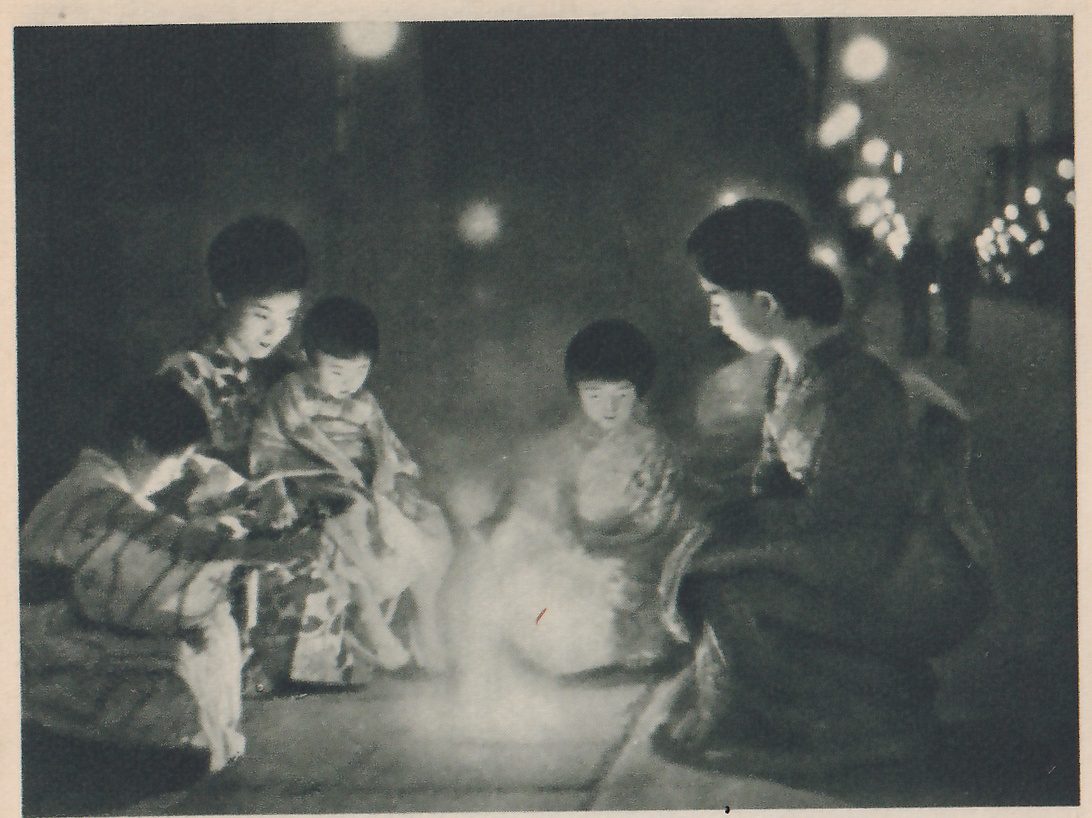
Dark black-and-white photograph of a night scene on a paved street, with several people crouching close together around a bright glow on the ground at the center. At the left a person with the hair in a bun looks down, with a small person in a patterned garment beside, and part of another person in a striped garment is cut off at the lower left edge. A second small person sits at the center behind the glow. At the right a person with the hair in a bun bends toward the glow, seen in profile. Blurred round street lights show in the background, and dim standing figures show at the far right.
Fireworks on summer evening. All spectators are dressed in cool cotton yukata

3. The Yukata

The other name of this garment, chūgata (medium pattern), has nothing to do with the size of the design but is given to it because a medium-sized stencil (from 3 shaku 7 sun, cloth measure, or 4.7 feet, to about 3 shaku 7.5 sun) is used in dying its oft-repeated design.

The word “yukata” is said to be an abbreviation of yukatabira, a garment put on to wipe the vapour from the body after a bath and never worn outside.

With changes in the drift of the times, they came to be worn for walks to enjoy the evening breeze in the summertime and were elaborated in colour and design. They are generally works of refined art, quite cool and
[p. 63]

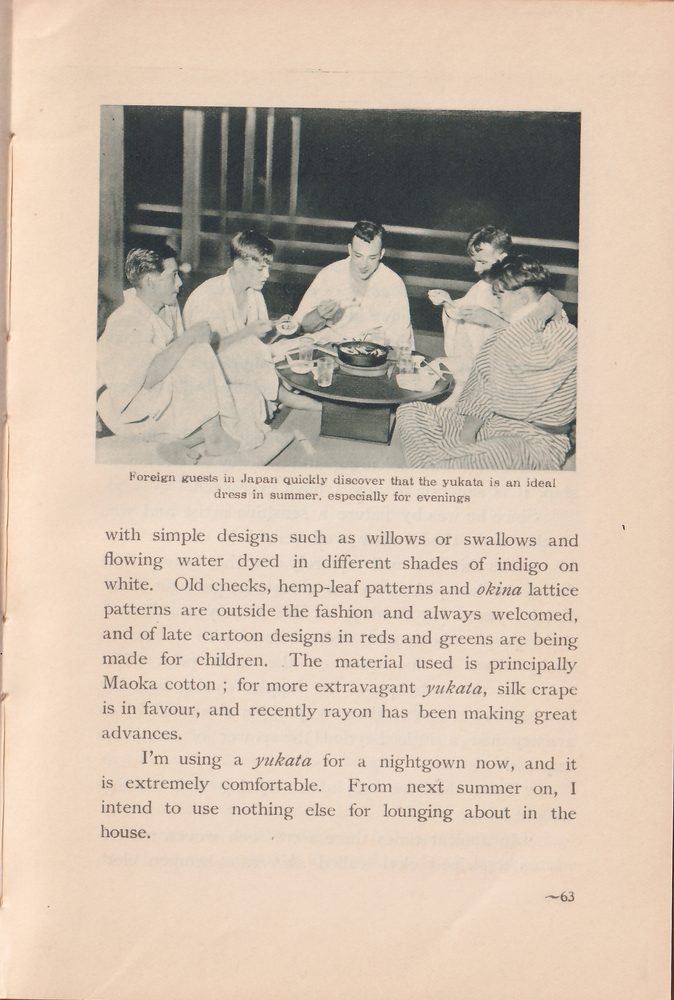
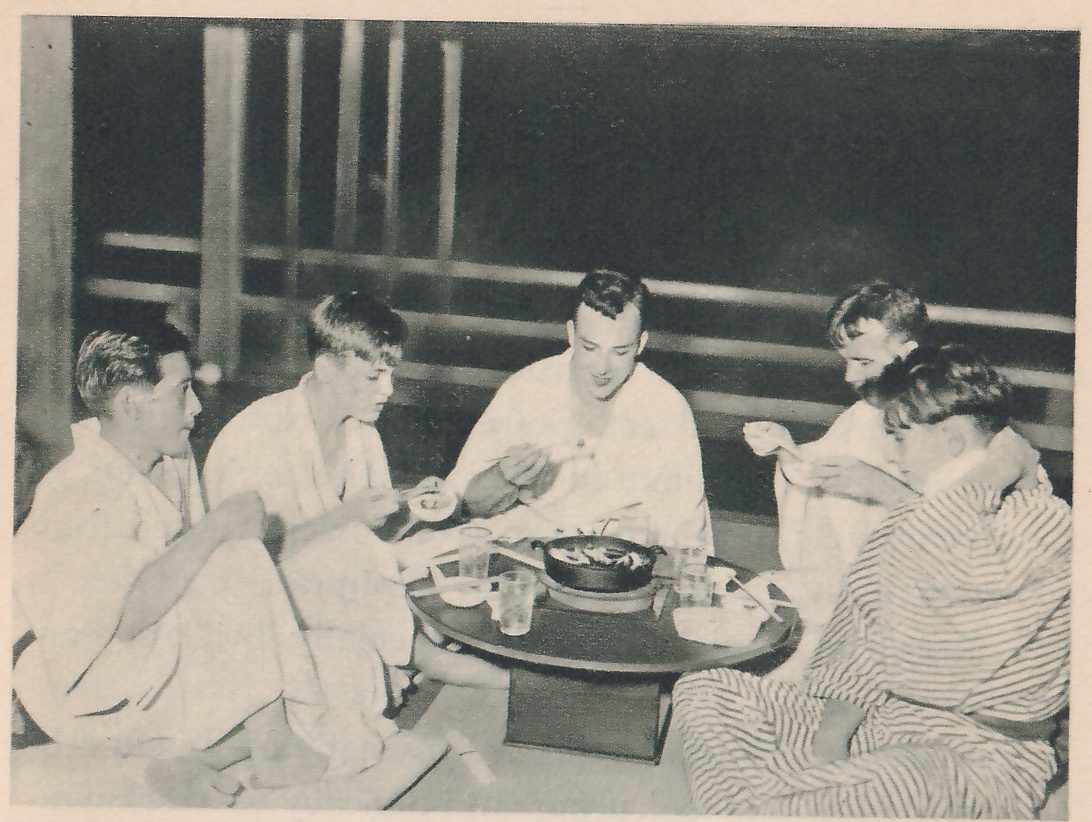
Black-and-white photograph at night of five people with short hair sitting on a mat floor around a low round dark table, on a veranda with wooden posts and rails behind them. Four wear plain pale loose garments, and the one at the lower right, sitting cross-legged, wears a garment with narrow vertical stripes. On the table stand a dark round pot, glasses and small dishes, and several of them hold small bowls and chopsticks.
Foreign guests in Japan quickly discover that the yukata is an ideal dress in summer, especially for evenings

with simple designs such as willows or swallows and flowing water dyed in different shades of indigo on white. Old checks, hemp-leaf patterns and okina lattice patterns are outside the fashion and always welcomed, and of late cartoon designs in reds and greens are being made for children. The material used is principally Maoka cotton; for more extravagant yukata, silk crape is in favour, and recently rayon has been making great advances.

I’m using a yukata for a nightgown now, and it is extremely comfortable. From next summer on, I intend to use nothing else for lounging about in the house.