IV. DIALOGUE ON THE OBI
“The other day I said that the kimono was an exceptional form of dress, but the obi is rather a peculiar thing, too, isn’t it? Since coming to Japan like this and becoming accustomed to seeing things, they no longer seem very strangePrinted: stange, but the obi is to us foreigners a most extraordinary ornament.”
“It must be. Sometimes we Japanese ourselves wonder why such a fabric, so really splendid even as a work of art, should be tied on the back.
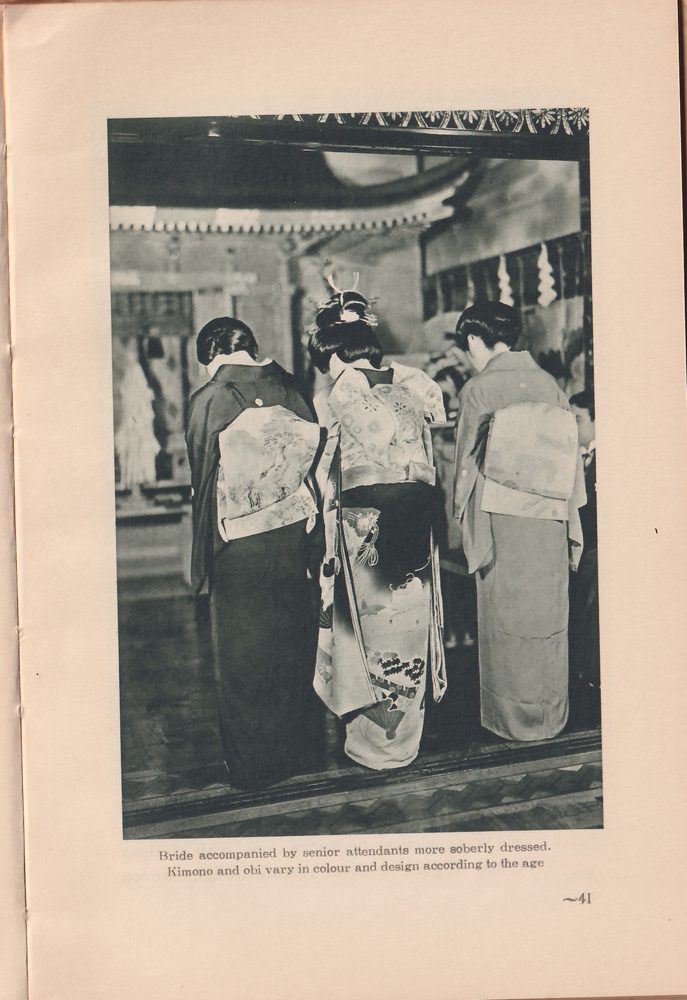
“But Monsieur B, this comes from what you once mentioned, the difference between revealed and hidden beauty. In short, woman’s dress in Europe and America is ornament made to cling to the curves of the body and bring out the beauty of those curves, isn’t it?
“The Japanese kimono wraps up the body and serves the purpose of hinting at its presence instead. And its colour and design are ornaments to beautify the body’s canvas.”
“Yes. For that matter, the focus of interest is quite different in the European and American woman’s dress and the Japanese kimono, isn’t it? They are alike in that they both make the waistline the dividing line and concentrate the attention on the face and breast, but their treatment of the waistline is utterly different. The Japanese kimono ignores the waistline, wraps a beautiful but immense obi around it, and through that very enlargement, rather ends by drawing
attention to it. Another difference is that in woman’s dress in Europe and America, the long skirt hides the constriction at the knees, but in the kimono, the lower part of the skirt is brightened and brings it out clearly. Whoever thought of attracting attention to the waistline by winding the obi around it hit upon a truly interesting idea. One of the special features of the Japanese woman’s costume is the obi.”
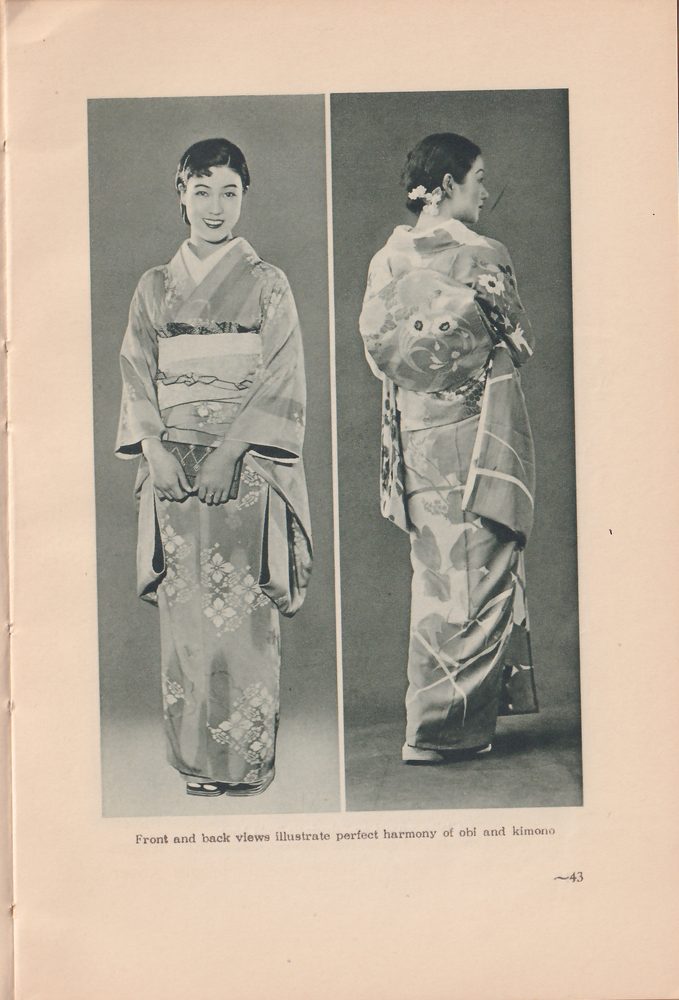
“Exactly. The kimono and the obi are two different things, but really they are one and inseparable. When we speak of the kimono, we quite naturally include the obi in our thought. The dress and the hat are very closely associated in woman’s dress in Europe and America, but the kimono and obi are even more closely combined. In Japan there is an old saying. The obi symbolizes Japan’s beauty.Printed: beanty.”
“The obi symbolizes Japan’s beauty!Printed: beanty! To be sure, that briefly and perfectly expresses the special nature of the Japanese kimono, doesn’t it?
“About the obi that the Japanese woman wears today, when did it originate? Was it at the same time that the kimono became fixed in form?”
“The present-day wide obi originated somewhat recently. Of course there have been obi since ancient times. But the obi bound round the naii by women of noble family in the Fujiwara Period (897–1185) was narrow, and when the hakama was worn, could not be seen.
“After the Muromachi Period (1392–1573) the samurai women tied their obi on over their aigi and took to wearing the coat called uchikake, and though the obi finally came into sight, since the uchikake was
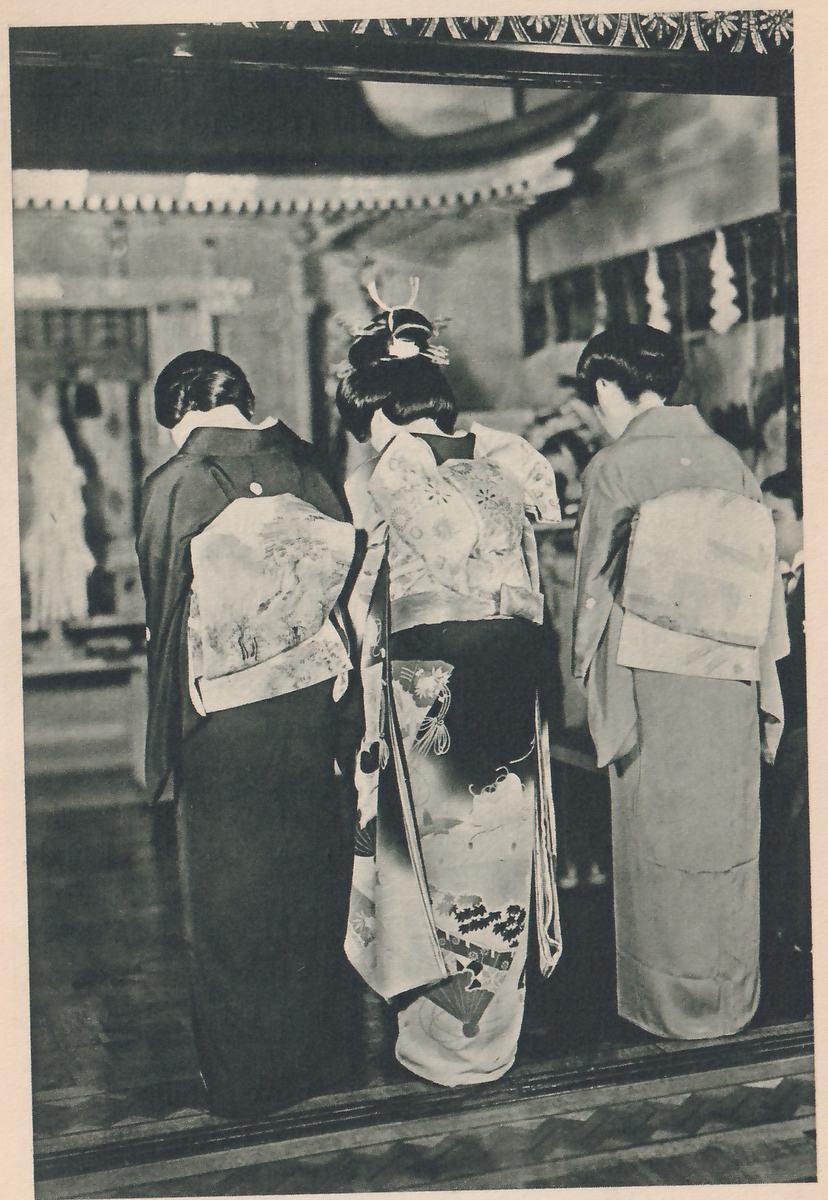
still worn, it was considered the principal article of ornament, and the obi could boast of no great beauty.
“In the Momoyama Period (1568–1615) a braided obi with tassels at each end called a Nagoya obi appeared. It was wrapped around the waist many times and tied in a dangling knot at either side. The obi had come to exist as an article of exterior wear and to have in it a rich element of ornament, but it was worn by only a small class and never came to be generally popular.
“In the Tokugawa Period (1615–1867) the cultural centre of the nation shifted to the townsmen, and the women wore the aigi as an uwagi (outer coat), bound on the obi, and for the first time took a prominent place in the world. But even in the Genroku years (1688–1704) of the Tokugawa Period the obi was not wide, as it is today. It was in the Kyōho years (1716–1736) of the Tokugawa Period that women came to wear the wide obi that has continued in favour to this day. The measurements of the wide obi of today, called maru obi, are, width, about 2 feet, folded double, length, about 11 feet.
“As in the case of the kimono there are for the obi various unwritten laws governing the colours and designs for different occasions, and here is a list of them:—
“With crested garment.
“Always a maru obi of woven stuff.
“On inauspicious occasions (with mourning garments), patternless obi of white, black or silver.
“On auspicious occasions, obi with designs worked in gold or silver thread, designs woven
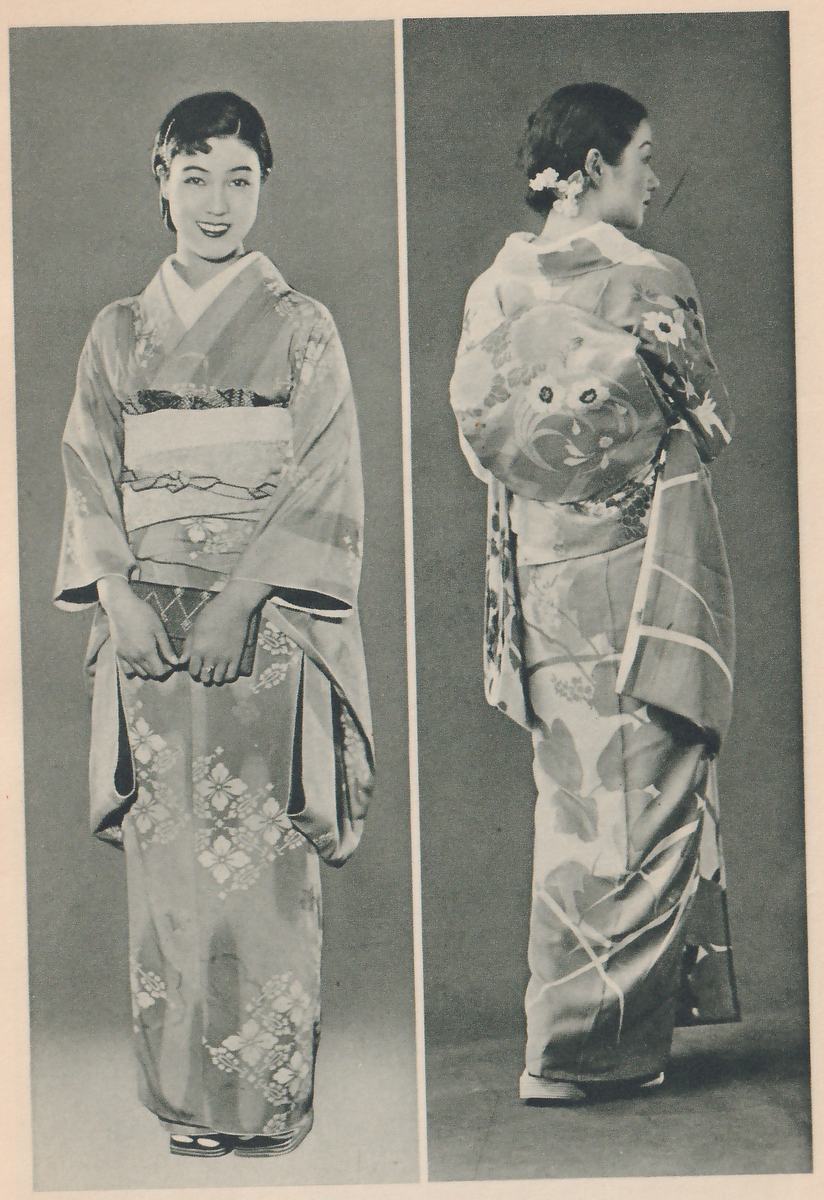
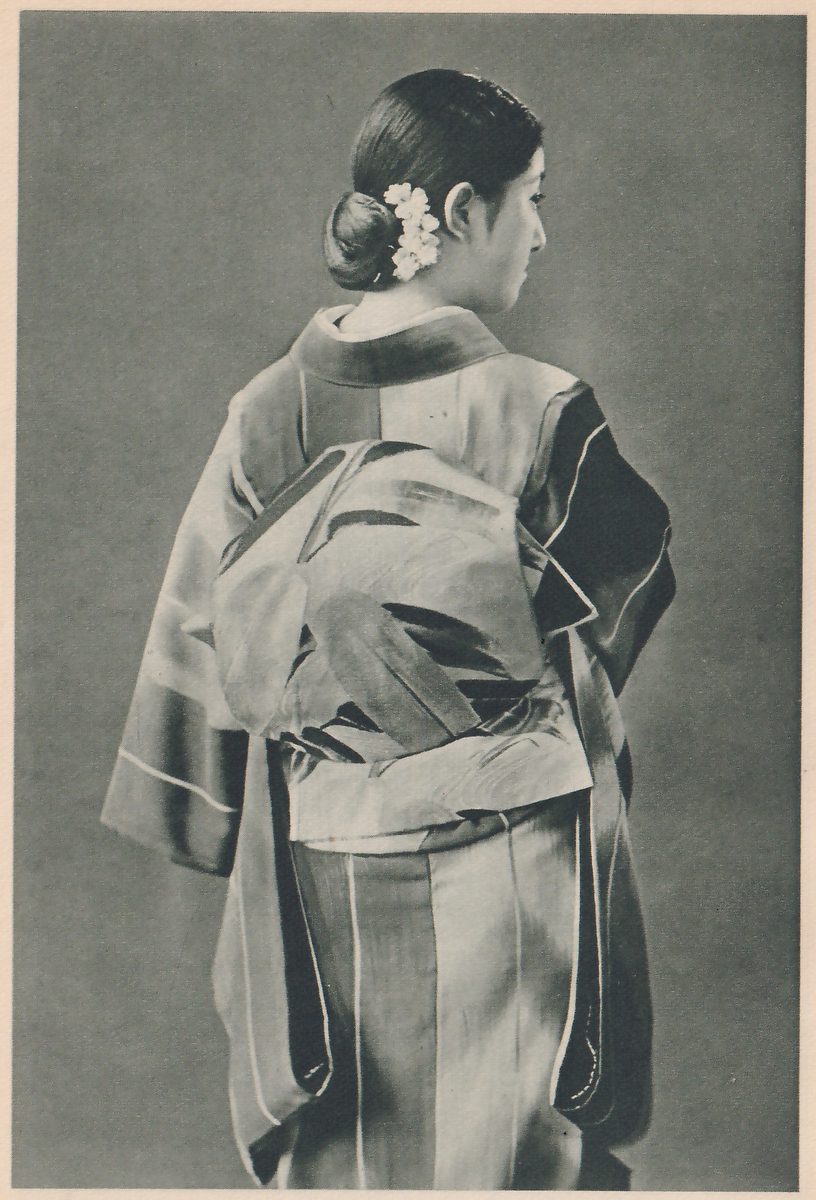
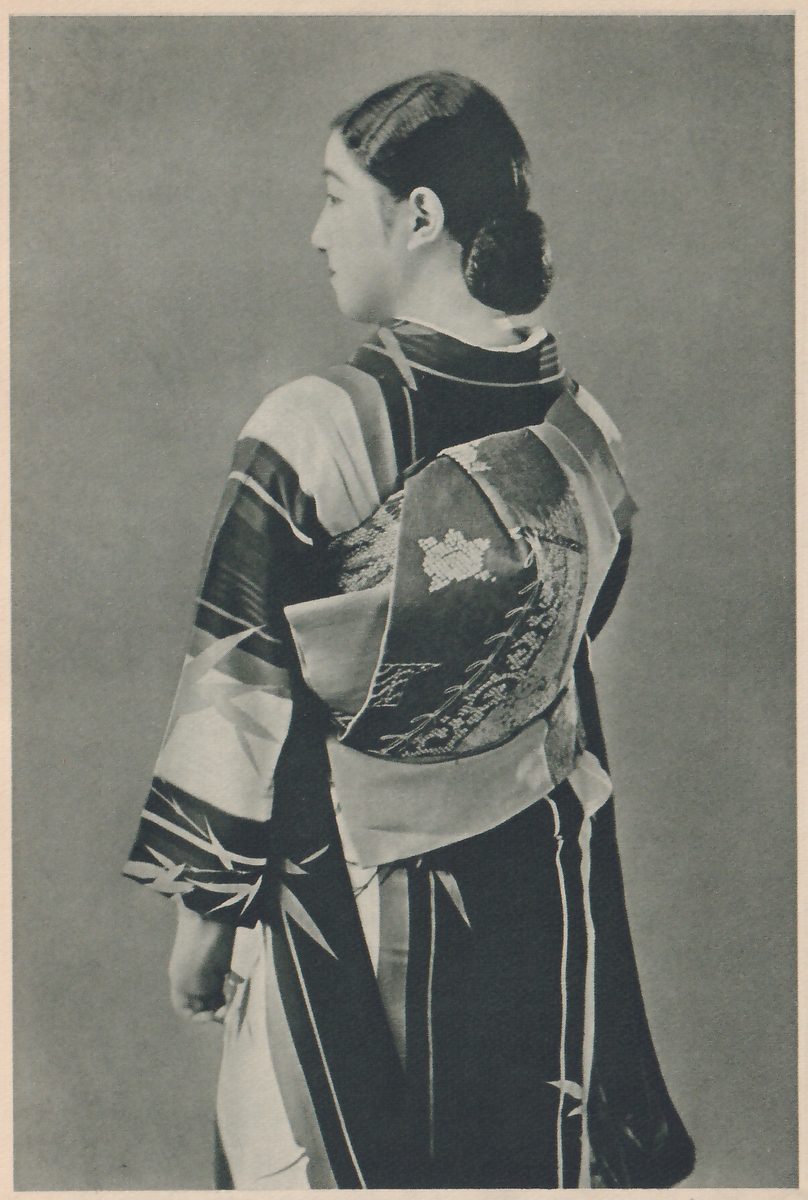
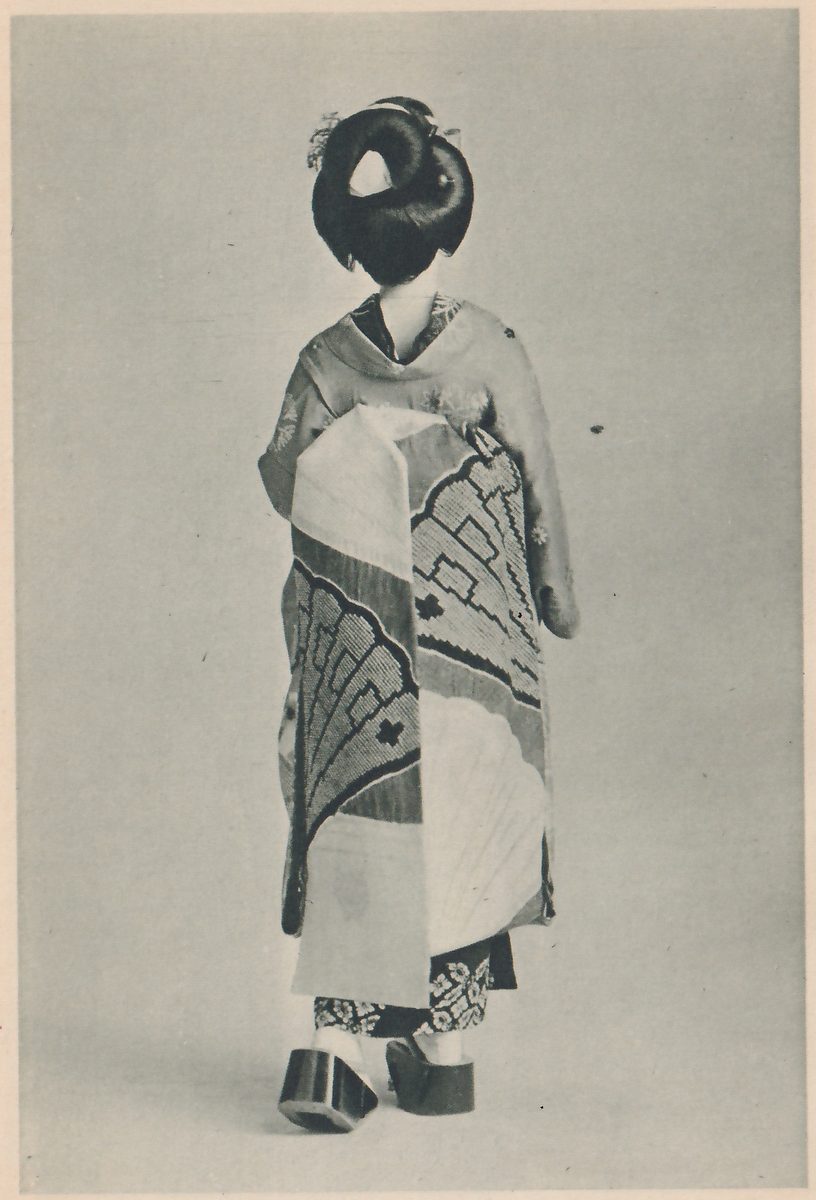
in the fabric and brought out with embroidery and gilding, magnificently wonderful obi with congratulatory designs such as pine, bamboo and plum, the four noble plants (bamboo, plum, chrysanthemum and orchid), storks and tortoises or paulownia and phoenixes.
“Calling and undress.
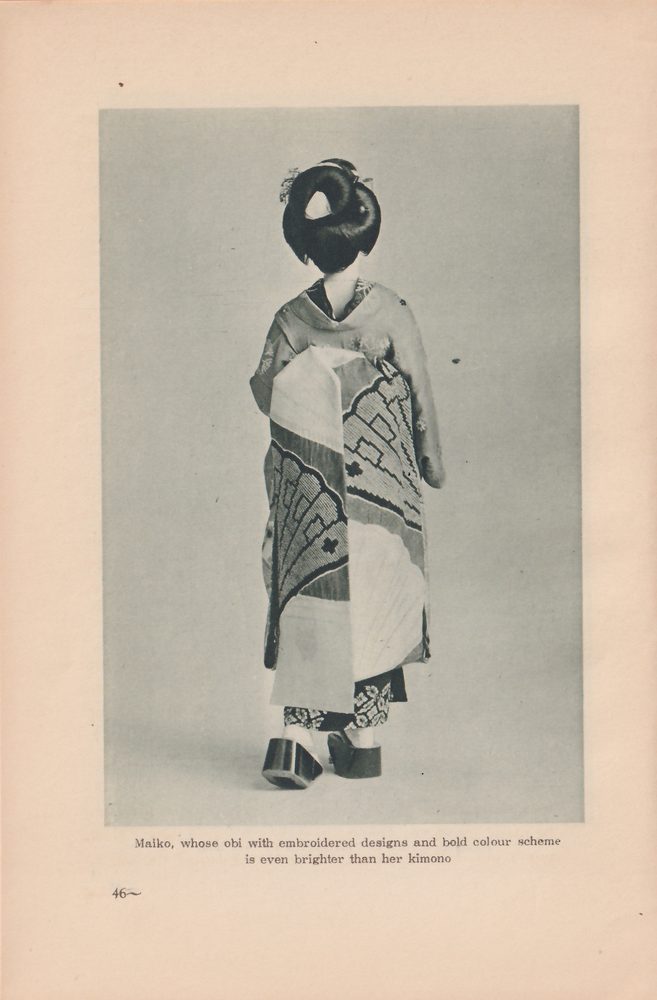
“Wide maru obi with the design either woven or dyed. There being freedom of choice in colours and materials, bright and beautiful things abound.
“For undress, the chūya obi (two materials of woven or dyed design nine sun, or about ten inches, in width sewed at the edges over padding) is also used.
“Material Used in Obi.
“The woven stuff used in both the maru obi and the chūya obi is ordinary brocade, heavy brocade, damask silk, etc, with embroidery and gilding added. Besides, a patterned cloth made in Hakata, shusu, habutae and silk crape are used.
“The dyeing is yūzen zome, hitta zome, etc.”
“When I was in Paris, I used as a wall hanging a beautiful brocade obi that a Japanese friend sent me and another of rather soft silver material with big tree peonies woven into it in vermilion and gold I had made into an evening cloak for my wife. In our eyes it was extremely beautiful and exotic, and wherever she went, she was delighted with the praise it evoked. Some obi can be made into attractive cushion covers, can’t they? Next, won’t you tell me about the ways of tying the obi?”
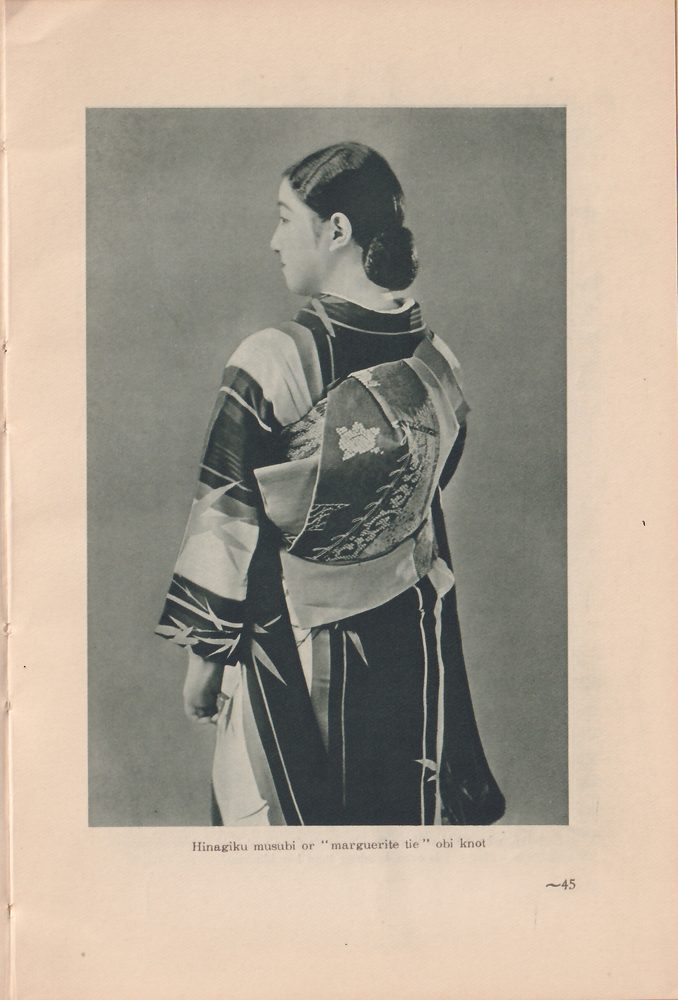
“Up to the years of the Genroku and Kyōho (1688–1736) of the Tokugawa Period, old and young alike tied the obi in front when in full dress, but after the Genbun years (1736–1741) of the Tokugawa Period, it was tied behind. Many styles of tying the obi, such as the Kichiya musubi, originated long ago by actors on the stage (the Kabuki female impersonator Uemura Kichiya was the first to employ it in the Enpō years (1673–1681) of the Tokugawa Period, and the Mizuki musubi (originated by Mizuki Tatsunosuke) have been in fashion, but the styles now in vogue are:—
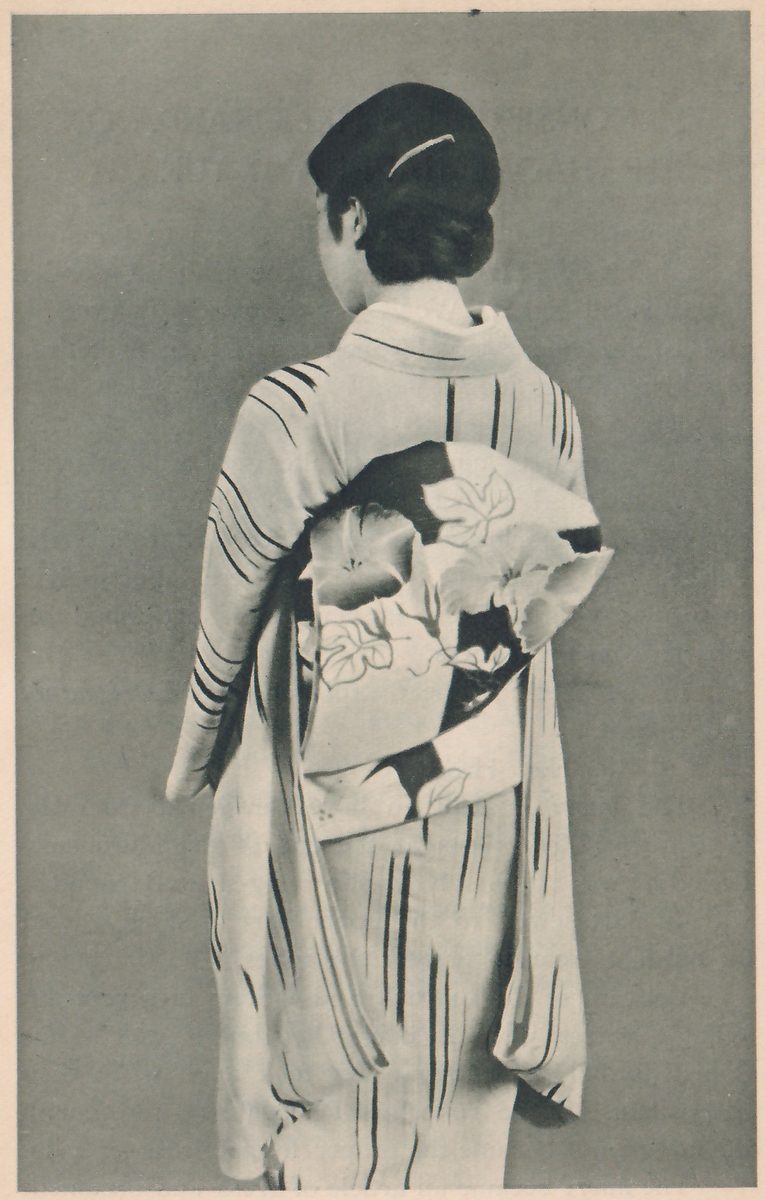
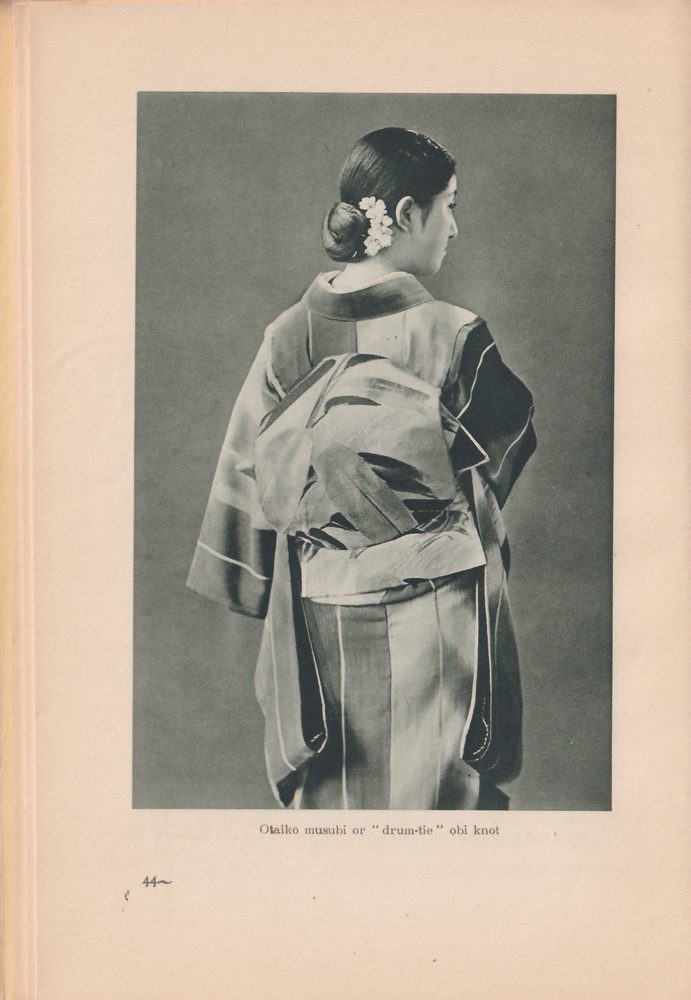
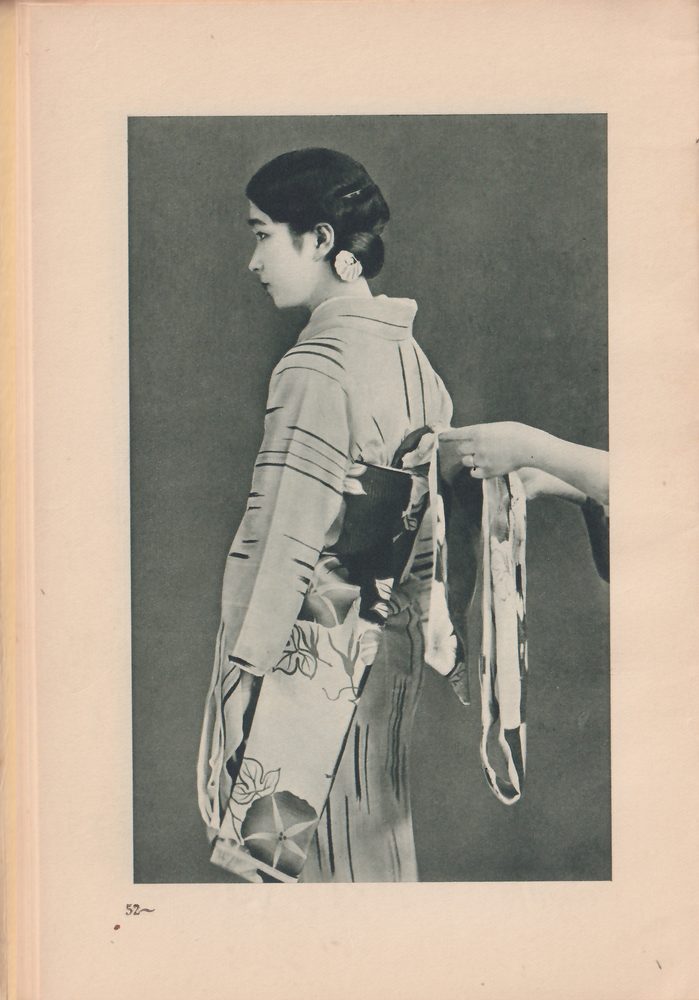
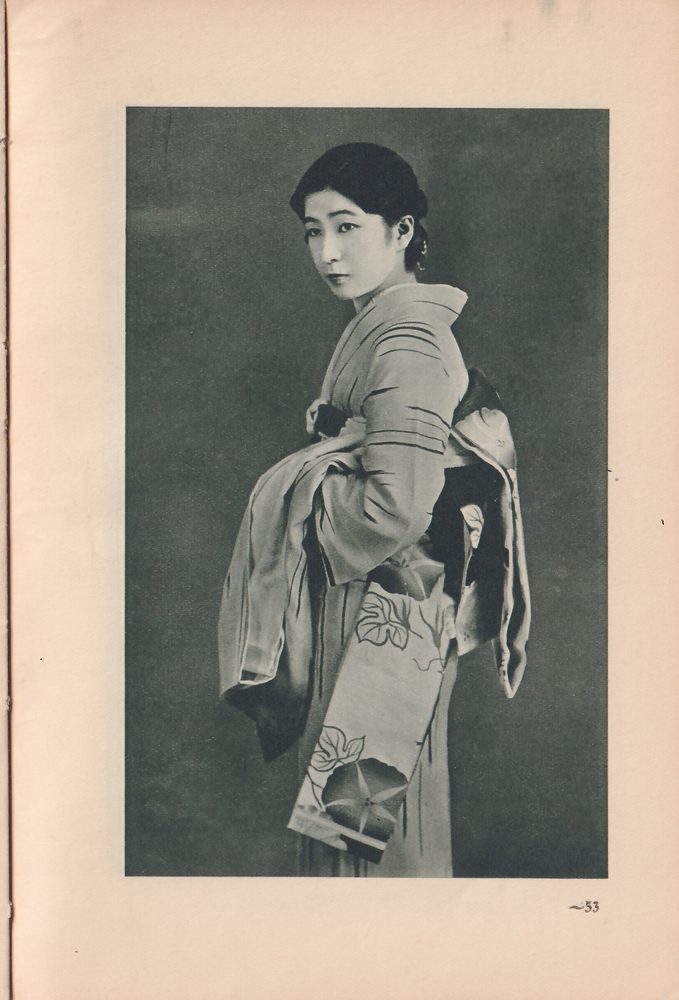
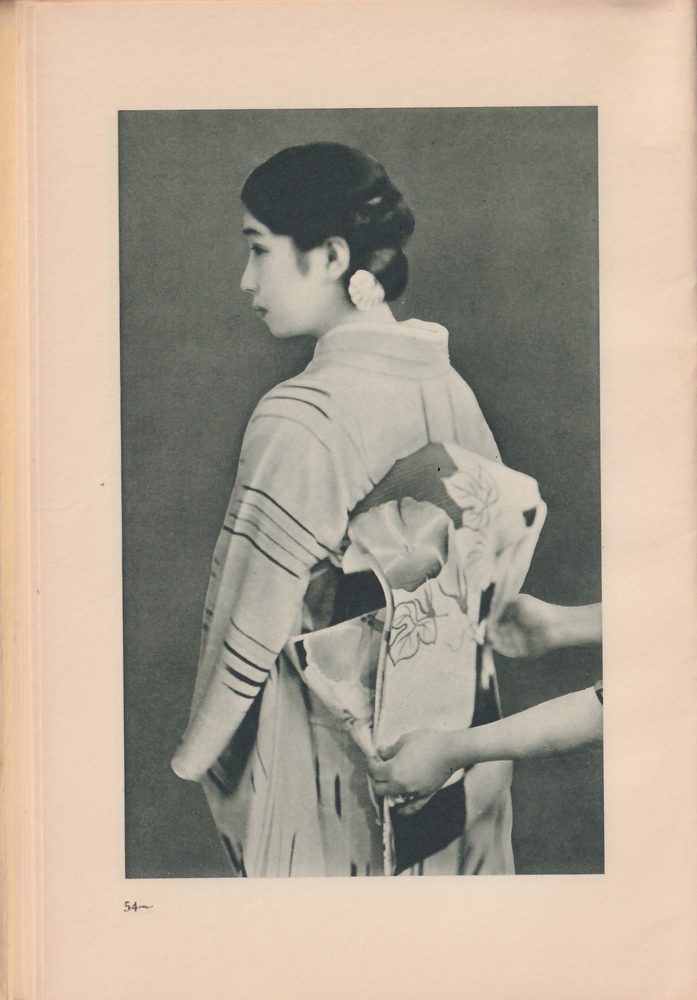
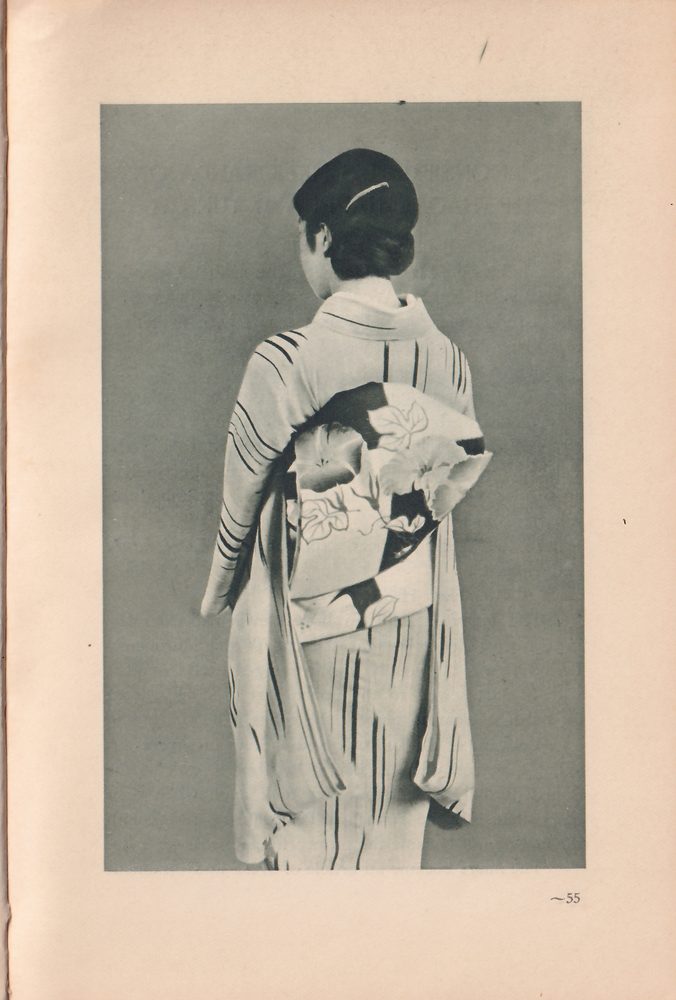
“(A) Otaiko musubi (drum tie), for all ages and occasions, and
“(B) Tateya no ji (in the shape of the erect written character ya), popular with young women on both formal and informal occasions.
“There are many other ways of tying the obi, but most of them are variations of one or other of these two forms.
“The girls’ obi knots you once praised at a dance were both of the sort called tateya no ji.”
“But you know one thing I always wonder at is the manner in which such a long stiff piece of tissue can be so gracefully tied. Can the Japanese lady tie the obi for herself?”
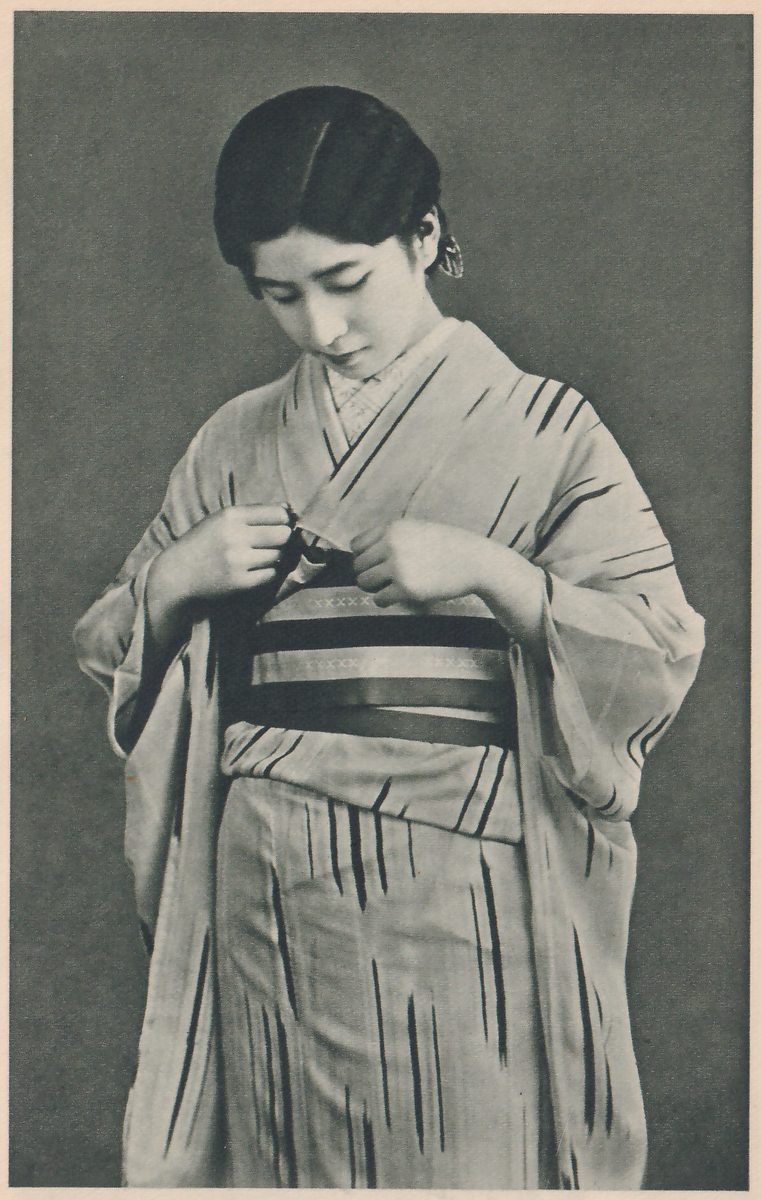
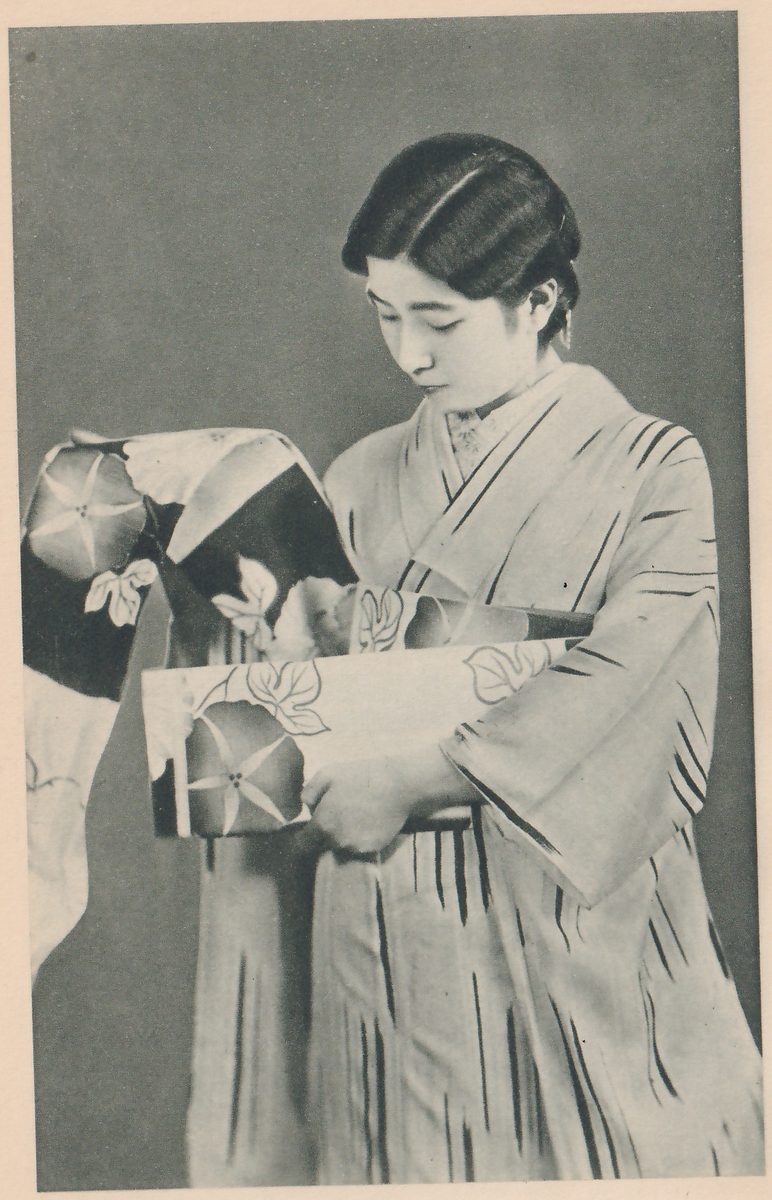
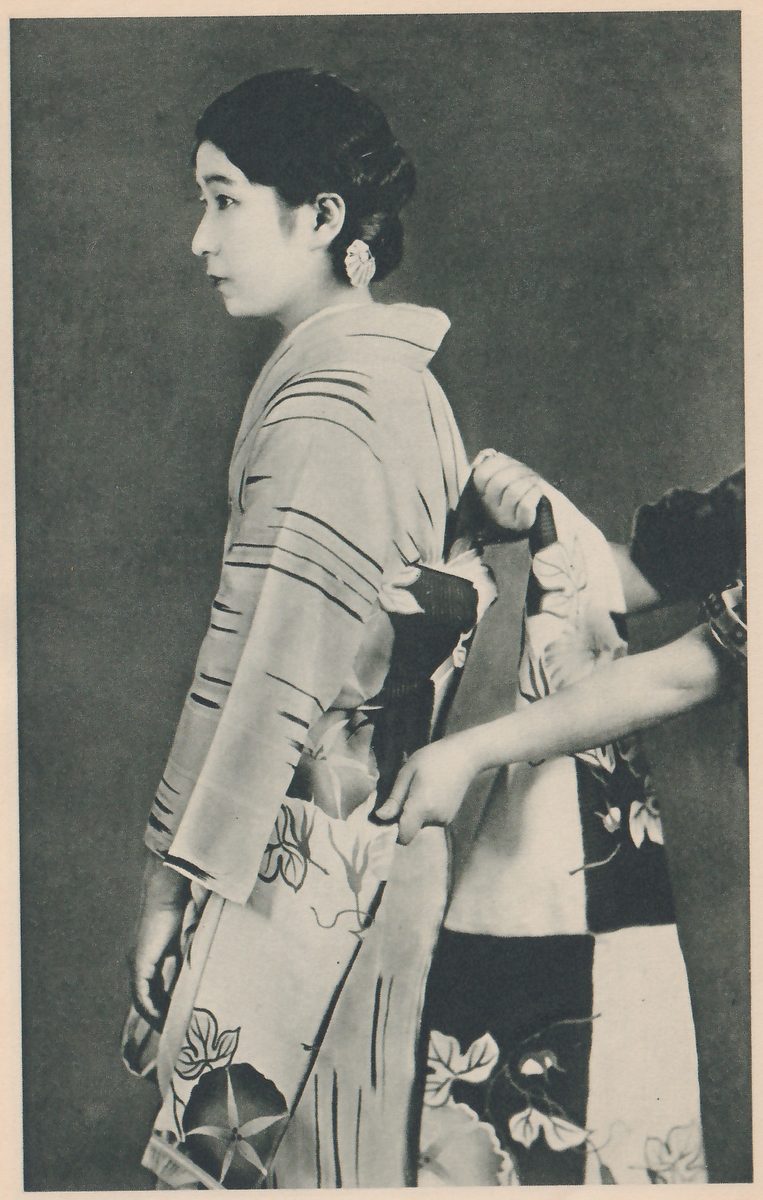
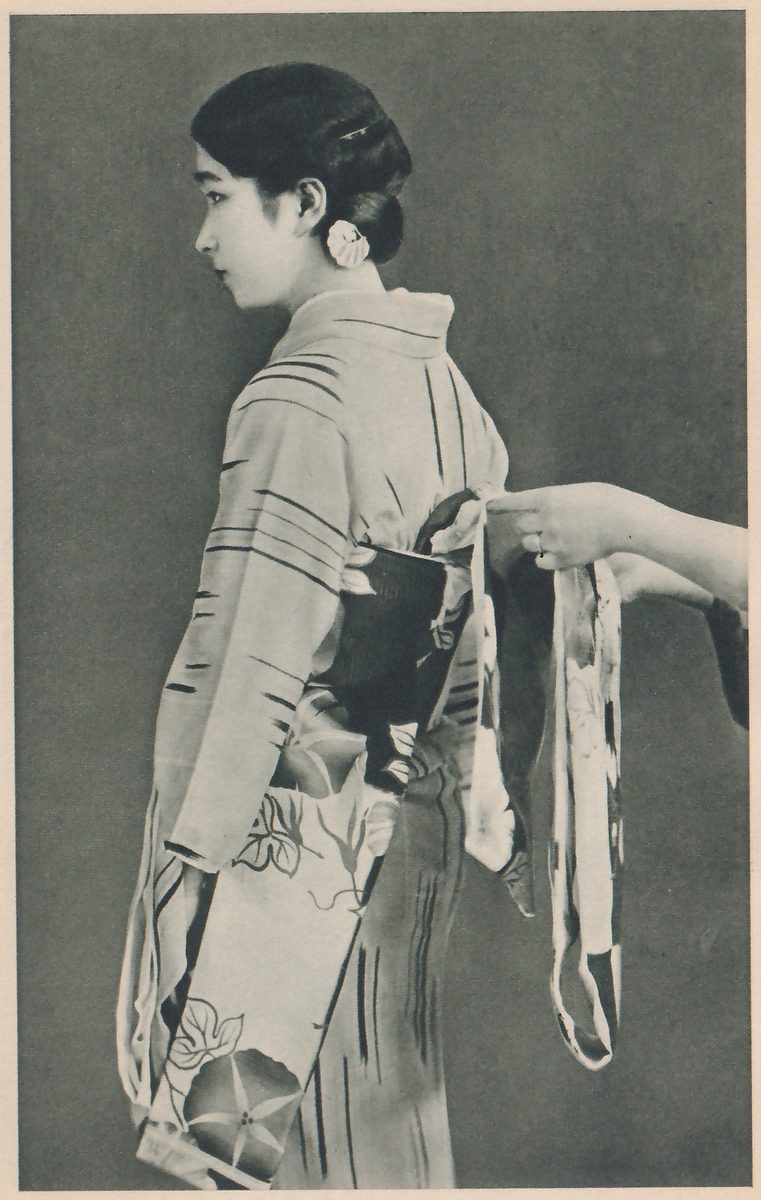
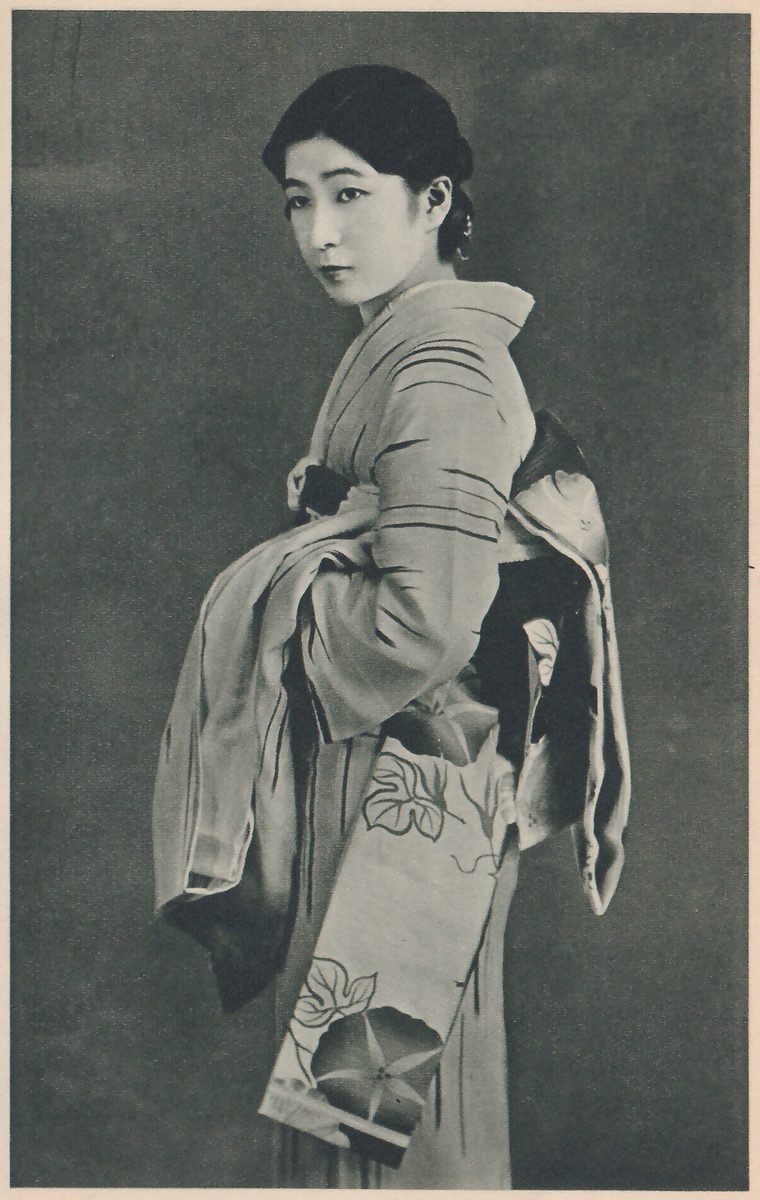
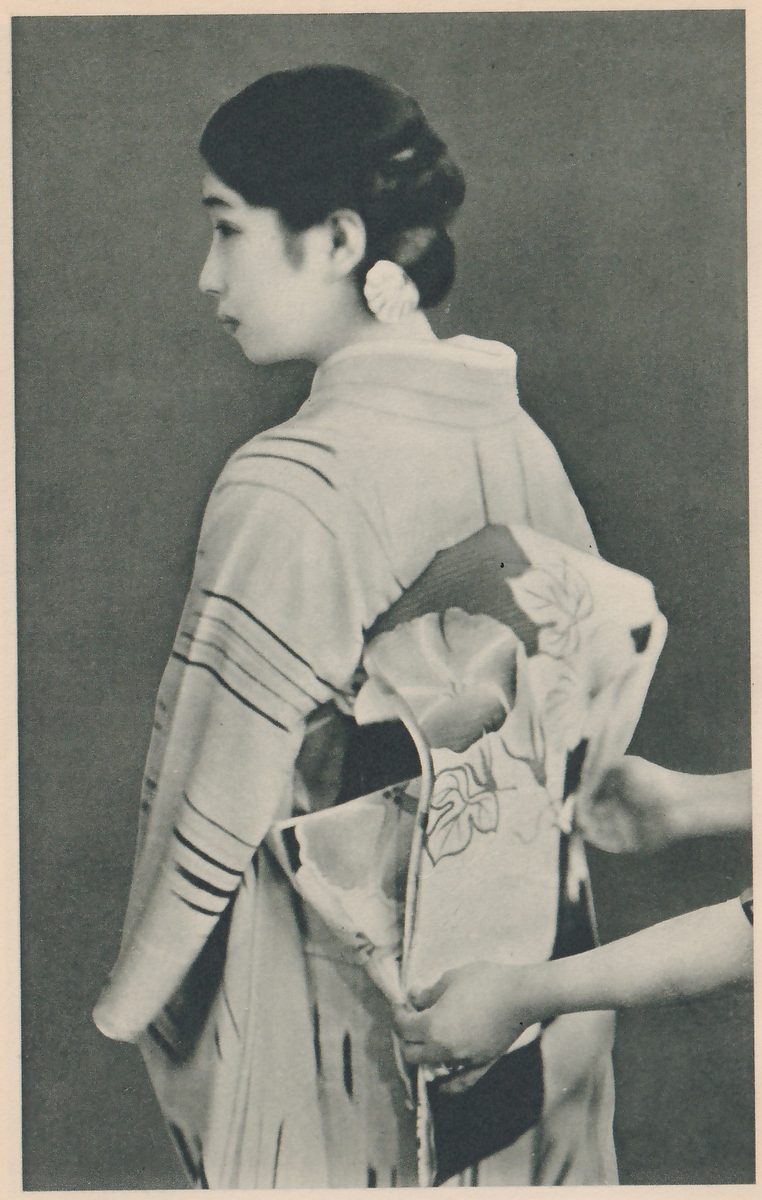
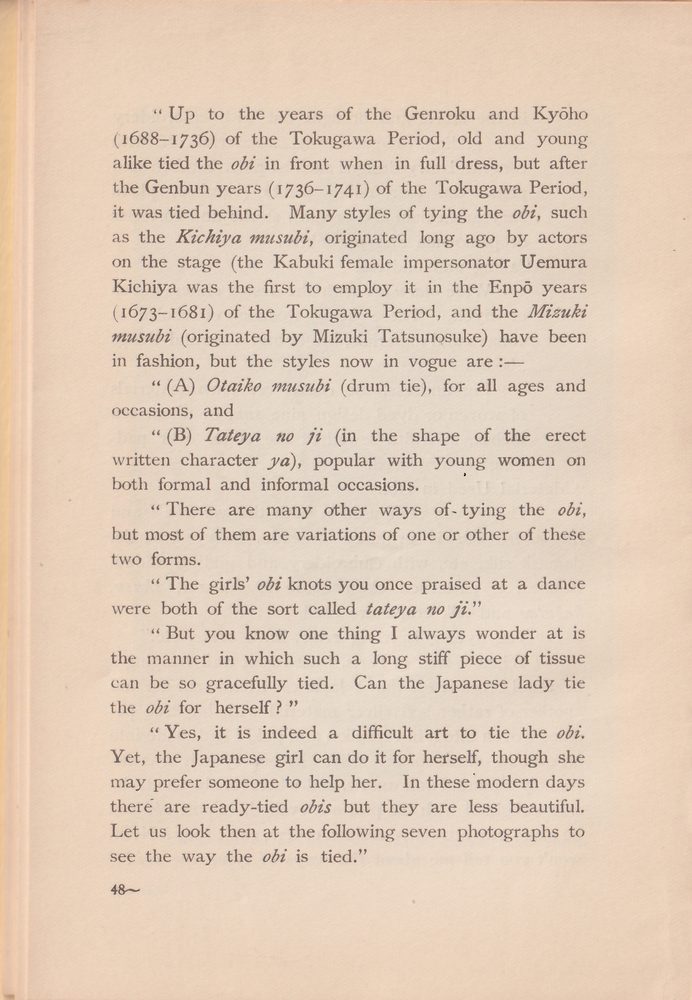
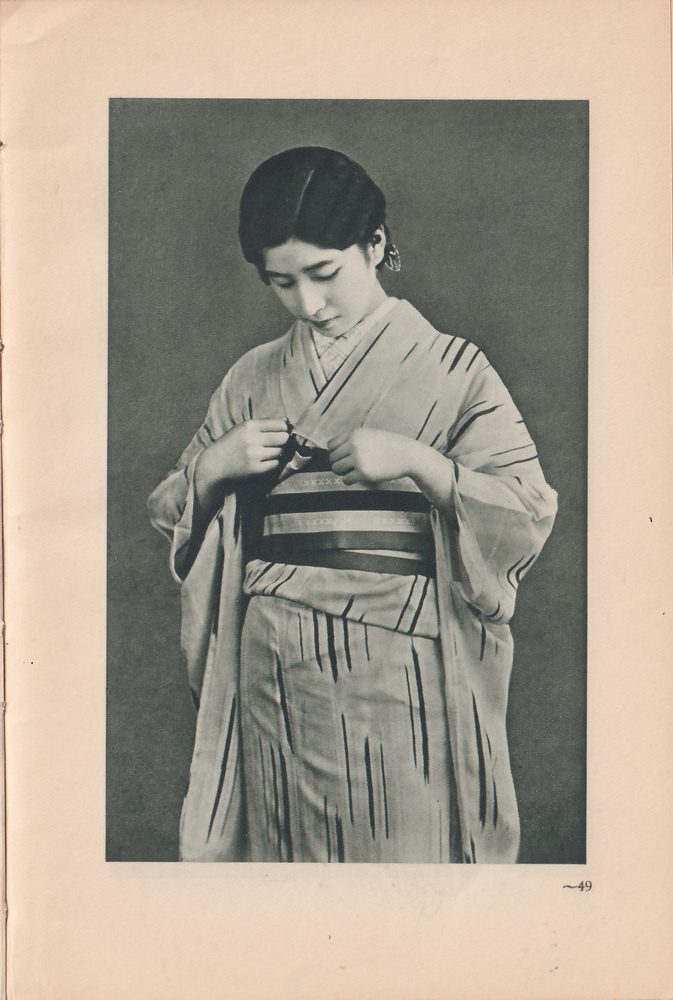
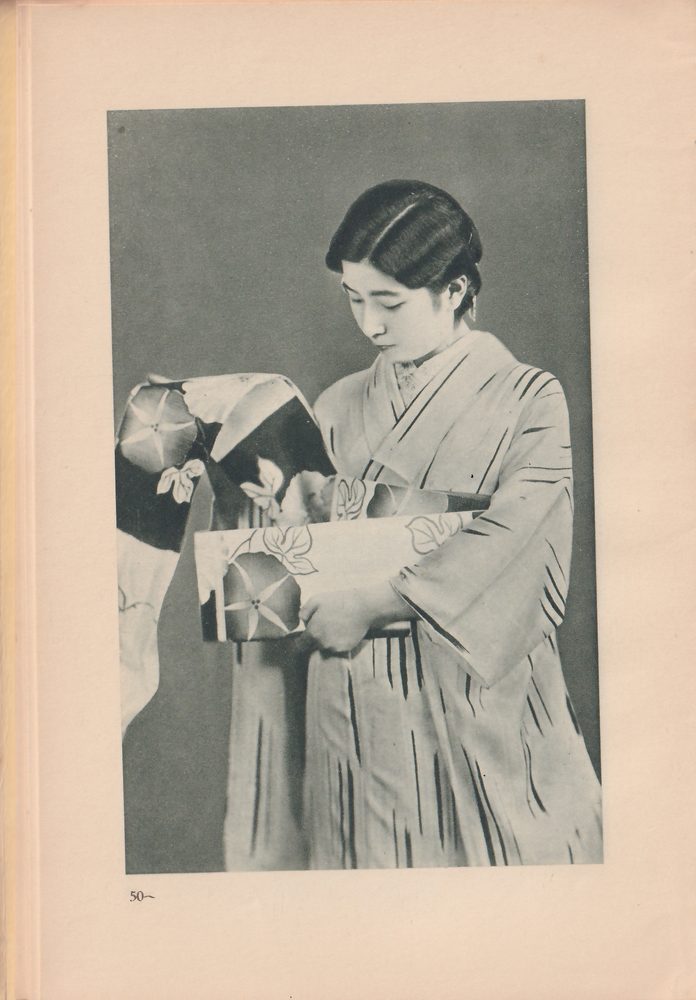
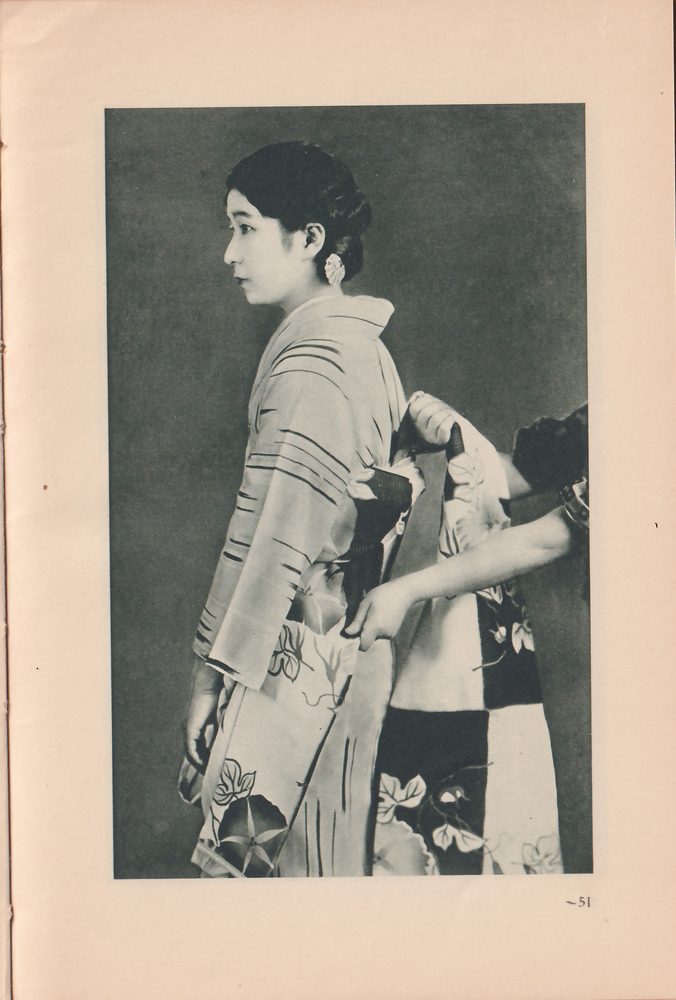
“Yes, it is indeed a difficult art to tie the obi. Yet, the Japanese girl can do it for herself, though she may prefer someone to help her. In these modern days there are ready-tied obis but they are less beautiful. Let us look then at the following seven photographs to see the way the obi is tied.”