
III. PRESENT-DAY KIMONO
One night I took Monsieur B to a programme of Japanese dances at the Kabukiza. Though his work was in a different field, he numbered many dancers among his friends, since they were all artists, so that there was much worth listening to in his excellent views on Japanese dancing, but the riot of colour and design in the foyer seemed to have intoxicated him again.
“The dancing is good, but this scene is still better,” he said dropping down on a sofa in the lobby and watching with all his eyes the stream of kimono drifting by.
There was a refined matron dressed in pure Japanese taste in a soft purplish gray silk crape kimono with an old-fashioned damask pattern in the weave and a double hollyhock leaf design embroidered scatteringly over it in gold and silver thread in the Takeyamachi manner, girdled in a dark blue obi with an arabesque pattern woven into it with lightly tinted gold thread, a newly invented thread with lacquer in it. There was a pretty young girl in a bright cream-coloured silk kimono with maple leaves and chrysanthemumsPrinted: crysanthemums dyed in bright vermilion and yellow reviving the elegance of the kosode design, bound in an obi figured with toys; and with her a modern young lady, who seemed to be her elder sister, in a trailing sleeved red kimono almost the
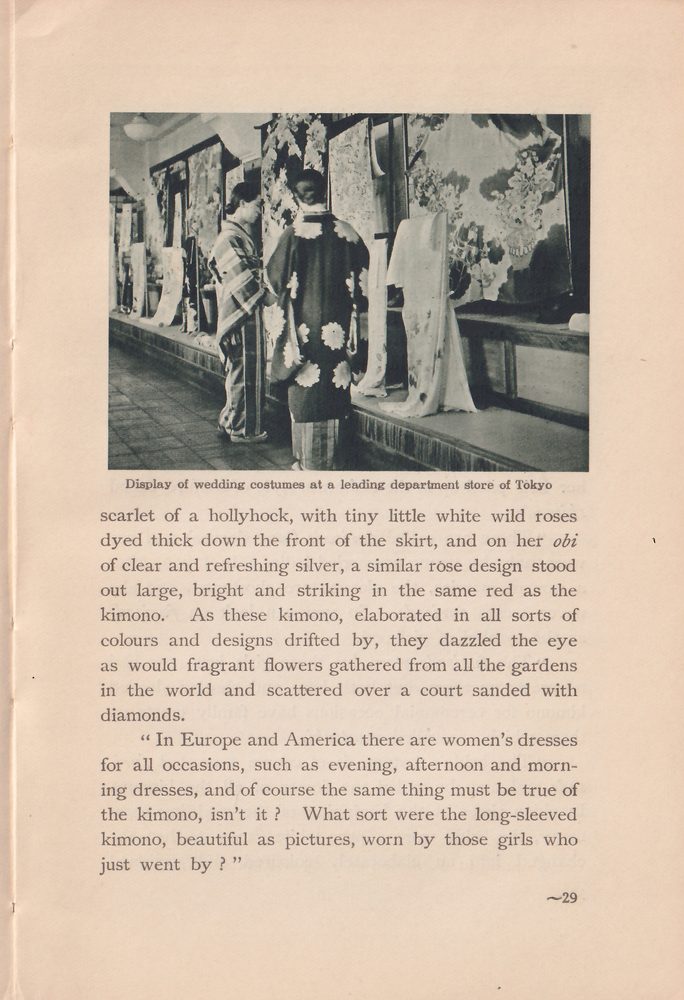
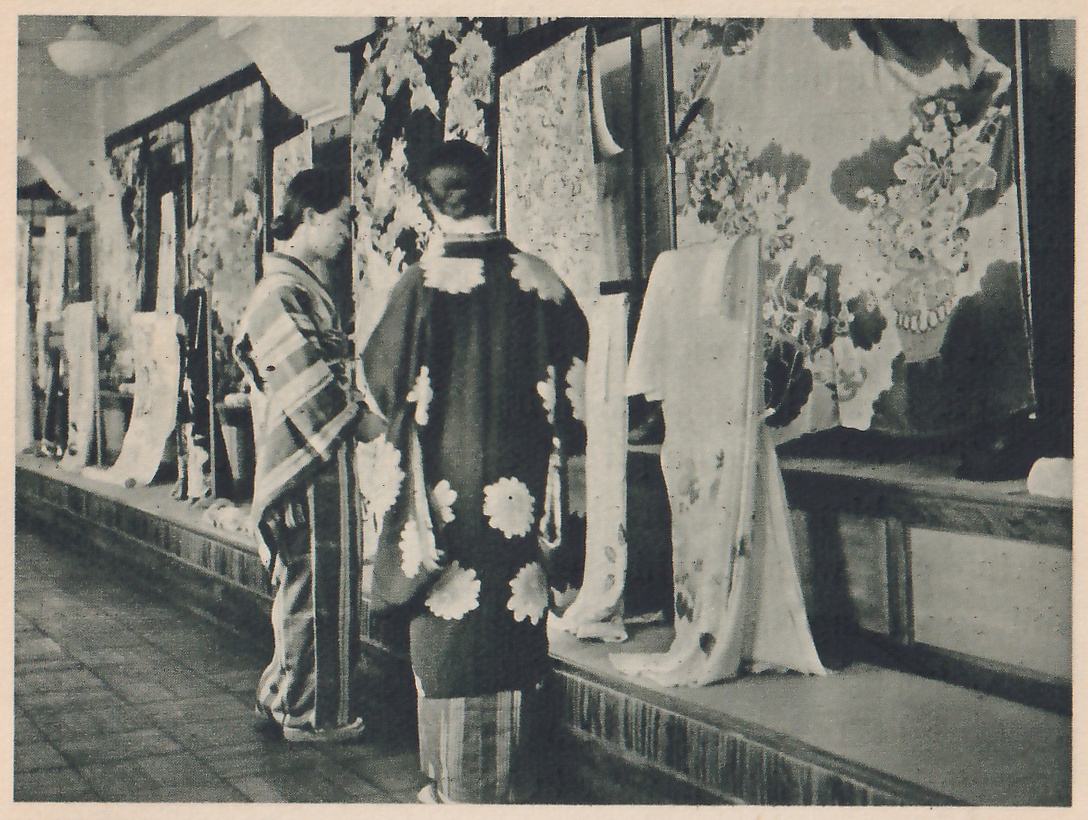
scarlet of a hollyhock, with tiny little white wild roses dyed thick down the front of the skirt, and on her obi of clear and refreshing silver, a similar rose design stood out large, bright and striking in the same red as the kimono. As these kimono, elaborated in all sorts of colours and designs drifted by, they dazzled the eye as would fragrant flowers gathered from all the gardens in the world and scattered over a court sanded with diamonds.
“In Europe and America there are women’s dresses for all occasions, such as evening, afternoon and morning dresses, and of course the same thing must be true of the kimono, isn’t it? What sort were the long-sleeved kimono, beautiful as pictures, worn by those girls who just went by?”
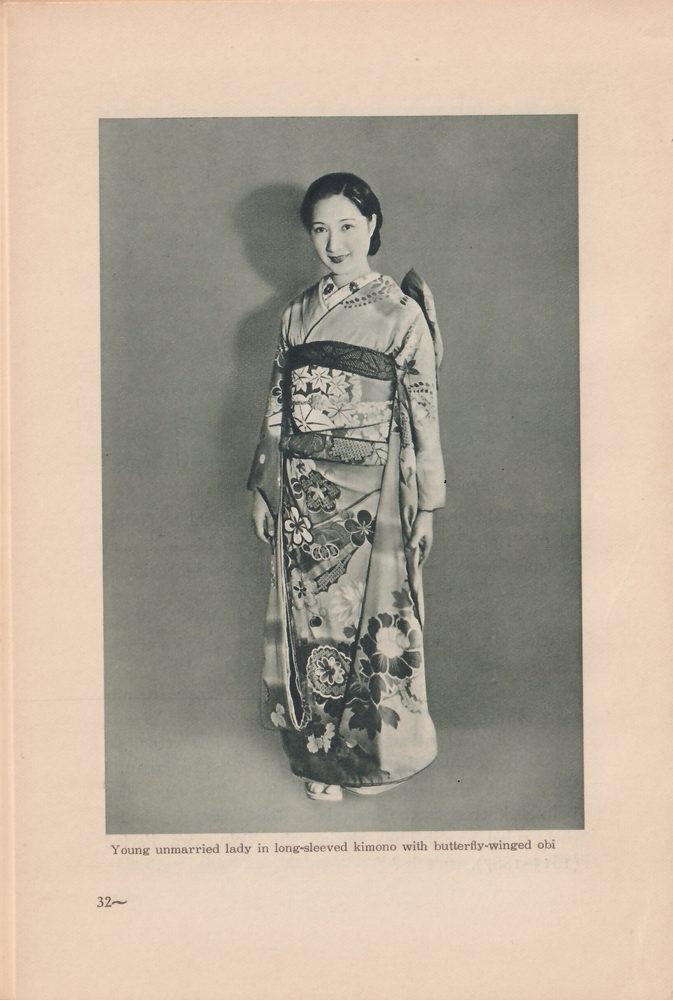
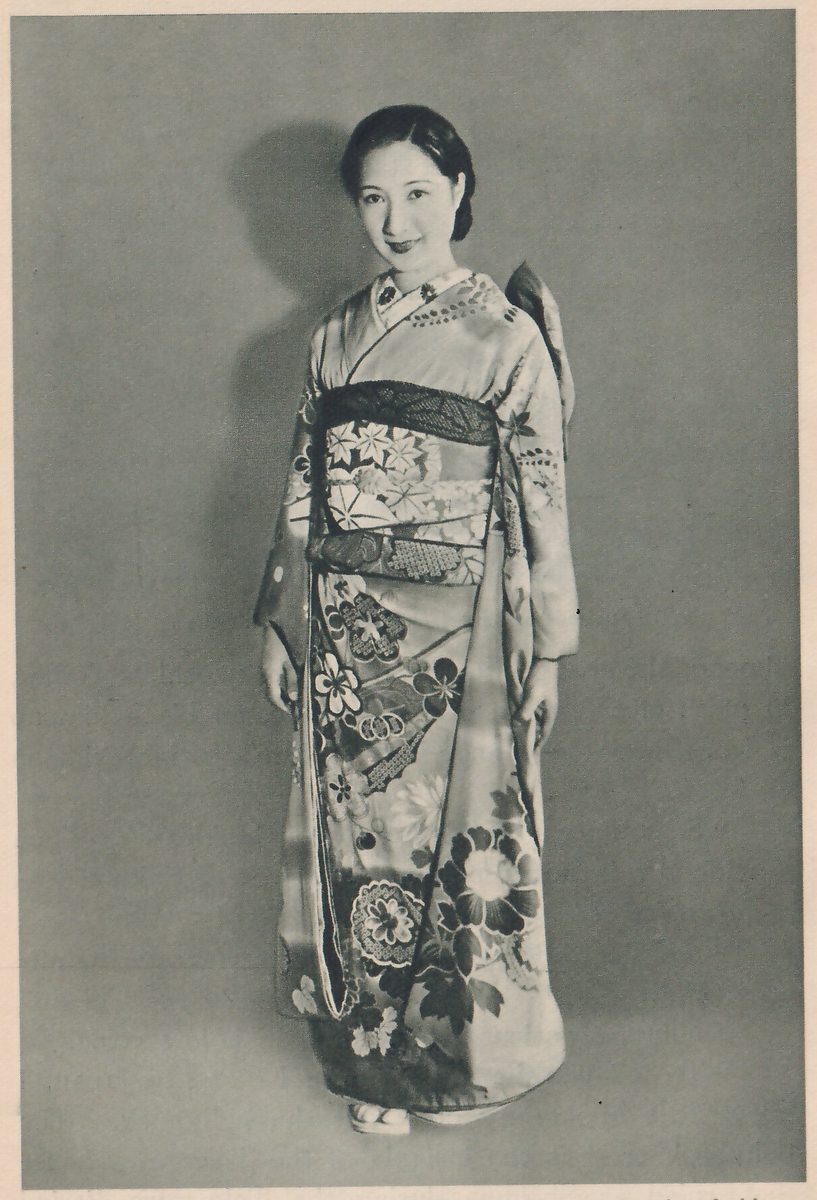
One of them was a girl of sixteen or seventeen with a childlike face that went well with a head of hair done up in the peach style. She was dressed in a long-sleeved kimono of a bright springlike straw colour, with dandelions, violets and vetch skilfully dyed and embroidered on the skirt, and butterflies flitting lightly about above them on the breast, bound at the waist in a one-piece obi designed in flying birds of brilliant colours.
The other was a girl of eighteen or nineteen dressed in a kimono of bright soft cobalt like the peaceful spring sky with a white peacock dyed and printed in foil spreading its magnificent wings across the whole skirt, bound in a white obi lavishly embroidered with the bright petaled blossoms of pyrus spectabilis, and the slight classical flavour in its novelty went well with her hair piled up in the elaborate style of coiffure called shimada.
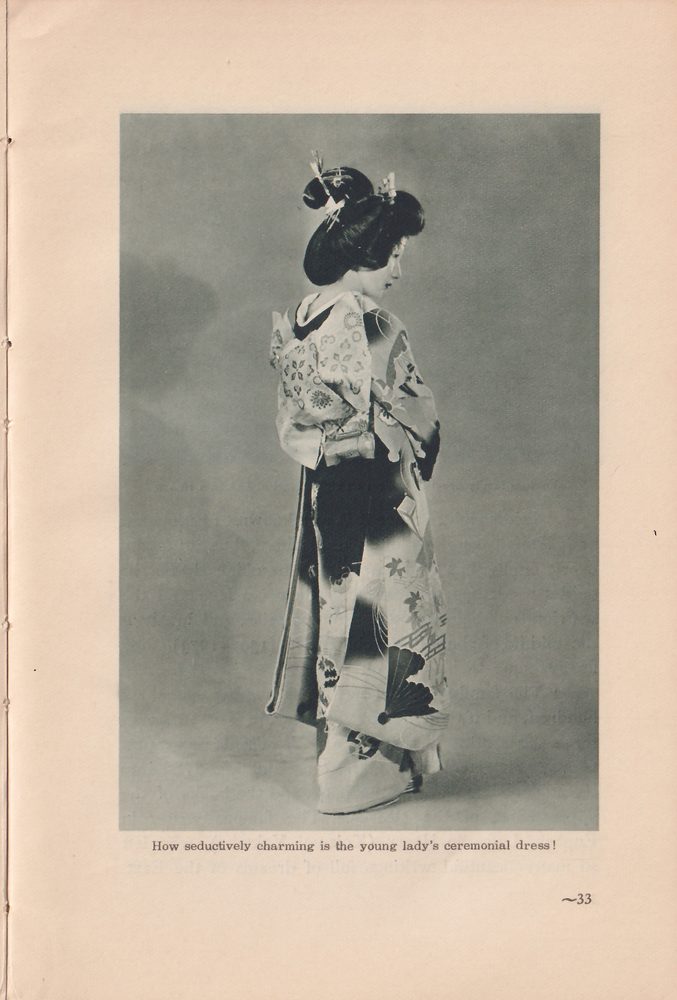
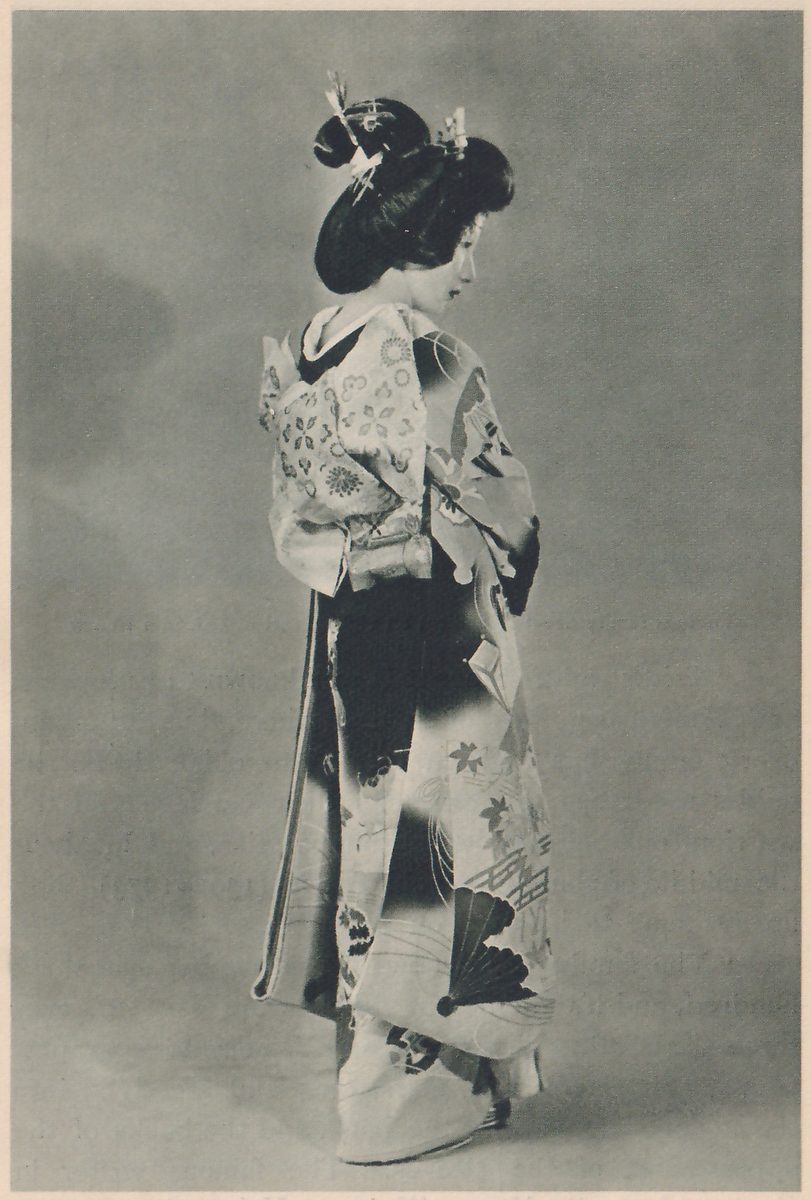
“Those are called furisode (long sleeves) and are worn only by young unmarried ladies. In Japan, after a woman marries, the sleeves are shortened, and she never wears furisode. So you can look on furisode as the symbol of girlhood.
“The furisode worn by those girls just now had no crests on them, but both long and shorter sleeved kimono for ceremonial occasions have family crests on them which are called montsuki.
“The bride’s costume is of course a crested furisode and may be called the flower of all the kimono. In olden times at the beginning of the wedding ceremony, the bride wore a pure white garment, then she changed into an elaborately coloured and designed
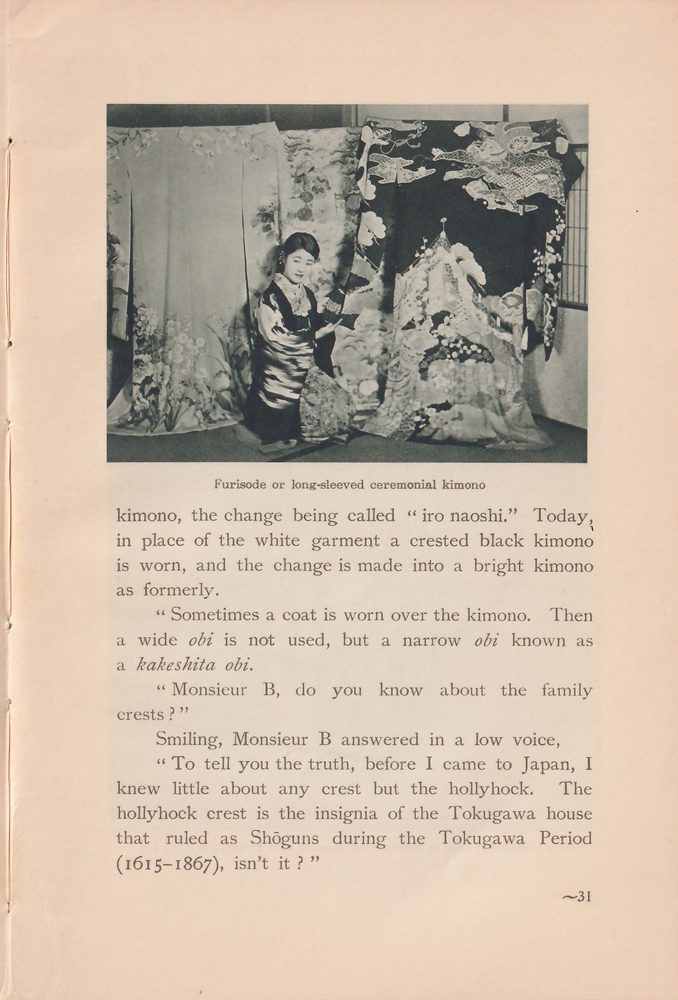
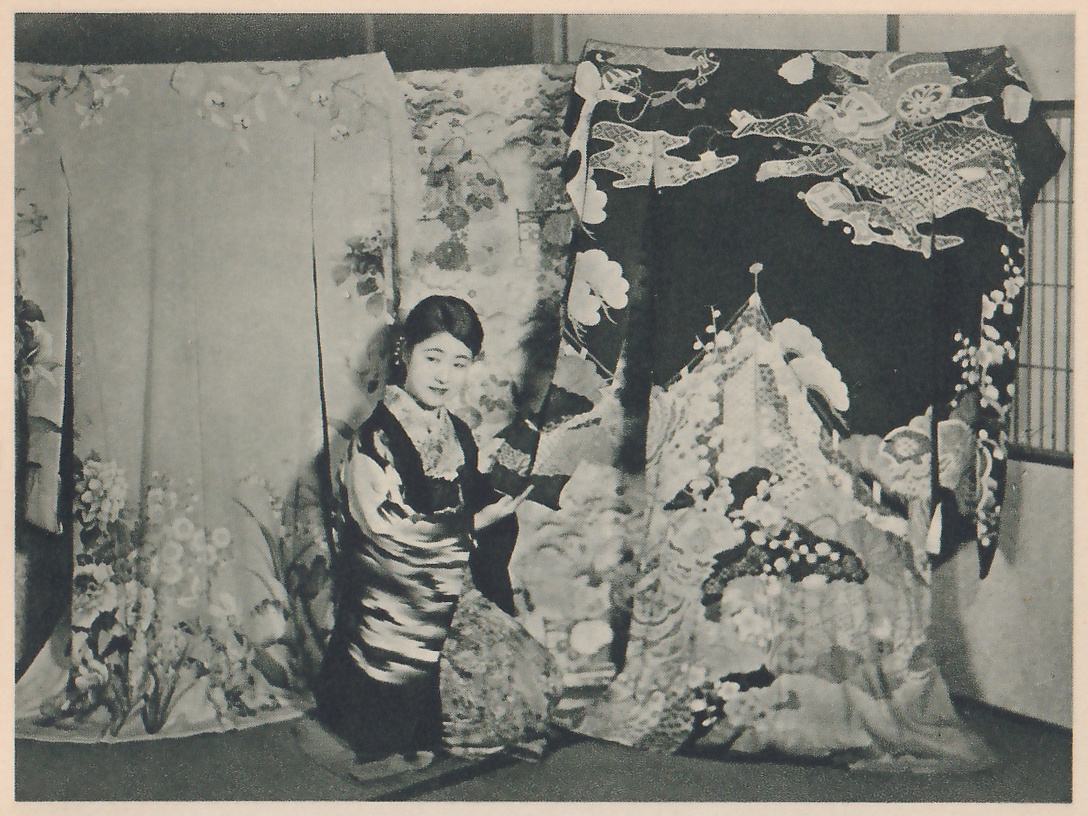
kimono, the change being called “iro naoshi.” Today, in place of the white garment a crested black kimono is worn, and the change is made into a bright kimono as formerly.
“Sometimes a coat is worn over the kimono. Then a wide obi is not used, but a narrow obi known as a kakeshita obi.
“Monsieur B, do you know about the family crests?”
Smiling, Monsieur B answered in a low voice,
“To tell you the truth, before I came to Japan, I knew little about any crest but the hollyhock. The hollyhock crest is the insignia of the Tokugawa house that ruled as Shōguns during the Tokugawa Period (1615–1867), isn’t it?”
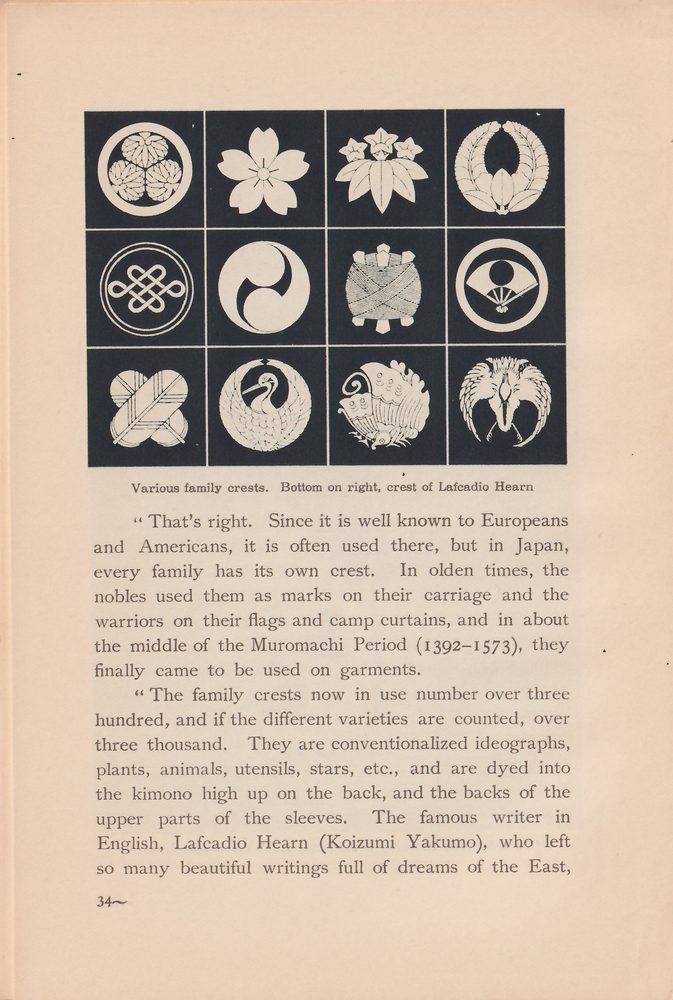
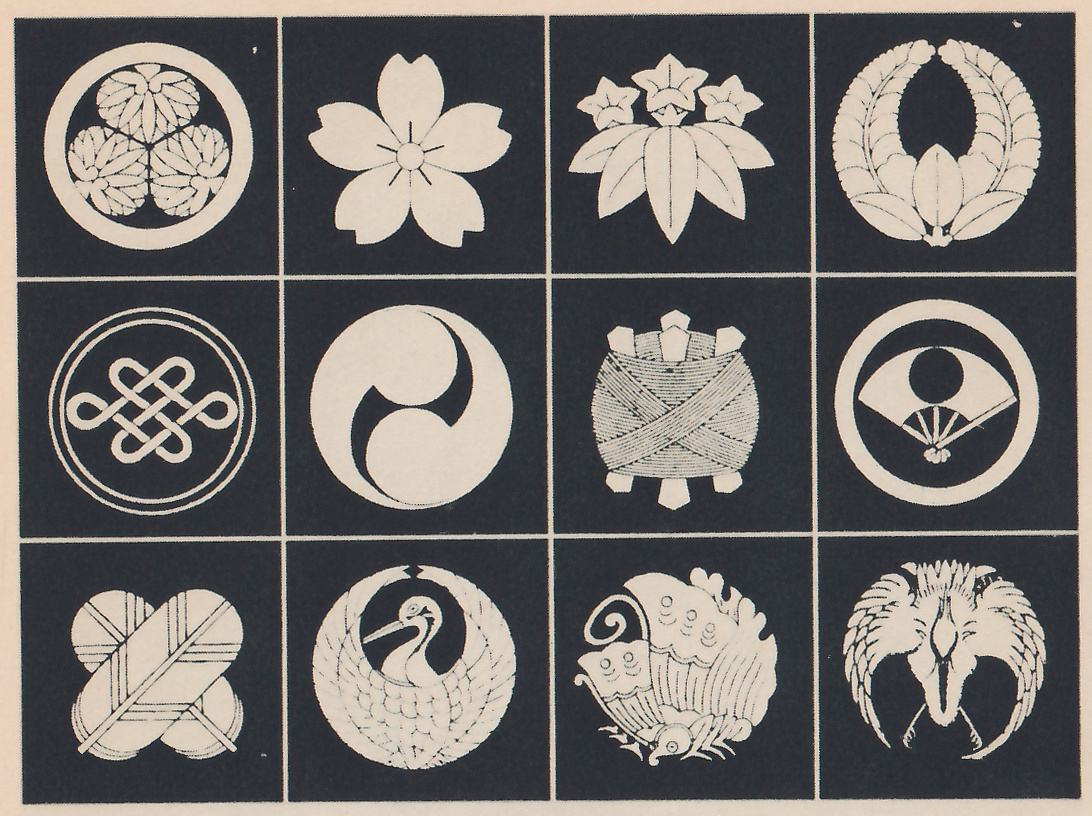
“That’s right. Since it is well known to Europeans and Americans, it is often used there, but in Japan, every family has its own crest. In olden times, the nobles used them as marks on their carriage and the warriors on their flags and camp curtains, and in about the middle of the Muromachi Period (1392–1573), they finally came to be used on garments.
“The family crests now in use number over three hundred, and if the different varieties are counted, over three thousand. They are conventionalized ideographs, plants, animals, utensils, stars, etc., and are dyed into the kimono high up on the back, and the backs of the upper parts of the sleeves. The famous writer in English, Lafcadio Hearn (Koizumi Yakumo), who left so many beautiful writings full of dreams of the East,
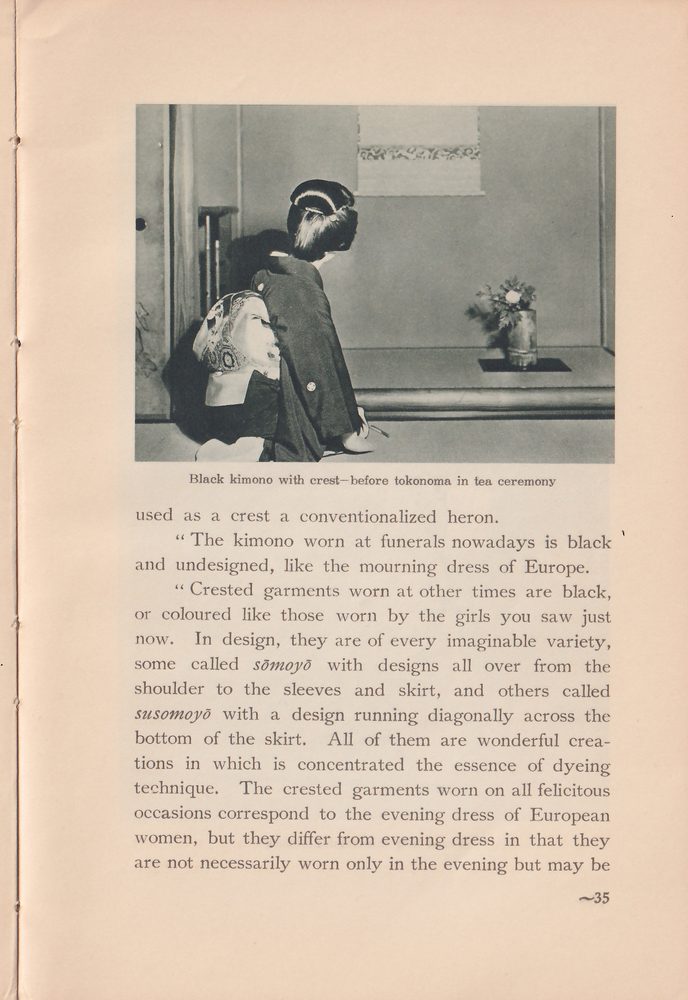
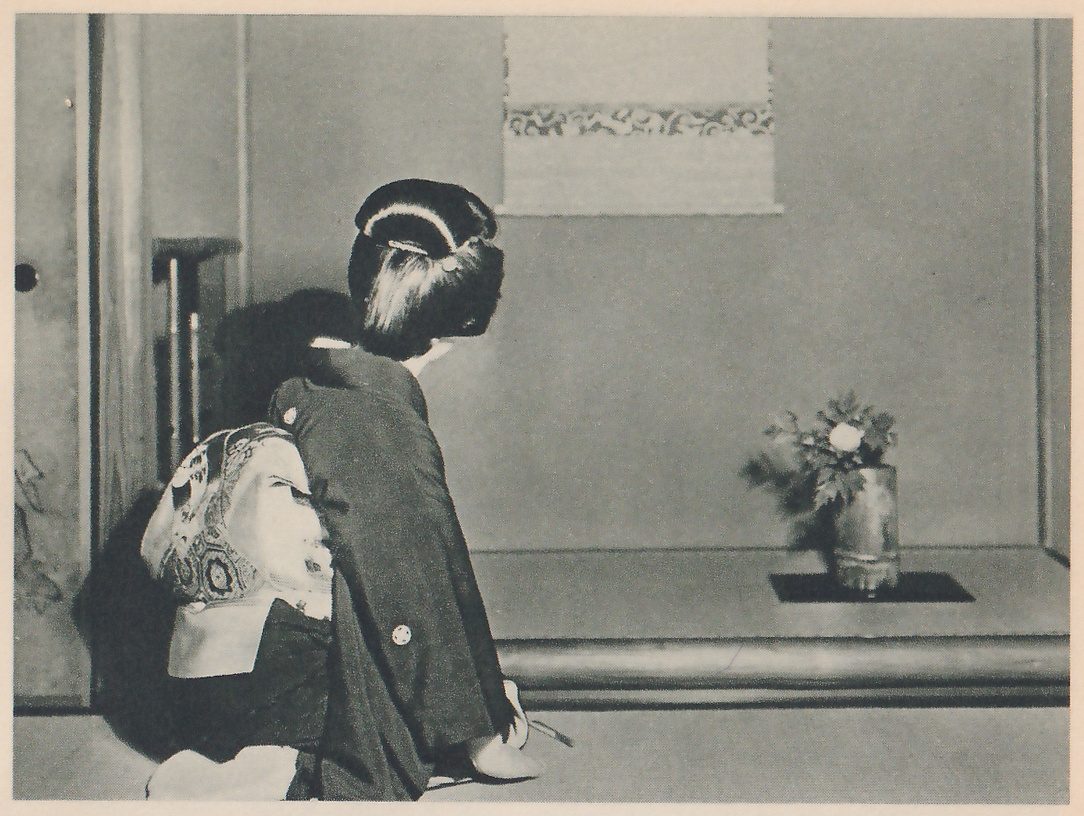
used as a crest a conventionalized heron.
“The kimono worn at funerals nowadays is black and undesigned, like the mourning dress of Europe.
“Crested garments worn at other times are black, or coloured like those worn by the girls you saw just now. In design, they are of every imaginable variety, some called sōmoyō with designs all over from the shoulder to the sleeves and skirt, and others called susomoyō with a design running diagonally across the bottom of the skirt. All of them are wonderful creations in which is concentrated the essence of dyeing technique. The crested garments worn on all felicitous occasions correspond to the evening dress of European women, but they differ from evening dress in that they are not necessarily worn only in the evening but may be
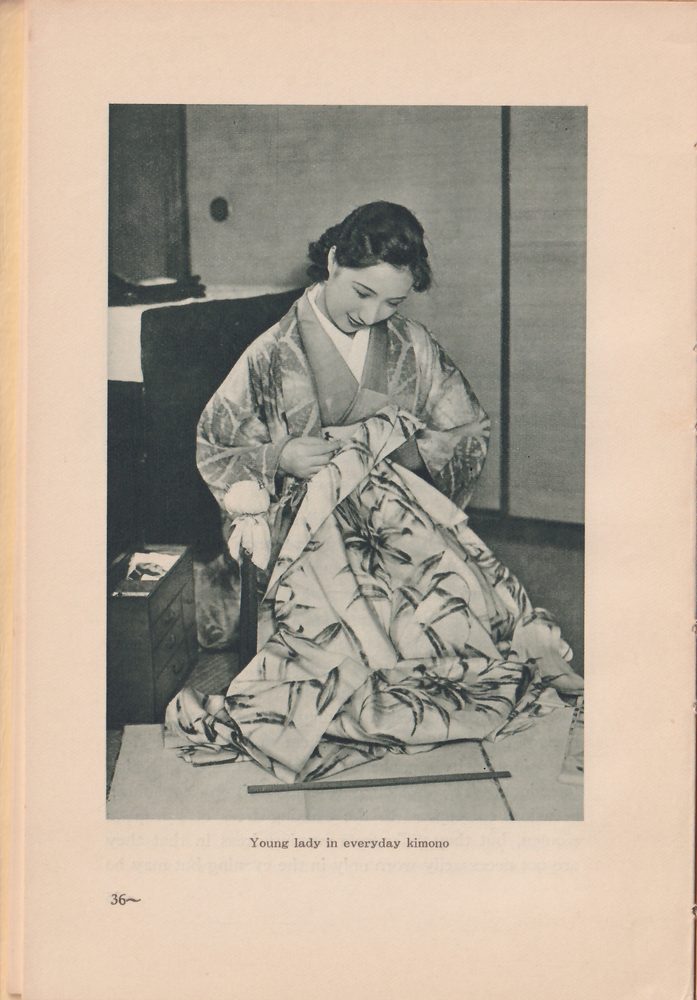
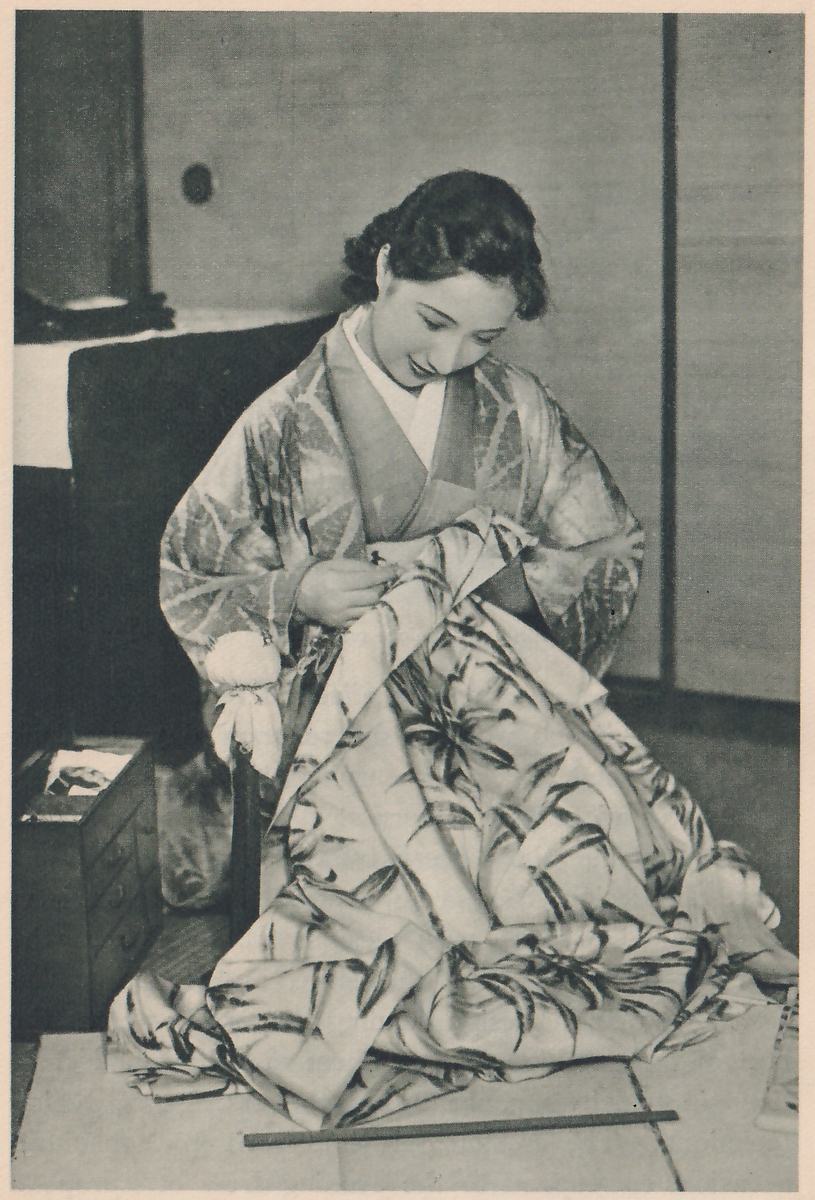

worn in the morning or at noon, or in fact at any time.
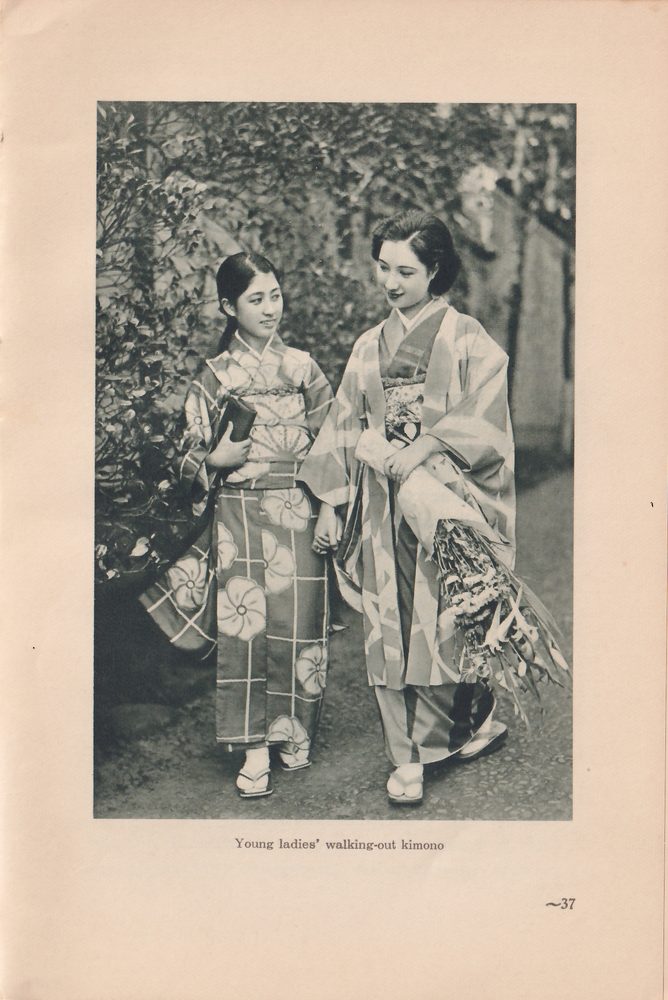
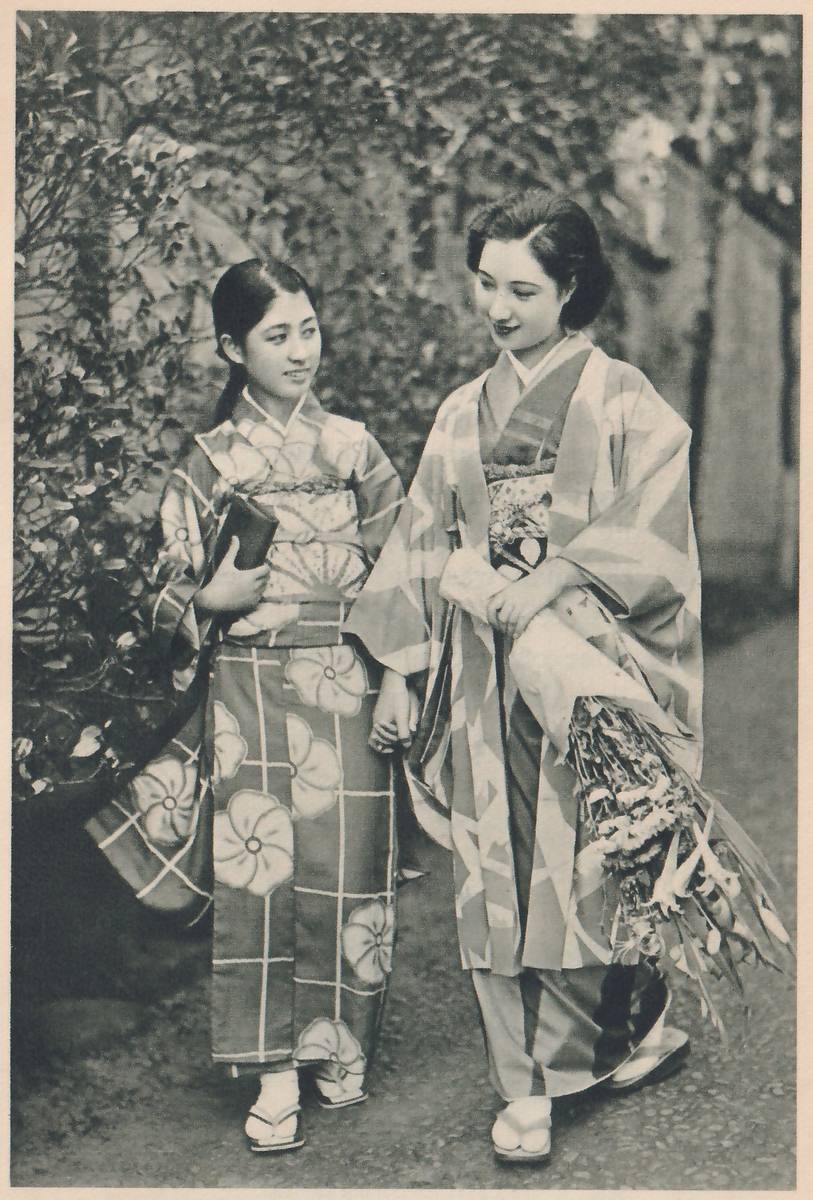
“Besides, there are fine patterned, striped and spotted undress kimono used for running errands, travelling or going to the theatre, and the ordinary house kimono.”
“Once I read a translation of a Japanese novel and was struck by one of the scenes in it. On the night of a ball, a man goes to meet his sweetheart in a suffocatingly sweet greenhouse. Of course on that night his sweetheart was more beautiful than a white lily faring across the moon. She was dressed in gala attire like a red rose in her glory at Cleopatra’s feast. She was really there in the gloriously blossoming greenhouse, but the man was literally dazzled and did not know which were flowers and which his sweetheart. At last he came out weary of searching. Just now I vividly recalled that passage, and I thought, ‘Except in Japan, no such fanciful composition.’”