
II. HISTORY OF THE KIMONO
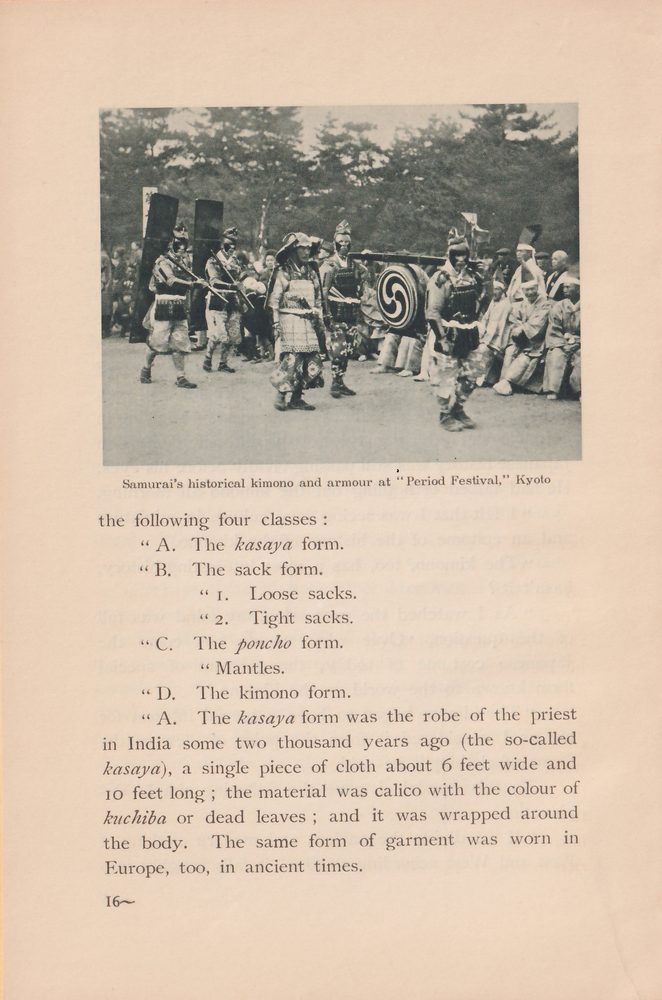
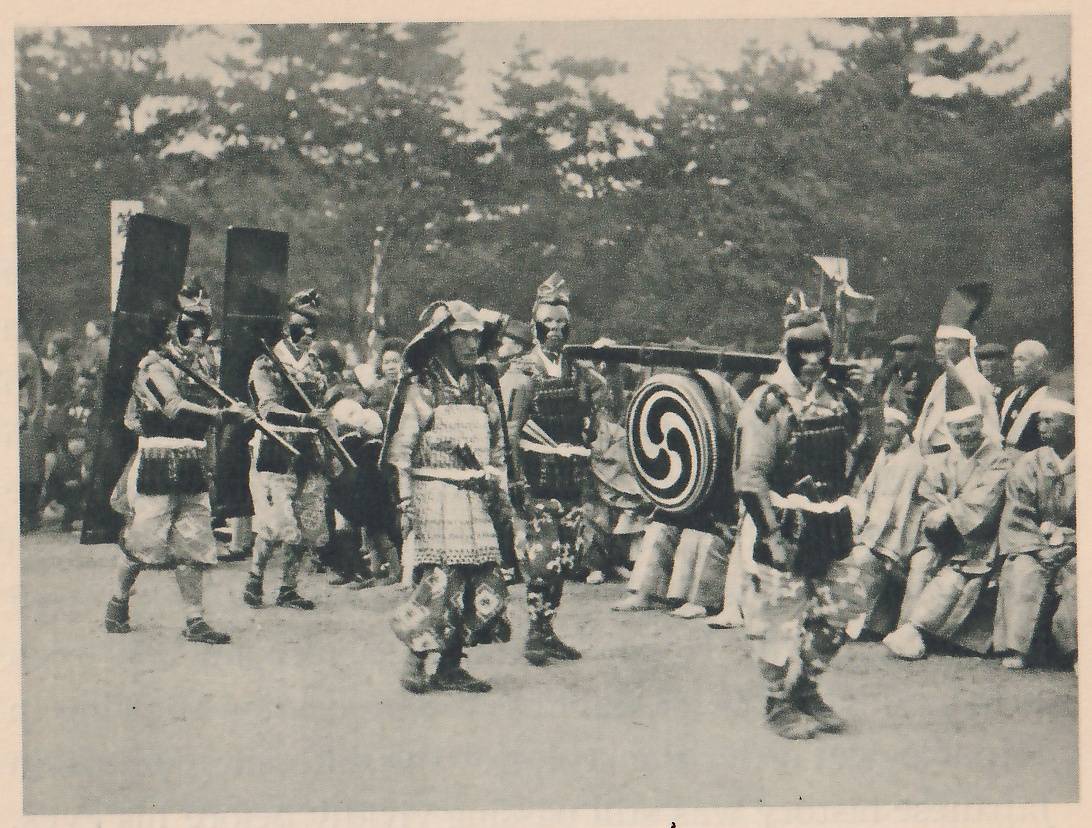
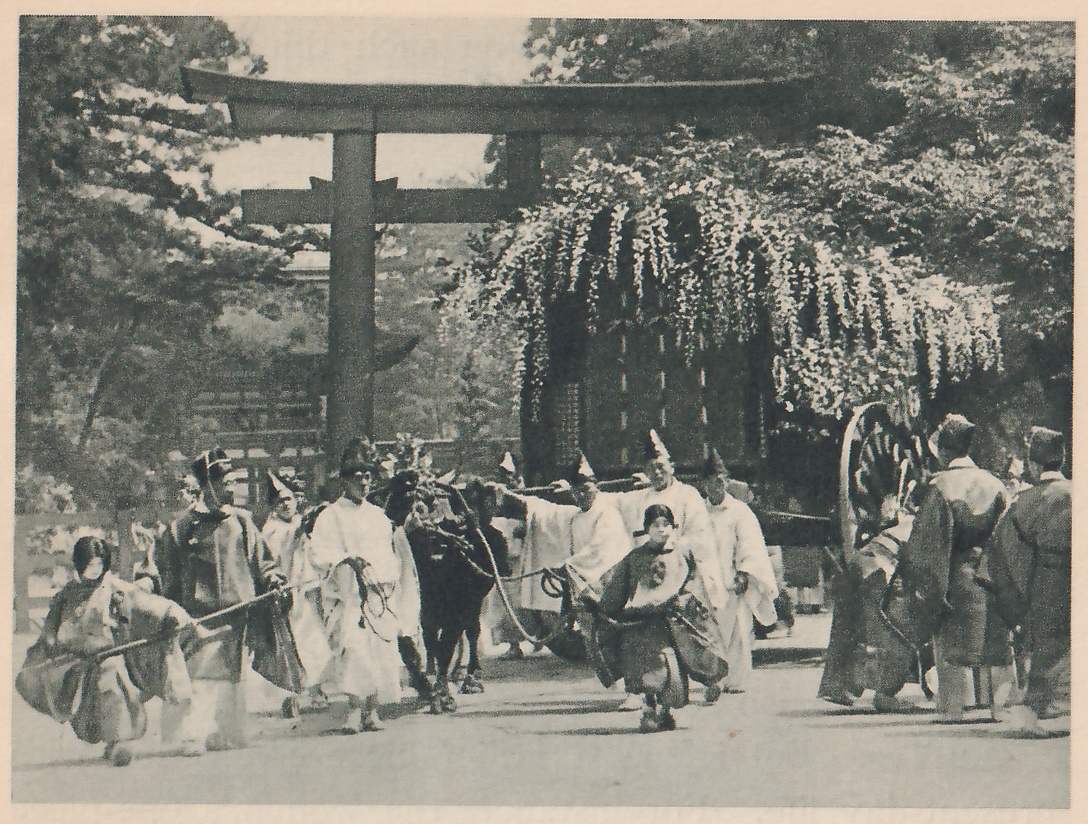
The pure fragrance of several yellow and white chrysanthemums thrown together in a celadon bowl on the mantelpiece called up faintly thoughts of autumn in the Orient. It was the twenty-third of October, in the middle of autumn, and Monsieur B, enjoying in the penetrating chill of morning the fire burning brightly in the fireplace, was eagerly telling me about the “Period Festival” of the Heian Shrine in Kyoto he had seen just the day before. Doubtless the procession showing in chronological order the styles of the different periods in Japanese history was still passing vividly before his eyes. He had talked of nothing but the kimono all morning.
“I felt that I was seeing race culture in miniature and an epitome of the history of the kimono.
“The kimono, too, has a most interesting history, hasn’t it?
“As I watched the procession, my mind was full of the question, ‘Over what course has come the Japanese costume of today, the garment of special form known to the world as the kimono?’
“The kimono began to have a special interest for me as I considered it from the point of view of the forms of clothing,” he said.
To this appeal, I gave the following simple explanation.
“If we divide the ancient and modern clothing of East and West according to form, it falls roughly into
the following four classes:
“A. The kasaya form.
“B. The sack form.
“1. Loose sacks.
“2. Tight sacks.
“C. The poncho form.
“Mantles.
“D. The kimono form.
“A. The kasaya form was the robe of the priest in India some two thousand years ago (the so-called kasaya), a single piece of cloth about 6 feet wide and 10 feet long; the material was calico with the colour of kuchiba or dead leaves; and it was wrapped around the body. The same form of garment was worn in Europe, too, in ancient times.
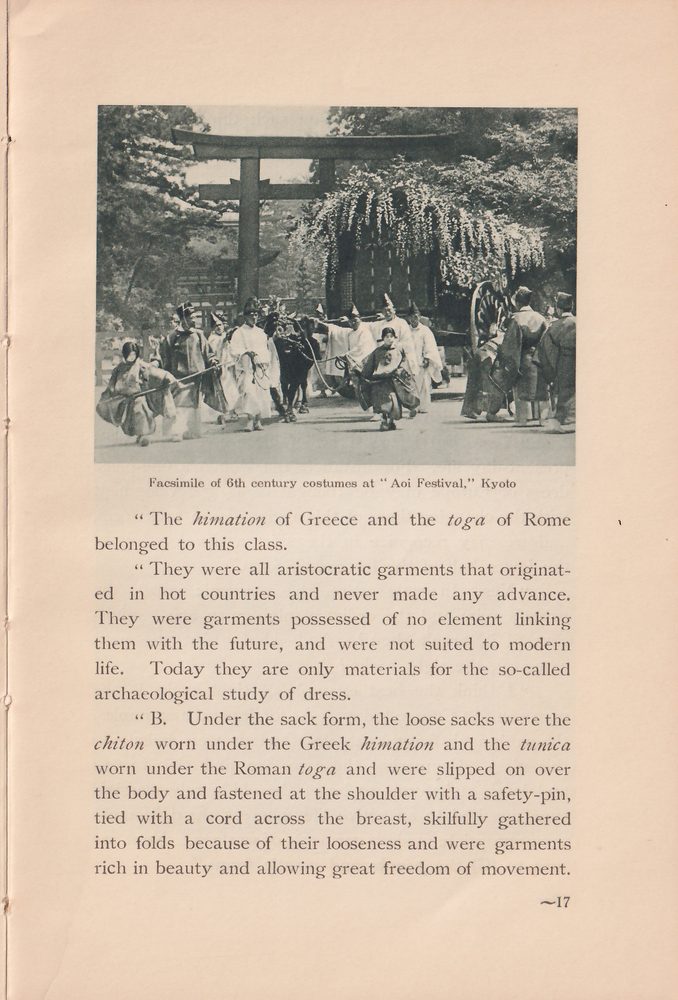
“The himation of Greece and the toga of Rome belonged to this class.
“They were all aristocratic garments that originated in hot countries and never made any advance. They were garments possessed of no element linking them with the future, and were not suited to modern life. Today they are only materials for the so-called archaeological study of dress.
“B. Under the sack form, the loose sacks were the chiton worn under the Greek himation and the tunica worn under the Roman toga and were slipped on over the body and fastened at the shoulder with a safety-pin, tied with a cord across the breast, skilfully gathered into folds because of their looseness and were garments rich in beauty and allowing great freedom of movement.
“Monsieur B, to tell you such things is, in the Oriental expression, like preaching to the Buddha, isn’t it?”
“Preaching to the Buddha? No, it’s fine of course. I’ve understood you perfectly. We call the Greek costume the art of folds. The beauty of the lines in one of the fleeing maidens in the Niobe group, the Nike of Samothrace, is really wonderful.”
Monsieur B, while deeply affirming this correspondence with his own opinion, went on eagerly inquiring:
“Then this loose sack form is classical like the kasaya form, isn’t it?”
“Yes. But it has a rather close connection with present-day life. For instance, the woman’s one-piece dress of Europe may be thought of as a development with the changing times of this ancient loose sack form, and we may recognize in the skirt a development of the lower half of the loose sack form.”
“Yes. In male attire, the academic gown, the priest’s robe and the ordinary nightgown are reminiscent of it, aren’t they? And what about the next category, the tight sacks?”
“I think the best example of tight sacks is the man’s suit in Europe today. As for Japanese examples, the workman’s livery coat, vest and drawers belong to this class. Comparing the two, we find the kasaya and loose sack forms to be of the old purely classical type unsuited to an active life, whereas the tight sacks are appropriate modern garments of workers. Next we turn to (C) the poncho and mantle forms.”
“Poncho? Oh, yes, I’ve heard of it. It’s a thing like a mantle made of a rectangular or elliptical piece of cloth with a slit cut in it for the head, used by the people of Mexico and Central and South America, isn’t it? Is there anything of that sort in Japan?”
“The priest’s dress of the middle ages and the long overdress called uchikake used in ancient pantomimic dances belong to this class, and besides there are mantles and raincoats of the mantle class.
“Last we come to (D) the kimono form. It should probably be called a sort of tight sack form, having characteristic long sleeves hanging straight down from the arms, plus a sash.
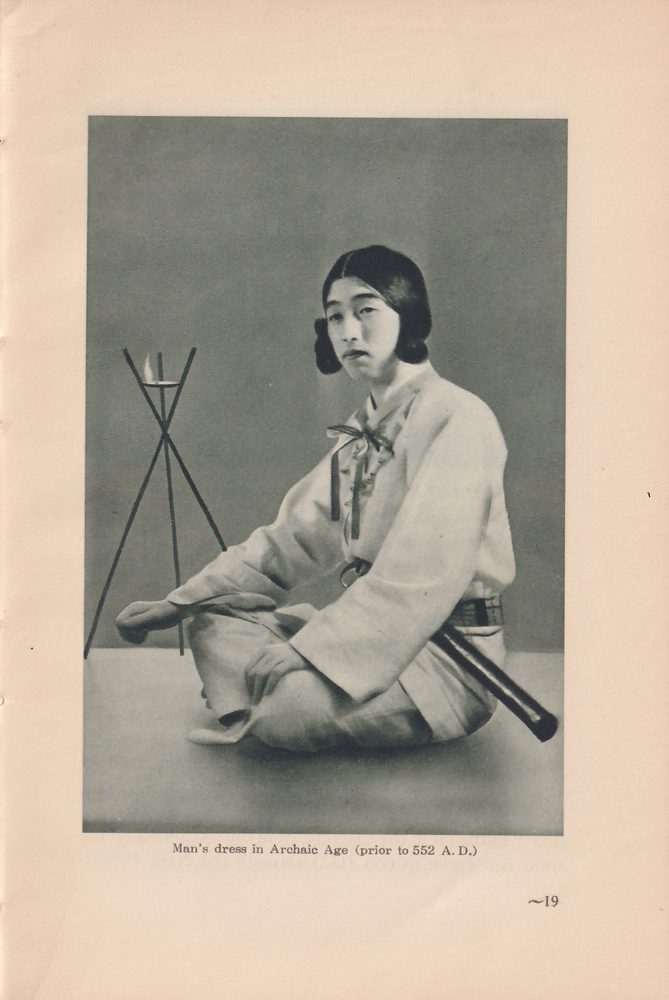
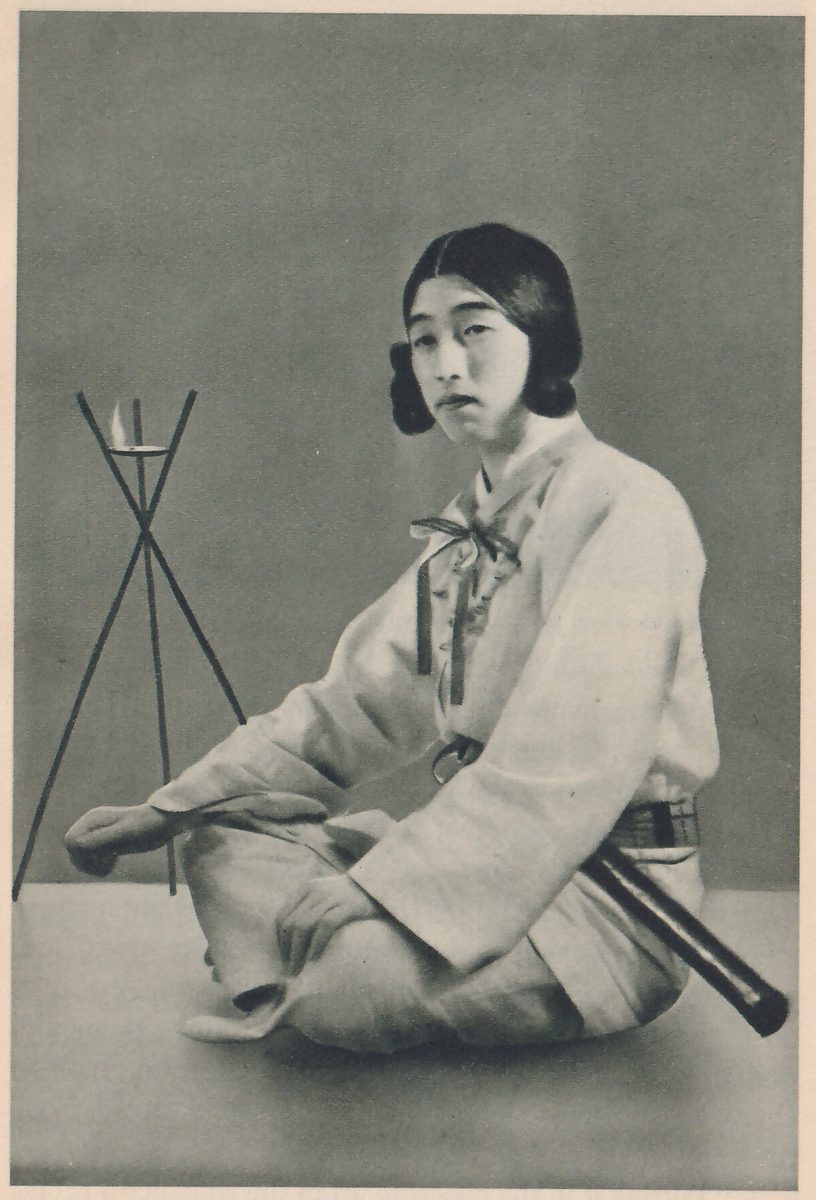
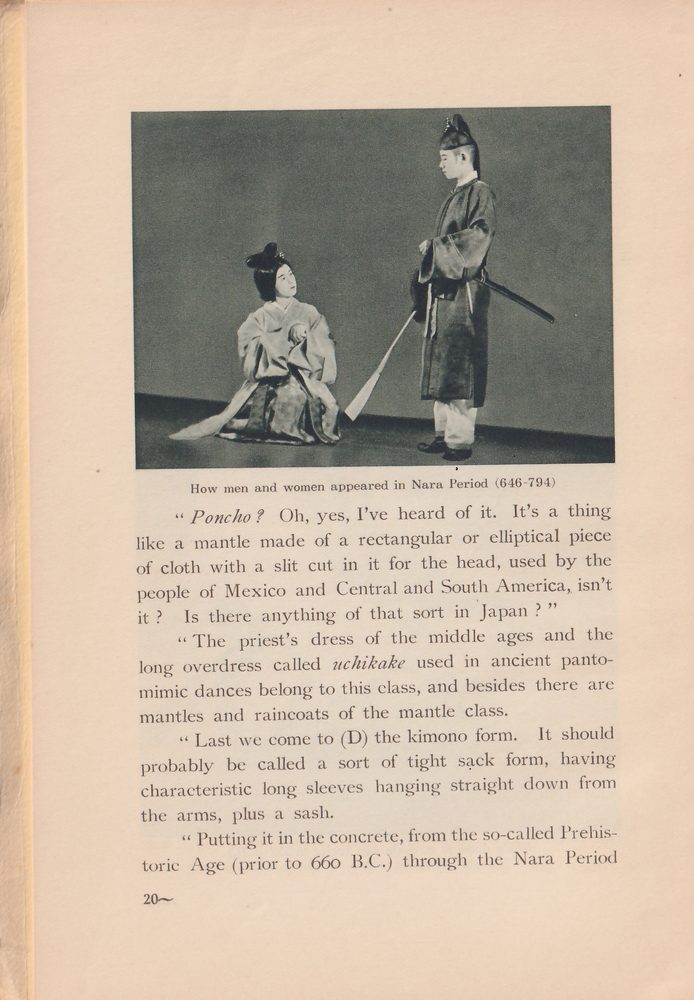
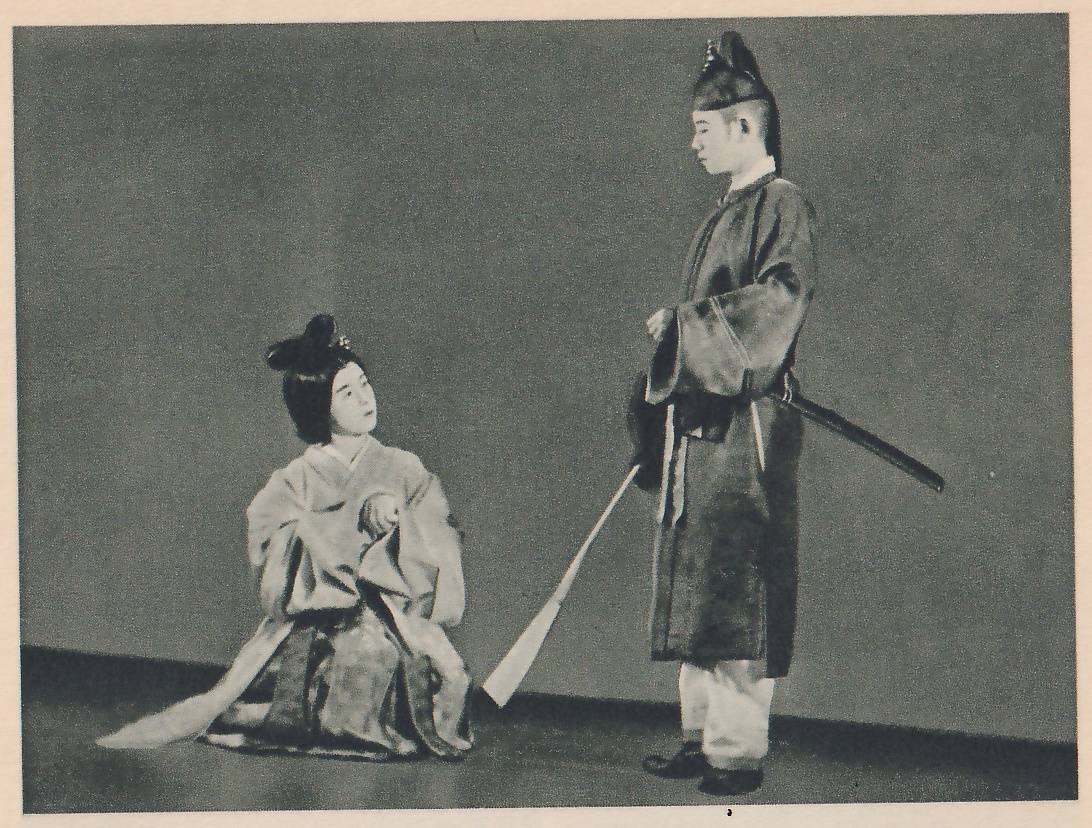
“Putting it in the concrete, from the so-called Prehistoric Age (prior to 660 B.C.) through the Nara Period
(646–794 A.D.), the male attire in Japan was in general like the frock-coat outfit of today, only looser, consisting of a narrow-sleeved upper garment called kinu reaching to about the knees and loose-legged trousers called hakama; and the female attire was like a European blouse and skirt, the garment corresponding to the blouse being called the kinu and that corresponding to the skirt the mo.
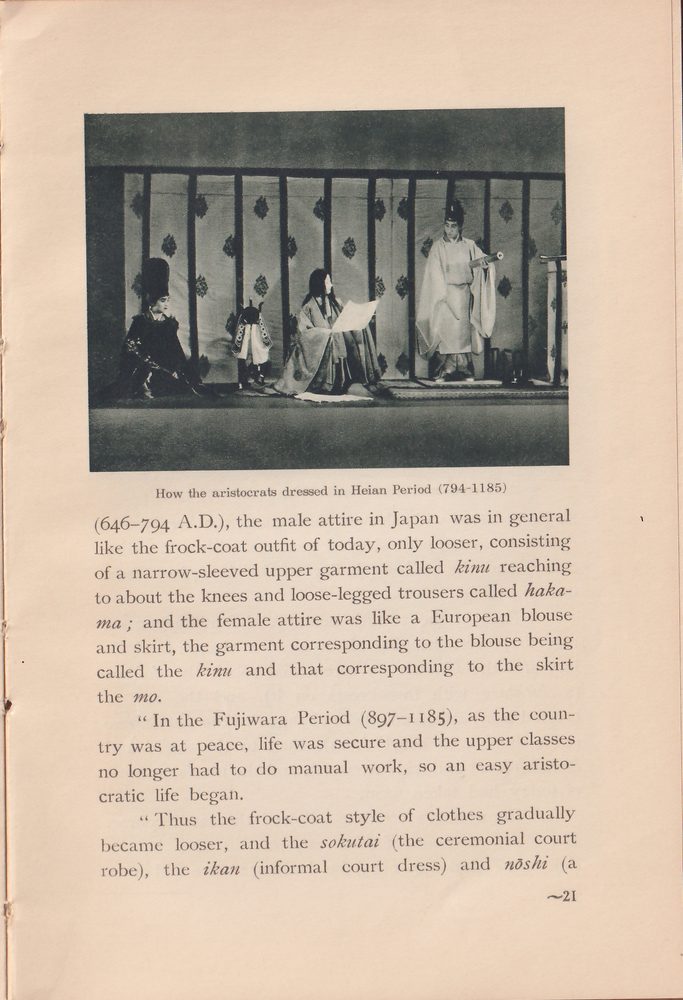
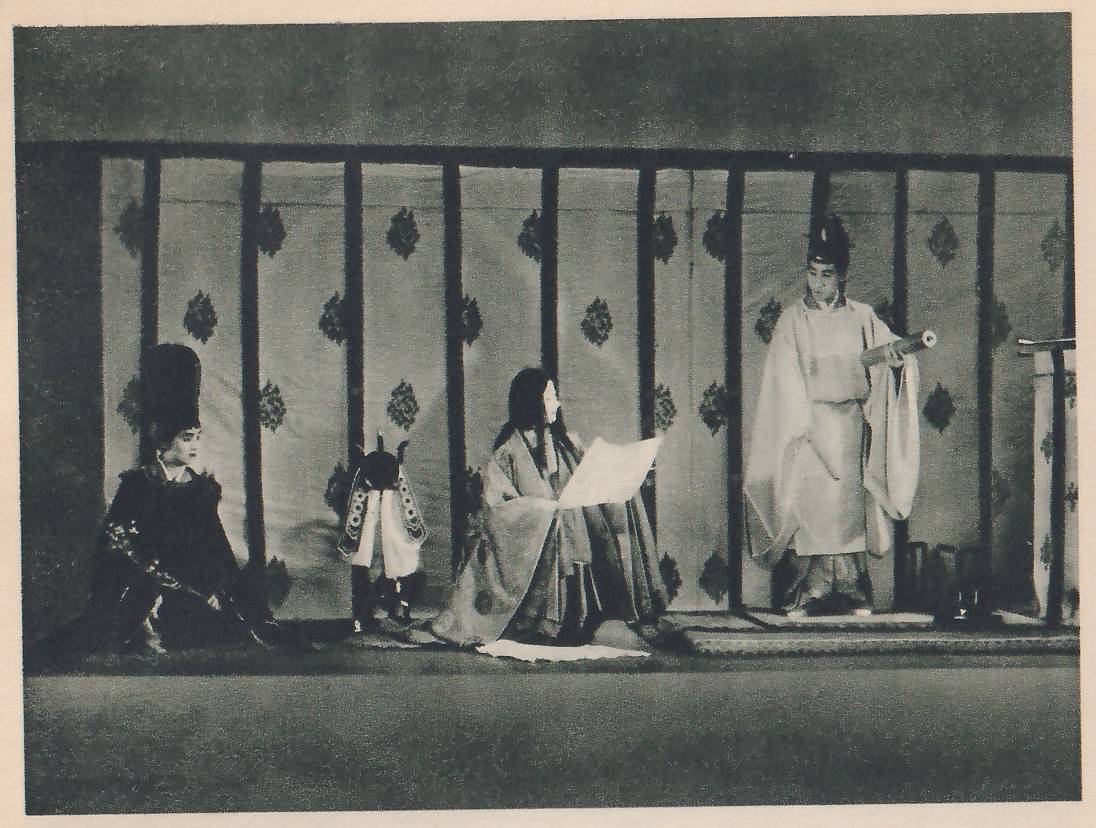
“In the Fujiwara Period (897–1185), as the country was at peace, life was secure and the upper classes no longer had to do manual work, so an easy aristocratic life began.
“Thus the frock-coat style of clothes gradually became looser, and the sokutai (the ceremonial court robe), the ikan (informal court dress) and nōshi (a
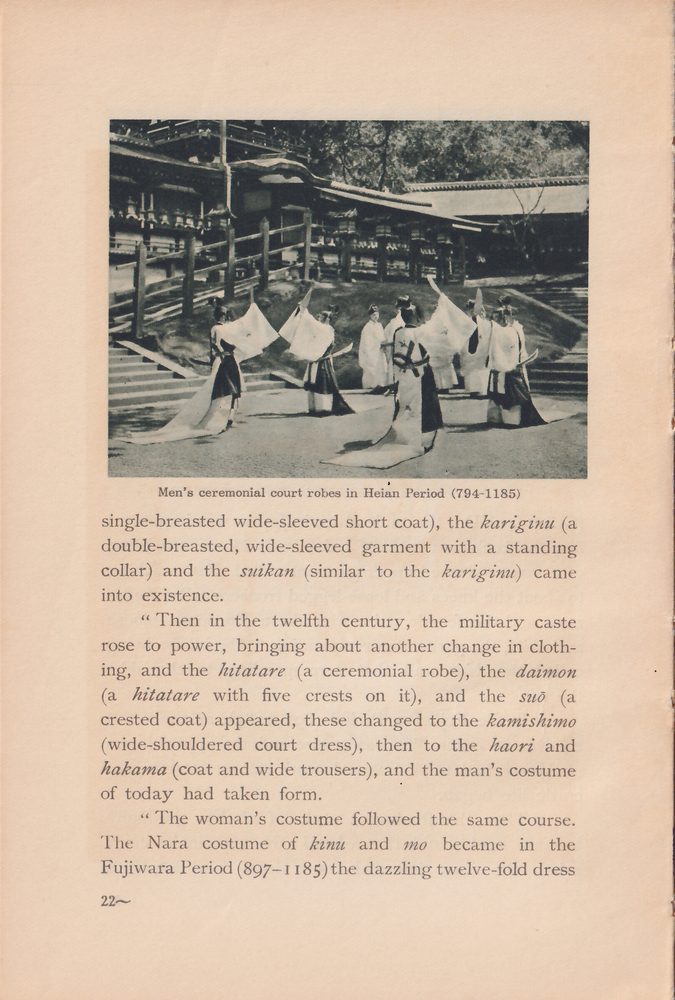
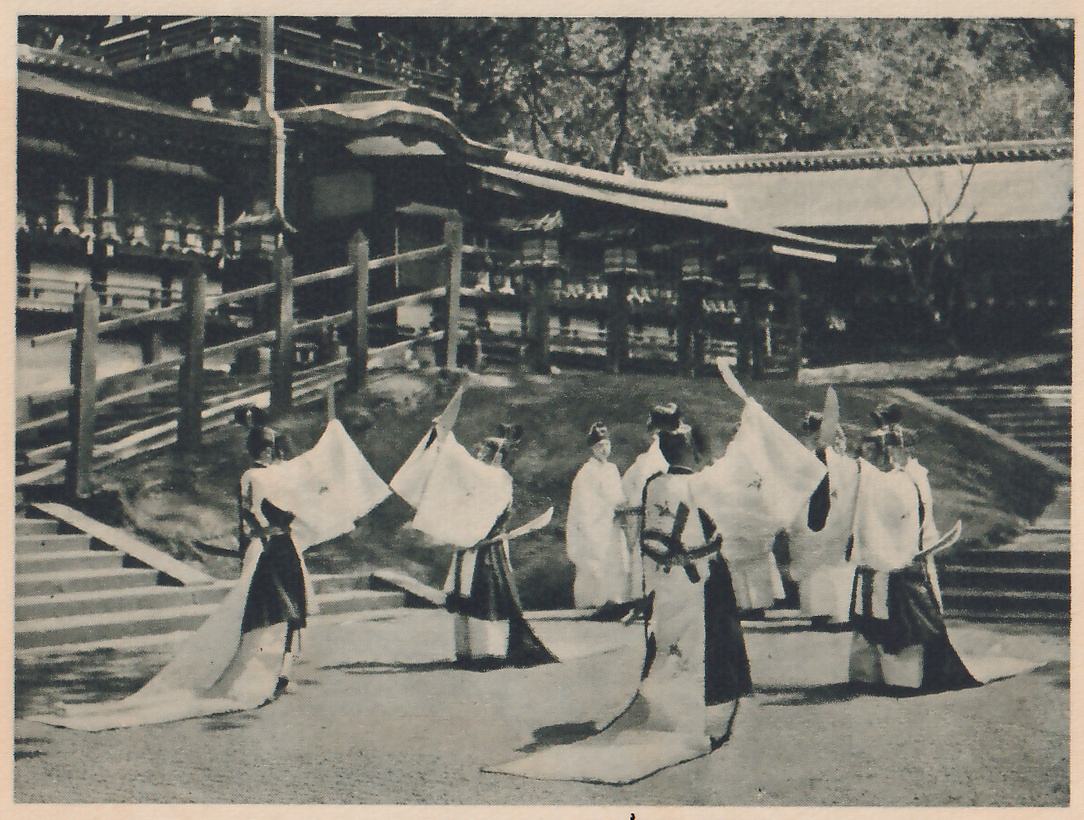
single-breasted wide-sleeved short coat), the kariginu (a double-breasted, wide-sleeved garment with a standing collar) and the suikan (similar to the kariginu) came into existence.
“Then in the twelfth century, the military caste rose to power, bringing about another change in clothing, and the hitatare (a ceremonial robe), the daimon (a hitatare with five crests on it), and the suō (a crested coat) appeared, these changed to the kamishimo (wide-shouldered court dress), then to the haori and hakama (coat and wide trousers), and the man’s costume of today had taken form.
“The woman’s costume followed the same course. The Nara costume of kinu and mo became in the Fujiwara Period (897–1185) the dazzling twelve-fold dress
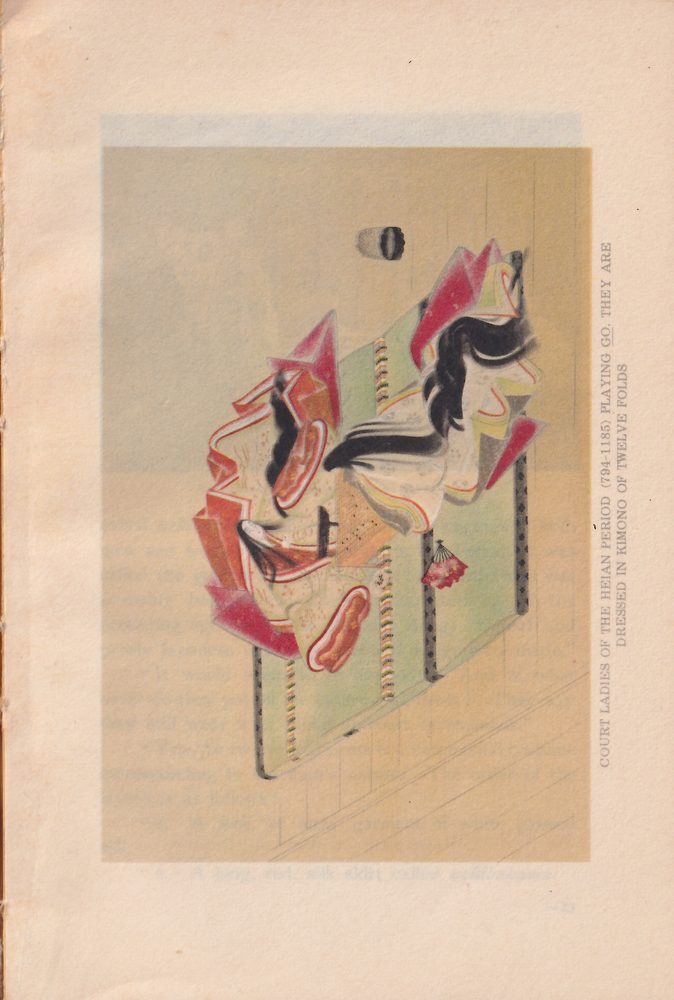
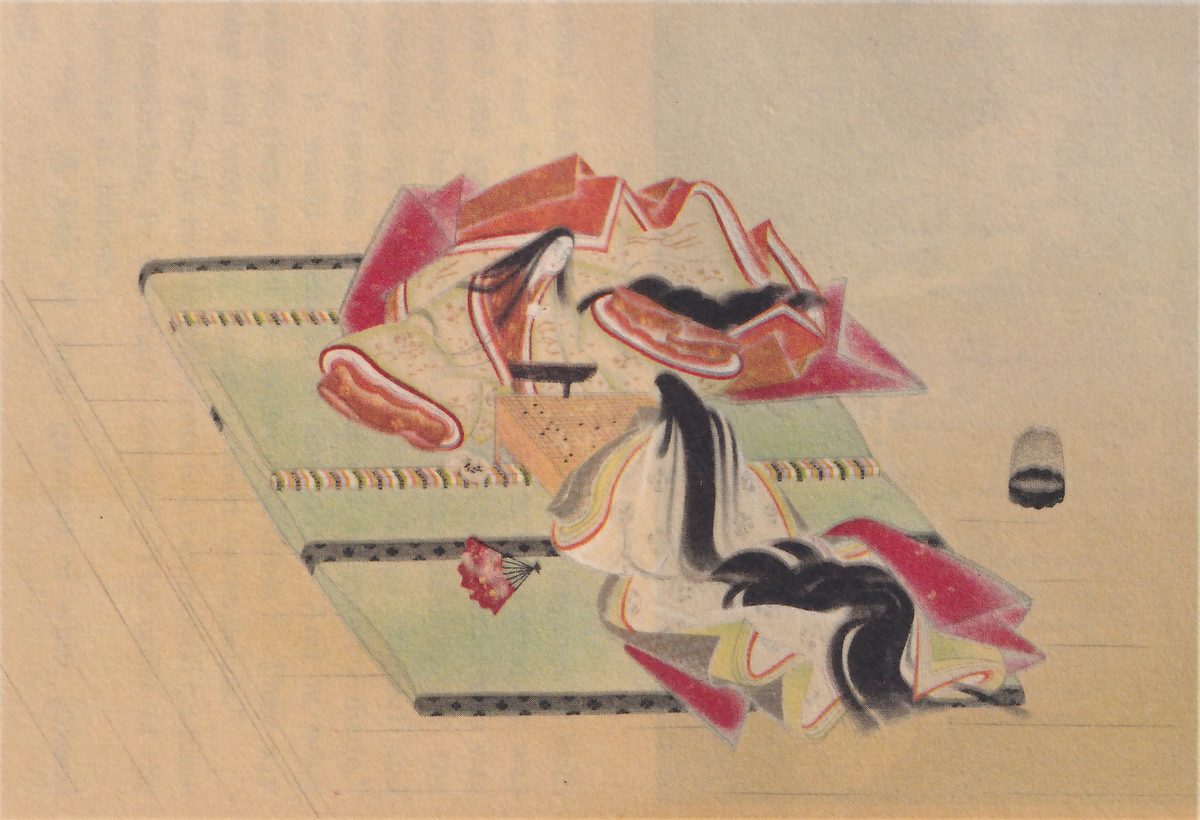
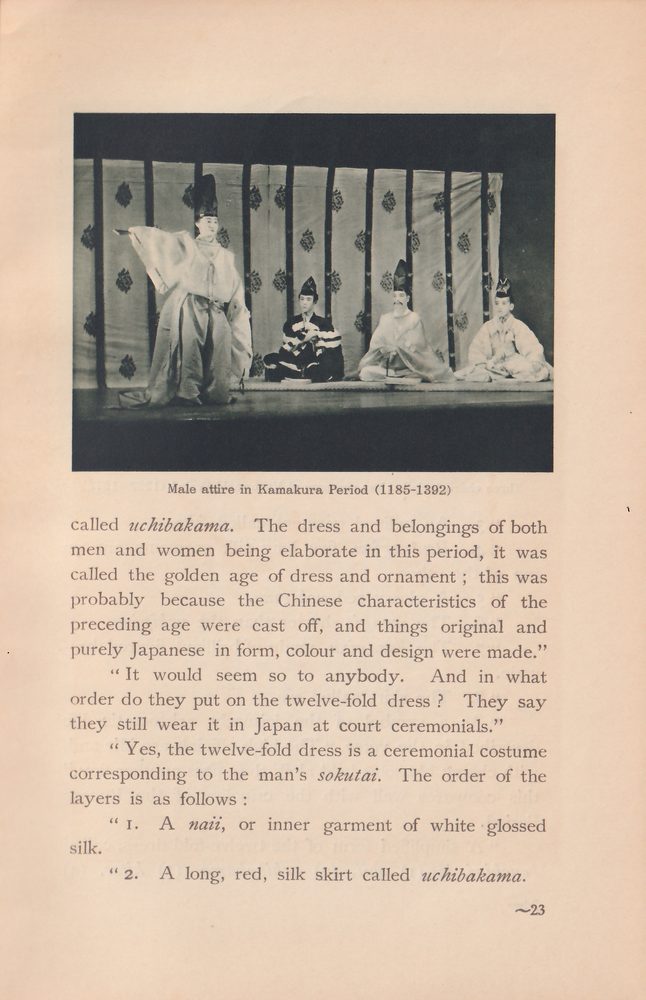
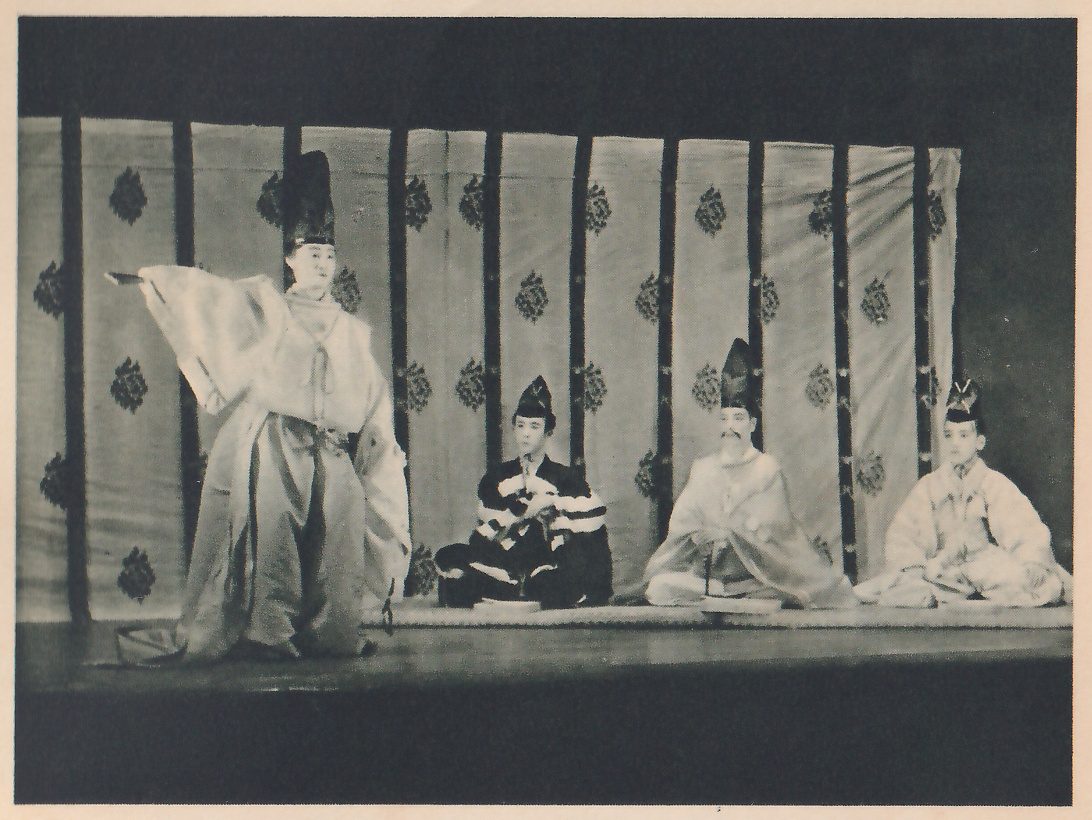
called uchibakama. The dress and belongings of both men and women being elaborate in this period, it was called the golden age of dress and ornament; this was probably because the Chinese characteristics of the preceding age were cast off, and things original and purely Japanese in form, colour and design were made.”
“It would seem so to anybody. And in what order do they put on the twelve-fold dress? They say they still wear it in Japan at court ceremonials.”
“Yes, the twelve-fold dress is a ceremonial costume corresponding to the man’s sokutai. The order of the layers is as follows:
“1. A naii, or inner garment of white glossed silk.
“2. A long, red, silk skirt called uchibakama.
“3. An unlined garment called hitoe.
“4. Itsutsuginu, five long silk garments one on top of the other.
“5. A glossy red uchiginu.
“6. The uwagi, shorter than the uchiginu.
“7. The karaginu, made of brilliant figured brocade.
“8. The skirt called mo.
“As a symbol of the leisurely aristocratic life described in the verse, “The high officials are idle and, with cherry blossoms held aloft, they pass another day,” this compares well with the crinoline of the Rococo Period.
“A simplified form of the twelve-fold dress, called kouchigi, is (1) naii, (2) uchibakama, (3) hitoe, (4)
uchigi, (5) uchiginu, (6) uwagi, (7) kouchigi. The kouchigi closely resembles the uwagi.
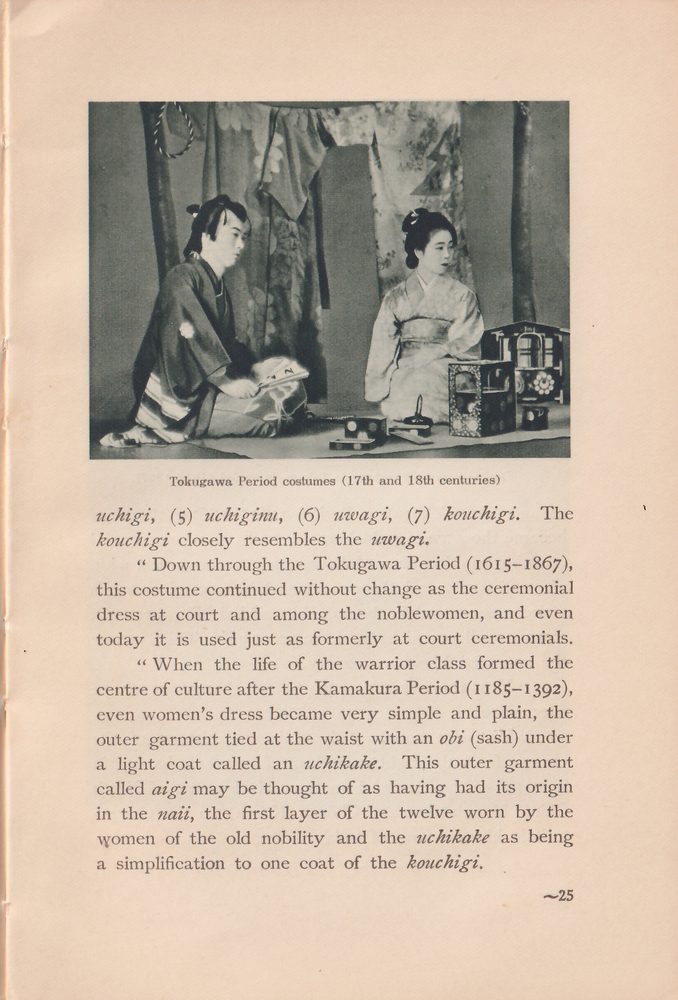
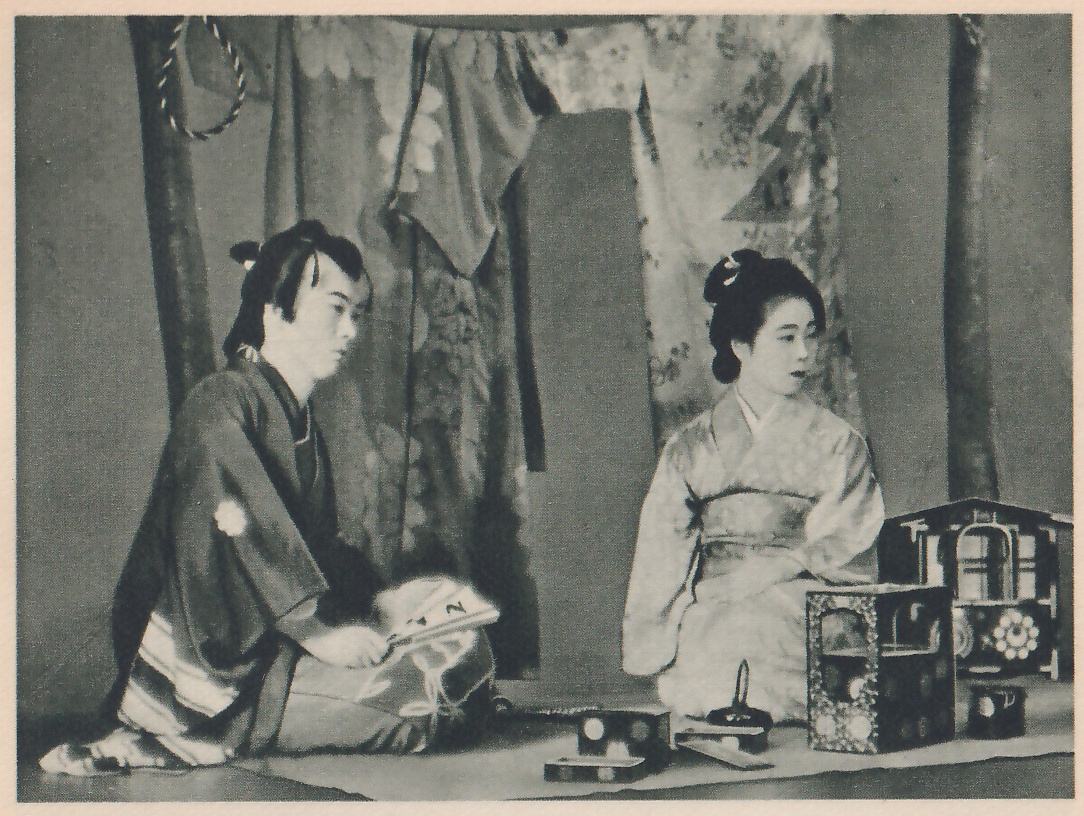
“Down through the Tokugawa Period (1615–1867), this costume continued without change as the ceremonial dress at court and among the noblewomen, and even today it is used just as formerly at court ceremonials.
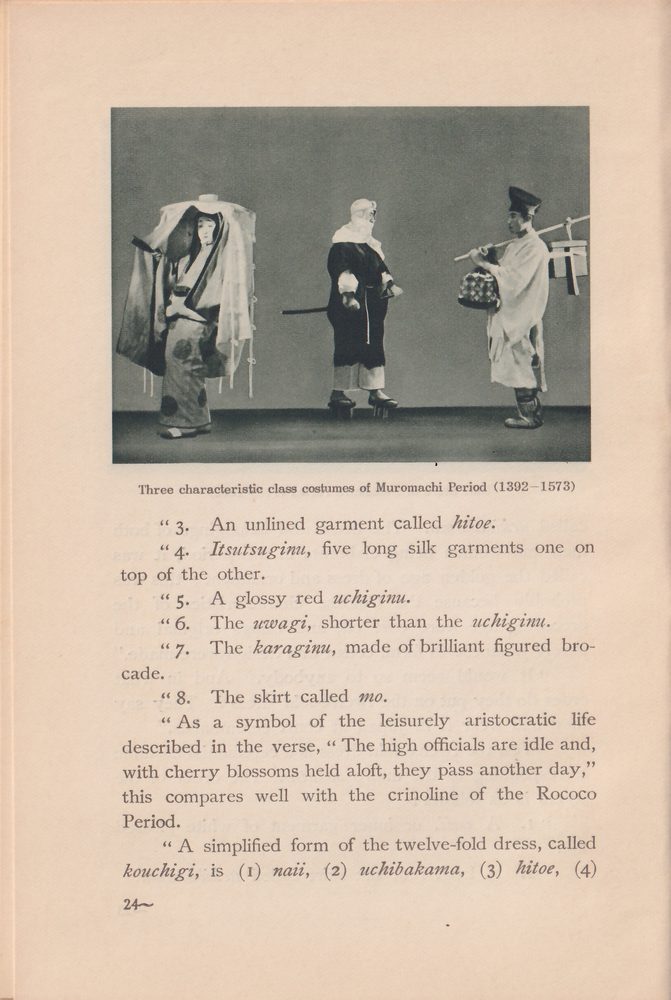
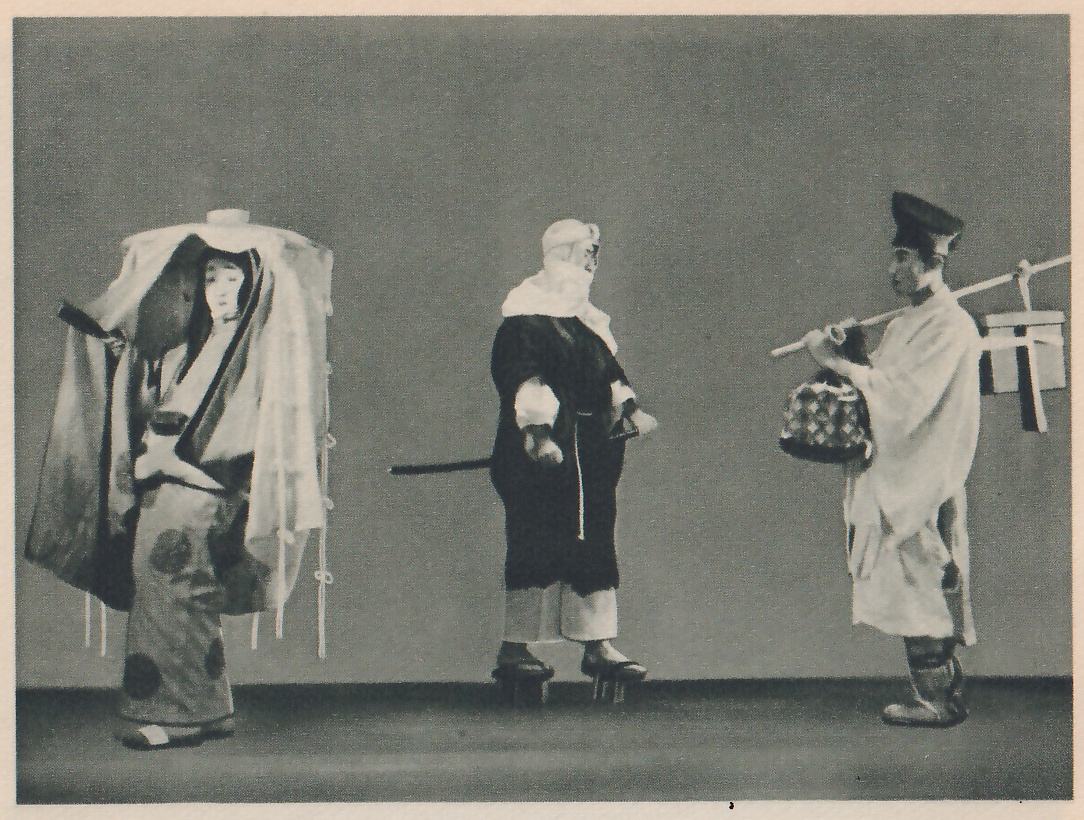
“When the life of the warrior class formed the centre of culture after the Kamakura Period (1185–1392), even women’s dress became very simple and plain, the outer garment tied at the waist with an obi (sash) under a light coat called an uchikake. This outer garment called aigi may be thought of as having had its origin in the naii, the first layer of the twelve worn by the women of the old nobility and the uchikake as being a simplification to one coat of the kouchigi.
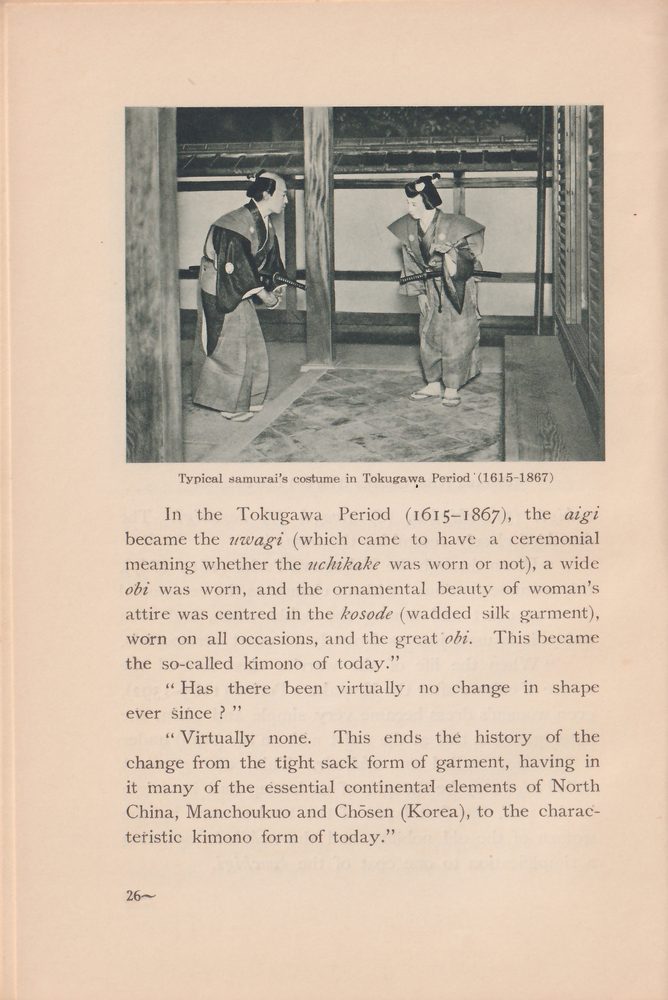
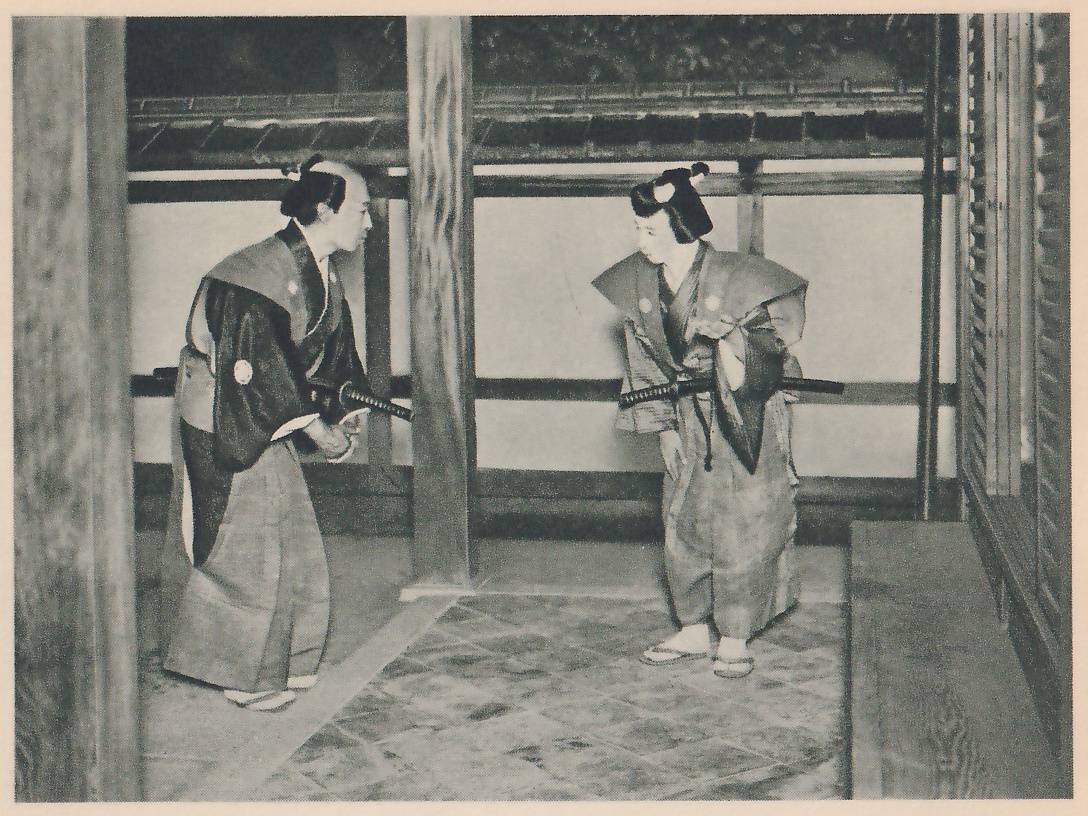
In the Tokugawa Period (1615–1867), the aigi became the uwagi (which came to have a ceremonial meaning whether the uchikake was worn or not), a wide obi was worn, and the ornamental beauty of woman’s attire was centred in the kosode (wadded silk garment), worn on all occasions, and the great obi. This became the so-called kimono of today.”
“Has there been virtually no change in shape ever since?”
“Virtually none. This ends the history of the change from the tight sack form of garment, having in it many of the essential continental elements of North China, Manchoukuo and Chōsen (Korea), to the characteristic kimono form of today.”
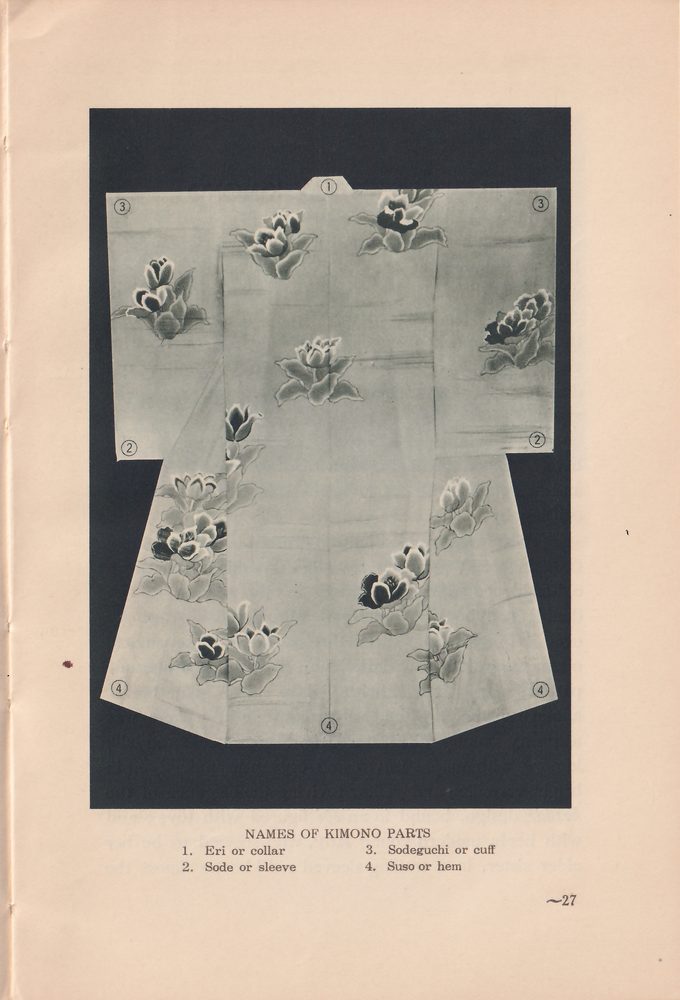
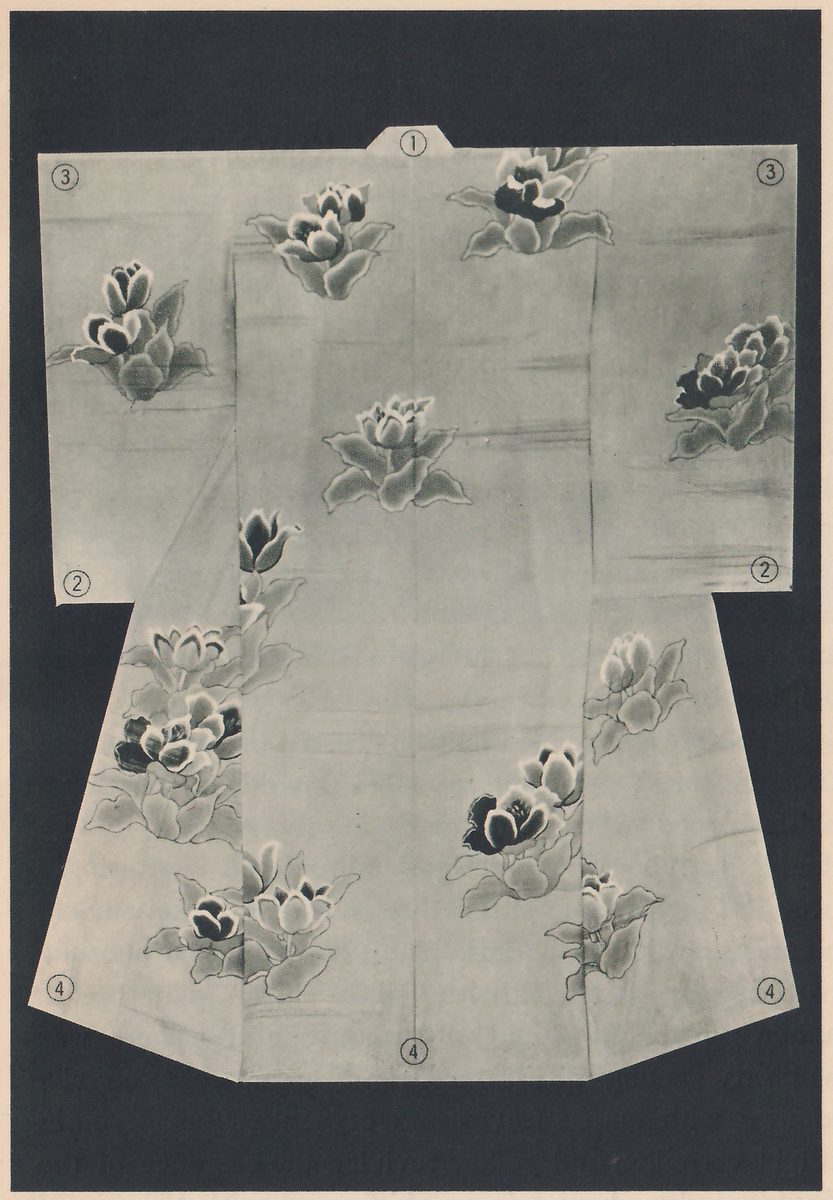
1. Eri or collar
2. Sode or sleeve
3. Sodeguchi or cuff
4. Suso or hem