
V. NOTABLE FEATURES OF JAPANESE HOT SPRINGS
From early times hot springs in Japan have been turned to account in a variety of ways—for medical and other purposes.
The miraculous cures mineral waters are capable of working depend, in no small measure, upon the ways they are utilized.
Below are some of the most characteristic uses to which Japanese mineral waters are put for therapeutic purposes.
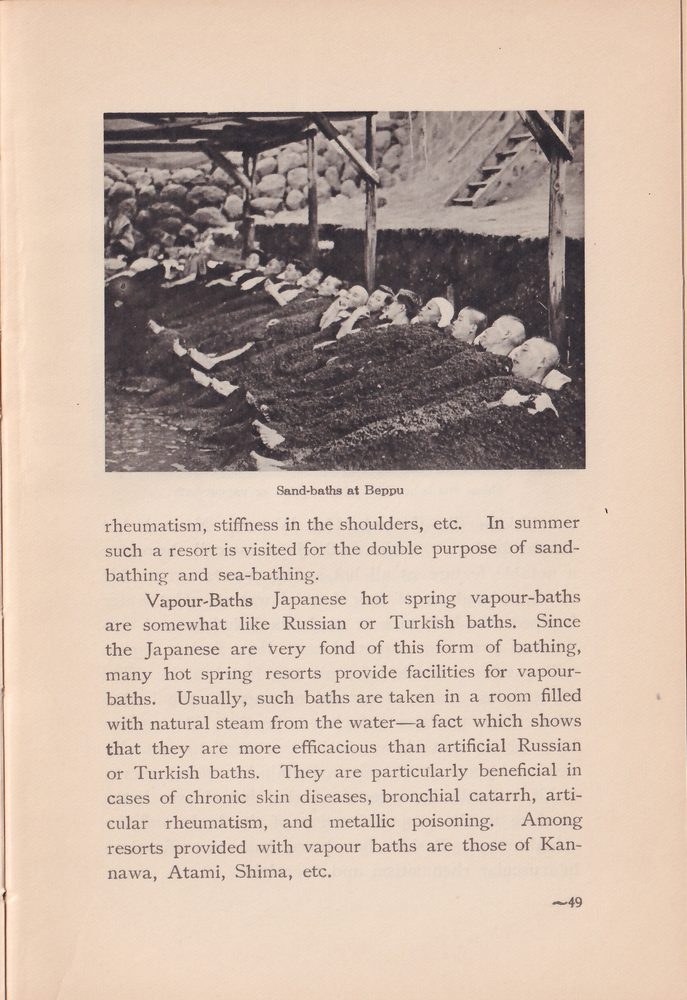
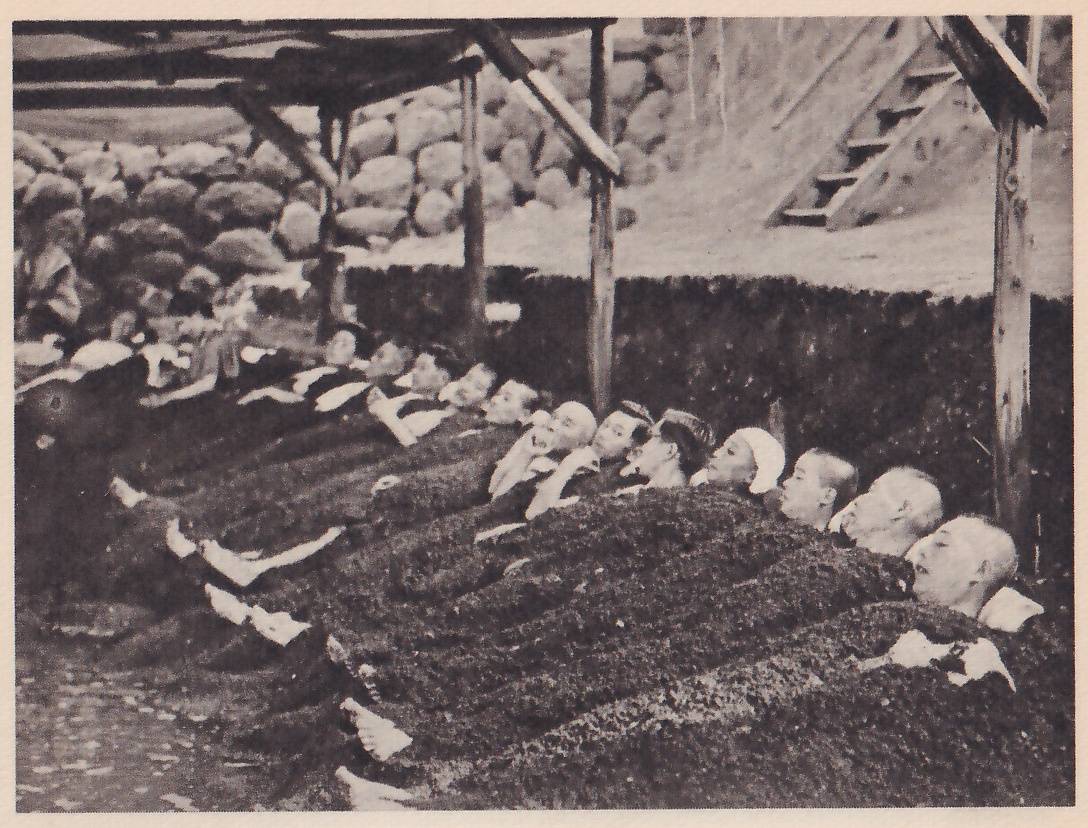
Sunayu or Sand-Baths As previously stated, sand-baths are typical of hot springs on the shore, as at Beppu and Ibusuki in Kyūshū. Sand-baths are taken at ebb tide, for the sea-water flowing in at high tide reduces the temperature. The bather digs a hole—or for that matter has one dug for him—large enough to bury half of his body, or sometimes, in a recumbent posture, the whole of it, except of course his head. The subject then gets the attendant to cover his recumbent body with sand, so that he may become buried alive for some length of time. The therapeutic action of the hot mineral waters, the pressure which the sand brings to bear upon the subject, the fresh air on the seashore, and, if it is in the daytime, an opportunity for a sun-bath—all these combine to make a sand bath valuable in the treatment of lumbago, neuralgia,
rheumatism, stiffness in the shoulders, etc. In summer such a resort is visited for the double purpose of sand-bathing and sea-bathing.
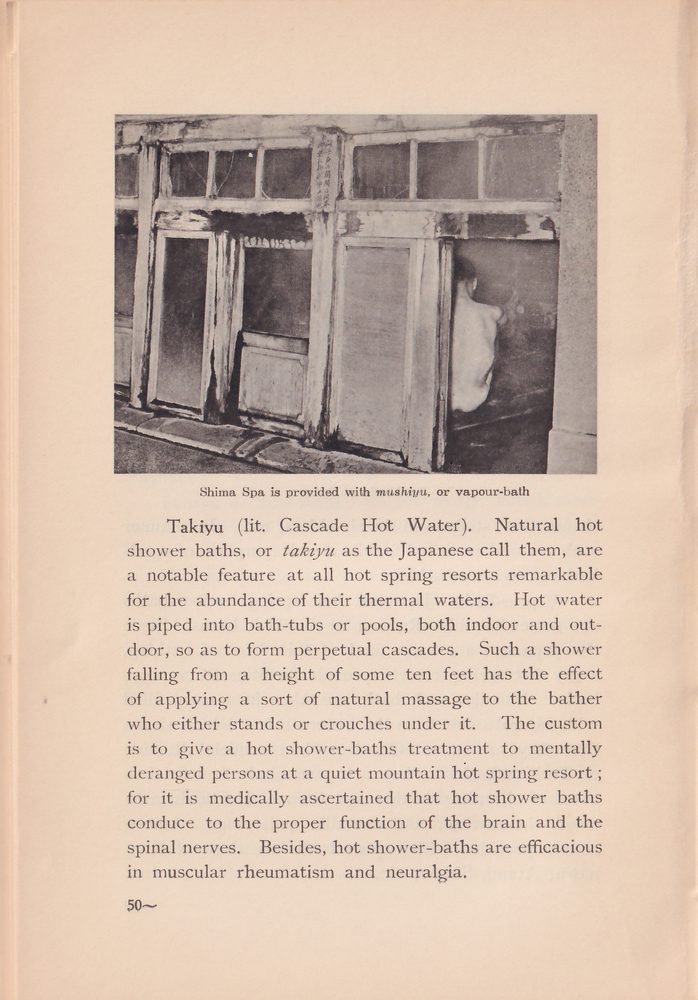
Vapour-Baths Japanese hot spring vapour-baths are somewhat like Russian or Turkish baths. Since the Japanese are very fond of this form of bathing, many hot spring resorts provide facilities for vapour-baths. Usually, such baths are taken in a room filled with natural steam from the water—a fact which shows that they are more efficacious than artificial Russian or Turkish baths. They are particularly beneficial in cases of chronic skin diseases, bronchial catarrh, articular rheumatism, and metallic poisoning. Among resorts provided with vapour baths are those of Kannawa, Atami, Shima, etc.
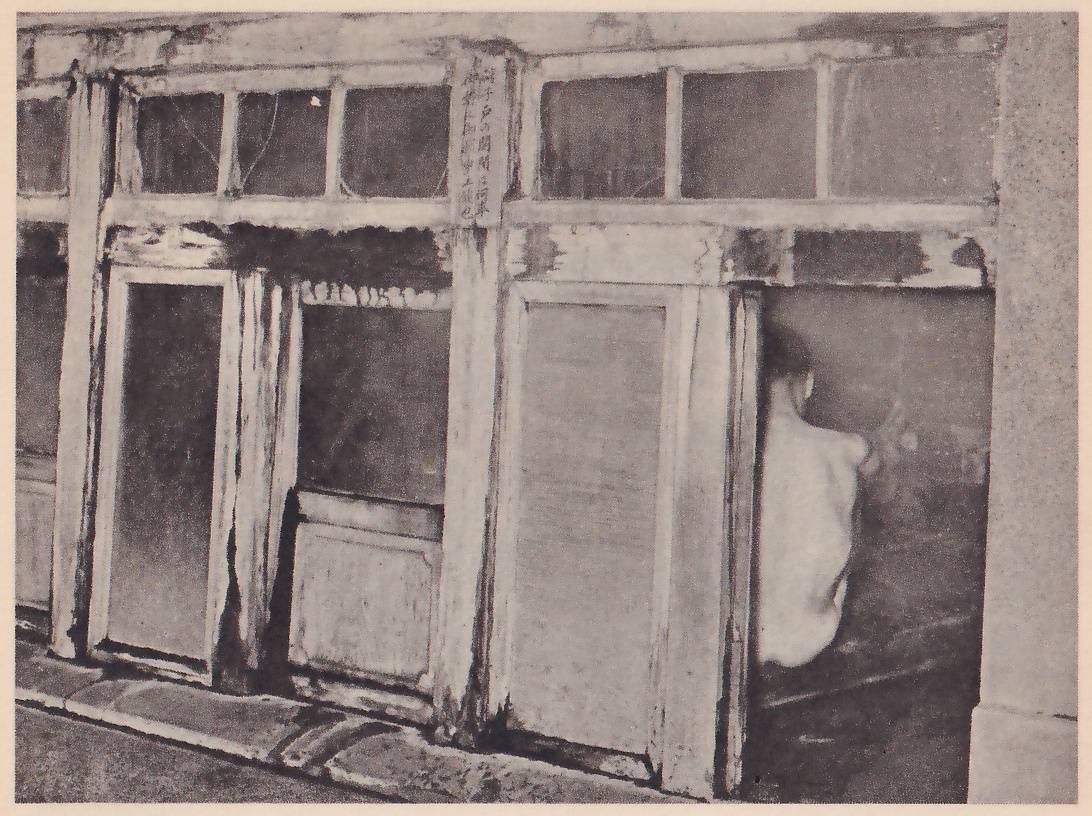
Takiyu (lit. Cascade Hot Water). Natural hot shower baths, or takiyu as the Japanese call them, are a notable feature at all hot spring resorts remarkable for the abundance of their thermal waters. Hot water is piped into bath-tubs or pools, both indoor and outdoor, so as to form perpetual cascades. Such a shower falling from a height of some ten feet has the effect of applying a sort of natural massage to the bather who either stands or crouches under it. The custom is to give a hot shower-baths treatment to mentally deranged persons at a quiet mountain hot spring resort; for it is medically ascertained that hot shower baths conduce to the proper function of the brain and the spinal nerves. Besides, hot shower-baths are efficacious in muscular rheumatism and neuralgia.
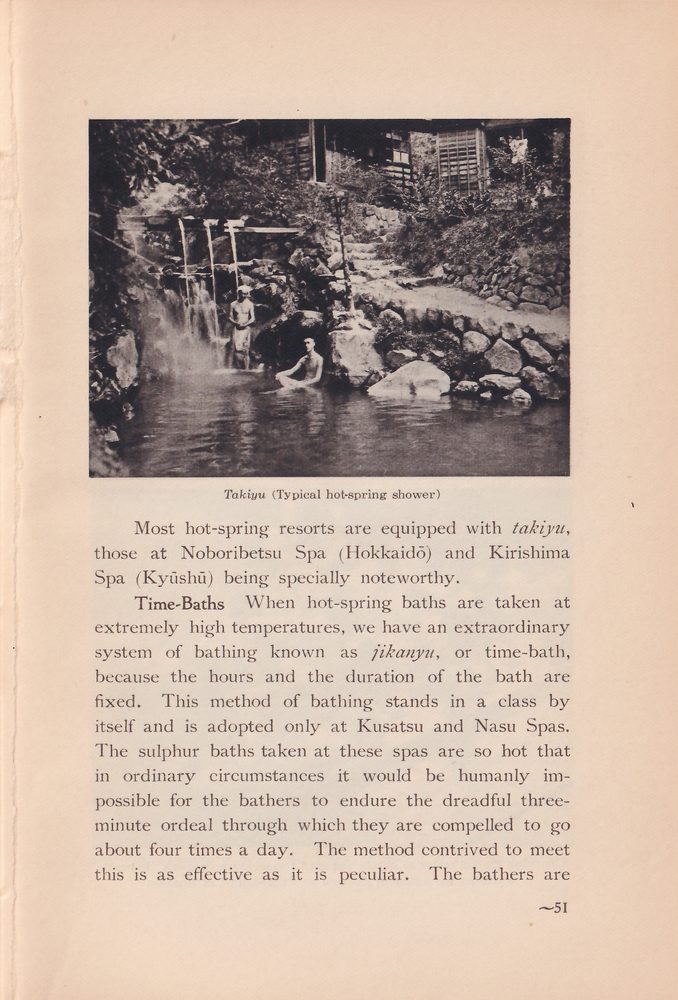
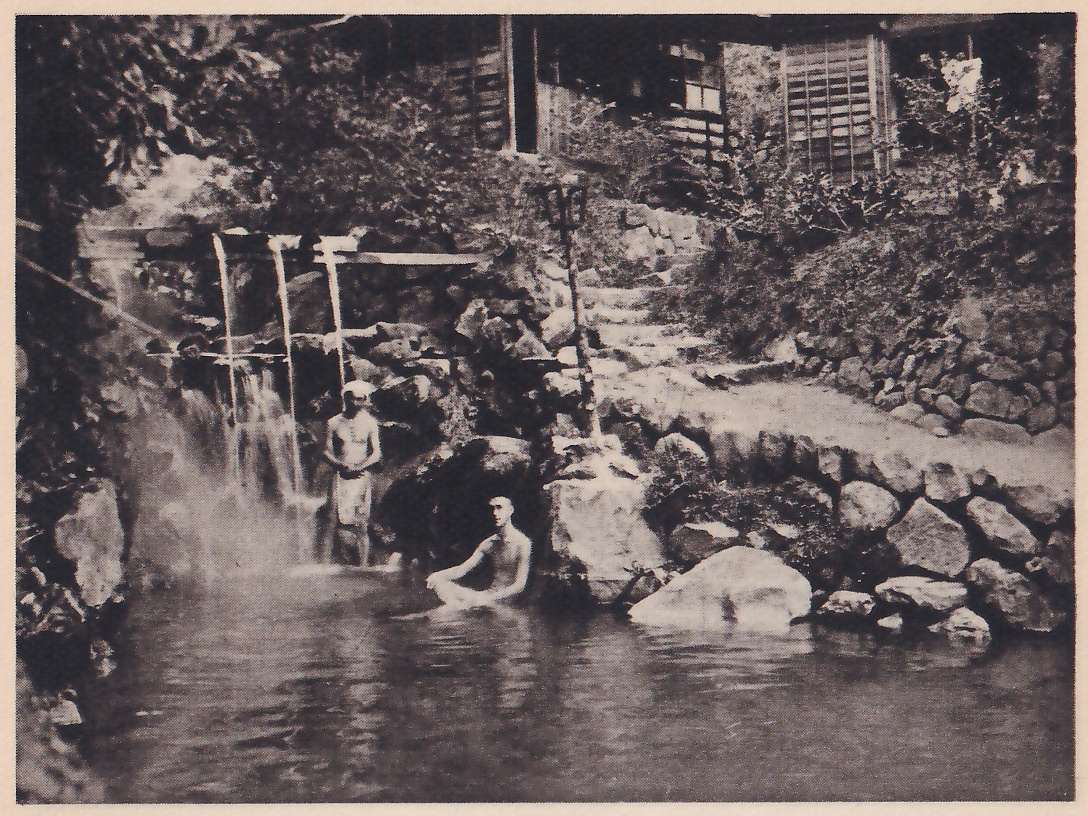
Most hot-spring resorts are equipped with takiyu, those at Noboribetsu Spa (Hokkaidō) and Kirishima Spa (Kyūshū) being specially noteworthy.
Time-Baths When hot-spring baths are taken at extremely high temperatures, we have an extraordinary system of bathing known as jikanyu, or time-bath, because the hours and the duration of the bath are fixed. This method of bathing stands in a class by itself and is adopted only at Kusatsu and Nasu Spas. The sulphur baths taken at these spas are so hot that in ordinary circumstances it would be humanly impossible for the bathers to endure the dreadful three-minute ordeal through which they are compelled to go about four times a day. The method contrived to meet this is as effective as it is peculiar. The bathers are
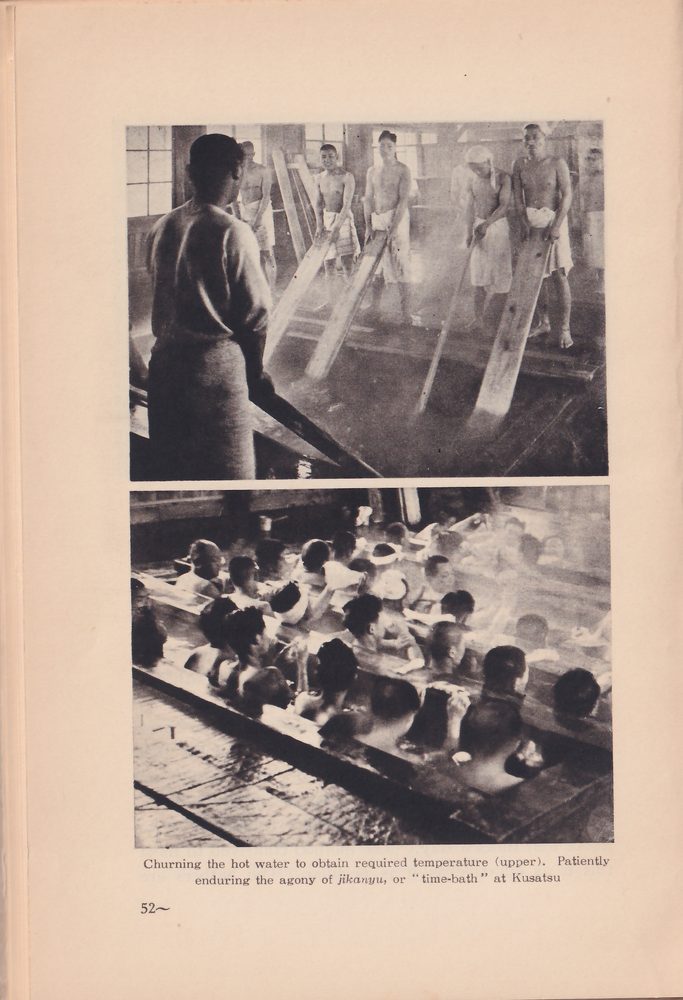
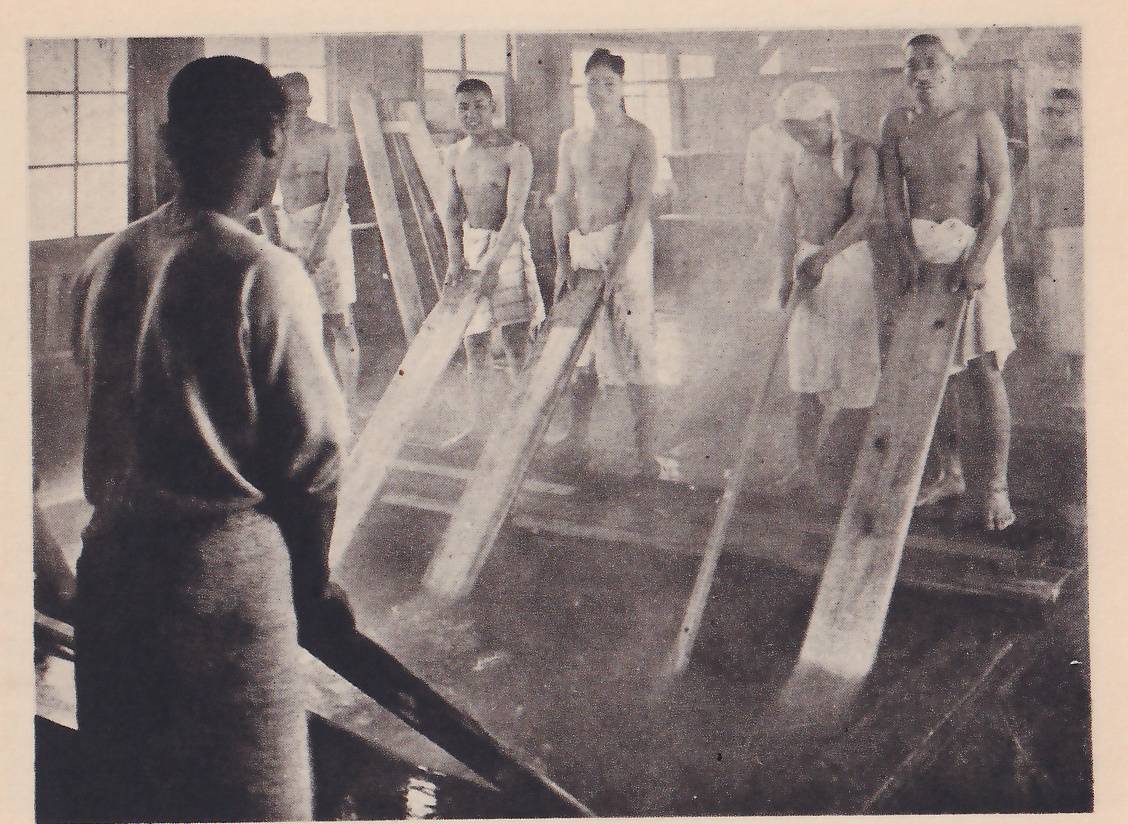
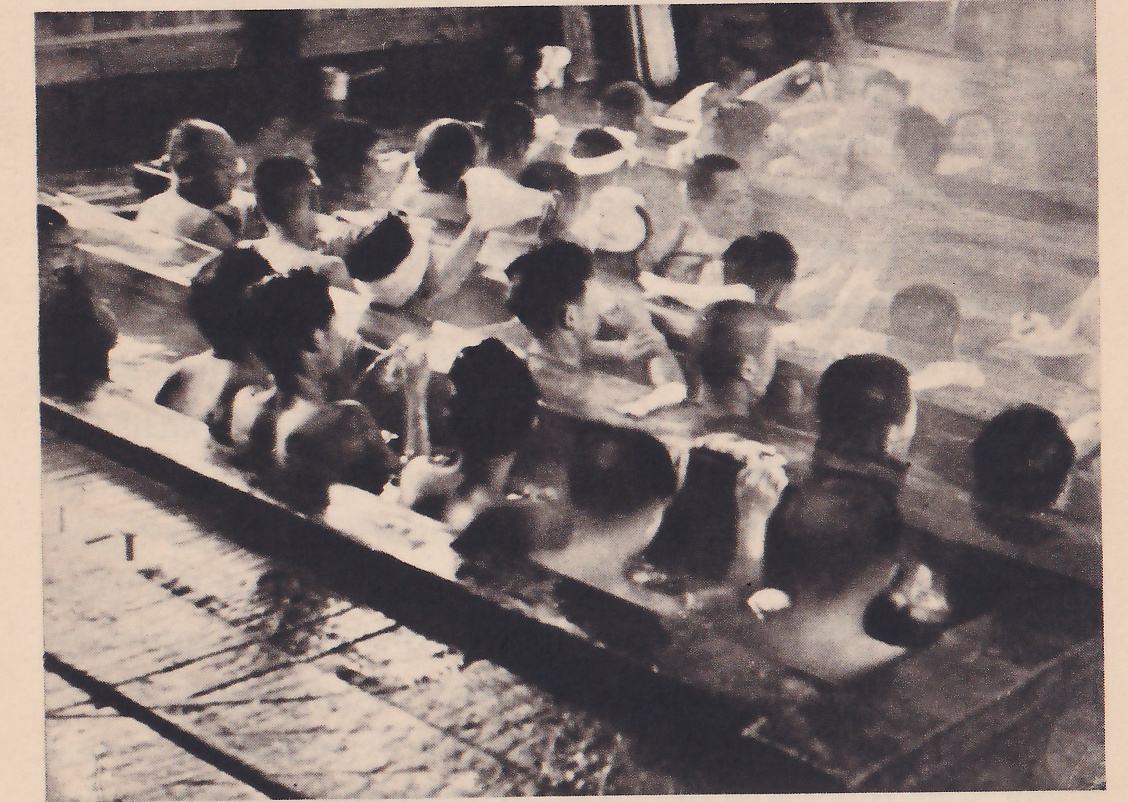
subjected to a discipline almost military in its strictness. The approach of the bathing time is proclaimed by the blast of a trumpet, and patients leave their inns for the baths, where they bathe at the word of command of the bath-master. The first process, which lasts anything from 15 to 30 minutes, consists in the bathers, some 30 to 50 in number at a time, taking their places round the oblong tubs and churning up the water with boards about six feet long and nine inches wide. They sing a folksong in unison, while churning up the water. When the scalding water is thus cooled to the required temperature, the bath-master orders them to stop churning and to wet their scalps and foreheads to prevent a rush of blood to the head. Then he gives the signal to take the tub. Into the water the unfortunates lower themselves, enduring the agony with the patience of Job. While they sit boiling, the bath-master keeps up their courage by notifying them of the passage of the minutes. It is easy to imagine how glad the patients must be when they are told to come out of the water at the end of the three long minutes.
Time-baths are considered beneficial in the treatment of chronic skin diseases, syphilis and nervous prostration. The hot springs at Kusatsu and Nasu are naturally frequented by those afflicted with such maladies.
Prolonged Subthermal Baths This method of bathing makes a striking contrast to the time-baths described above, for it consists in bathing for more than one hour in moderately hot water. Although the water is only moderately hot, yet long immersion has the effect
of keeping the bather warm long after the bath. That is the advantage of this method. The usual practice is for the bathers to rest their heads on the beams laid across the tubs, so that they may be able to keep themselves immersed in the water with outstretched legs for some considerable time.
The foregoing is a rough sketch of some of the traditional hot spring treatments prevailing in Japan,—methods which long experience has taught to be efficacious. Visitors to these shores will no doubt find that every one of these treatments, except perhaps the time-bath, is a delightful experience.
So much for methods of hot spring cure. We shall now consider how our hot mineral waters are utilized industrially.
At the springs of Kannawa on the outskirts of Beppu is an alligator farm where thermal spring water plays an important part in breeding this species of reptile for commercial purposes. It seems that the firm at Kannawa is fairly successful in its enterprise.
Another popular way of turning hot spring water to account is to pipe it so that hothouses may be run for growing plants out of season. This is a very economical, not to say profitable, way of growing melons and vegetables in winter, for it rules out competition by horticulturists who have to burn coal night and day to keep hothouses going. There is a number of such hothouses at Beppu and Ibusuki in Kyūshū.
Iron spring water is used for colouring textiles. Bathers often indulge in this form of amusement just to kill time. Towels, handkerchiefs, and piece-goods
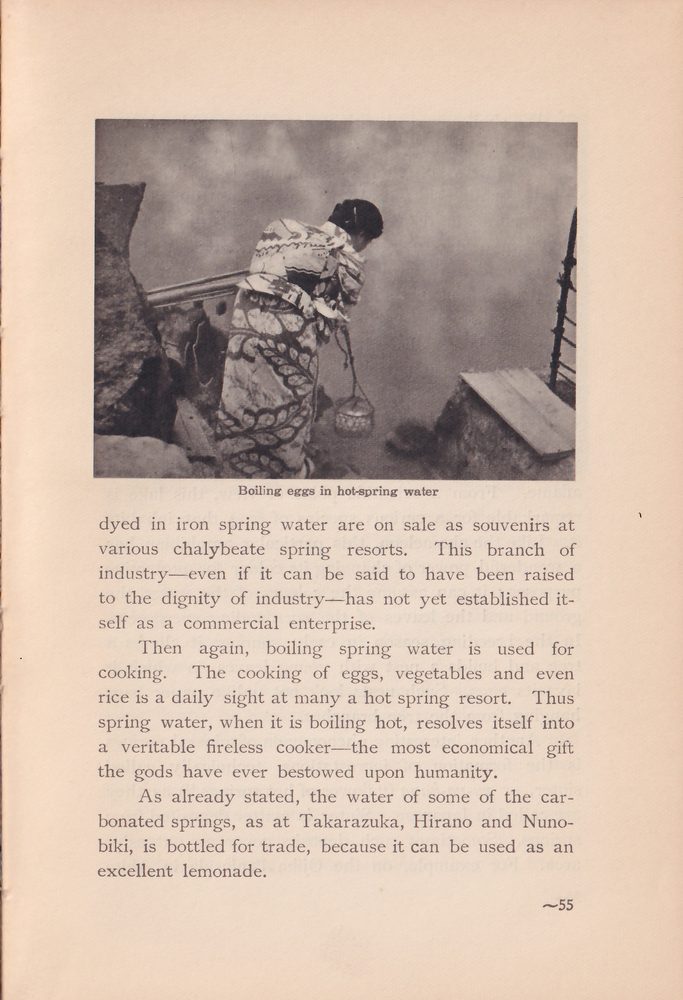
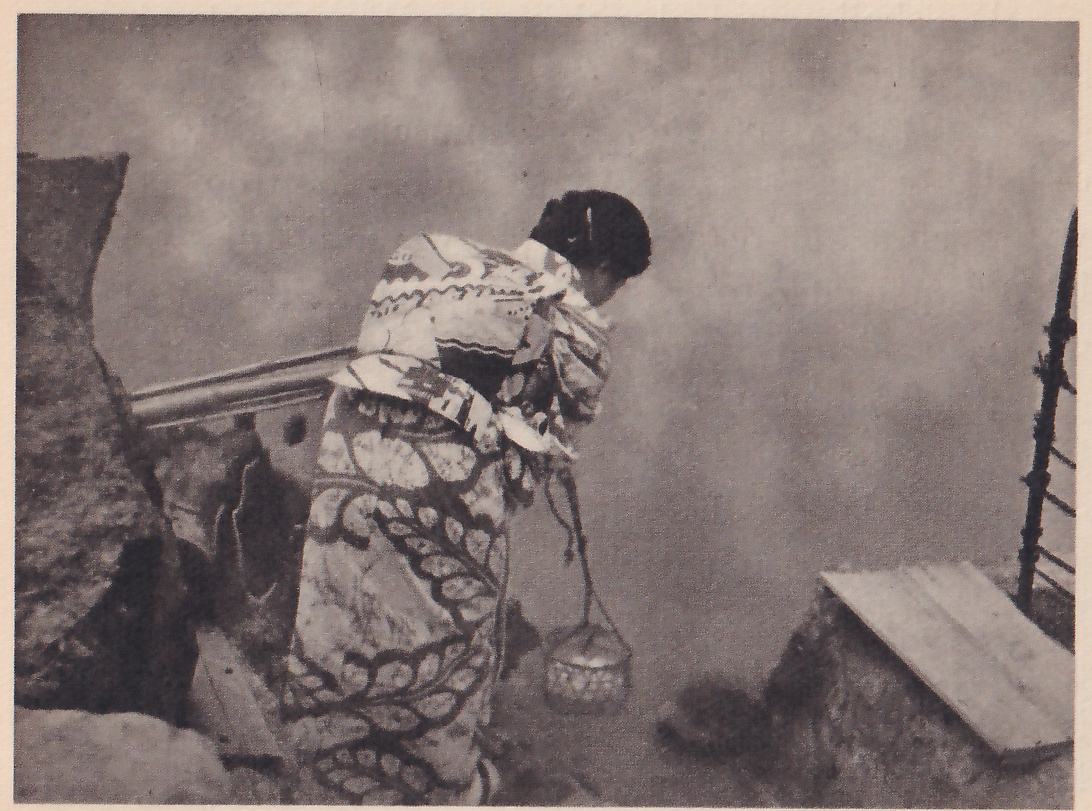
dyed in iron spring water are on sale as souvenirs at various chalybeate spring resorts. This branch of industry—even if it can be said to have been raised to the dignity of industry—has not yet established itself as a commercial enterprise.
Then again, boiling spring water is used for cooking. The cooking of eggs, vegetables and even rice is a daily sight at many a hot spring resort. Thus spring water, when it is boiling hot, resolves itself into a veritable fireless cooker—the most economical gift the gods have ever bestowed upon humanity.
As already stated, the water of some of the carbonated springs, as at Takarazuka, Hirano and Nunobiki, is bottled for trade, because it can be used as an excellent lemonade.
We shall now deal with some of the notable phenomena of hot springs.
At Itō Spa on the Izu Peninsula is a little lake called Jō-no-ike, in which there live some tropical salt-water fish. This is because the water of this pond is lukewarm owing to a thermal spring. The denizens of this pond are now under government protection as a national monument; for they are considered of scientific value. In this connection mention may be made of another lake called Hatchō-ike, not far from the hot springs at Yugashima in the Amagi mountains on the Izu Peninsula. The lake, only a little more than half a mile round, nestles in pretty woodland scenery and is beautiful in spring with the surrounding cherry trees in bloom, and in autumn with the tinted foliage all aflame. From a scientific point of view, this lake is remarkable for a curious species of frog that inhabits it. Like the chameleon, this particular amphibian has a wonderful power of changing its colour for protective purposes: it can assume the colours of the water, the ground and the leaves of the surrounding evergreens. In the breeding season in early summer it climbs a tree and builds a nest with young leaves, in which it lays its eggs. Such nests look not unlike paper bags hanging from the tree branches.
Another interesting phenomenon of mineral springs is the formation of incrustations, technically called sinter, or yu-no-hana (“flower of hot springs”) as they are called in Japanese. Sinter is matter deposited from springs. Sometimes such deposits cover an extensive area. For example, on the Ojika Peninsula in Akita
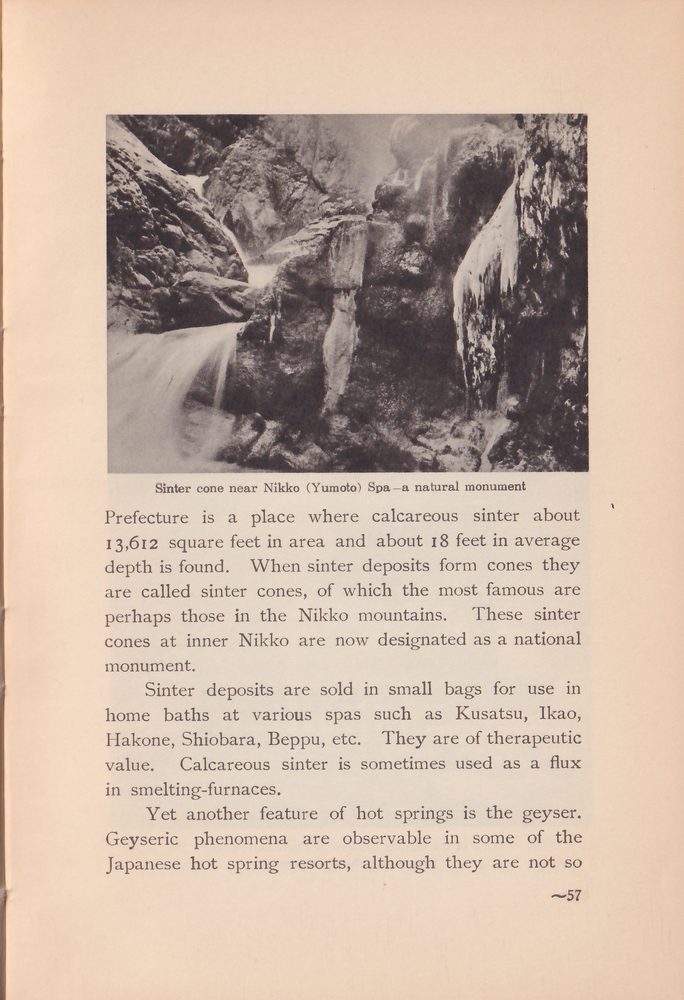
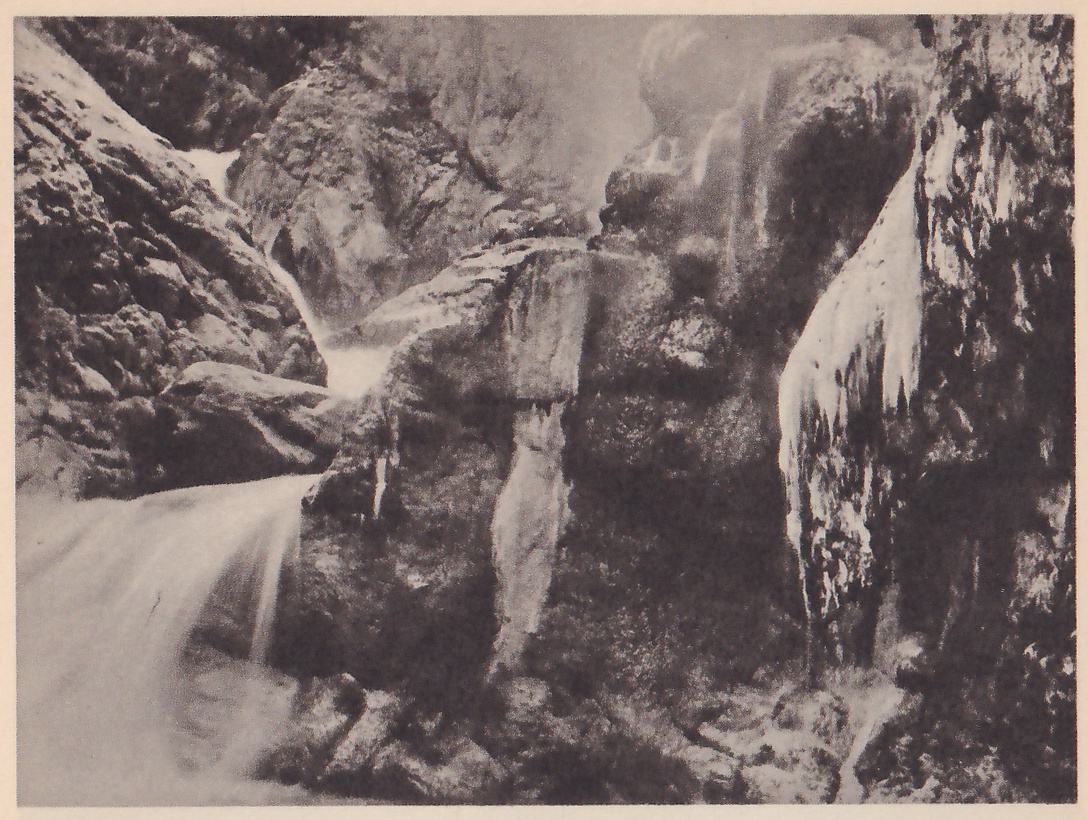
Prefecture is a place where calcareous sinter about 13,612 square feet in area and about 18 feet in average depth is found. When sinter deposits form cones they are called sinter cones, of which the most famous are perhaps those in the Nikko mountains. These sinter cones at inner Nikko are now designated as a national monument.
Sinter deposits are sold in small bags for use in home baths at various spas such as Kusatsu, Ikao, Hakone, Shiobara, Beppu, etc. They are of therapeutic value. Calcareous sinter is sometimes used as a flux in smelting-furnaces.
Yet another feature of hot springs is the geyser. Geyseric phenomena are observable in some of the Japanese hot spring resorts, although they are not so
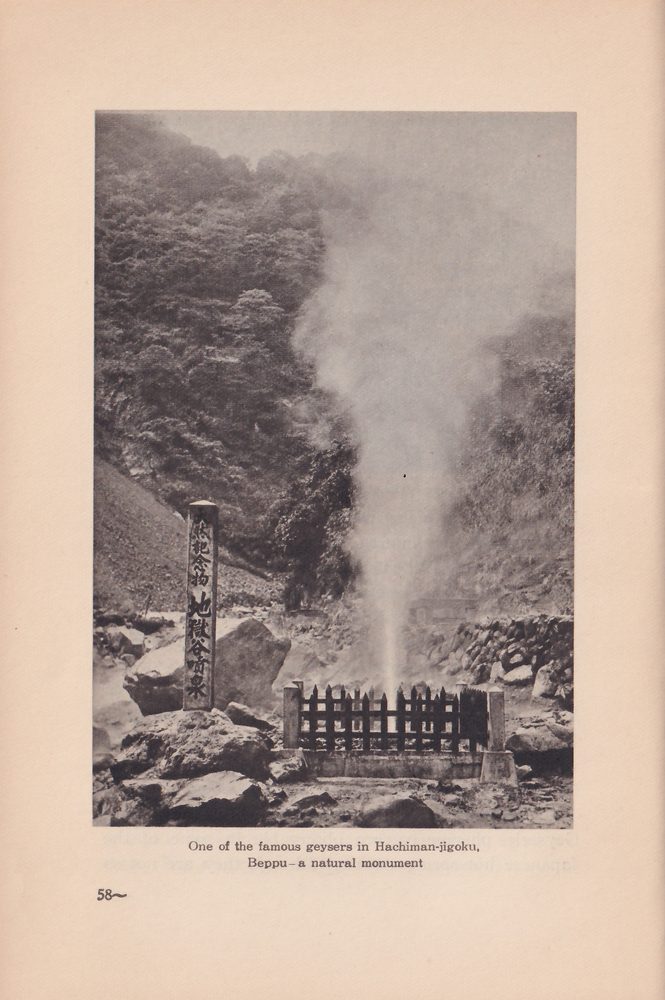
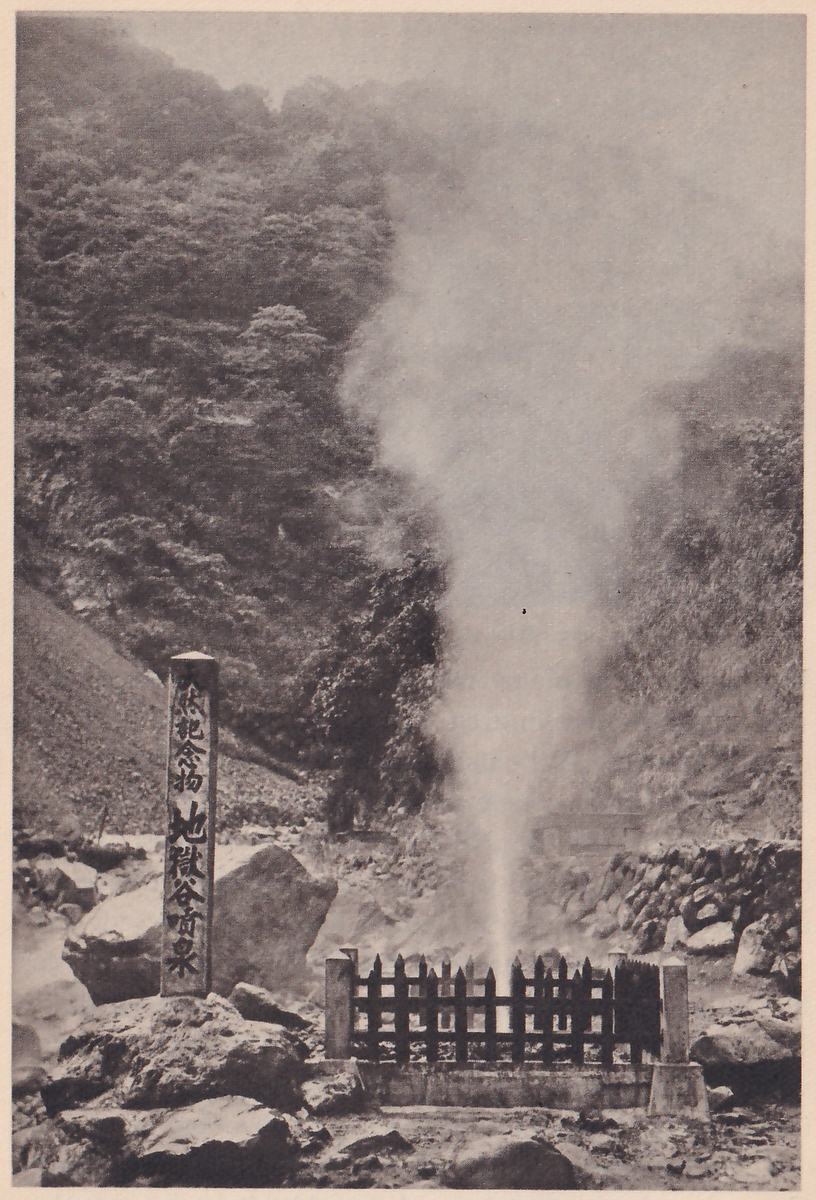
numerous as in Iceland or New Zealand, and none of them are on so gigantic a scale as those in the world-famous Yellowstone National Park. The regular intervals at which these intermittent hot springs spout into the air range anything from a few seconds to several months. Sometimes geysers spout irregularly. Here in Japan we have two geysers of sufficient importance. One is at Kwankaiji (Beppu) and the other at Onikōbe near Sendai City. Of particular interest, because uncommon, is the Unzen geyser which ejects nothing but mud, reminding one of a volcanic eruption in miniature.
In a previous chapter reference was made to the fact that one of the characteristics of Japanese hot spring resorts is the charming scenery amid which most of them are set. Added to scenic enchantment, there are several forms of outdoor recreation, for the enjoyment of which it is expedient, if not necessary, to make a hot spring resort one’s headquarters. Among such recreations are skiing, skating, hiking and angling. In the snow season skiing is an unquestionable lure of northeastern Japan, in addition to Hokkaido. And needless to say, the popularity or otherwise of skiing resorts depends to a great extent upon whether they are near hot springs. Then there are lakes easily reached from hot spring resorts and which afford good skating. The recent hiking craze in Japan naturally adds to the prosperity of hot spring resorts.
Finally, comes the consideration of hot spring resorts as headquarters for anglers. The whole land being an anglers’ paradise, the chances are that visitors to Japanese spas can combine bathing with fishing.
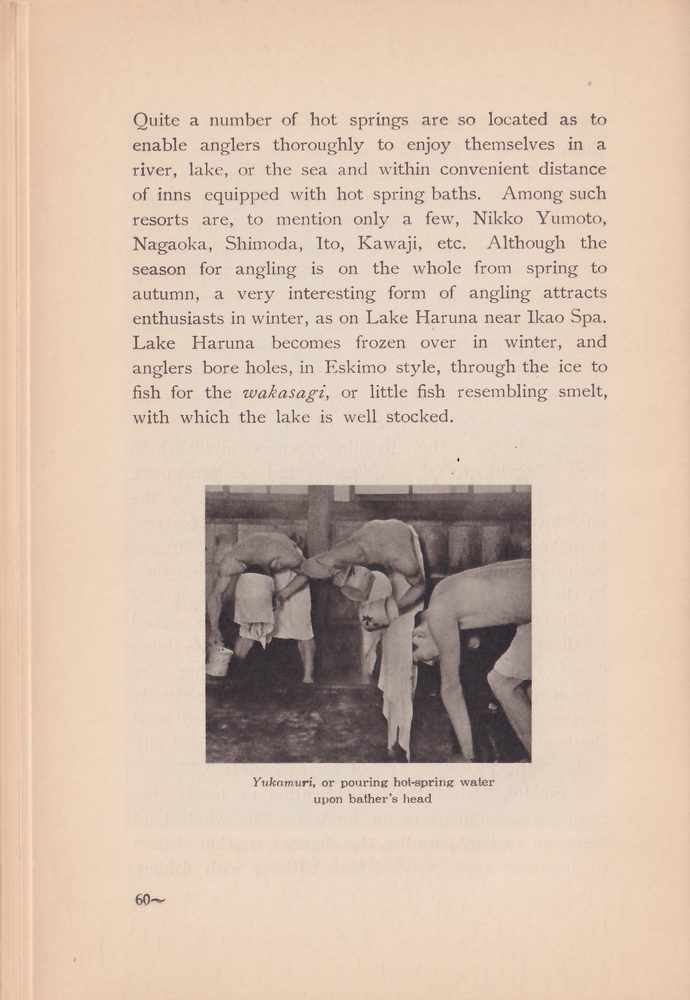
Quite a number of hot springs are so located as to enable anglers thoroughly to enjoy themselves in a river, lake, or the sea and within convenient distance of inns equipped with hot spring baths. Among such resorts are, to mention only a few, Nikko Yumoto, Nagaoka, Shimoda, Ito, Kawaji, etc. Although the season for angling is on the whole from spring to autumn, a very interesting form of angling attracts enthusiasts in winter, as on Lake Haruna near Ikao Spa. Lake Haruna becomes frozen over in winter, and anglers bore holes, in Eskimo style, through the ice to fish for the wakasagi, or little fish resembling smelt, with which the lake is well stocked.