
VI. HOT SPRING RESORTS NEAR CITIES
In the preceding pages a cursory survey has been made of hot springs in Japan. This chapter purports to be of help to prospective visitors to the principal resorts easily accessible from the larger cities of the Empire.
Tokyo is fortunate in having a number of hot spring resorts scattered about within a distance of some 100 miles of it. A westward train journey of a little over two hours takes one to the springs at Hakone, well known to Western visitors for its beautiful mountain scenery and the well-equipped Fujiya Hotel. The Hakone region is blessed with something like a dozen springs—Yumoto, Tōnosawa, Miyanoshita, Sokokura, Dōgashima, Kiga, Kowakidani, Gōra, Ashinoyu, Ubako, and Sengokuhara,—all accessible by motor-car, except Dōgashima.
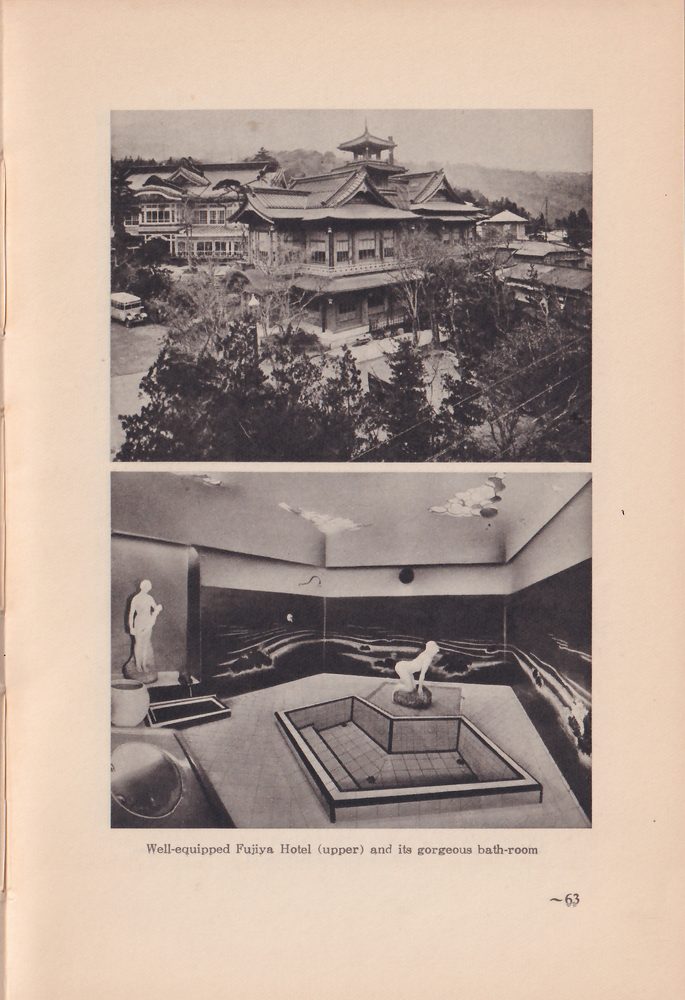
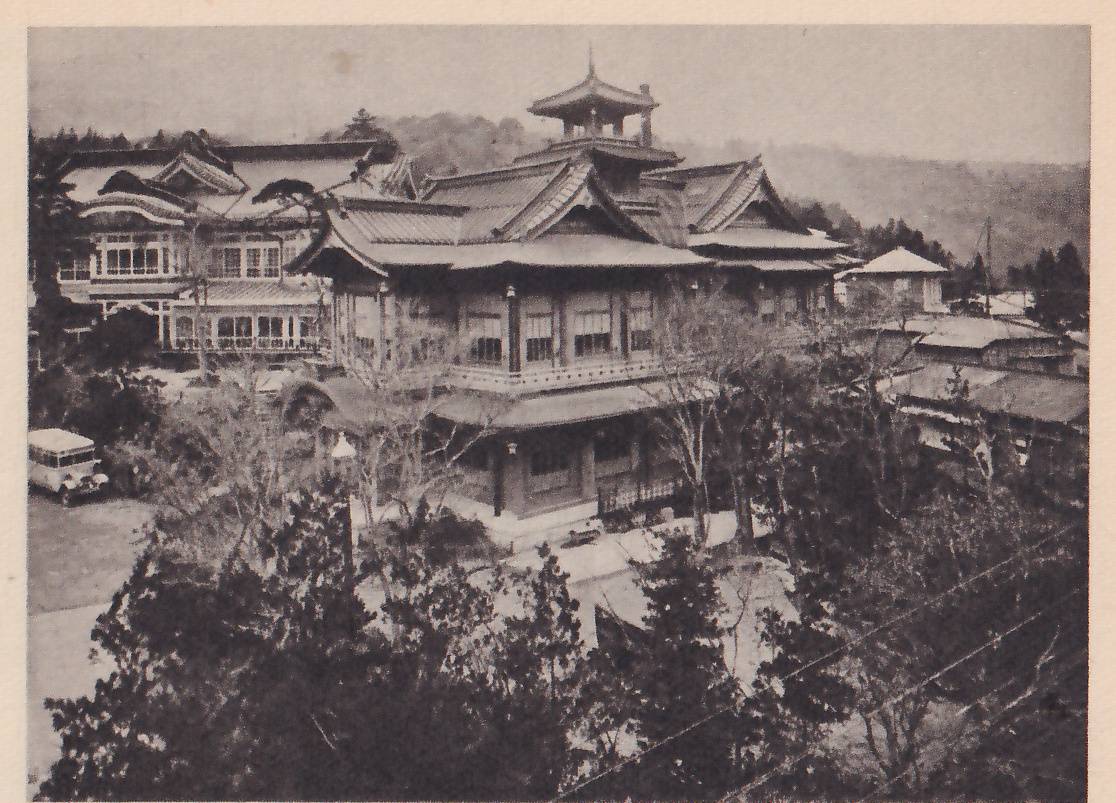
The world-famous Fujiya Hotel is at Miyanoshita, about an hour’s motor drive from Odawara Station. It is a great pity that none of the springs mentioned above are found on the shore of the lovely mountain-lake Ashinoko, otherwise called Lake Hakone. “An official Guide to Japan” or “Terry’s Guide to the Japanese Empire”—or for that matter any pamphlet on Hakone—will tell the visitor what there is to see in this place of scenic and historic interest. Suffice it to say here that the sights that are really worth seeing are Mount
Fuji, as it mirrors itself in the lake, and the view of the graceful mountain from top to foot as seen from the Nagao Pass, not very far from Miyanoshita. Another series of enchanting views is that obtainable along the driveway that connects Hakone with Atami, the Riviera of Japan, via the Jikkoku Pass.
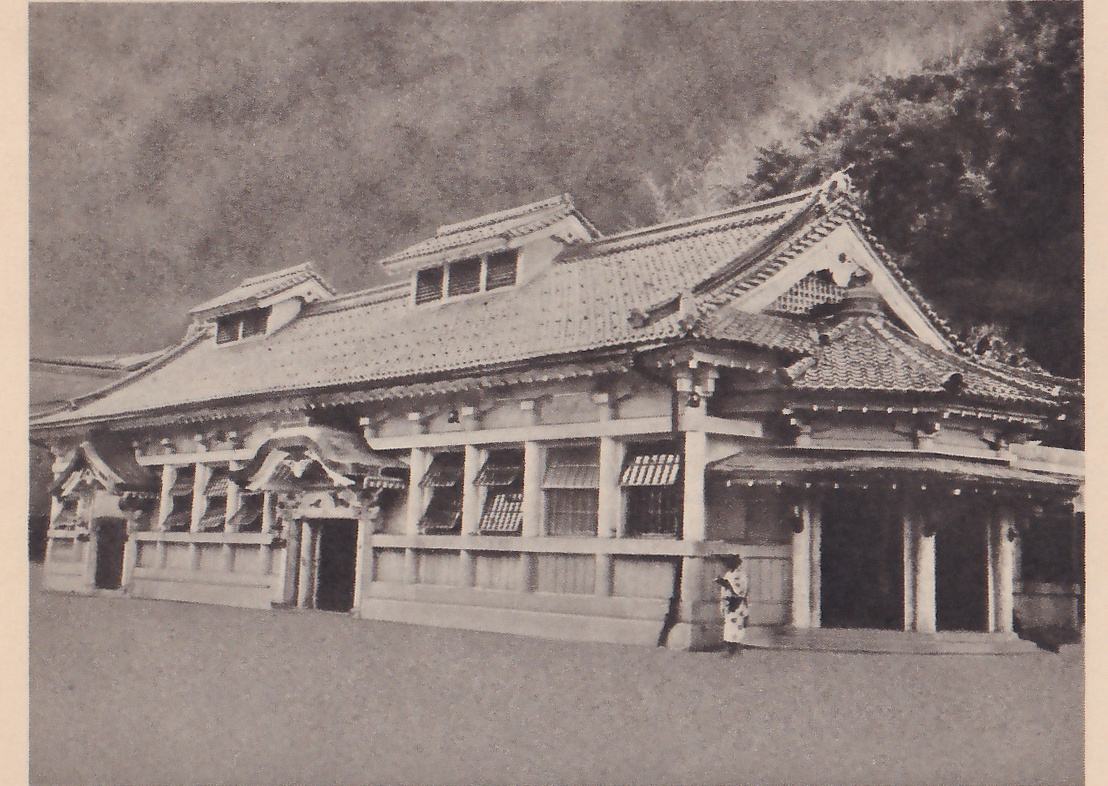
The Izu Peninsula has a wealth of hot springs, of which Atami is the most important. Since the opening to traffic in December, 1934, of that triumph of engineering, Tanna Tunnel, Atami has become one of the chief stations on the Tōkaidō Main Line,—a fact which shows clearly that this picturesque winter resort is becoming increasingly prosperous. An express train takes the visitor from Tokyo to Atami within 1.50 hours. Between Odawara and Atami Stations is another hot-spring resort called Yugawara which is also popular with Tokyo people. One of the notable features of the picturesque Izu Peninsula is that it has a network of good motor-roads. About one hour’s motor drive from Atami along the eastern shore takes one to Itō Spa. Some four miles and a half south of Itō, are the Kawana Golf Links, accessible in about 20 minutes by motor-car. It is one of the largest golf courses in Japan. Here an A1Printed: AI tourist hotel is now being built. Between Itō and the southern extremity of the peninsula are several springs such as Atagawa, Yatsu, Mine, Yugano, Kōchi, Rendaiji, and Shimogamo. The western shore is likewise beautiful, and blessed with hot springs. The more important are Toi, Funabara, Yoshina, Yugashima, Nagaoka, and Shuzenji, of which the last-named resort is the best known, for one of the baths there is built
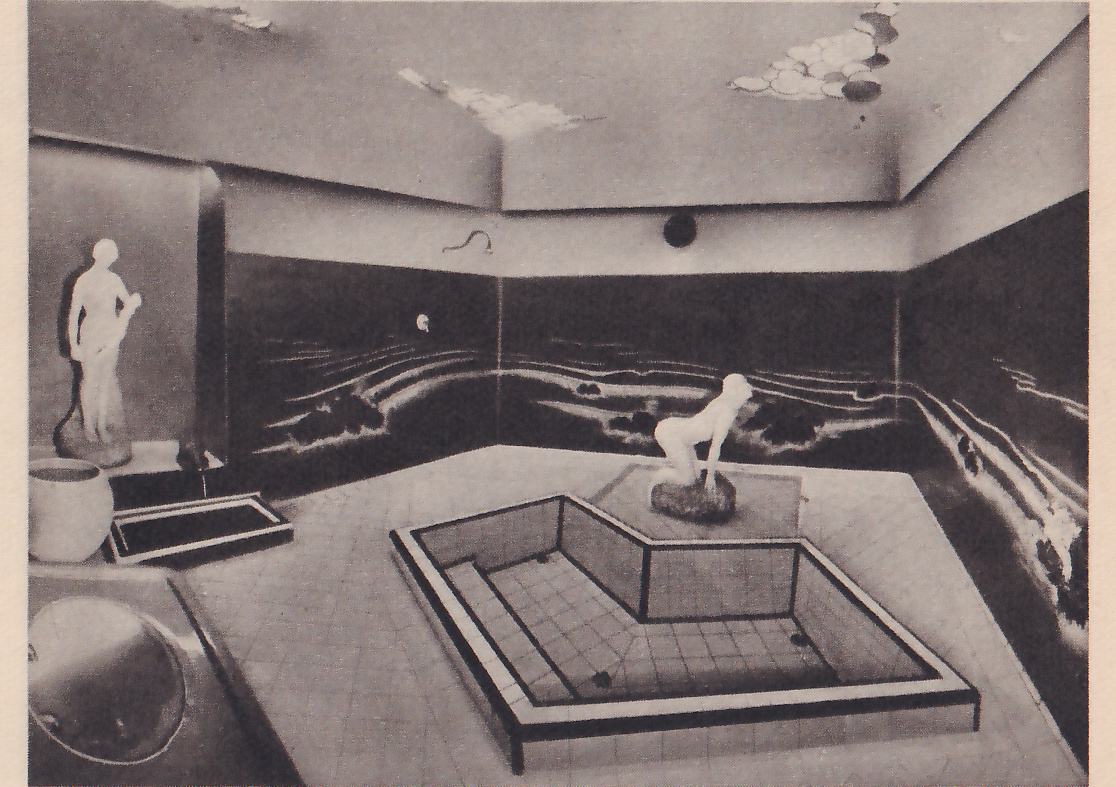
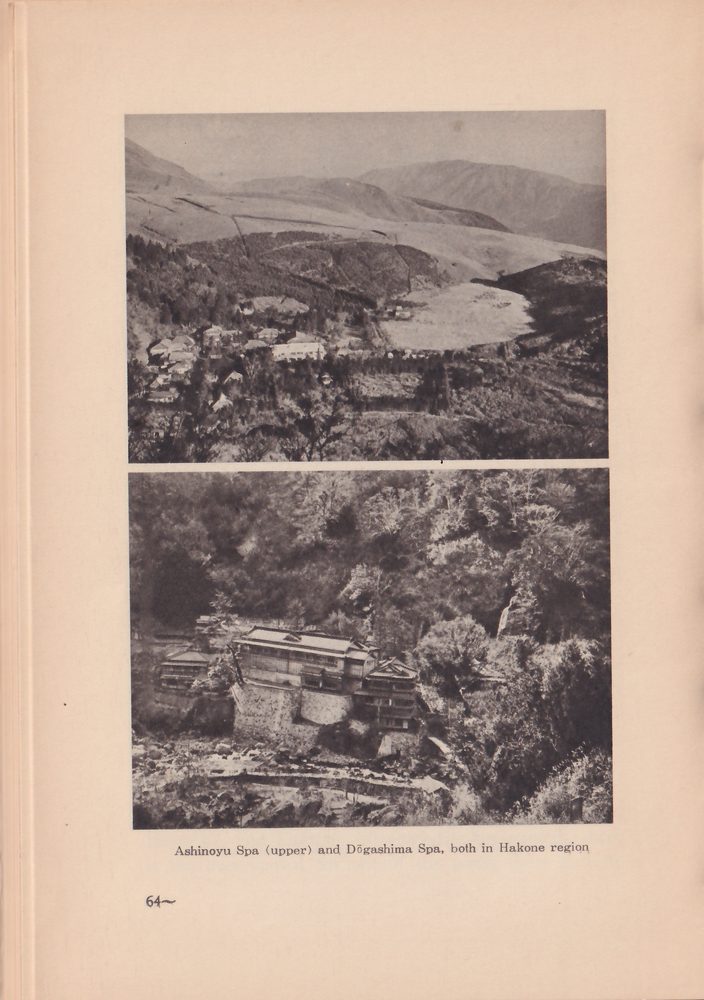
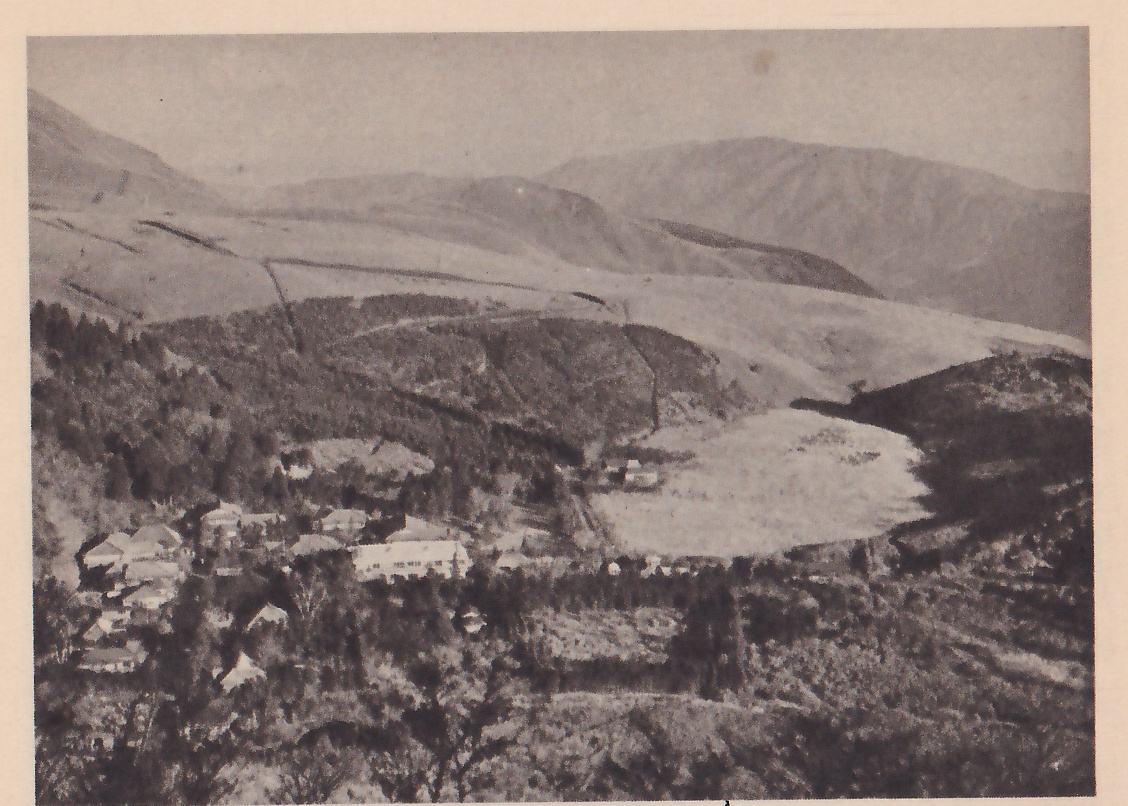
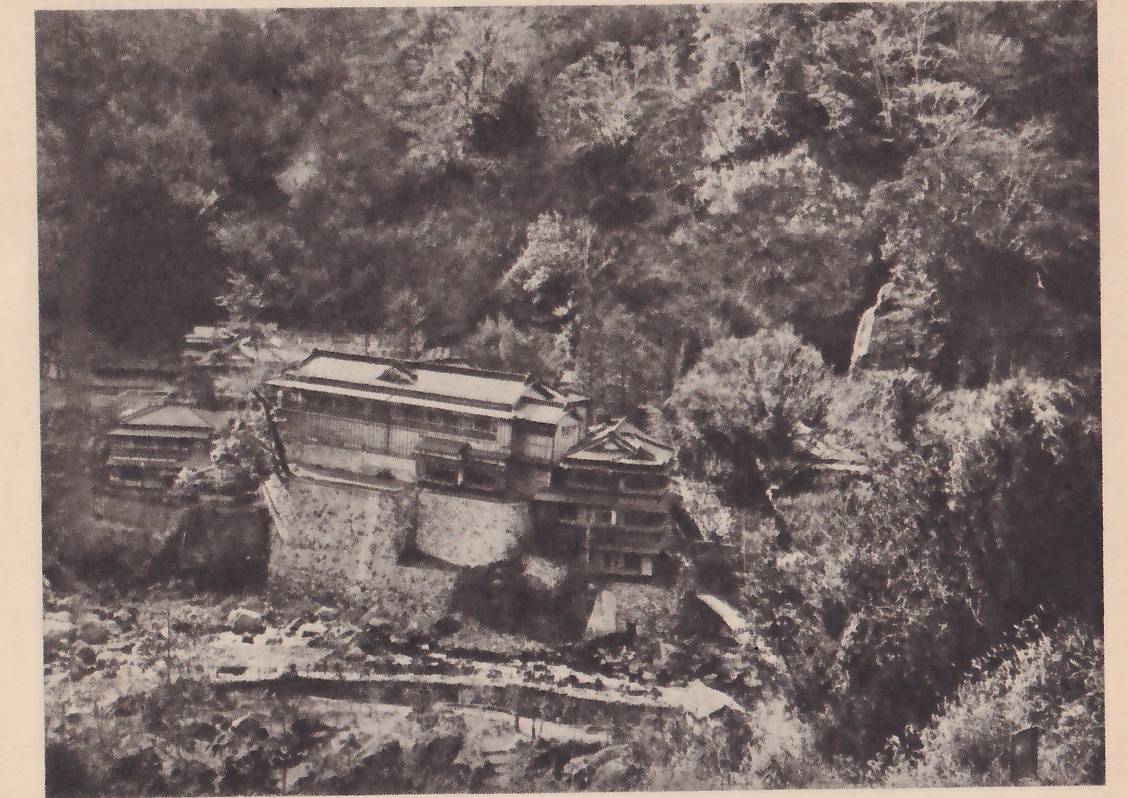
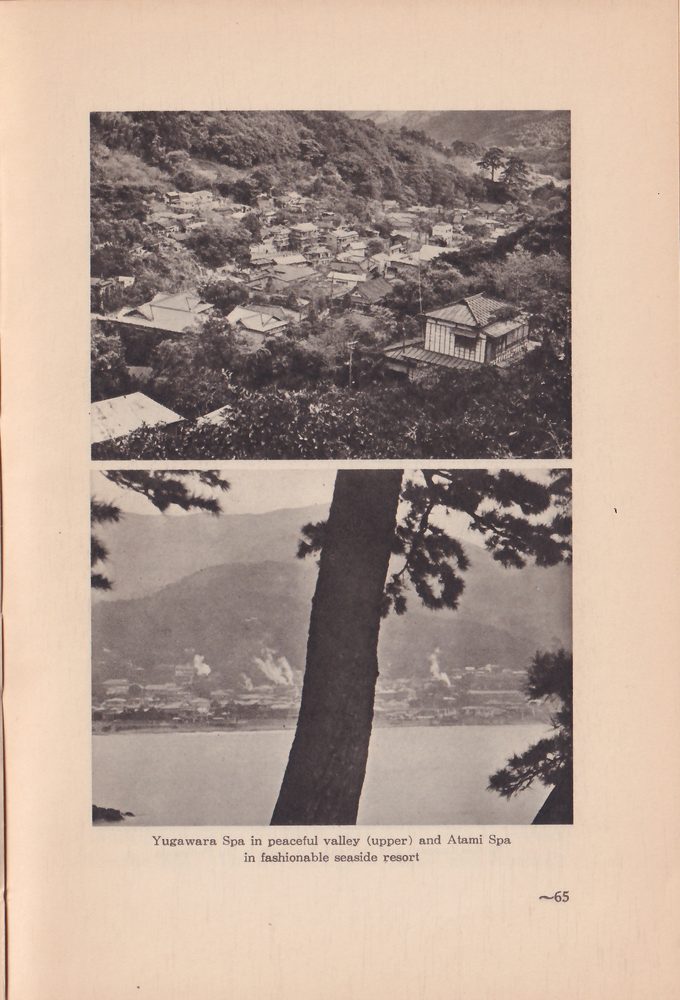
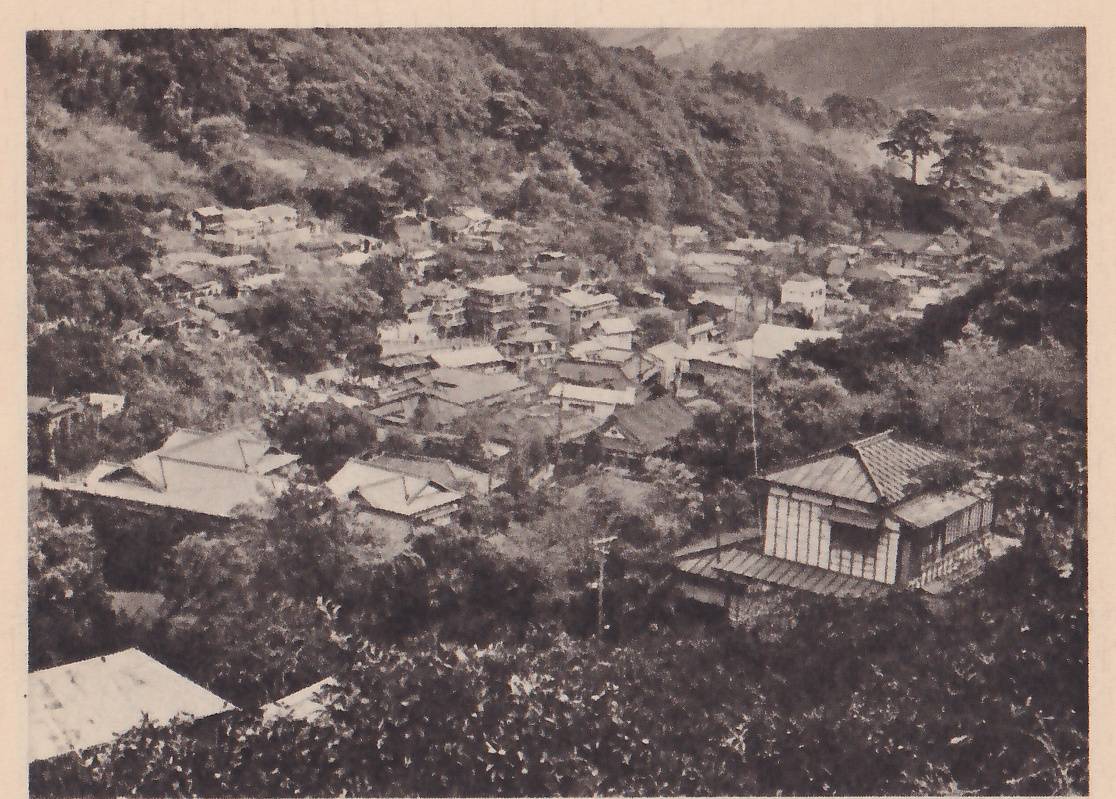
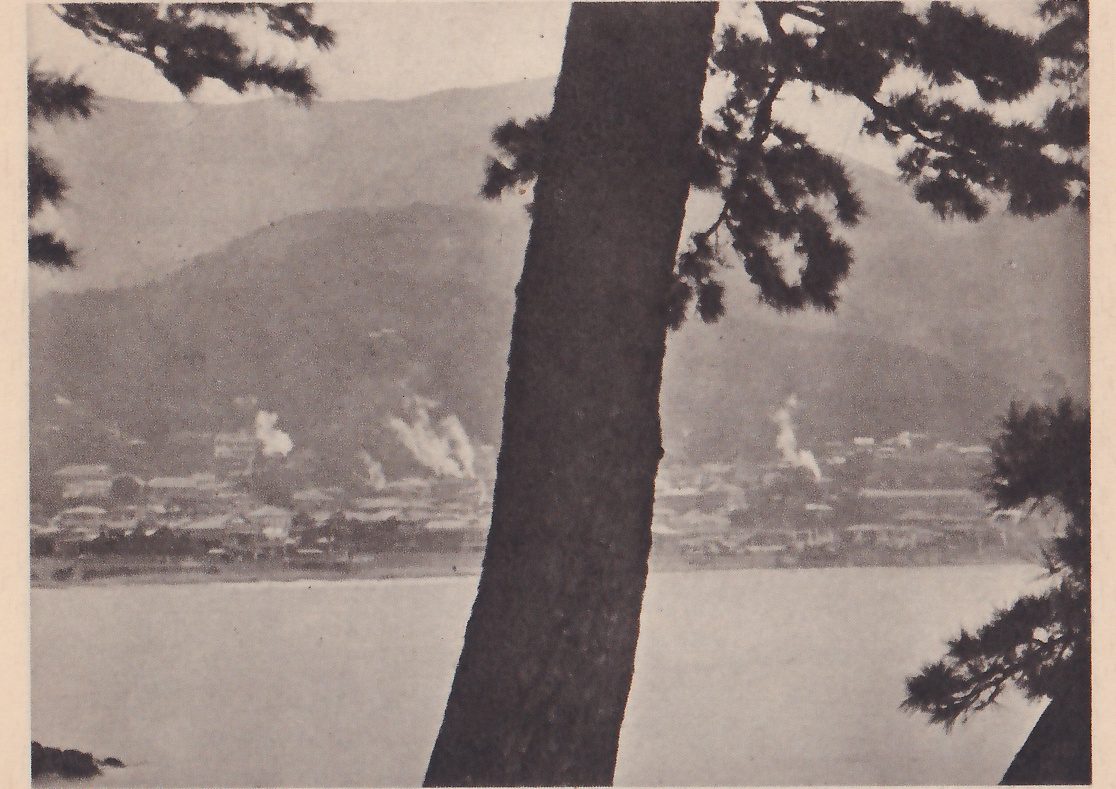
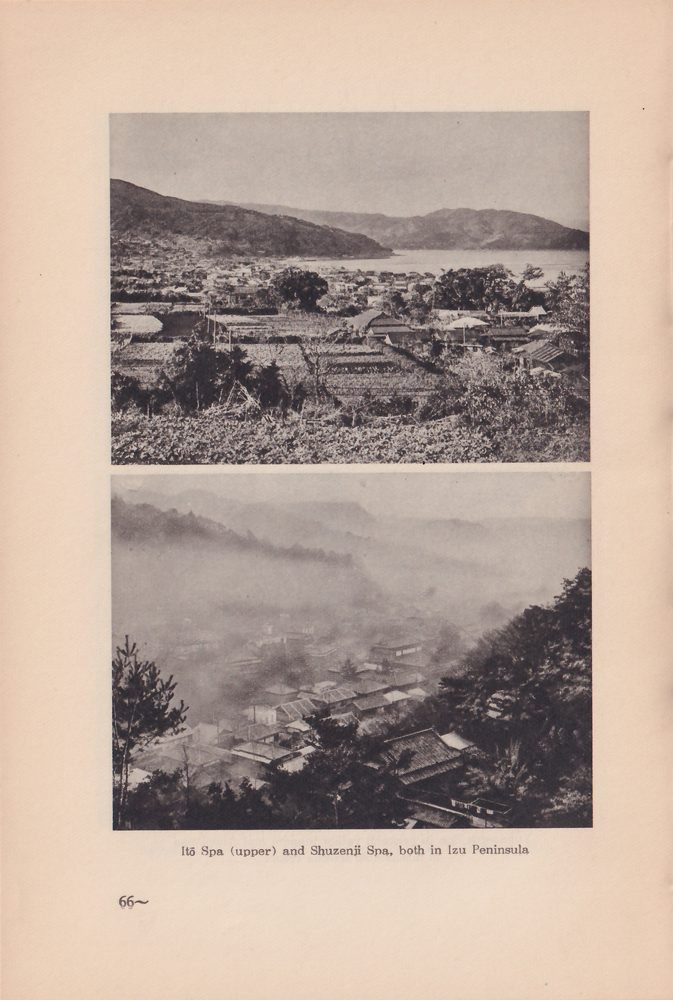
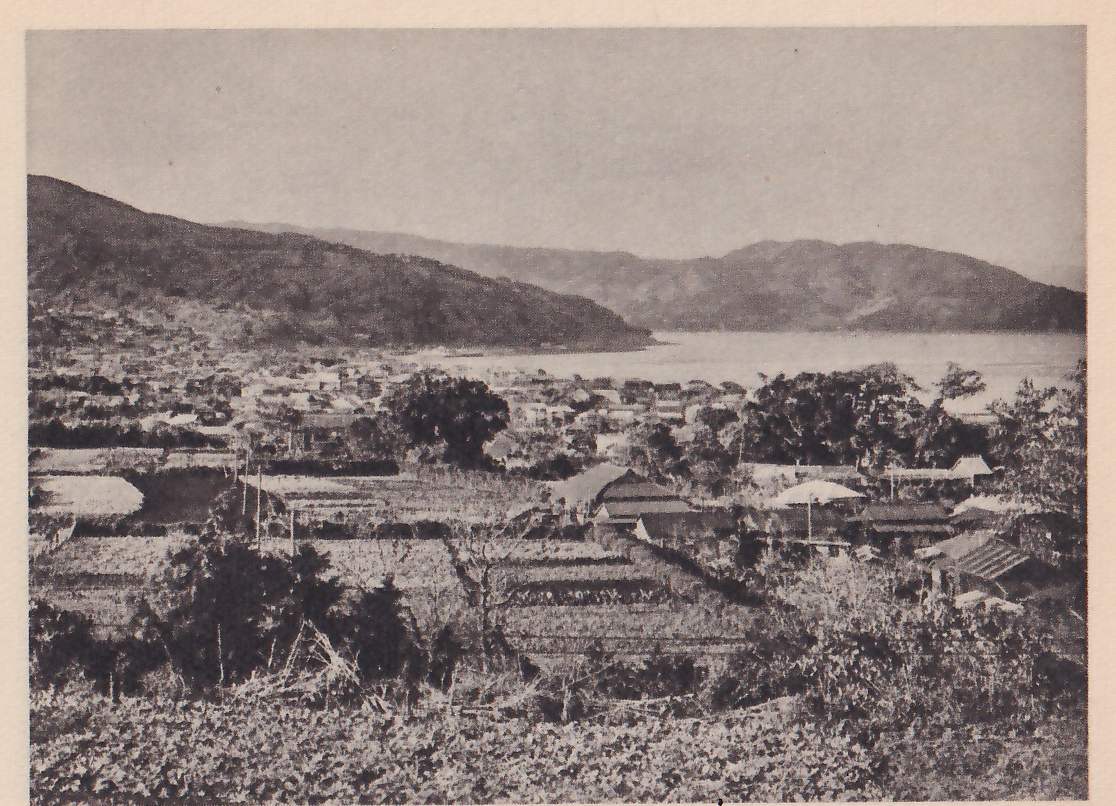
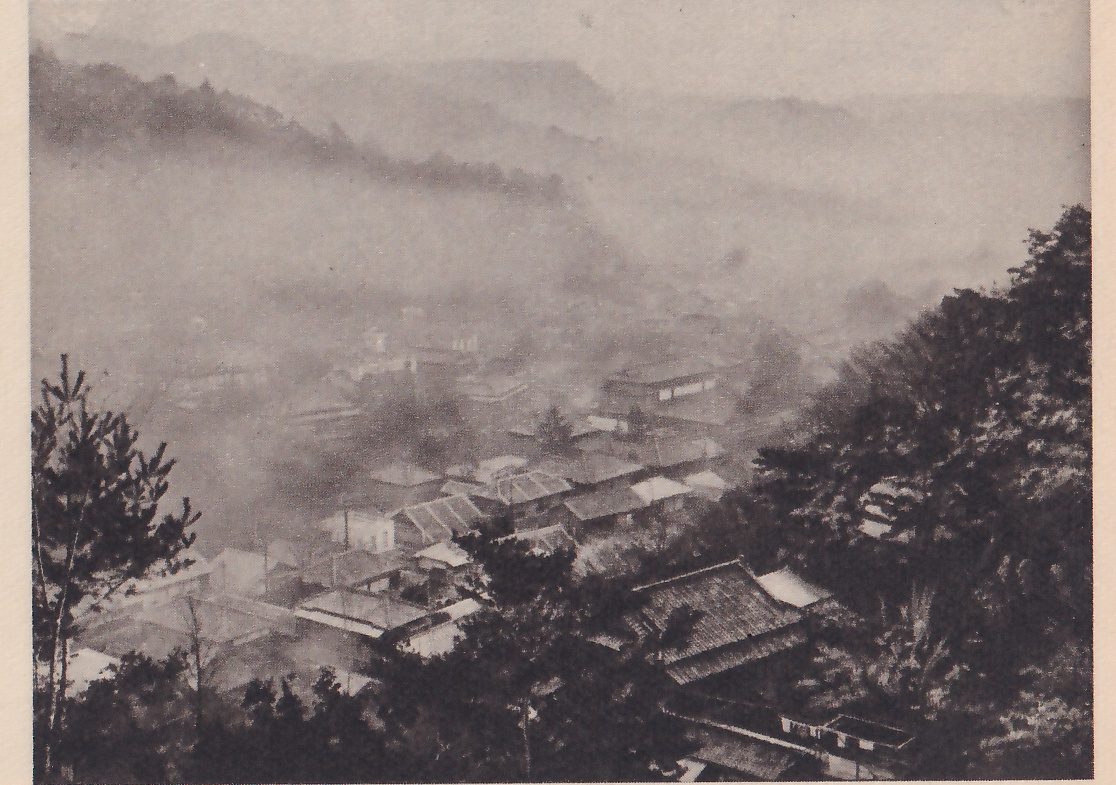
in the style of architecture that prevailed in the Era of Tempyō (729–748). If a drive along the western shore is rewarded with a fine view of Mt. Fuji, that along the eastern shore enables the traveller constantly to feast his eyes upon the volcano of Mihara on Ōshima Island which seems to float on the bosom of the sea. Both drives give him beautiful seascapes, as well as the thrilling experience of skirting edges of exceedingly high cliffs.
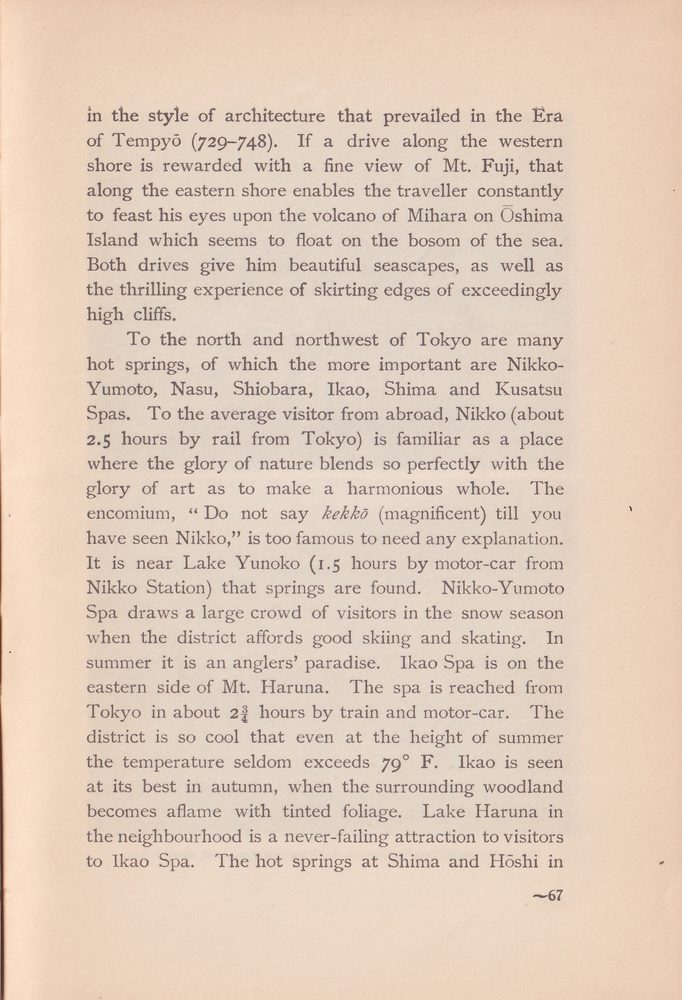
To the north and northwest of Tokyo are many hot springs, of which the more important are Nikko-Yumoto, Nasu, Shiobara, Ikao, Shima and Kusatsu Spas. To the average visitor from abroad, Nikko (about 2.5 hours by rail from Tokyo) is familiar as a place where the glory of nature blends so perfectly with the glory of art as to make a harmonious whole. The encomium, “Do not say kekkō (magnificent) till you have seen Nikko,” is too famous to need any explanation. It is near Lake Yunoko (1.5 hours by motor-car from Nikko Station) that springs are found. Nikko-Yumoto Spa draws a large crowd of visitors in the snow season when the district affords good skiing and skating. In summer it is an anglers’ paradise. Ikao Spa is on the eastern side of Mt. Haruna. The spa is reached from Tokyo in about 2¾ hours by train and motor-car. The district is so cool that even at the height of summer the temperature seldom exceeds 79° F. Ikao is seen at its best in autumn, when the surrounding woodland becomes aflame with tinted foliage. Lake Haruna in the neighbourhood is a never-failing attraction to visitors to Ikao Spa. The hot springs at Shima and Hōshi in
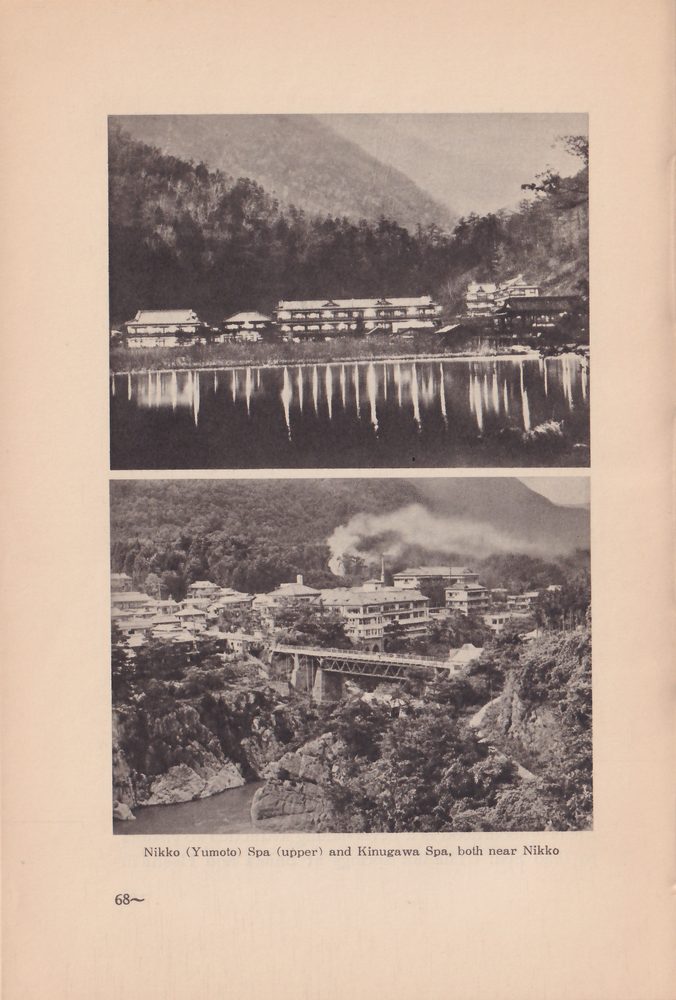
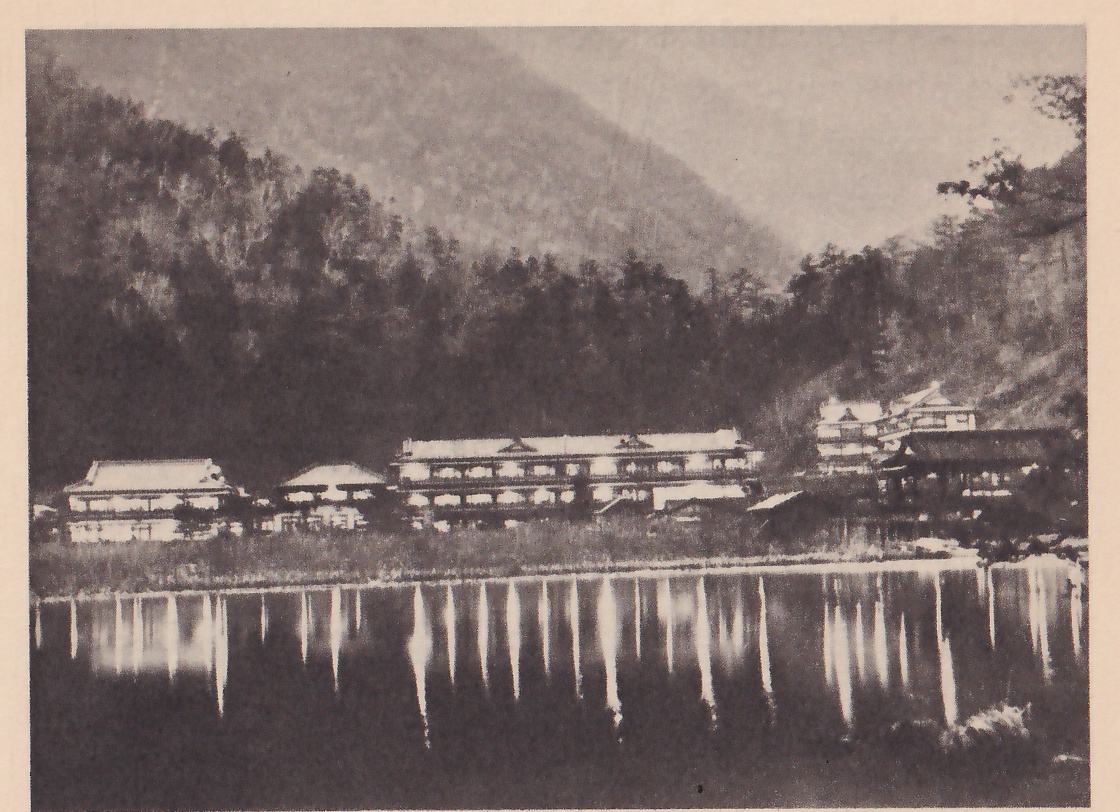
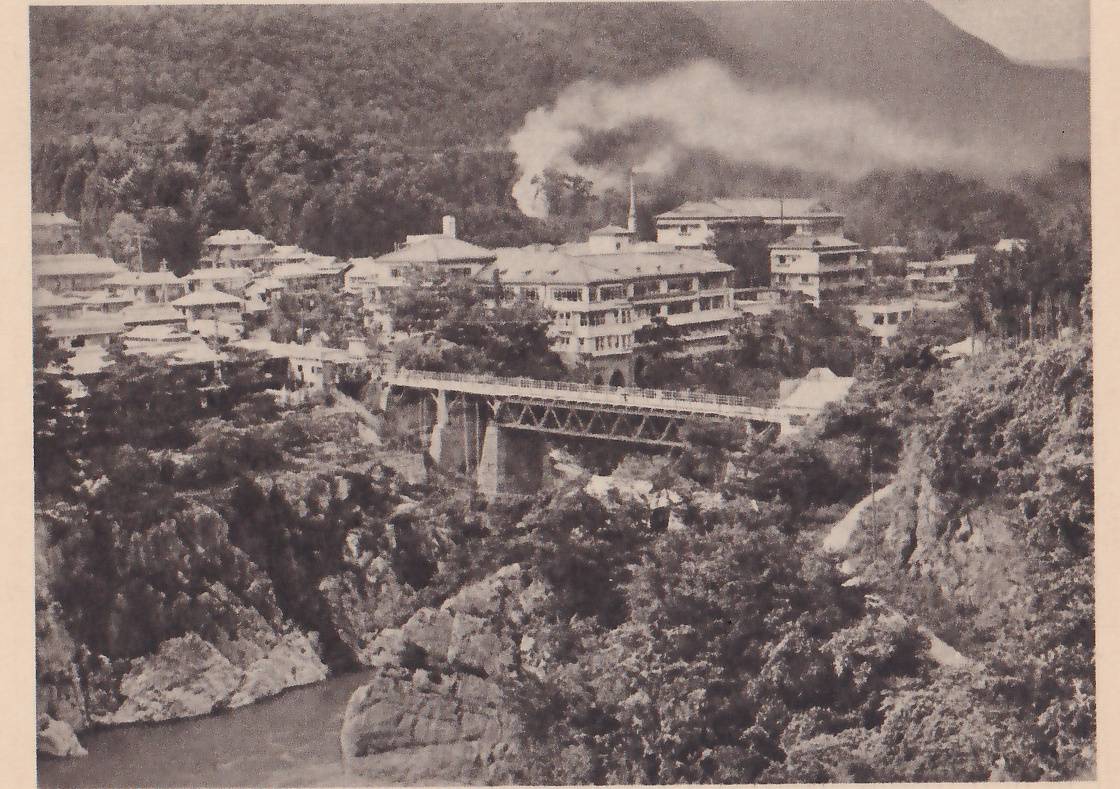
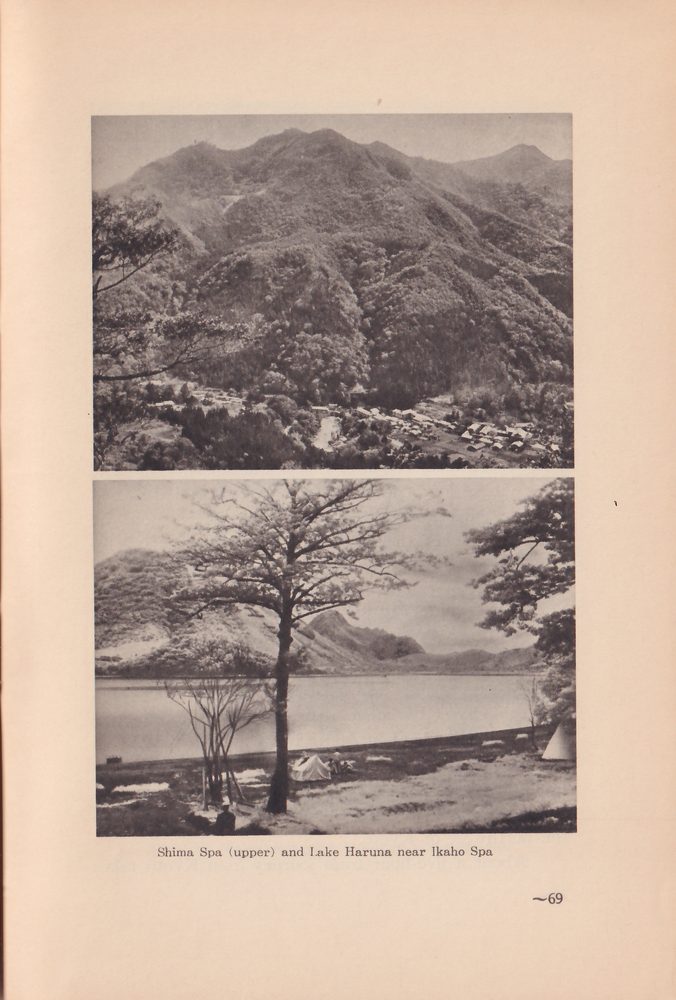
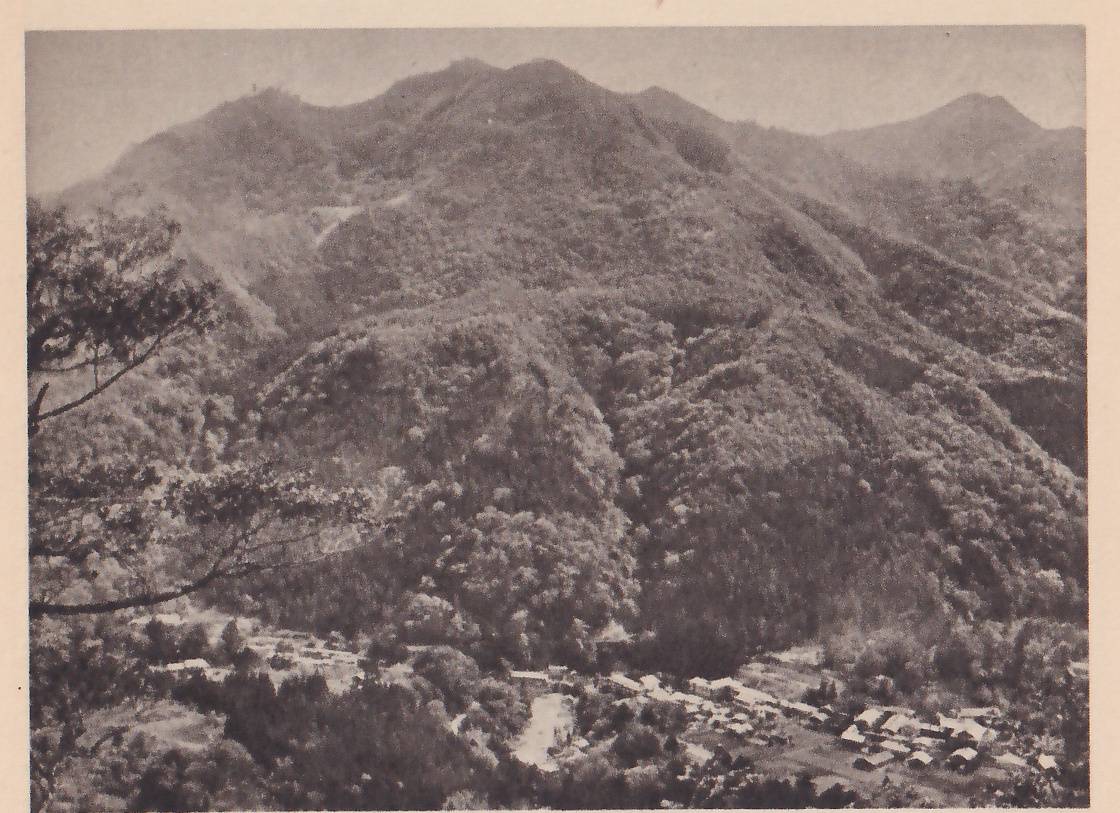
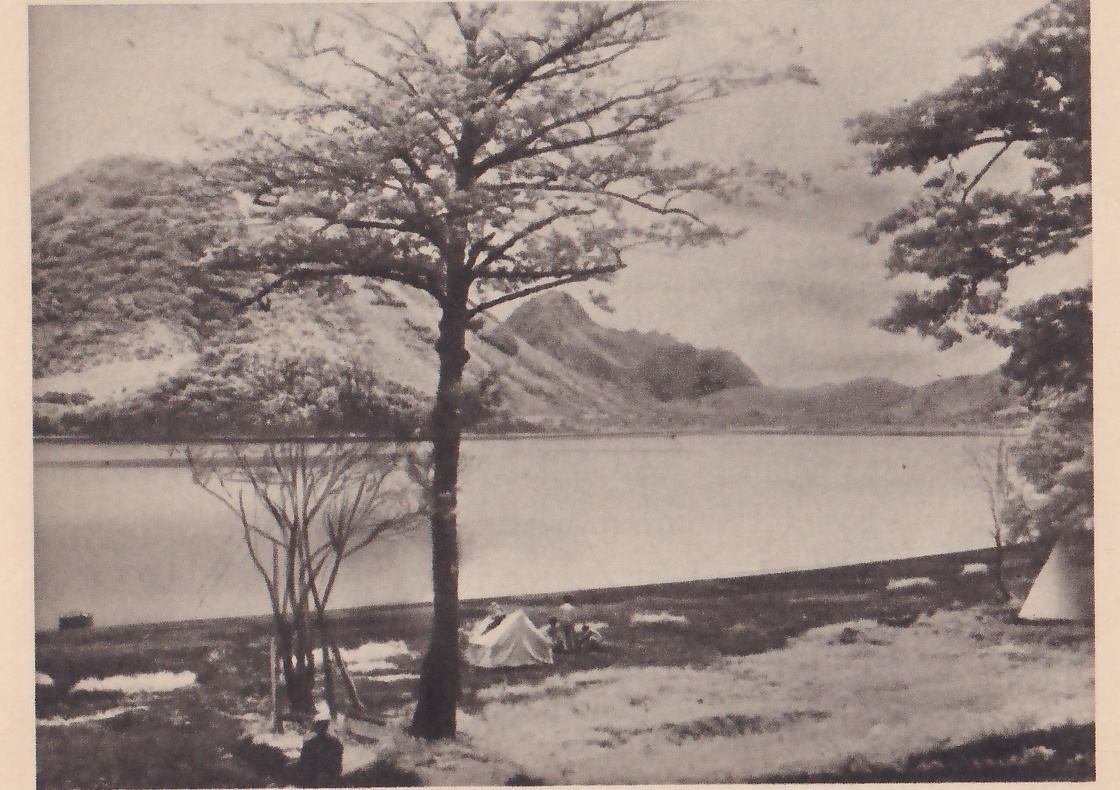
this region are excellent summer resorts, in both places 79° F. being about the highest midsummer temperature. Of Kusatsu Spa much has already been said in the preceding chapter. It is reached in about three hours by tram or about two hours by bus from Karuizawa, the well-known summer resort. Its title to fame rests on the “time-baths.” Shiobara Spa is off the Tōhoku Main Line, and is accessible from Tokyo in about three hours. Shiobara is the collective name of 11 springs that cluster there. Charming valley scenery and autumn tints are a remarkable feature of this spa. Nasu is situated a little to the north of Shiobara. Like Shiobara, it has a group of sulphur springs, such as Yumoto, Benten, Daimaru, Sandogoya, Takaomata, Kitayu, Yawata, Itamuro, Iimori; Shin-nasu, etc. The most interesting of local sights is what is called sesshō-seki, or “death-stone,” of traditional interest on the upper course of the Yugawa stream. Nasu is also noted for its time-baths.
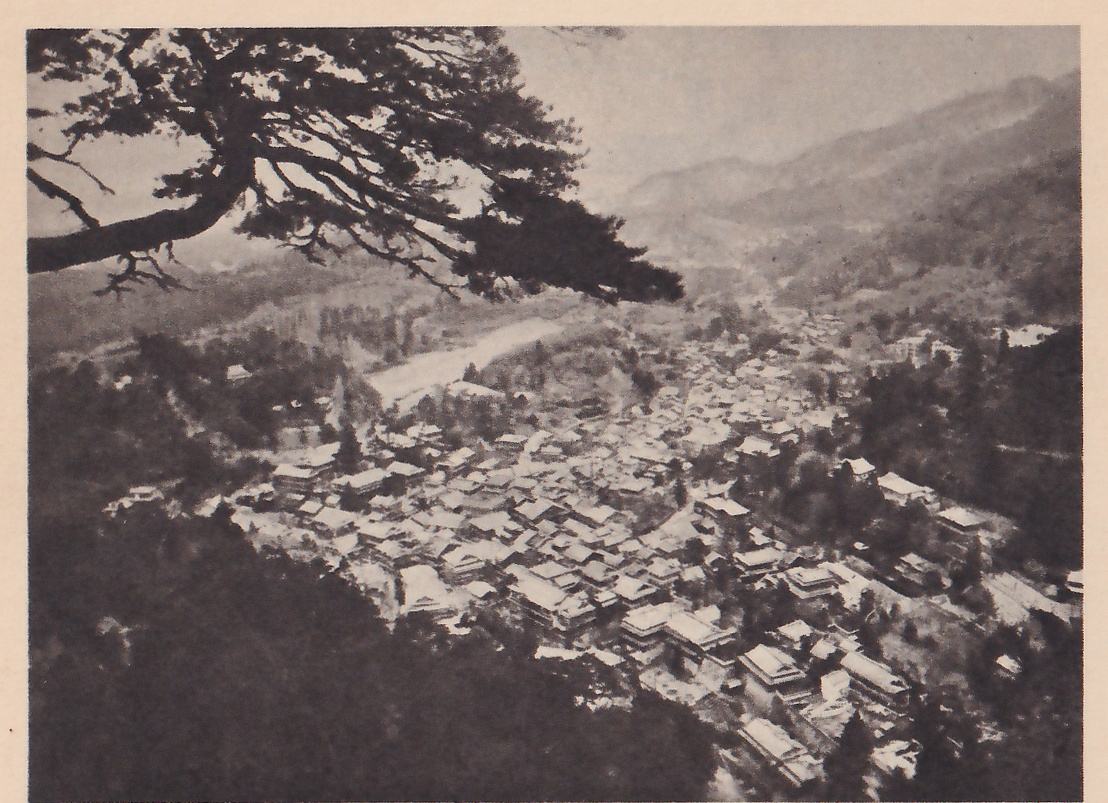
The Osaka and Kobe districts are not so rich in hot springs as the Tokyo region, although the classic cities of Kyoto and Nara lie quite near with all their attractions of international appeal. Perhaps the hot-spring resort nearest to Osaka and Kobe is Arima Spa, accessible by motor-car in about one hour and a quarter from Kobe and about one hour and a half from Osaka. The development of transport facilities has brought nearer to Osaka and Kobe the several hot-spring resorts in the Kii Peninsula and those lying to the northwest of Kyoto.
About a five-hour train journey from Kyoto takes
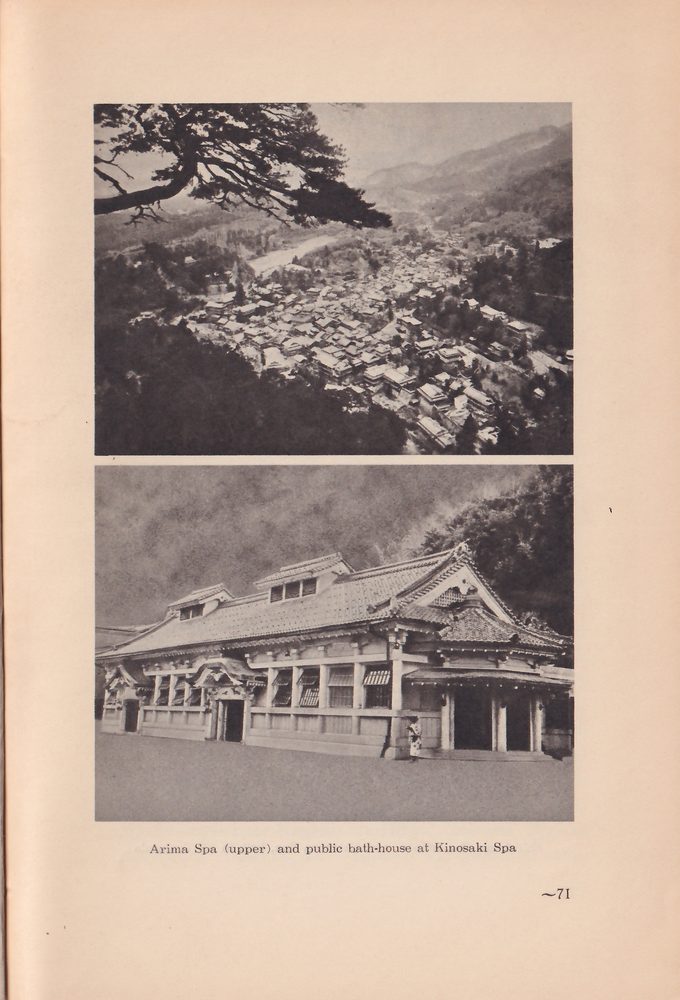
one to the hot springs at Kinosaki. From olden days it has been customary for Kyoto people to patronize this resort which has weak alkaline salt springs. The place nestles in charming surroundings. Higashiyama hill, east of the town, commands an extensive view over the Sea of Japan. Among local attractions are the Onsen-ji Temple of historic interest and the basalt grottoes (Genbudō).
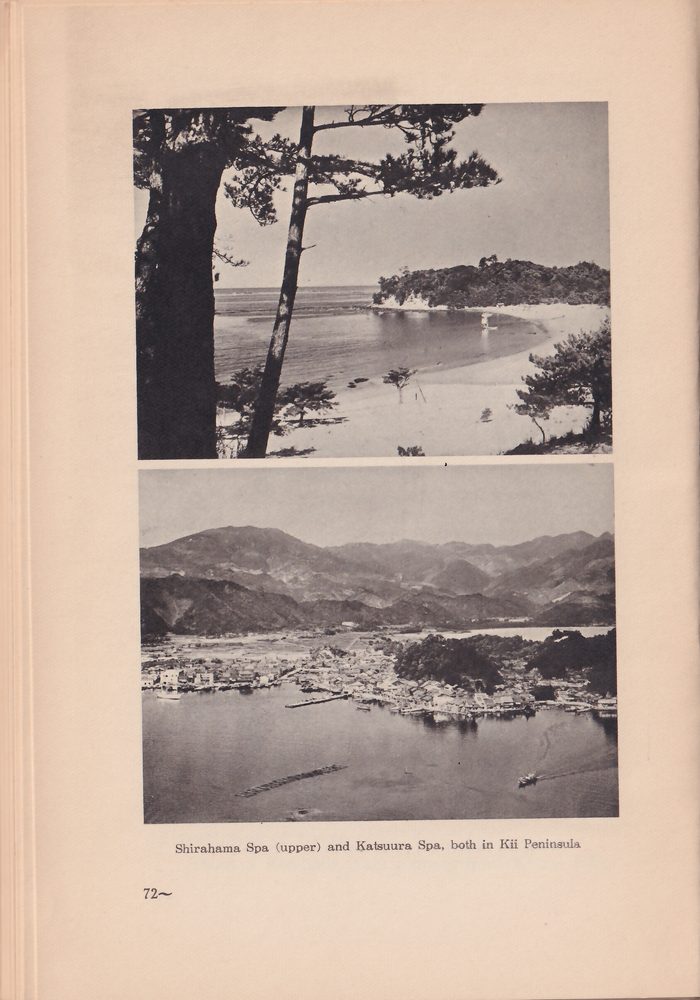
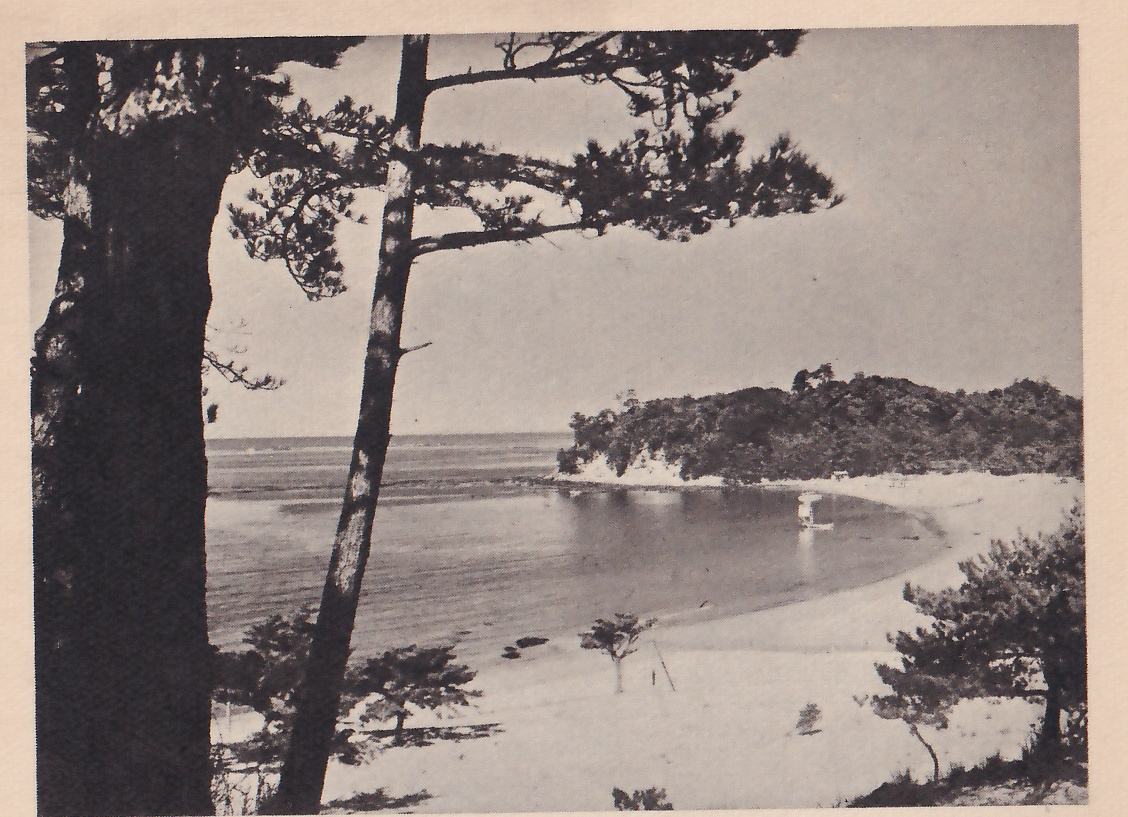
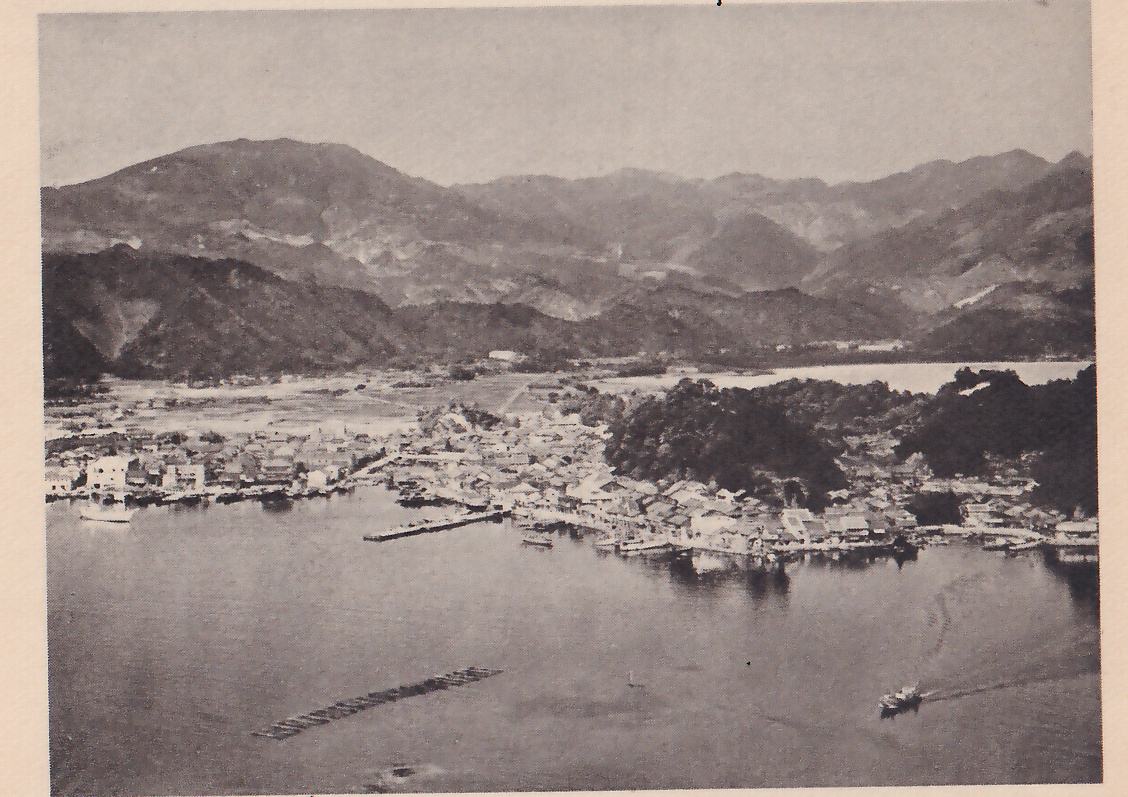
To the south of Osaka are the springs of Yunomine, Yukawa, Shirahama, Katsuura and Ryūjin. Of these, Shirahama, Yusaki and Katsuura Spas are seaside resorts and are naturally popular in summer. They are also fine winter resorts, because the Kii region, like the Izu Peninsula, is free from the rigours of the cold season.
The most important city lying northeast of Tokyo is Sendai, which is familiar to foreign visitors, because it is close to the famous Matsushima, one of Japan’s scenic trio, and Takayama, an ideal summer resort. Within easy reach of Sendai are several hot springs, of which the most popular is perhaps Aone Spa. It has a fine prospect over the plains of Sendai and the picturesque cluster of pine-clad islets in the Bay of Matsushima. Another popular spa near Sendai is Narugo, accessible by train in about two hours. About five miles north of Narugo Spa is the Onikōbe geyser.
In a previous chapter it was mentioned that no prefecture has more hot-spring resorts than Nagano Prefecture, of which Nagano is the main city. Nagano is reached in about 5 hours by train from Tokyo. The principal spas near Nagano are Hirao, Nozawa, Myōkō, Ikenodaira, Akakura, etc. Hirao is the collective name
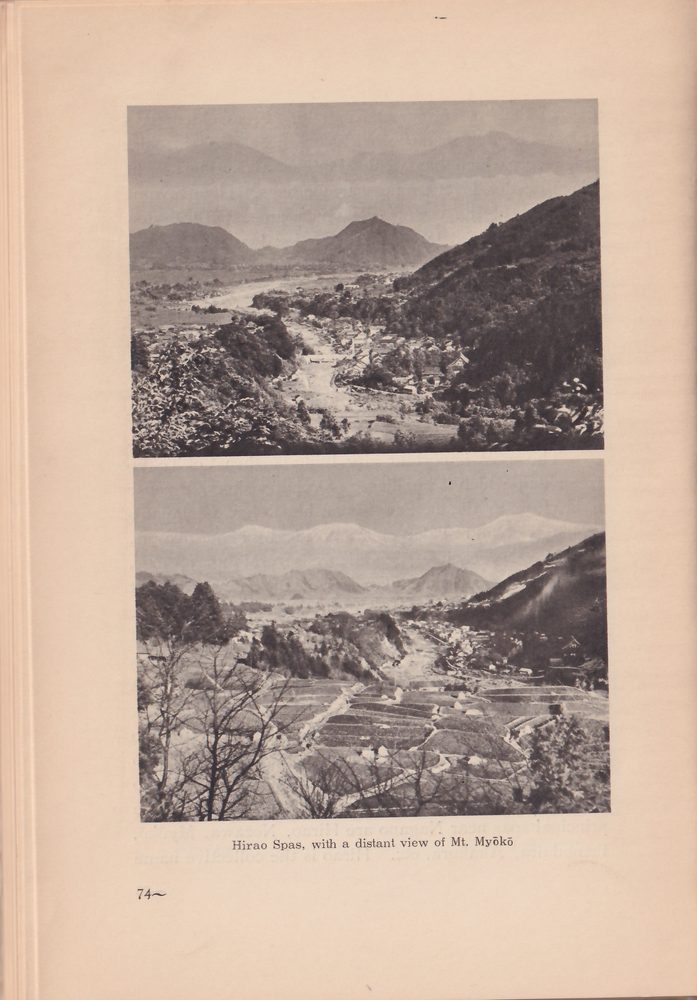
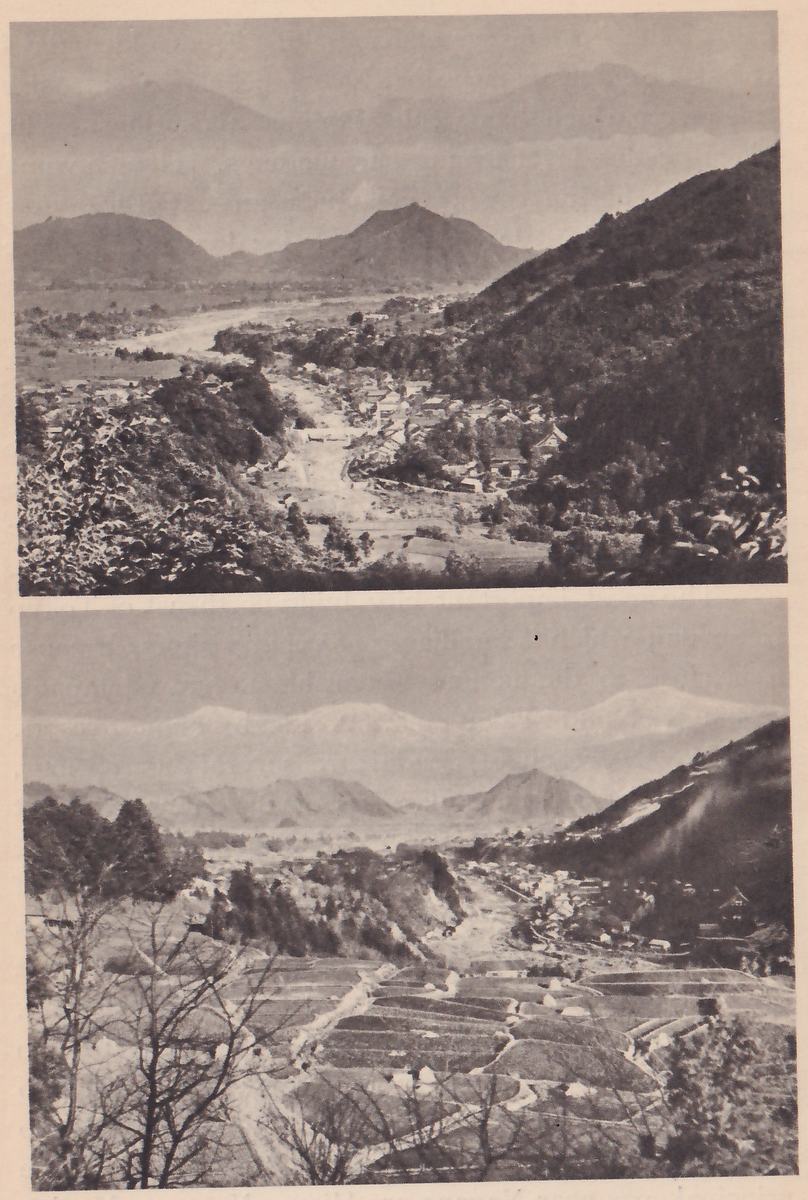
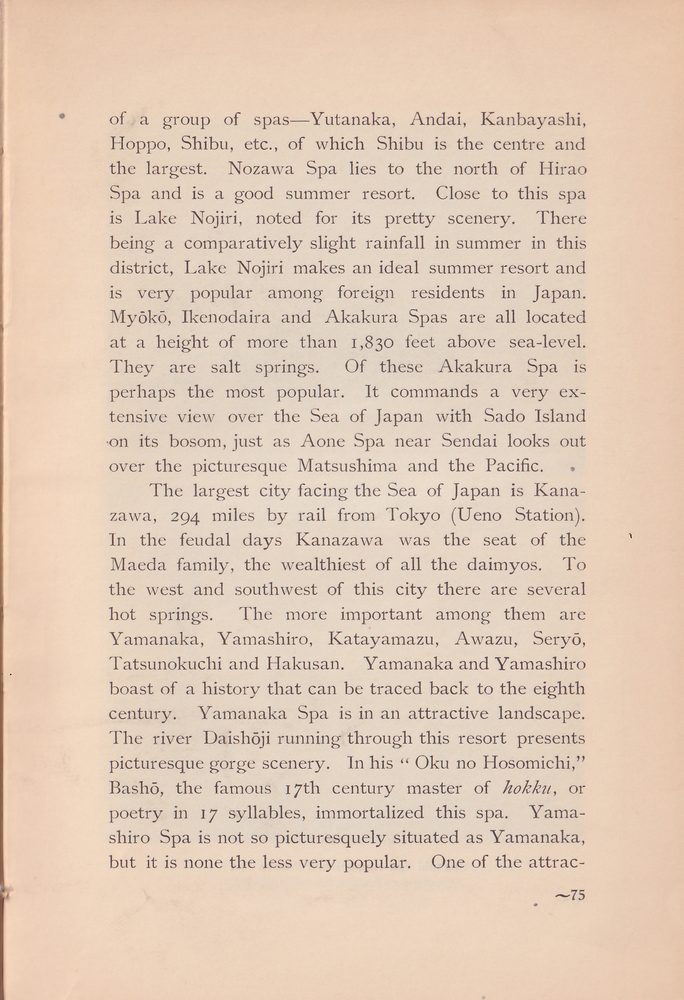
of a group of spas—Yutanaka, Andai, Kanbayashi, Hoppo, Shibu, etc., of which Shibu is the centre and the largest. Nozawa Spa lies to the north of Hirao Spa and is a good summer resort. Close to this spa is Lake Nojiri, noted for its pretty scenery. There being a comparatively slight rainfall in summer in this district, Lake Nojiri makes an ideal summer resort and is very popular among foreign residents in Japan. Myōkō, Ikenodaira and Akakura Spas are all located at a height of more than 1,830 feet above sea-level. They are salt springs. Of these Akakura Spa is perhaps the most popular. It commands a very extensive view over the Sea of Japan with Sado Island on its bosom, just as Aone Spa near Sendai looks out over the picturesque Matsushima and the Pacific.
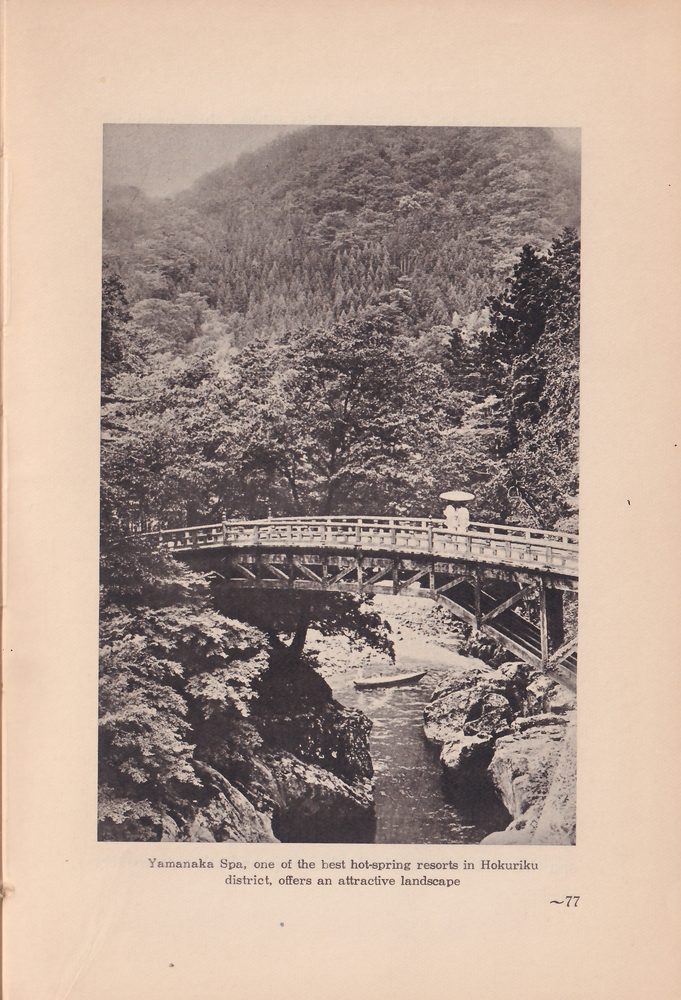
The largest city facing the Sea of Japan is Kanazawa, 294 miles by rail from Tokyo (Ueno Station). In the feudal days Kanazawa was the seat of the Maeda family, the wealthiest of all the daimyos. To the west and southwest of this city there are several hot springs. The more important among them are Yamanaka, Yamashiro, Katayamazu, Awazu, Seryō, Tatsunokuchi and Hakusan. Yamanaka and Yamashiro boast of a history that can be traced back to the eighth century. Yamanaka Spa is in an attractive landscape. The river Daishōji running through this resort presents picturesque gorge scenery. In his “Oku no Hosomichi,” Bashō, the famous 17th century master of hokku, or poetry in 17 syllables, immortalized this spa. Yamashiro Spa is not so picturesquely situated as Yamanaka, but it is none the less very popular. One of the attrac-
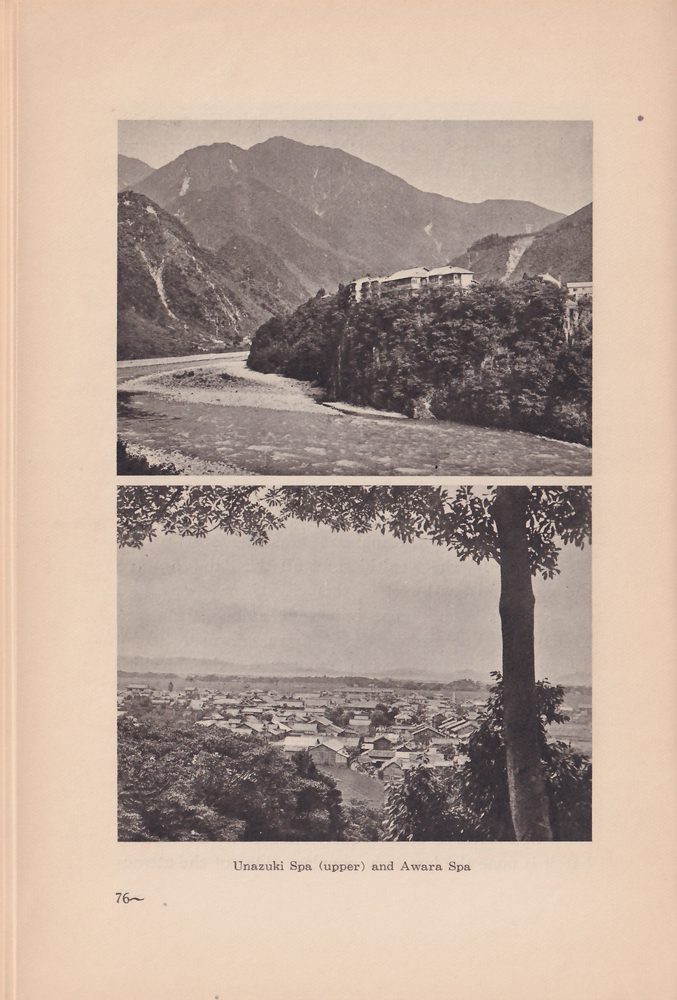
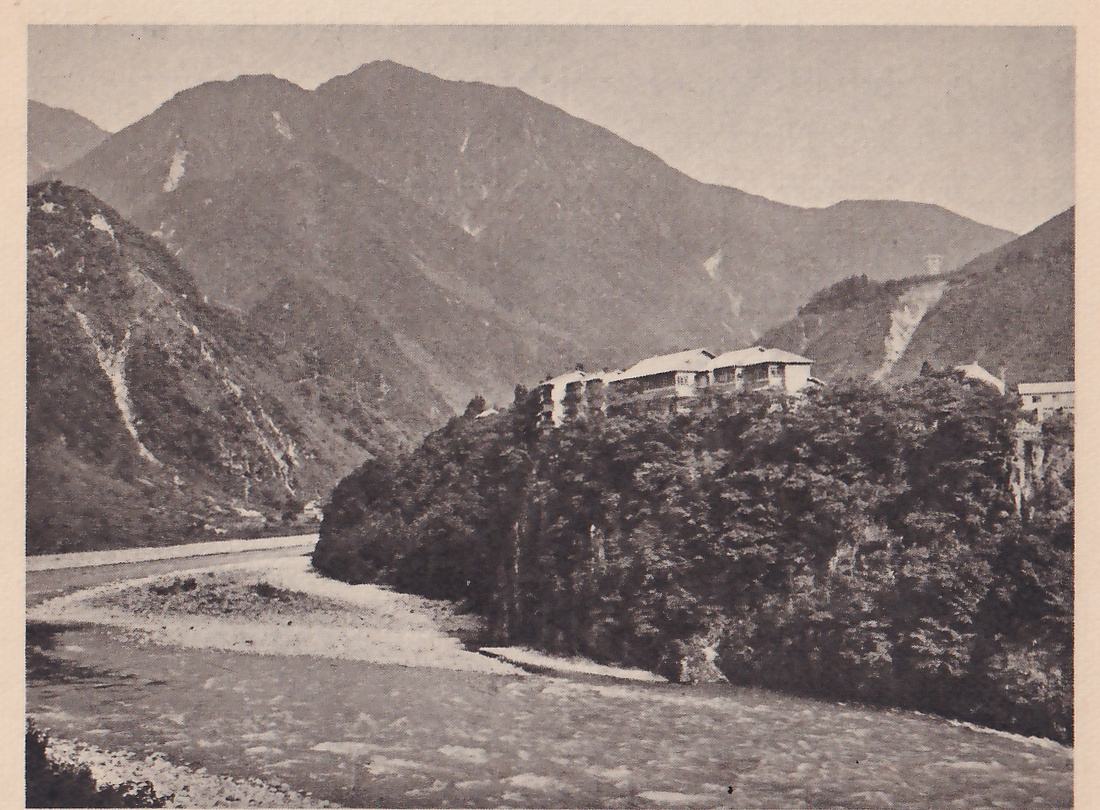
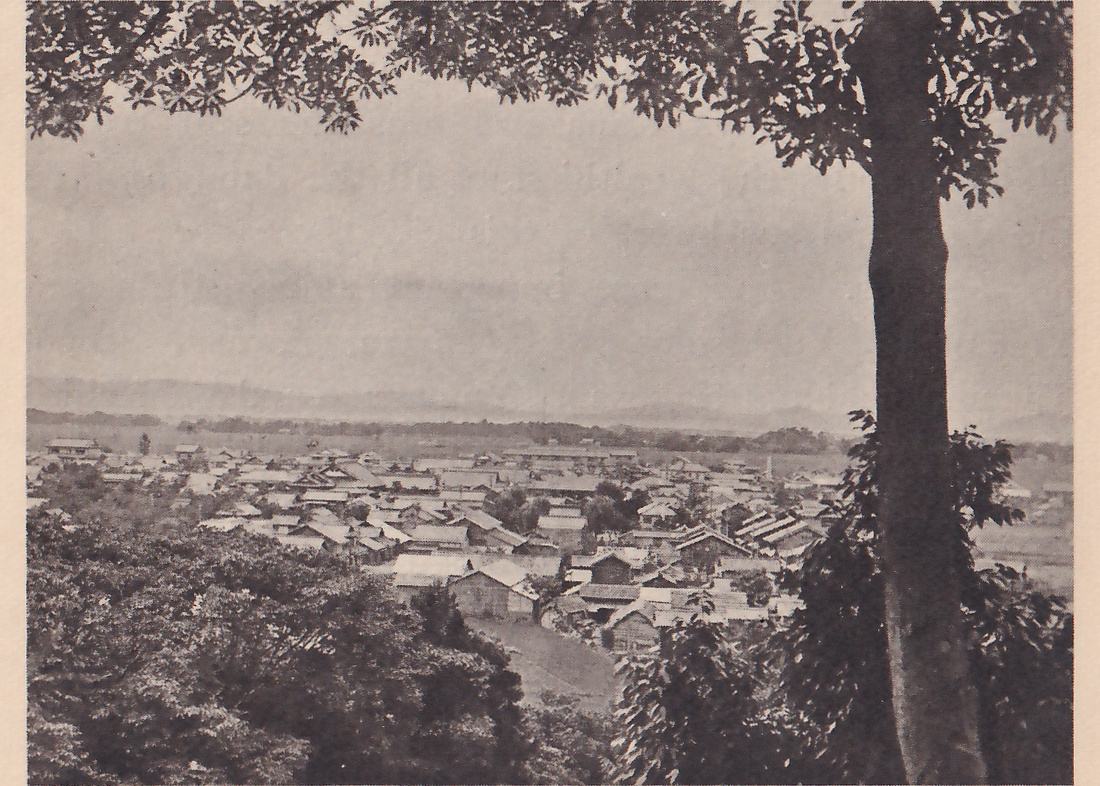
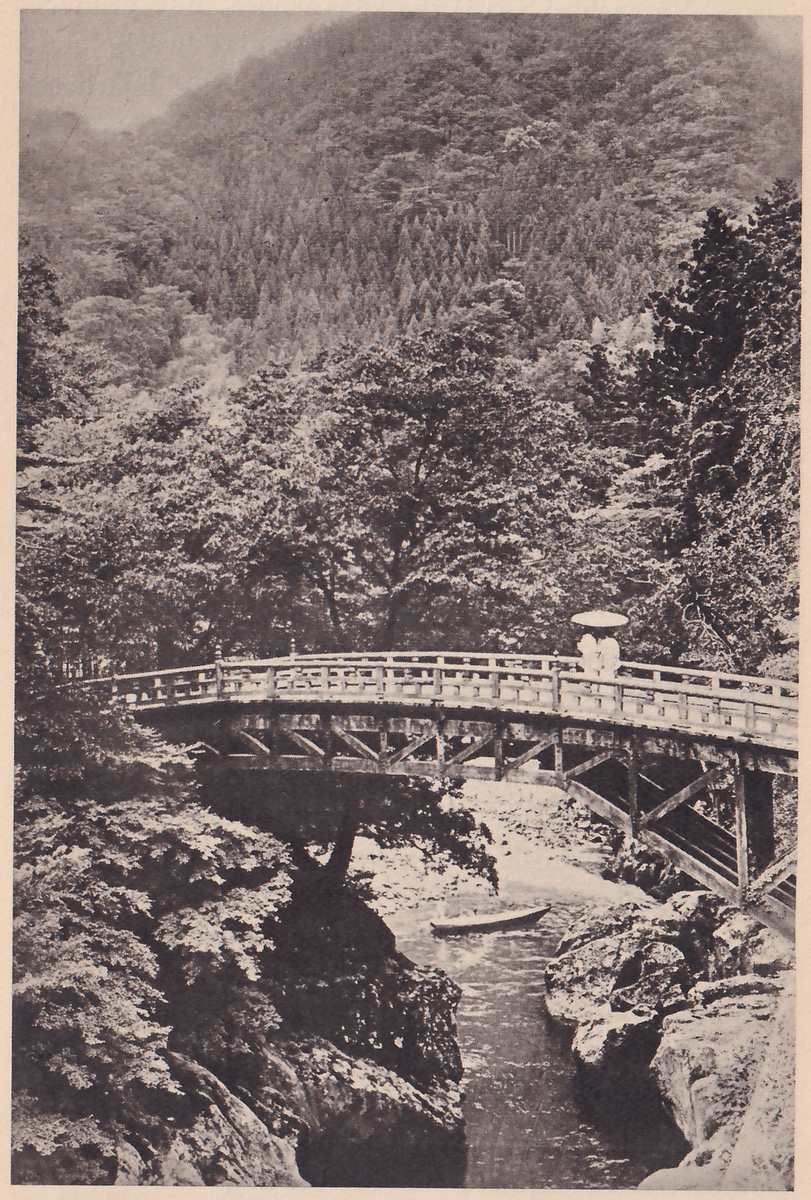
tions of Yamashiro Spa is the kilns where they produce Kutani ware, which, together with inlay work, constitutes a Kanazawa specialty. In the neighbourhood are Buddhist temples well worth visiting. Katayamazu Spa is on the shore of Shibayamagata, a lake about 10 miles round. The lake affords good bathing and boating. Inns with hot spring baths are built along the lake shore. Awazu is a sulphur spring. All these hot-spring resorts are conveniently connected by an electric railway line.
Another group of spas is to be found at the foot of soaring Mt. Hakusan some 20 miles south of Kanazawa. With a height of 8865 feet, this mountain has been regarded from of old as one of the three popular, sacrosanct peaks in Japan, the other twoPrinted: other ,two being Mt. Fuji and Mt. Tateyama. The chief among these spas are Chūgū, Hakusan, and Iwama. Hakusan Spa is at an altitude of 3976 feet and makes a good headquarters for climbers of Mt. Hakusan. Naturally, all these resorts present a lively scene in the hot season.
As important cities lying away to the northwest of Osaka, Tottori and Matsue may be mentioned. Matsue is of Lafcadio Hearn fame. Tottori is reached by rail in about 5 hours from Osaka. Like Beppu in Kyūshū, the city itself has several spas—all salt springs. To the southeast of the city are two springs, Iwai and Yumura. From Iwami Station on the San-in Main Line, Iwami Spa is easily reached by motor-car or tram. This spa is on the Gamō River, and with mountains on the southeast is remarkable for its bracing air. At this spa the custom is for the bather to pour bath water over
his own head with a ladle. About 2.5 miles north of the spa is a pretty beach locally known as the Matsushima of San-in, because the sea is dotted with islets. Farther east of Iwai, and therefore closer to the Kinosaki springs, to which reference has already been made, is Yumura Spa. Motor-car is available from Hamasaka Station on the San-in Main Line. The spring of Arayu at this spa has a very high temperature; so high in fact that the water is used for cooking eggs and vegetables, as well as for heating hothouses.
To the west of Tottori City are several springs. About half an hour’s train journey from Tottori takes one to the spas of Hamamura and Katsumi. Hamamura is close to the beach where good sea-bathing may be had. Katsumi Spa is remarkable for the large quantity of waters it produces. Sand hills near the beach afford the fun of sand-skiing, a variant of the regular skiing. Farther to the west are Matsuzaki, Tōgō and Misasa Spas. Both Matsuzaki and Tōgō are well known as lake-shore spas, and they are frequented for their picturesque situation. Misasa Spa is one of the few radioactive springs in Japan. It has been demonstrated that this spa contains more radium than any other in Japan. This is clearly shown by the fact that the most thoroughly equipped sanatorium of any in the Empire is here at this spa. The sanatorium is provided with excellent facilities for both wet and dry inhalation of radium emanation. In the centre of the dry inhalation room is a hollow cement column so designed that radium emanates from the top of it. Patients may sit in chairs around the column in ordinary clothing.
Misasa Spa is reached by motor-car from Agei Station on the San-in Main Line.
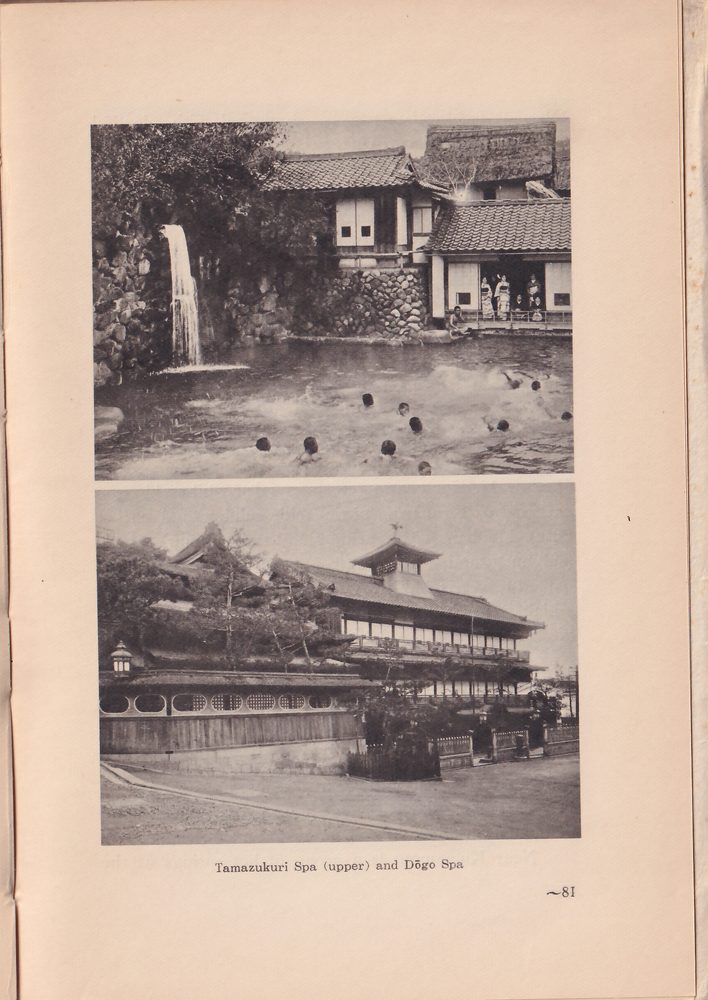
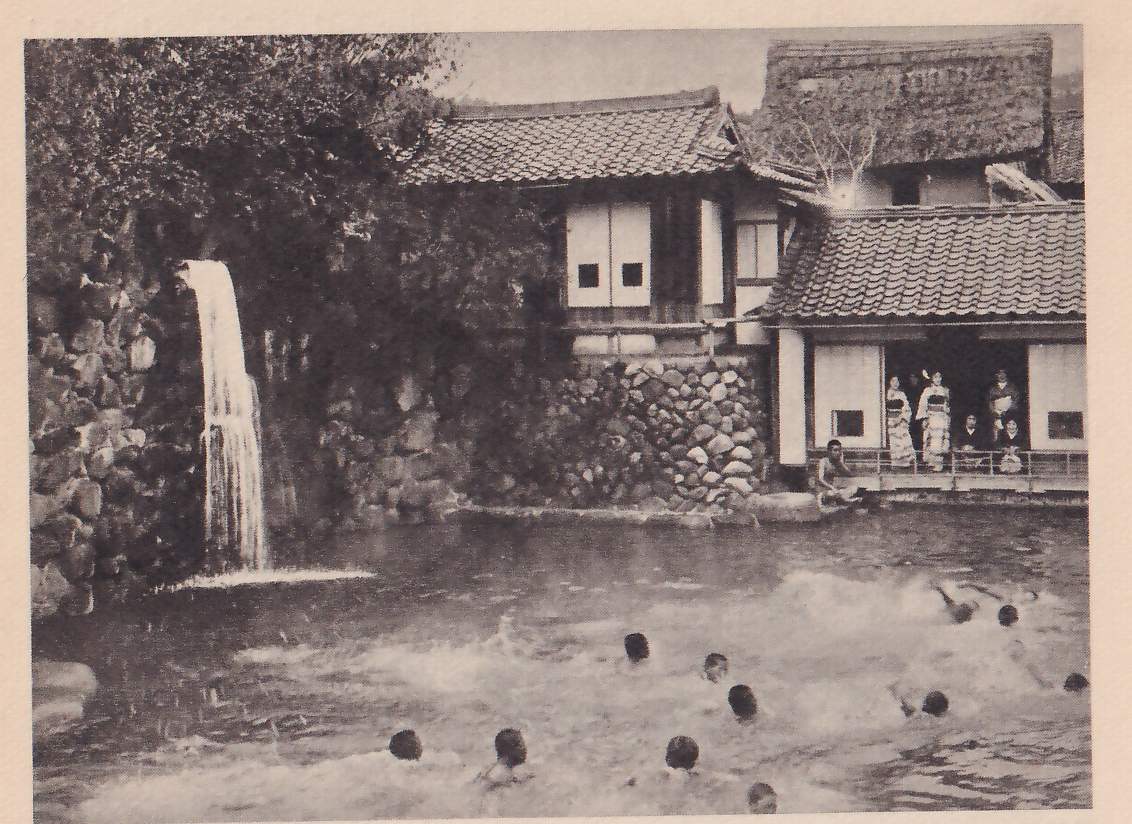
Matsue, a picturesque city 75.5 miles west of Tottori, is noted for Lake Shinji and the Hearn Museum. Near Matsue are several springs, of which Tamazukuri Spa (bitter spring) is the most popular. This region has many caves and stone coffins of archaeological interest. The spa is a popular resort for Matsue people. The famous Lake Shinji lies north of the spa. To the east of Matsue and on the Bay of Miho is Kaike Spa (saline spring). It is about two miles and a half from Yonago, another important city on the San-in Main Line. With Mt. Daisen as its background and a beautiful seascape in front, this spa can challenge comparison in scenery with any beach hot spring resort.
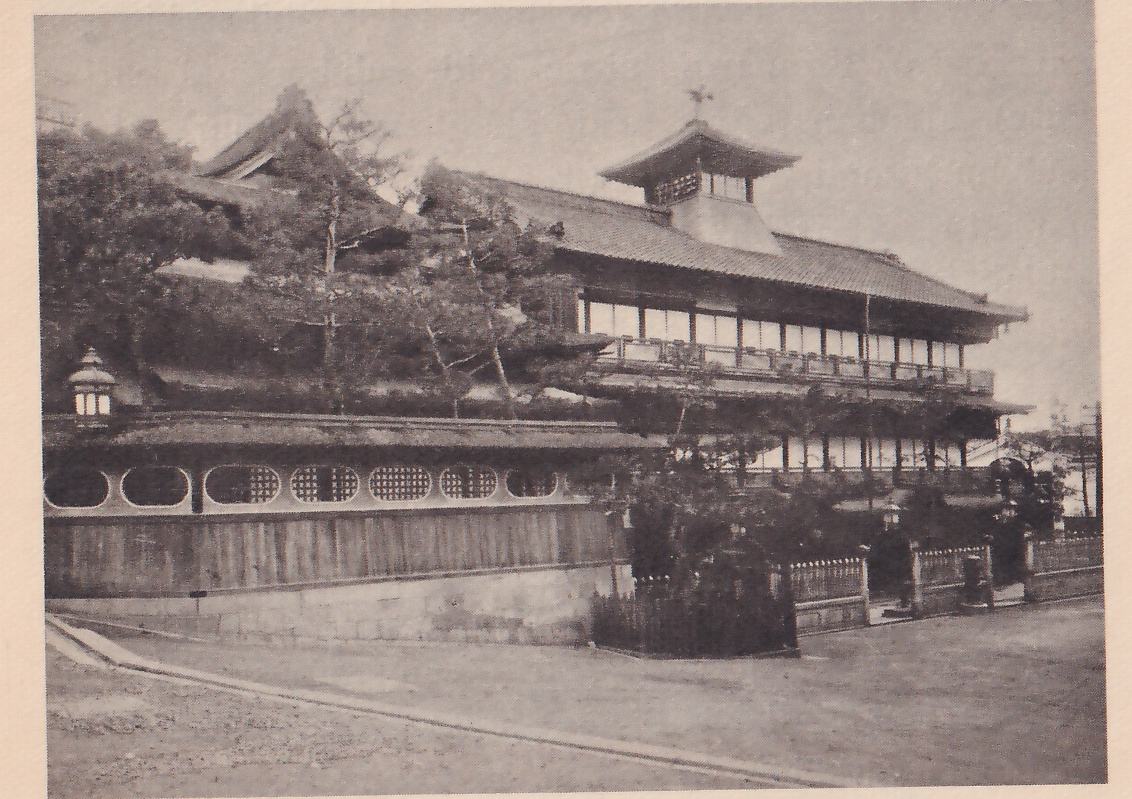
We may dismiss Shikoku Island by merely mentioning that it has very few hot spring resorts, Dōgo Spa (simple thermal) being the most popular.
The island of Kyūshū is rich in hot springs. The principal cities in Kyūshū are Fukuoka, Moji, Nagasaki, Kumamoto, Kagoshima and Beppu. Of these cities the most familiar to foreign visitors are perhaps Nagasaki and Beppu. Unzen Spa is doubtless the most important among those found near Nagasaki. The spa is easily accessible by motor-car from Nagasaki. Located on Mt. Unzen at an altitude of 2,385 feet, the spa is attractive in mountain and sea scenery. Unzen is an ideal summer resort and attracts a great many people from Shanghai and Hongkong every year. Hotel accommodation and other facilities are better than
those at most other resorts. Endowed with plentiful seasonal attractions, Unzen is a hot-spring paradise almost without rival. The whole district is now designated as one of Japan’s 12 National Parks.
Beppu is a spa resort of international appeal. To foreign visitors it is known as the Karlsbad of Japan. Tourist ships that visit this country on their round-the-world cruise generally call at Beppu harbour. There is a good ship service between Osaka and Beppu twice daily through the Inland Sea, while on land it is directly connected by rail with Moji, from which it takes about four hours.
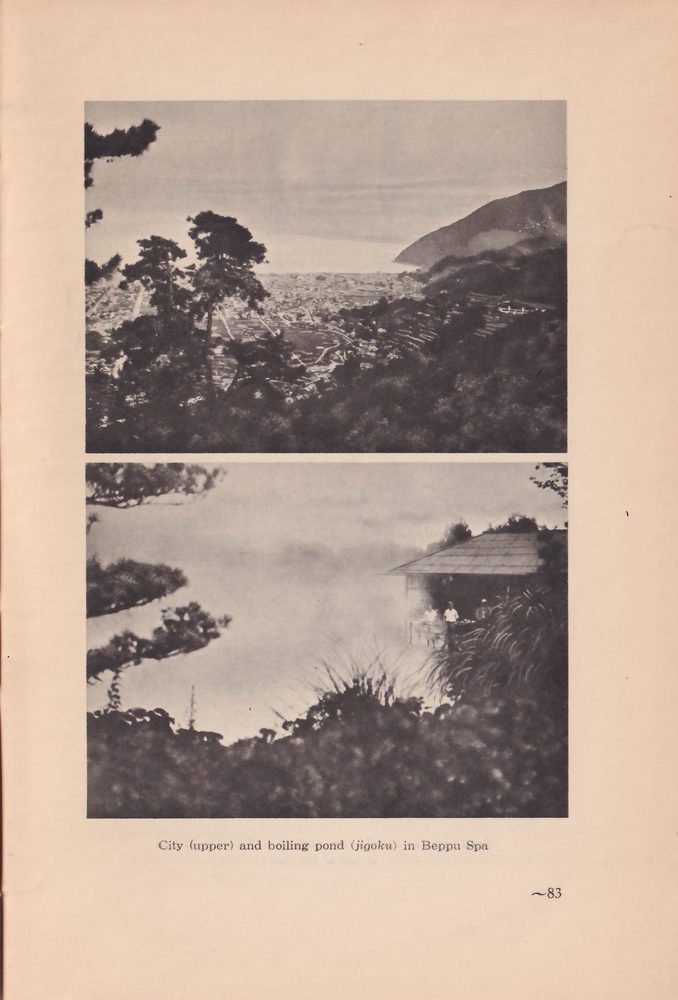
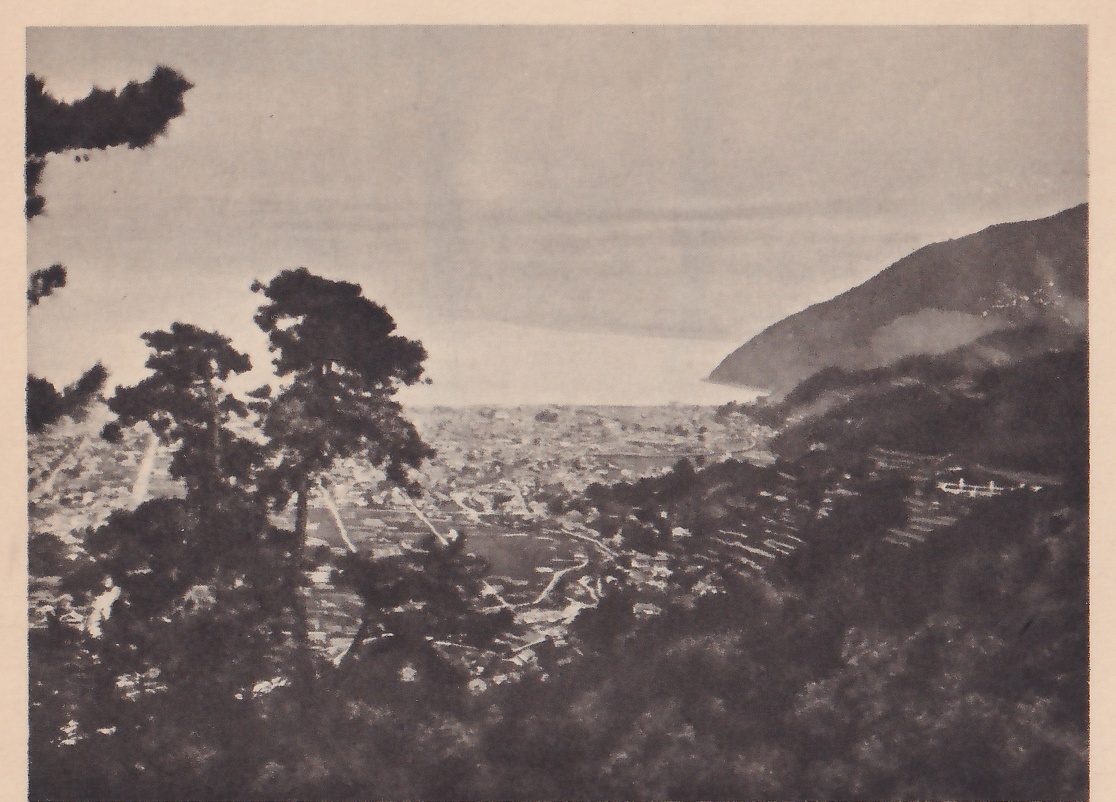
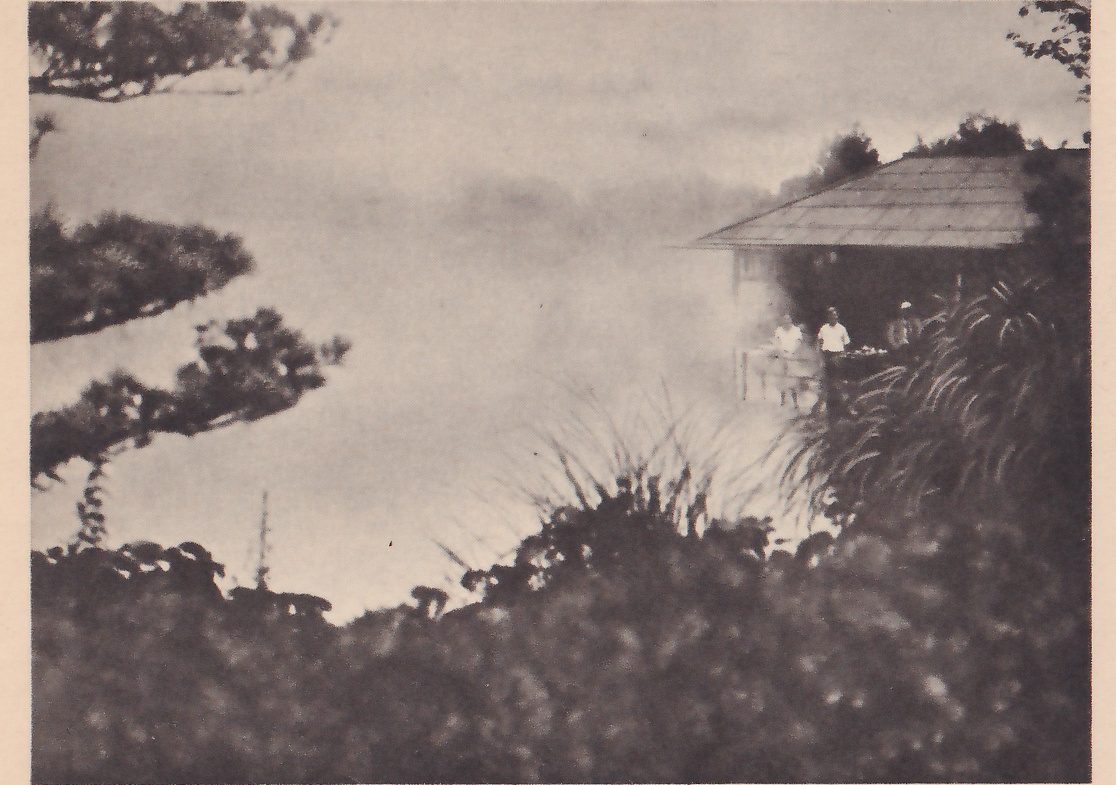
As stated in a previous chapter, the outstanding feature of Beppu Spa is hot sand-baths on the beach. There are eight springs in this district—Beppu proper, Hamawaki, Kamegawa (common salt), Shibaseki (iron carbonate), Kannawa (nitric acid, sulphur and carbonate), Myōban (nitric acid, alum and sulphur), Hotta (sulphur), and Kankaiji (iron carbonate). The last-named resort is half-way up the slope of Mt. Tsurumi, which is at the back of the city, and commands a fine view of the bay. All these springs, and those at Kamegawa in particular, are remarkable for the abundance of their waters. One of the attractions at Beppu is to visit the numerous boiling ponds (jigoku) for which the region is well known. The largest is called Umi-jigoku (lit. “sea hell”) and is said to have a depth of over 400 feet and a temperature of 194.9° F. The one called Chinoike-jigoku (lit. “blood-pond hell”) is vermilion in colour, as the name suggests.
Near Kumamoto is a group of hot springs at the
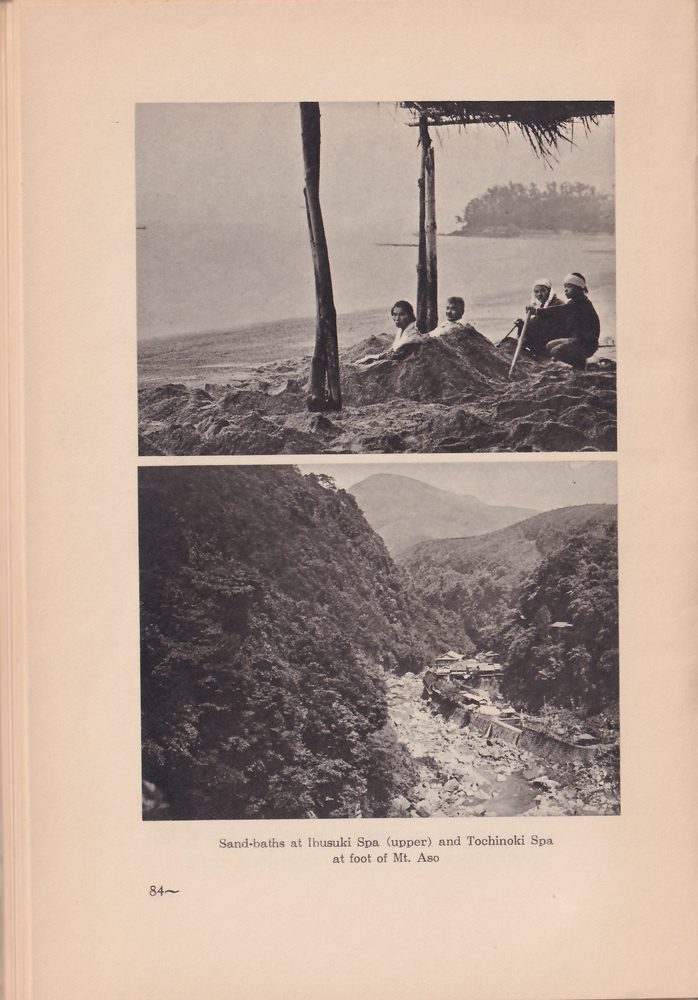
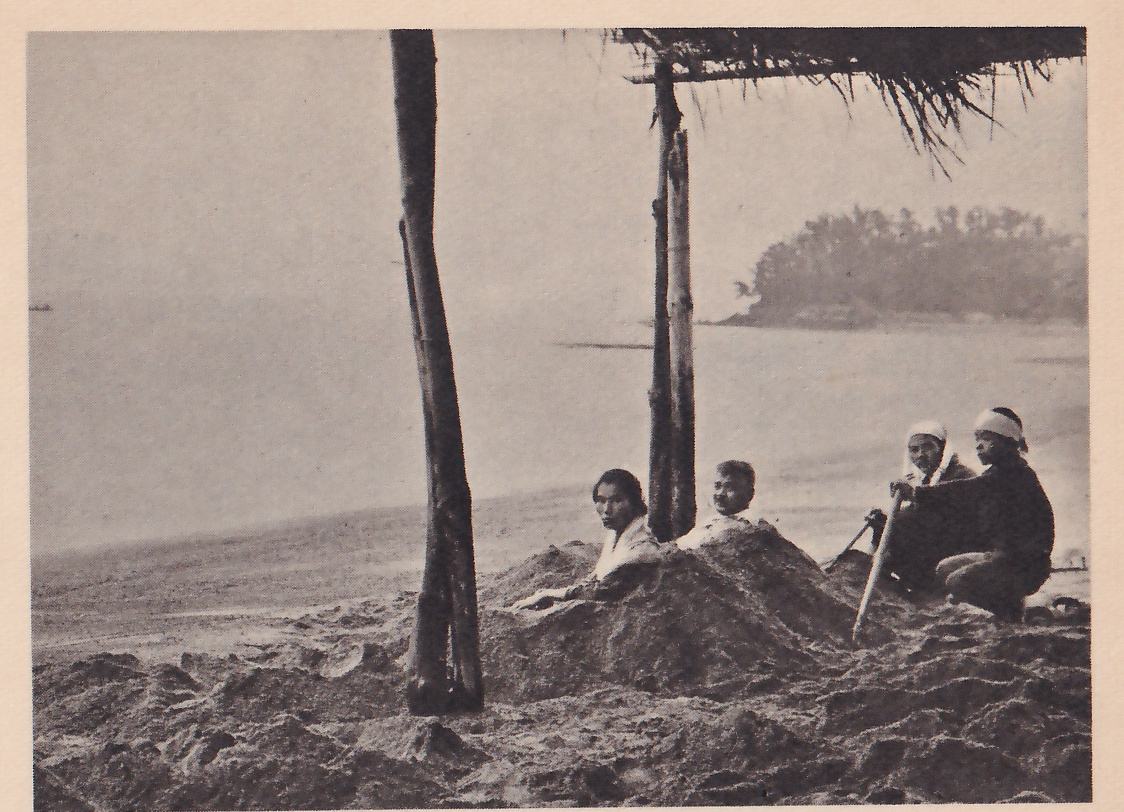
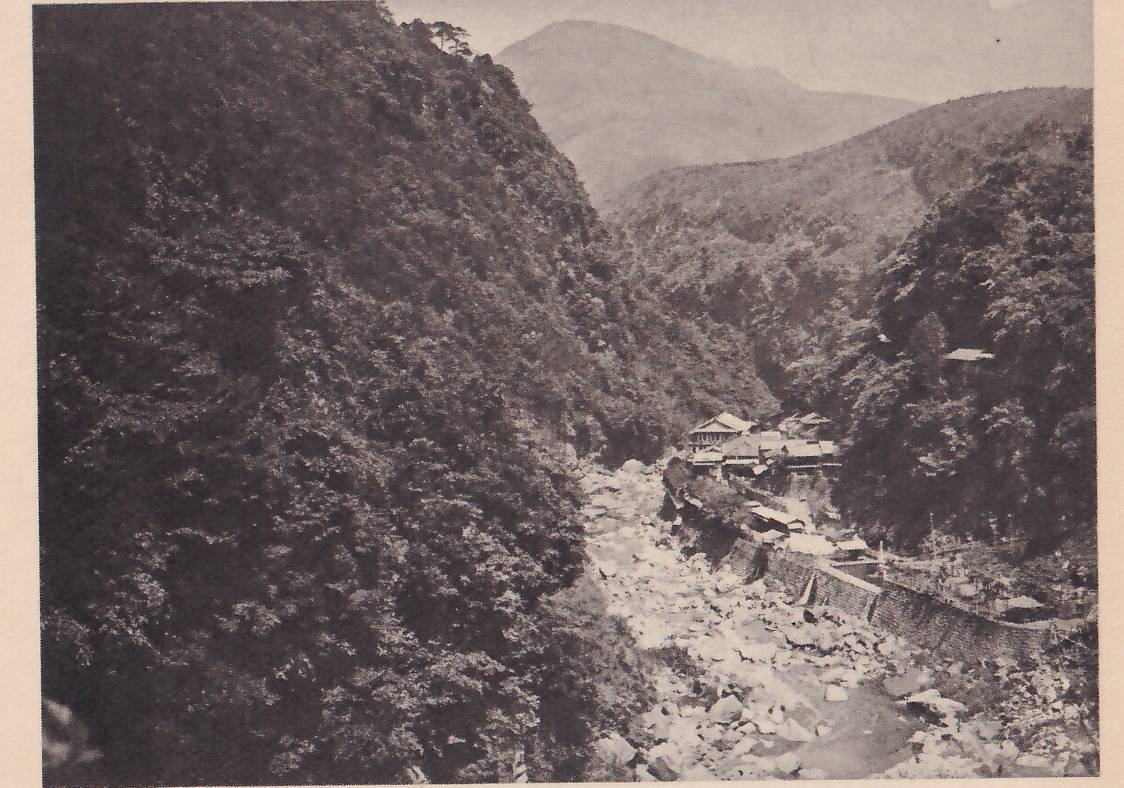
base of Mt. Aso, noted the world over for its gigantic crater. A tourist hotel is to be built at Yunotani Spa at the foot of Mt. Aso. Then there are Kirishima and Ibusuki Spas, near Kagoshima. Like Unzen and Aso, Kirishima has been officially designated as a national park. Like Beppu Spa, Ibusuki Spa affords hot sand-baths on the beach. But accommodation in all these resorts is not so satisfactory as at Beppu or Unzen.
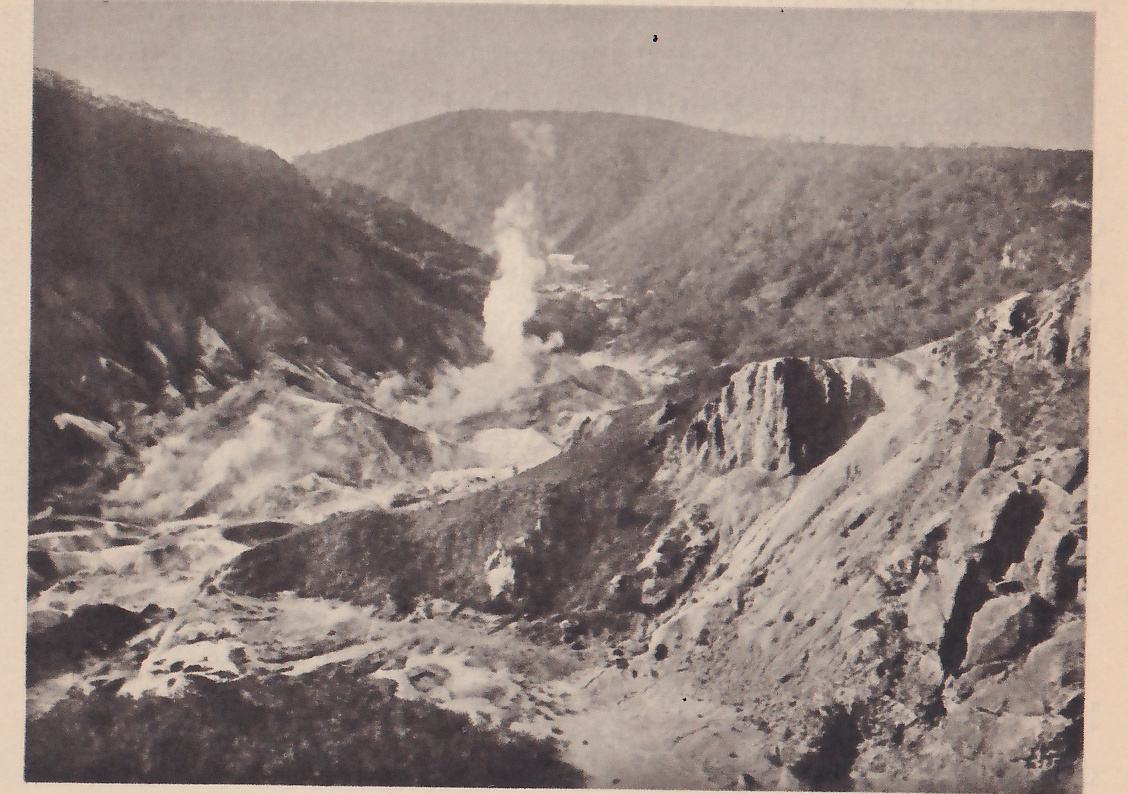
It is a far cry from the island of Kyūshū to Hokkaidō. Hokkaidō is in fact so far away even from Tokyo, and the distance is no doubt a deterrent to prospective visitors to this large island blessed with an abundance of hot springs. The most important spa in Hokkaidō is unquestionably Noboribetsu Spa, 15.3 miles from Muroran (128.6 miles from Hakodate, the gate of HokkaidōPrinted: Hokkaido). Noboribetsu is one of the natural wonders in Hokkaidō and should be visited by everybody who finds his way to this island. The spa is as varied in chemical constituents as it is enormous in the quantity of water. In this respect at least one is reminded of Beppu Spa in Kyūshū. The spa is attractively situated in a large ravine ringed in by timbered mountains. The amazing sight at Jigokudani (lit. “valley of hell”) is a huge crater about a mile round and about 400 feet deep, filled with cones and hills of sinter from hot springs.
To the northwest of Noboribetsu are several saline hot springs on the shore of Lake Tōya. Like many other lakeshore springs, they are noted for their picturesque situation.
Towards the western end of the island is another
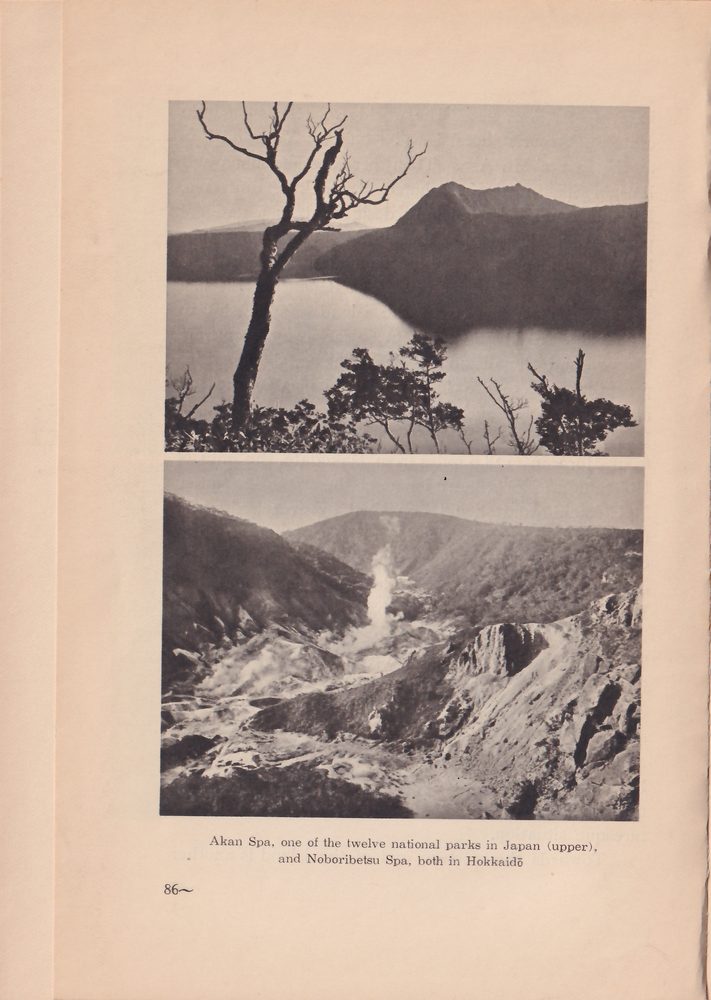
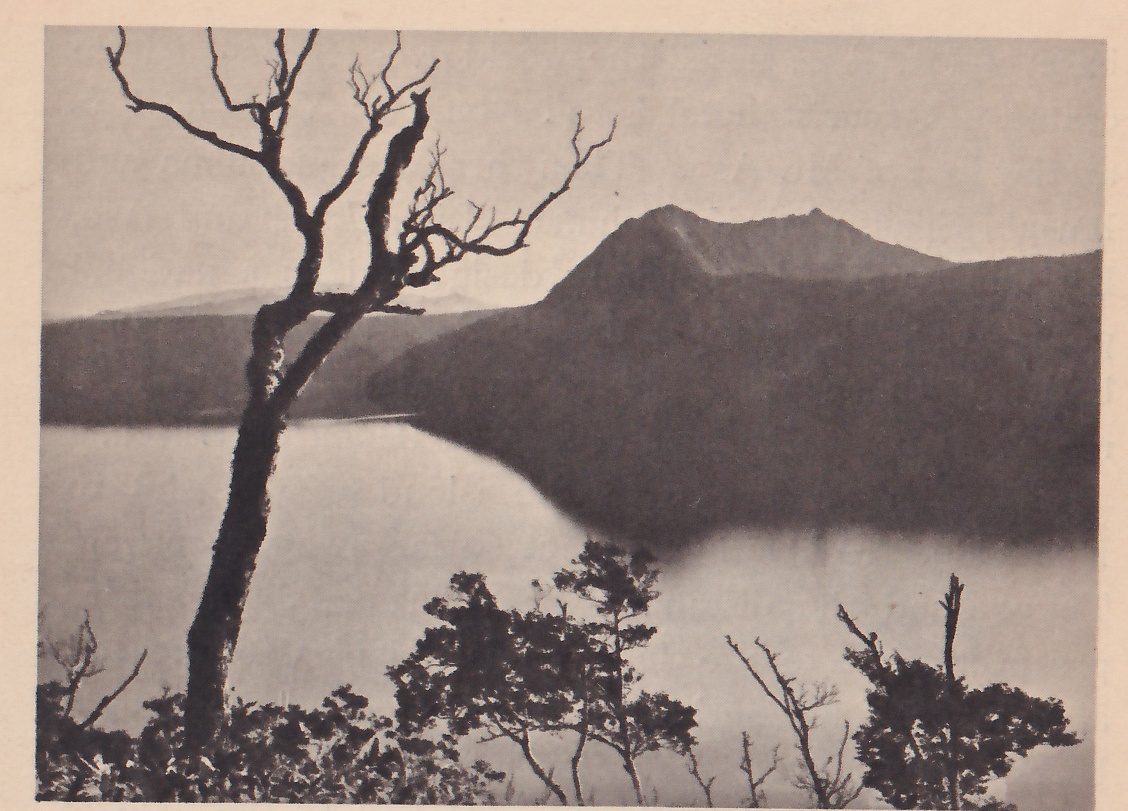
lakeshore spa known as Akan-onsen, Akan being the name of a beautiful lake in that region—a region which has been designated as a national park.
Close to Sapporo is Jōzankei Spa and near Hakodate is a spa called Yunokawa.
The foregoing is no better than a very incomplete list of the principal hot springs to be found in the Japanese Empire. For detailed scientific information on the subject the reader is referred to “The Mineral Springs of Japan” by Dr. Risaku Ishizu and “The Hot Springs of Japan” published by the Japanese Government Railways.