
1. EARLIEST PERIOD OF THE JAPANESE DRAMA
The origin of the Japanese drama is said to have been the sacred dance which was performed before the heavenly cave, in which the great Ancestral Goddess had hid Herself, long ago, in the mythological age of the gods. In this respect, finding its origin in the ceremonies performed before the gods, Japanese drama may be said to resemble the Greek drama.
Gigaku. Later on, during the reign of the Empress Suiko, about 612 A. D., a naturalized citizen named Mimashi introduced a musical dance from South
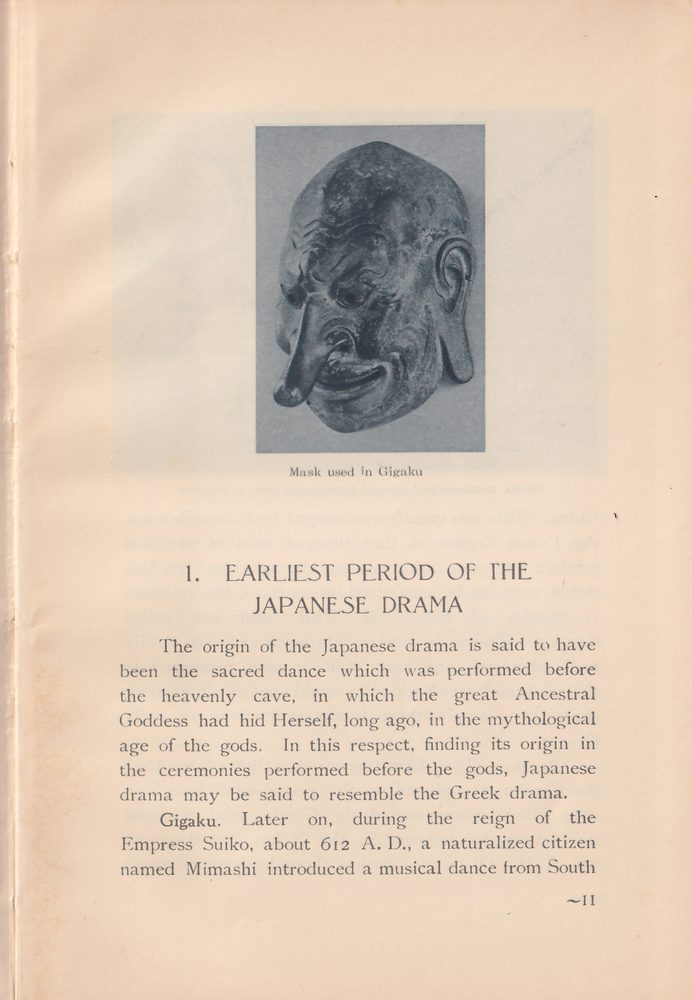
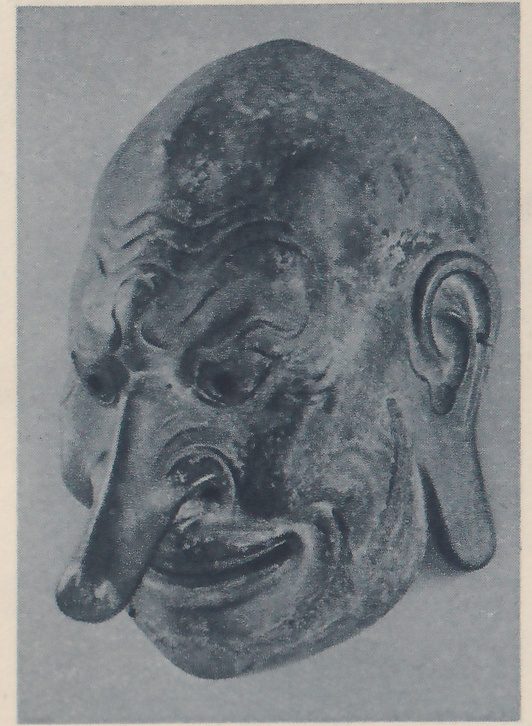
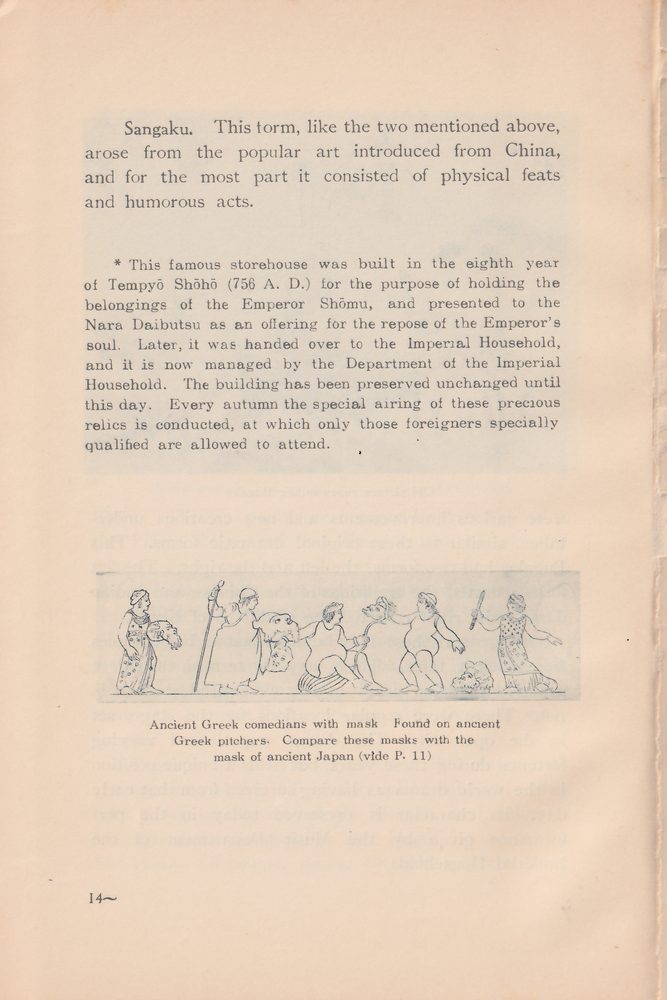
China. This was greatly encouraged by Prince Shōtoku, the Prince Regent of that time, a man of profound wisdom and deep faith. It was through him that this dance came to be conducted as part of the religious ceremonies of Buddhism. This form was called Gigaku. The masks used in this dance were artistically well advanced, and may still be seen, preserved in the Shōsōin* at Nara. It would be an interesting study to compare these masks with those of early Greece.
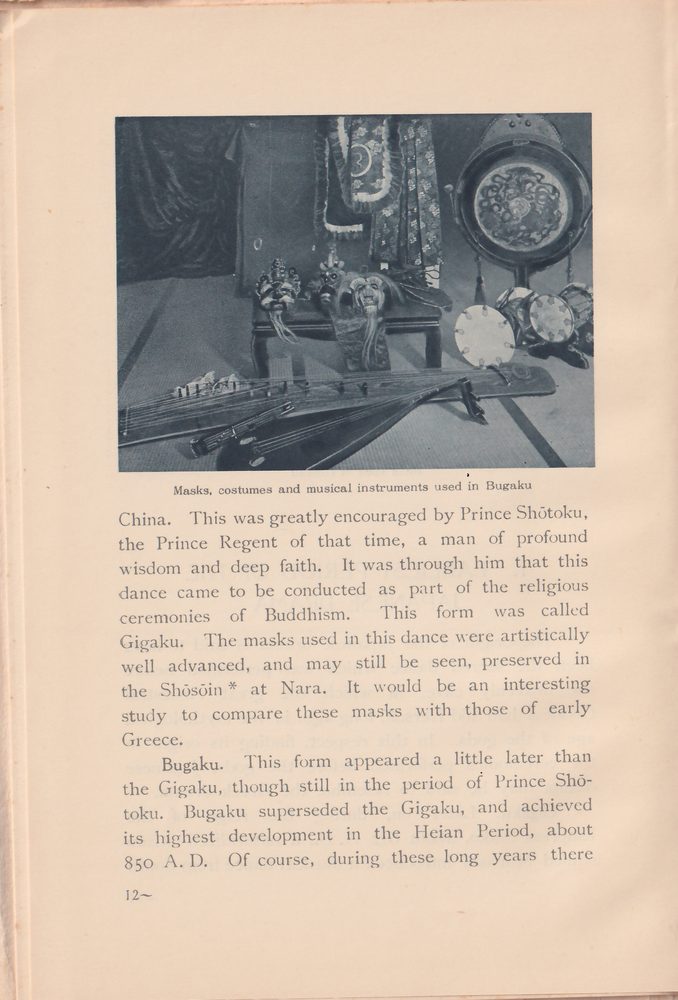
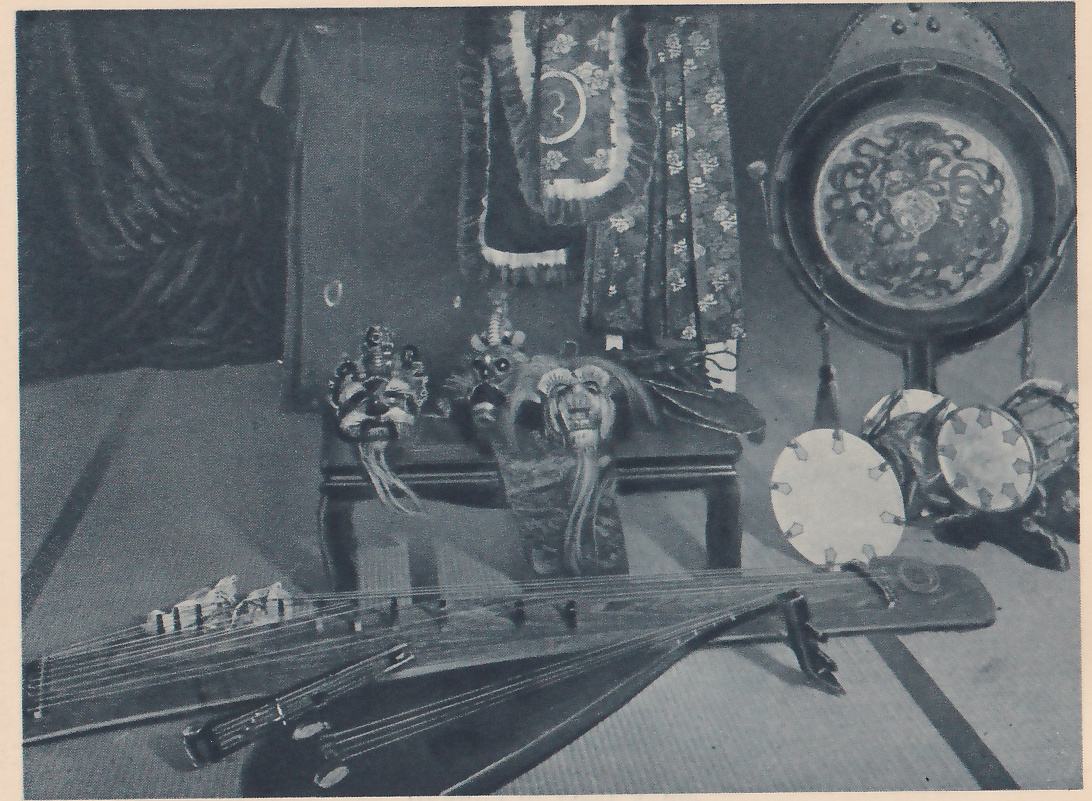
Bugaku. This form appeared a little later than the Gigaku, though still in the period of Prince Shōtoku. Bugaku superseded the Gigaku, and achieved its highest development in the Heian Period, about 850 A. D. Of course, during these long years there
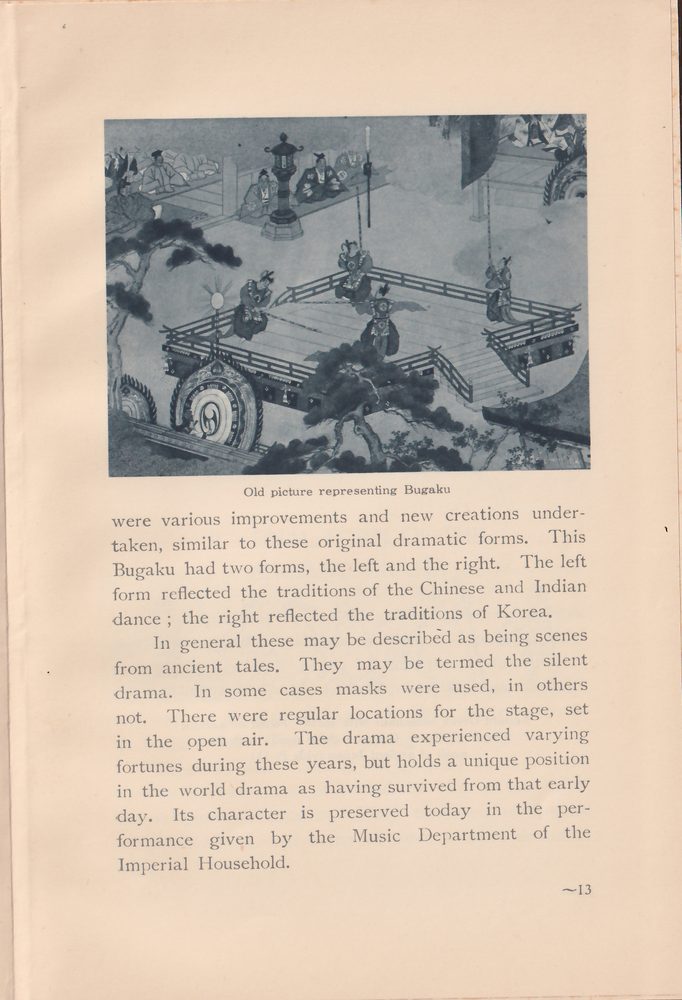
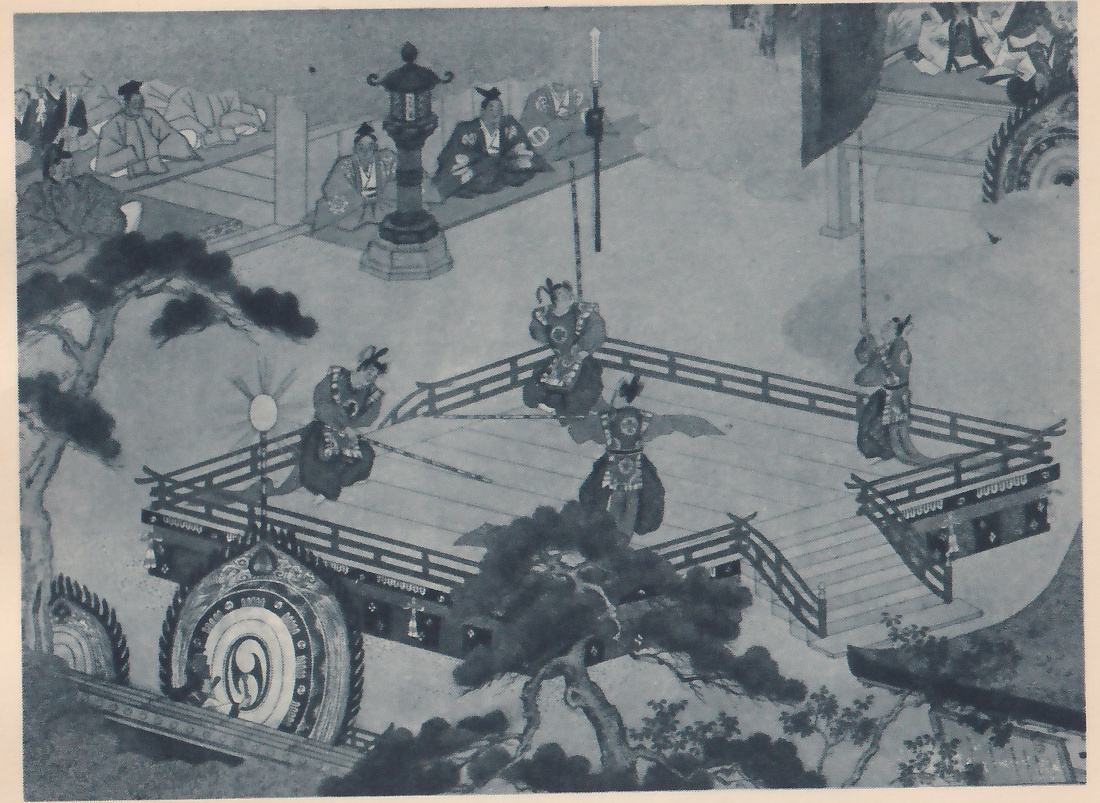
were various improvements and new creations undertaken, similar to these original dramatic forms. This Bugaku had two forms, the left and the right. The left form reflected the traditions of the Chinese and Indian dance; the right reflected the traditions of Korea.
In general these may be described as being scenes from ancient tales. They may be termed the silent drama. In some cases masks were used, in others not. There were regular locations for the stage, set in the open air. The drama experienced varying fortunes during these years, but holds a unique position in the world drama as having survived from that early day. Its character is preserved today in the performance given by the Music Department of the Imperial Household.
Sangaku. This formPrinted: torm, like the two mentioned above, arose from the popular art introduced from China, and for the most part it consisted of physical feats and humorous acts.
* This famous storehouse was built in the eighth year of Tempyō Shōhō (756 A. D.) for the purpose of holding the belongings of the Emperor Shōmu, and presented to the Nara Daibutsu as an offering for the repose of the Emperor’s soul. Later, it was handed over to the Imperial Household, and it is now managed by the Department of the Imperial Household. The building has been preserved unchanged until this day. Every autumn the special airing of these precious relics is conducted, at which only those foreigners specially qualified are allowed to attend.