
I. AN OUTLINE OF THE HISTORY OF JAPANESE GARDENS
The origin of Japanese gardens may be traced to the era of the Empress Suiko (592–628 A.D.), when, according to a document remaining today, there already existed well-designed gardens with artificial hills and ornamental ponds. It is well known that Soga-no-Umako, a high functionary of that period, was the possessor of a beautiful garden.
What therefore was the nature of Japanese gardens in those early days? It is hoped that the following will make this clear. The art of garden-making was imported from Korea, as were many other arts and crafts, and it is not difficult to imagine that both the designers and their assistants were Koreans naturalized in Japan.
In the Nara Period (645–781 A. D.), direct intercourse with the continent of China was opened, and Chinese influence began to make itself felt in various phases of Japanese life. The progress of garden-making kept pace with the advance of architecture, and fine landscape gardens came to adorn the palaces and villas of the Emperor, the princes of the blood, and wealthy nobles. In these gardens, not only rocks, water, trees, and plants, but even birds, animals and fishes formed part of the material that contributed to their composition. Moreover, in these gardens
various feasts were given to add the enjoyment of the open air to the pleasures of the table. None of these old-time gardens is to be seen now, but they are occasionally referred to in contemporary poetry of Japanese and Chinese styles.
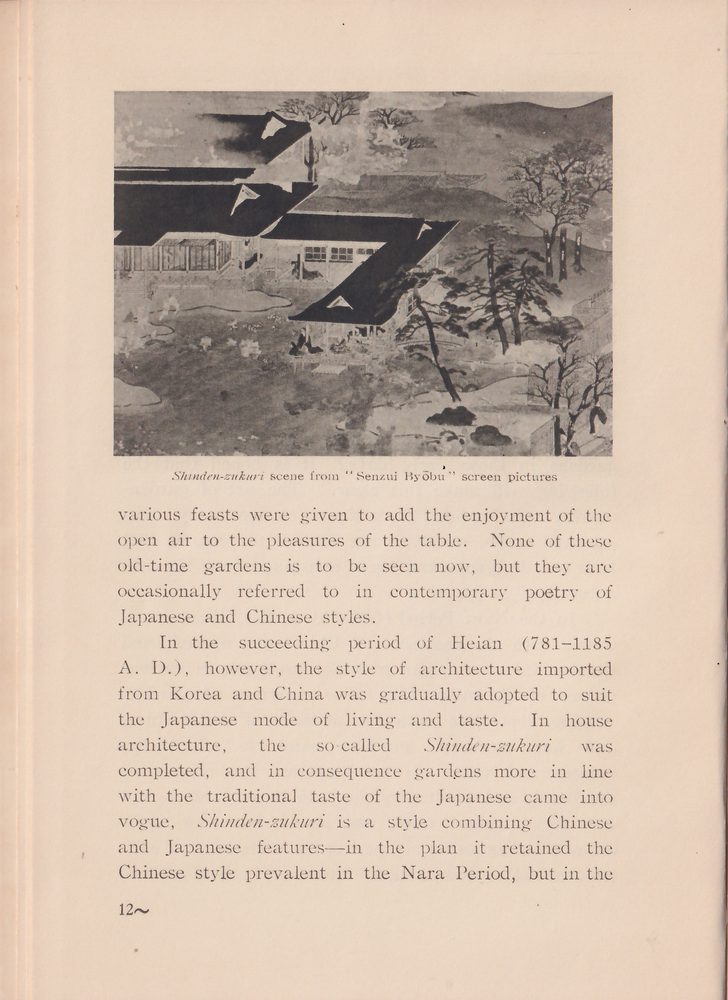
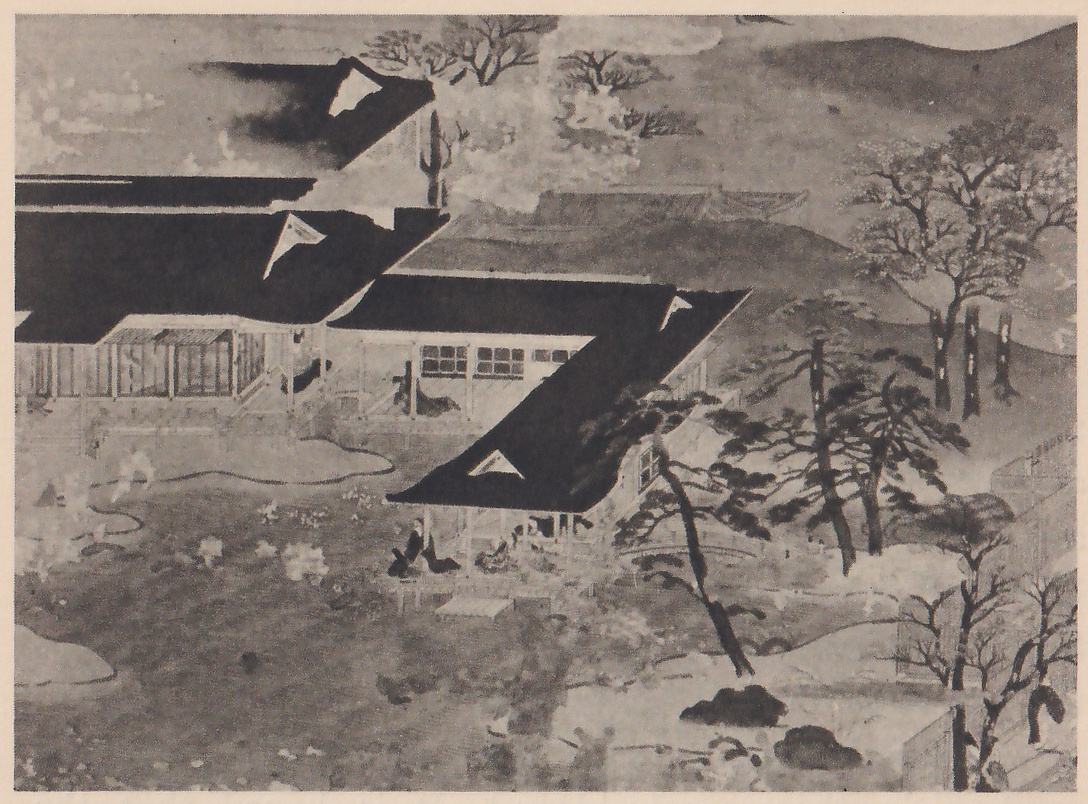
In the succeeding period of Heian (781–1185 A. D.), however, the style of architecture imported from Korea and China was gradually adopted to suit the Japanese mode of living and taste. In house architecture, the so-called Shinden-zukuri was completed, and in consequence gardens more in line with the traditional taste of the Japanese came into vogue, Shinden-zukuri is a style combining Chinese and Japanese features—in the plan it retained the Chinese style prevalent in the Nara Period, but in the
elevation it was purely Japanese, graced with elements of elegance and lightness. A similar tendency was to be found in the design of gardens.
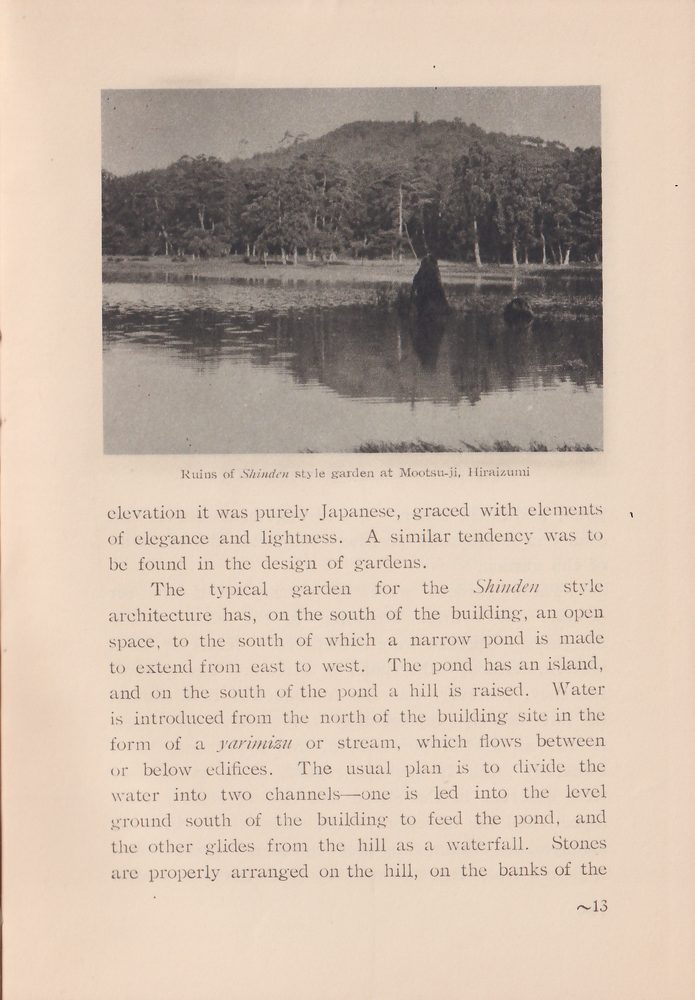
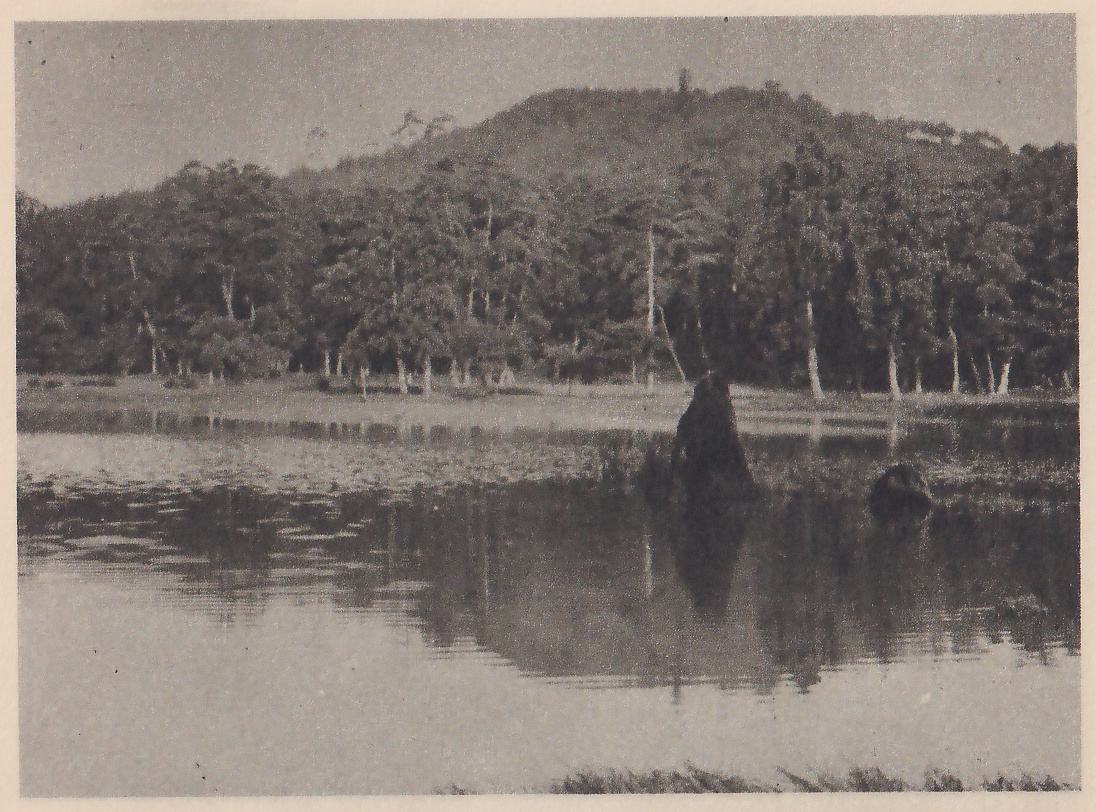
The typical garden for the Shinden style architecture has, on the south of the building, an open space, to the south of which a narrow pond is made to extend from east to west. The pond has an island, and on the south of the pond a hill is raised. Water is introduced from the north of the building site in the form of a yarimizu or stream, which flows between or below edifices. The usual plan is to divide the water into two channels—one is led into the level ground south of the building to feed the pond, and the other glides from the hill as a waterfall. Stones are properly arranged on the hill, on the banks of the
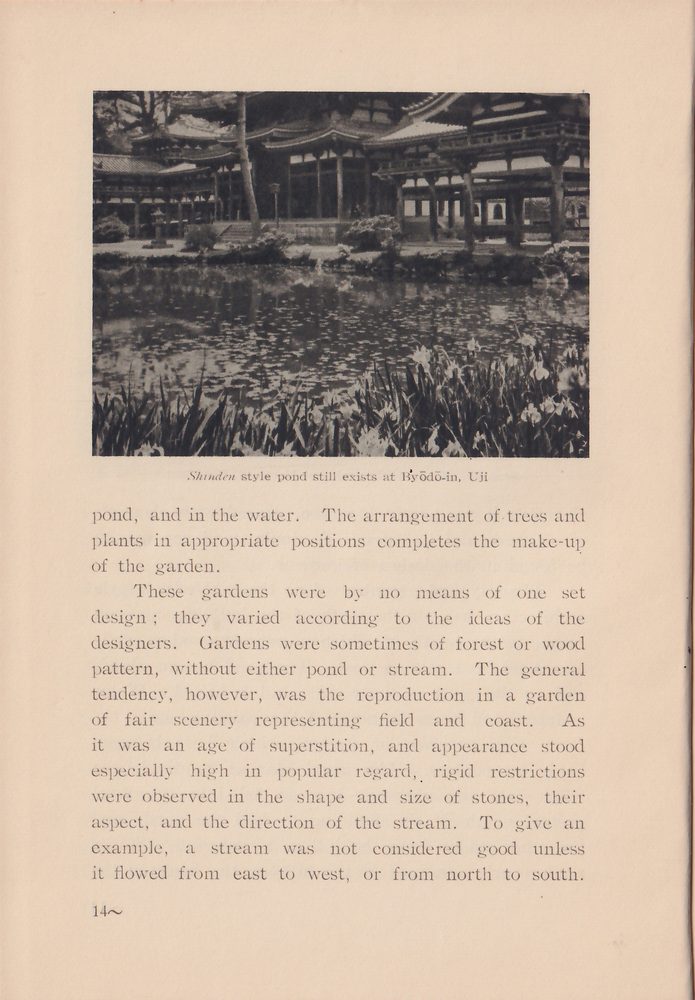
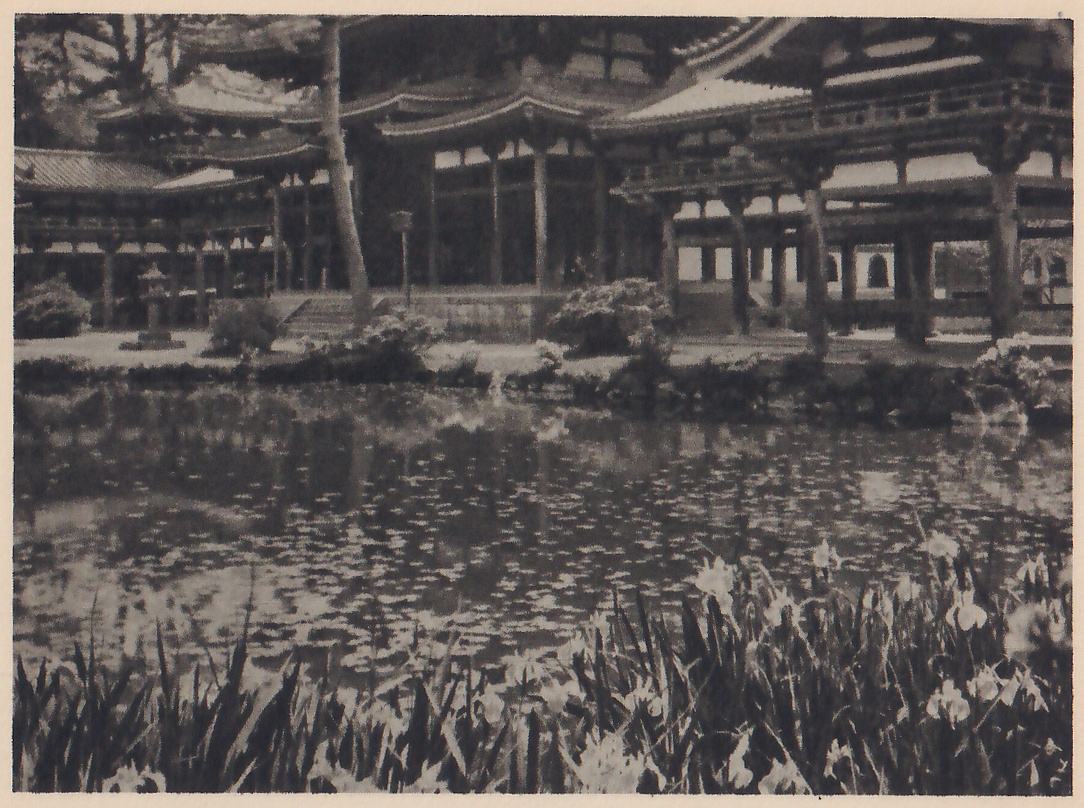
pond, and in the water. The arrangement of trees and plants in appropriate positions completes the make-up of the garden.
These gardens were by no means of one set design; they varied according to the ideas of the designers. Gardens were sometimes of forest or wood pattern, without either pond or stream. The general tendency, however, was the reproduction in a garden of fair scenery representing field and coast. As it was an age of superstition, and appearance stood especially high in popular regard, rigid restrictions were observed in the shape and size of stones, their aspect, and the direction of the stream. To give an example, a stream was not considered good unless it flowed from east to west, or from north to south.
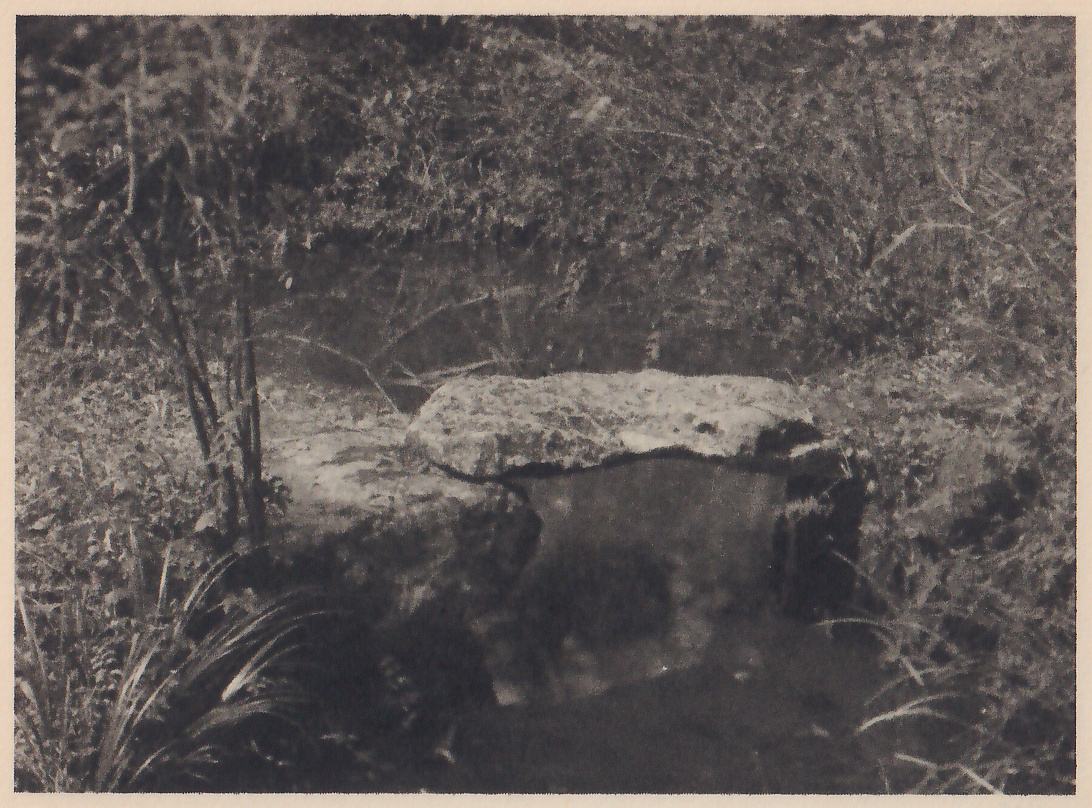
According to Chinese mythology the four quarters are ruled by four deities—east by Seiryū, west by Byakko, north by Genbu, and south by Shujaku; and it was believed that east was the source of purity, and west the outlet of all impurities. Hence the direction of the stream. The philosophy of the positive and the negative* had also its influence in fixing the details of garden design.
Such superstition was natural to the unenlightened minds of those old days, and consequently there was nothing surprising about it. What is surprising, however, is the fact that the tradition based on primitive
* Principles in nature, according to the Chinese philosophers, were inculcated in garden architecture.
superstition should have had its sway in landscape gardening until recent times.
In the Heian Period many gardens were laid out to adorn homes, villas, shrines, and temples. It appears that these gardens were substantially of the same type. This statement is borne out by some old garden sites, where outlines of the type are still traceable, and by contemporary pictures which have come down to us.
This style of landscape gardening widely prevailed down to the middle of the Kamakura Period (1186–1393 A. D.), but a change was introduced when Buddhist priests of the Zen sect came to design their own gardens. This change resulted from three factors—(1) the introduction of a new style of architecture,
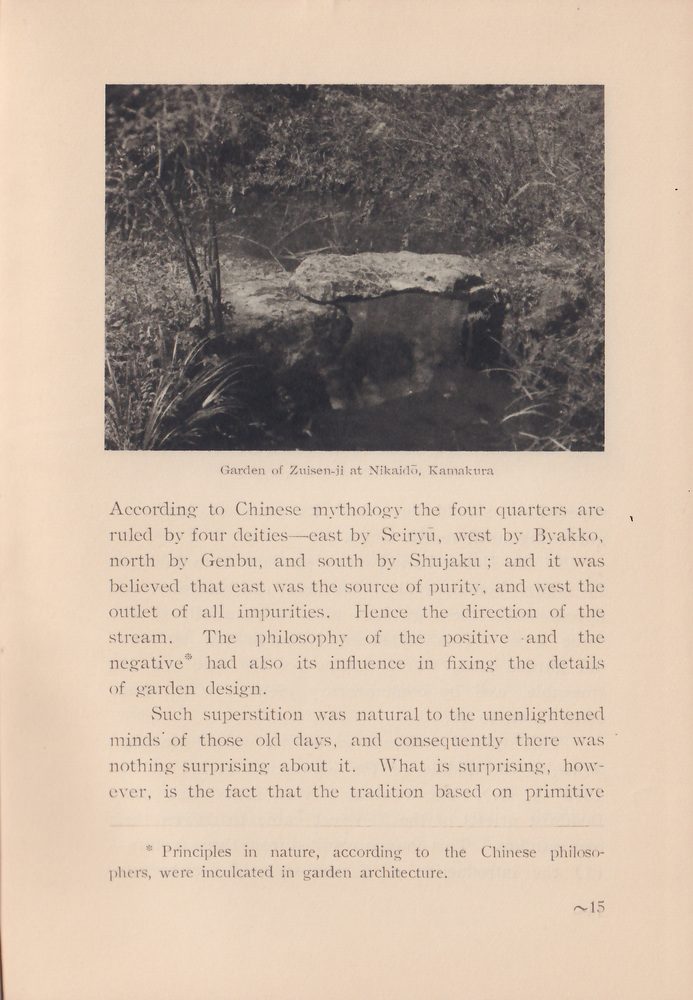
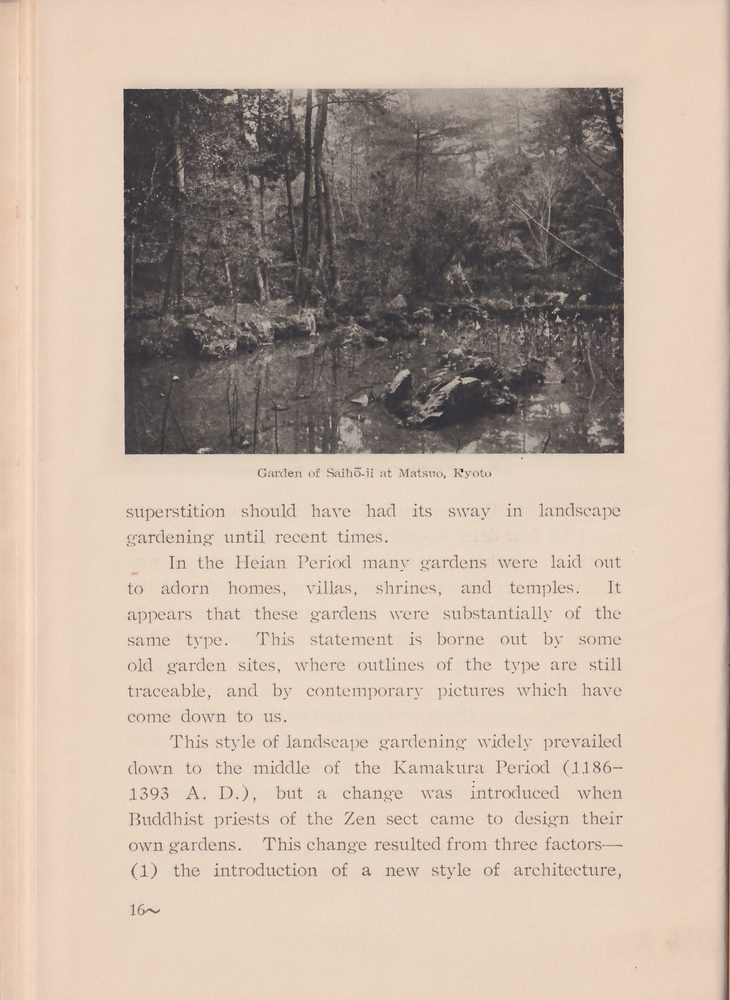
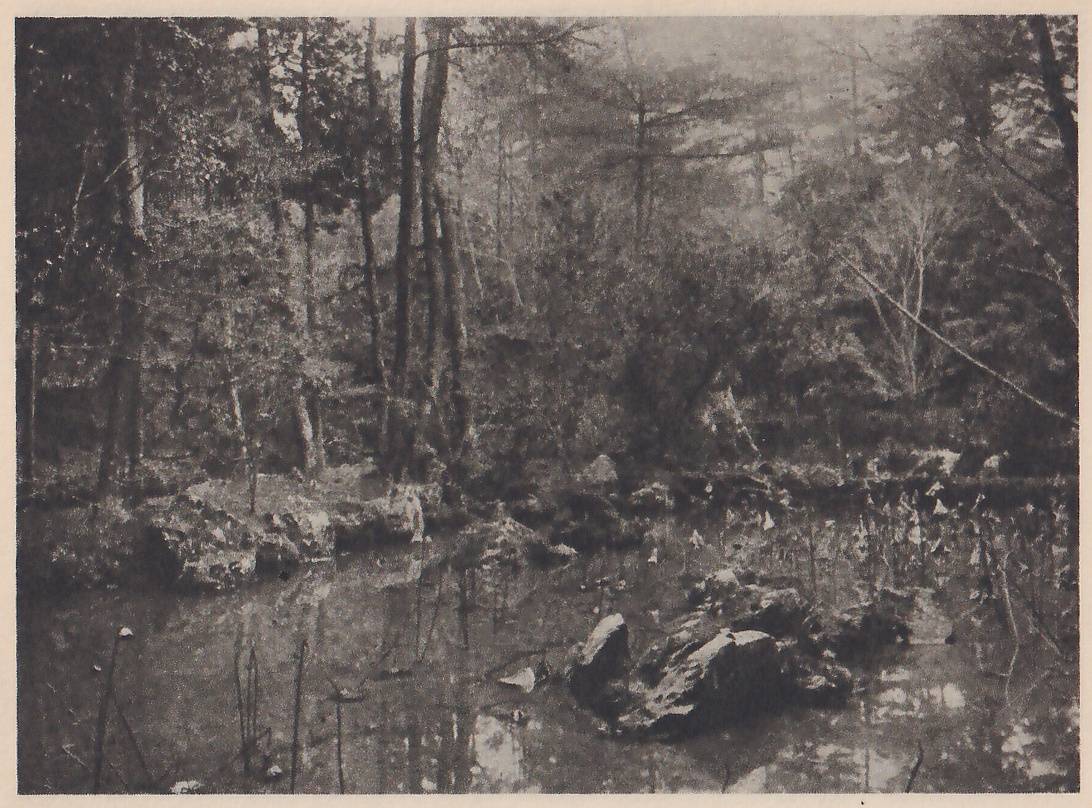
(2) the appeal of Zen philosophy, and (3) the stimulus of the landscape painting of the Sung and Yüan dynasties,* contemporary with the period under review. These paintings were much appreciated by the Zen priests and members of the aristocracy. As might be expected, gardens designed with these forces in full play were not so decorative as those of the Heian Period—they were more reposeful, more substantial. The prominent features were stones, water and evergreens, with little change throughout the four seasons. Specimens of Kamakura gardens still to be seen are those of the Zuisen-ji at Nikaidō, Kamakura, and of the Saihō-ji in Kyoto. Tradition
* Chinese dynasties (963—1367 A. D.)
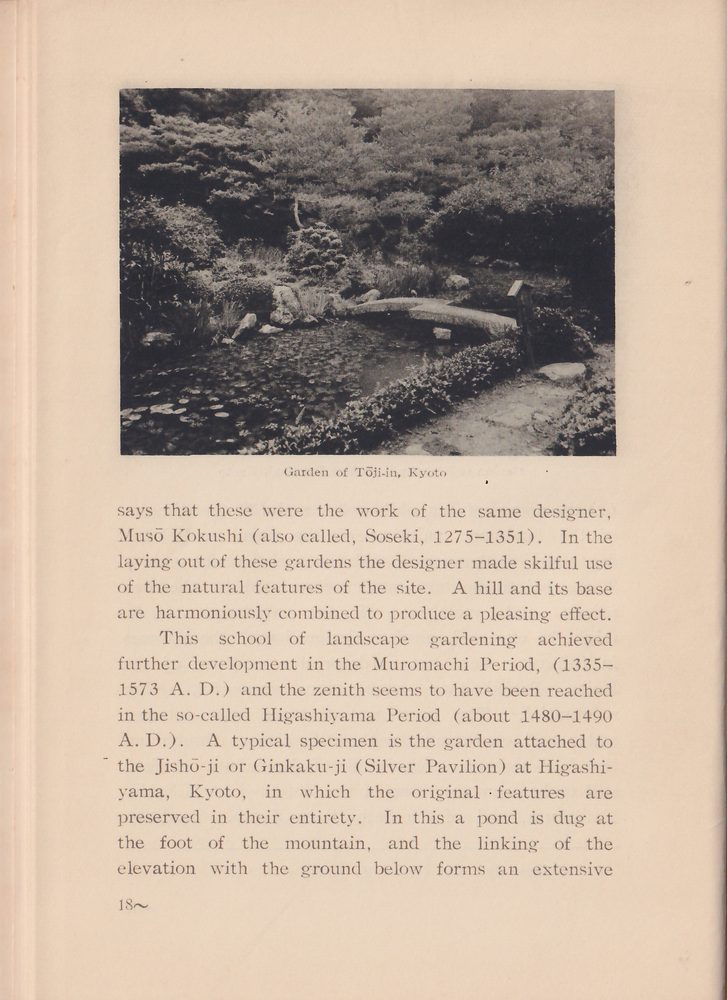
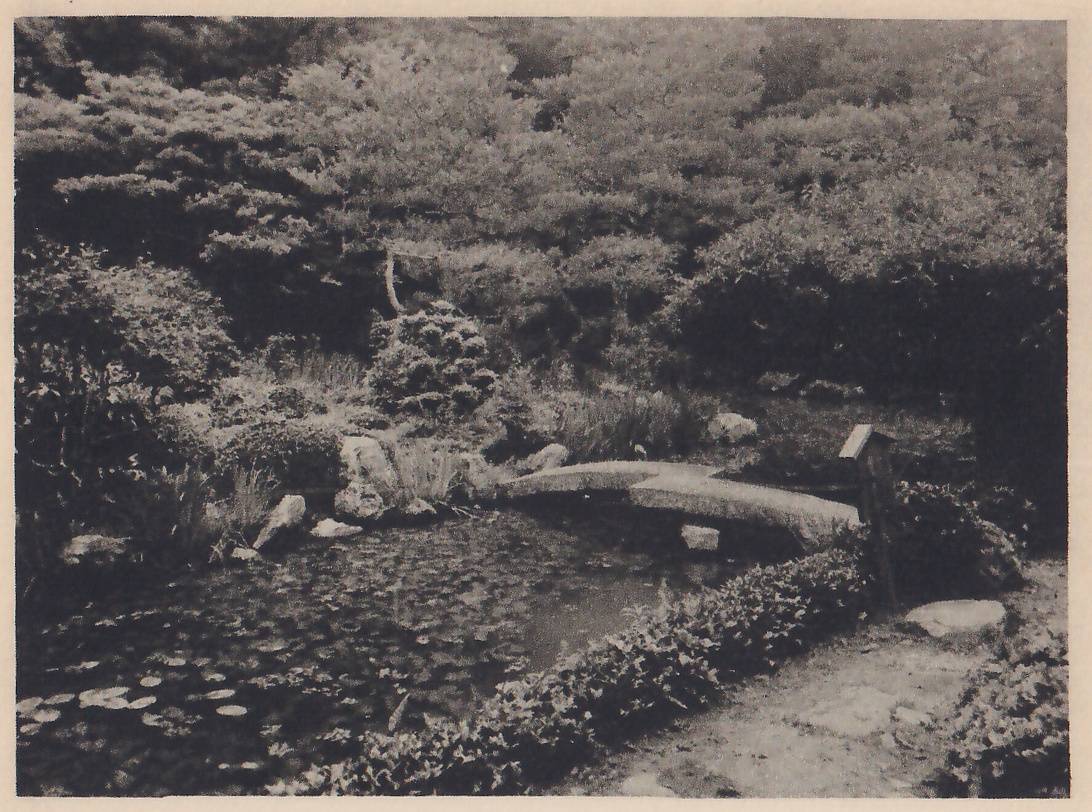
says that these were the work of the same designer, Musō Kokushi (also called, Soseki, 1275–1351). In the laying out of these gardens the designer made skilful use of the natural features of the site. A hill and its base are harmoniously combined to produce a pleasing effect.
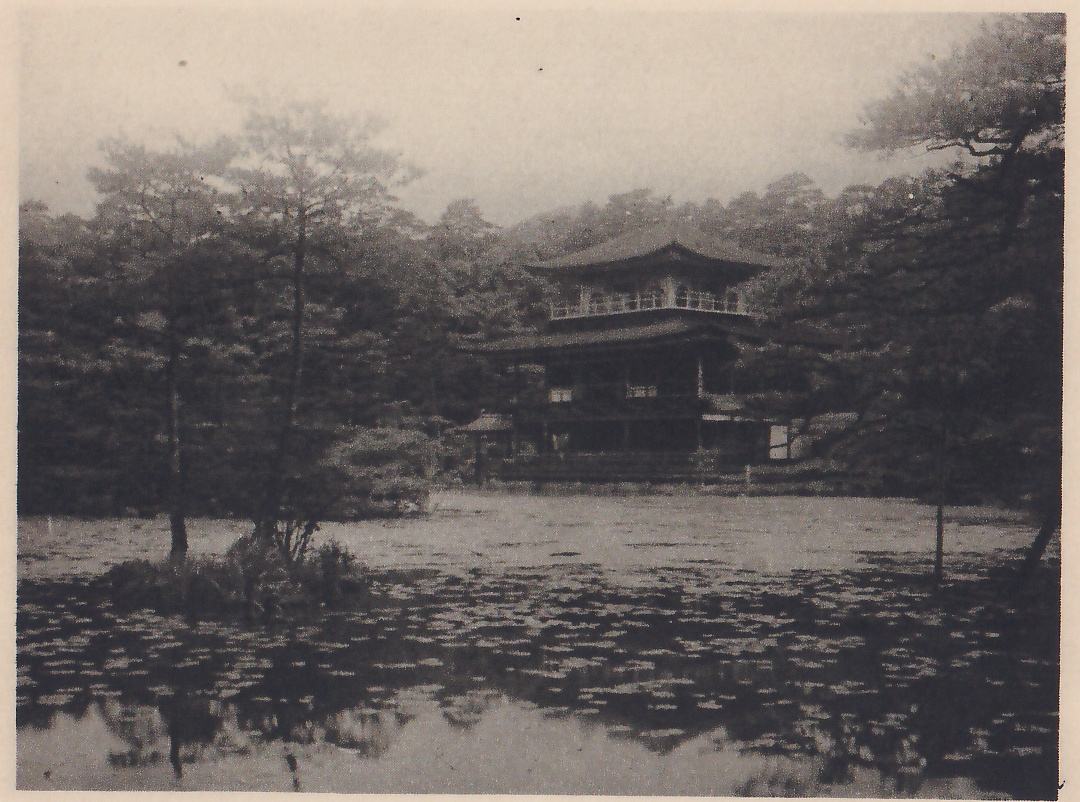
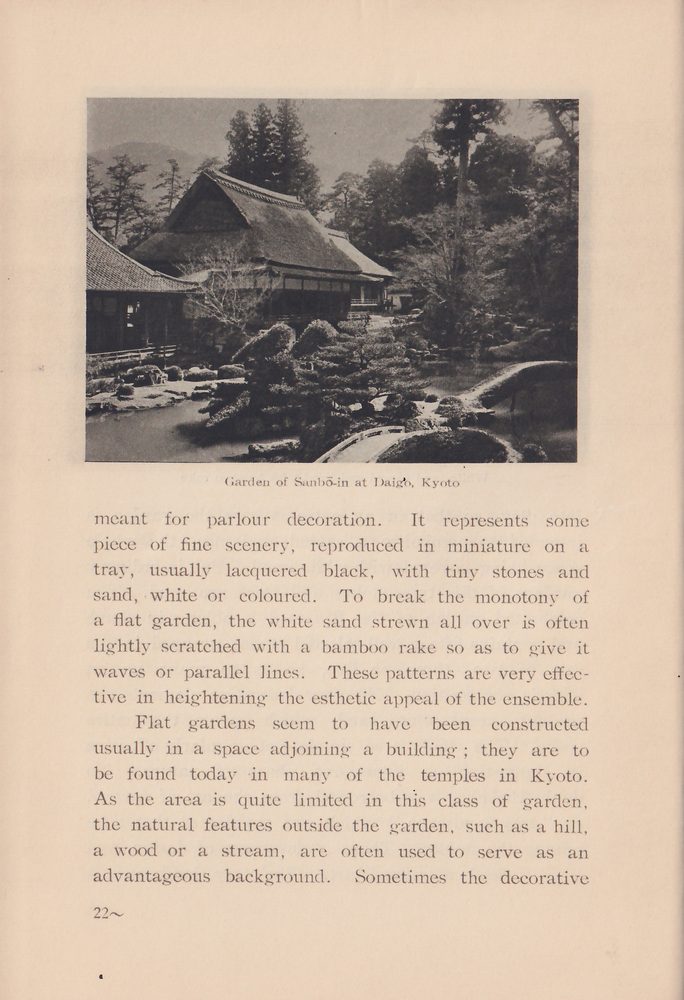
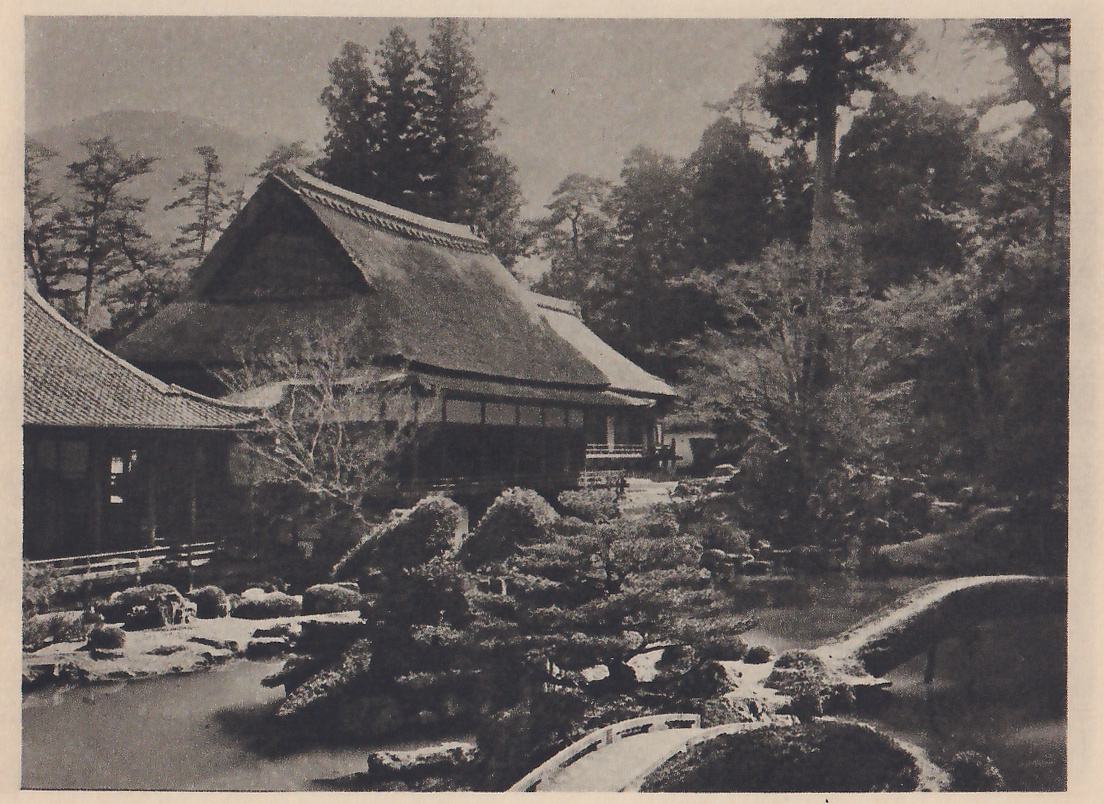
This school of landscape gardening achieved further development in the Muromachi Period, (1335–1573 A. D.) and the zenith seems to have been reached in the so-called Higashiyama Period (about 1480–1490 A. D.). A typical specimen is the garden attached to the Jishō-ji or Ginkaku-ji (Silver Pavilion) at Higashiyama, Kyoto, in which the original features are preserved in their entirety. In this a pond is dug at the foot of the mountain, and the linking of the elevation with the ground below forms an extensive
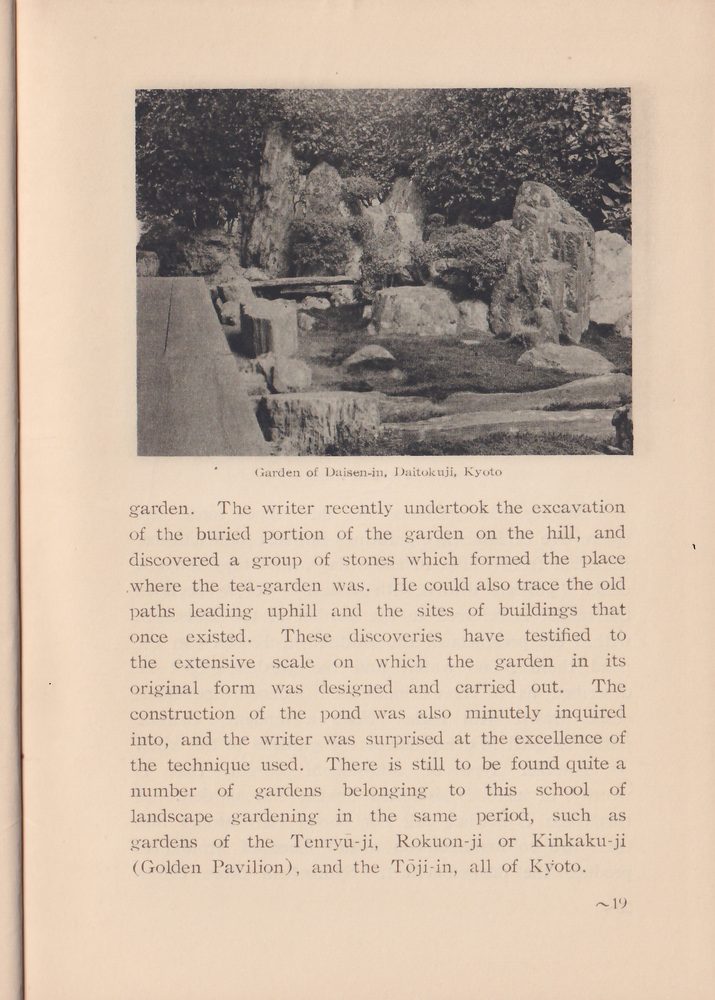
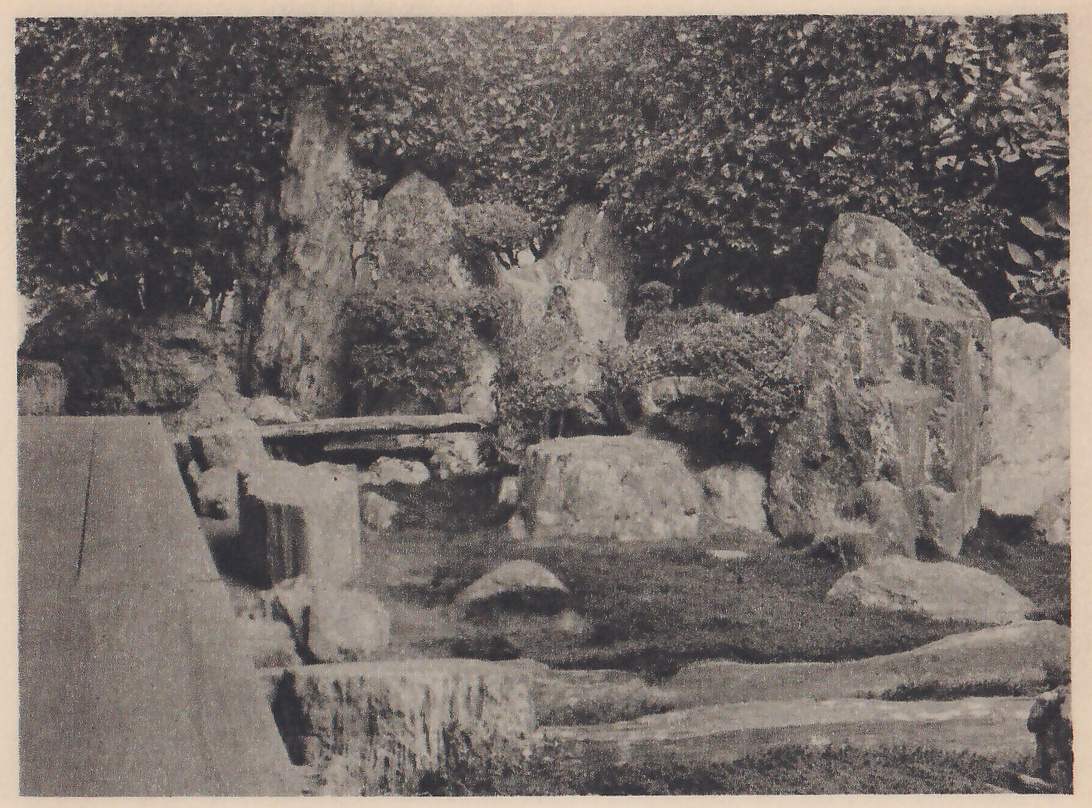
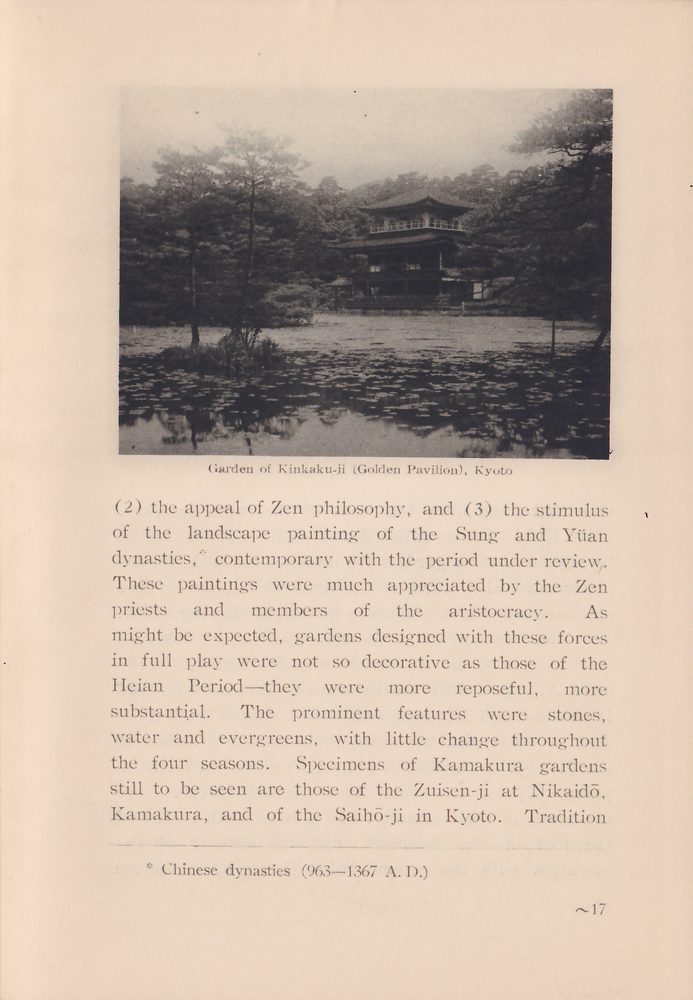
garden. The writer recently undertook the excavation of the buried portion of the garden on the hill, and discovered a group of stones which formed the place where the tea-garden was. He could also trace the old paths leading uphill and the sites of buildings that once existed. These discoveries have testified to the extensive scale on which the garden in its original form was designed and carried out. The construction of the pond was also minutely inquired into, and the writer was surprised at the excellence of the technique used. There is still to be found quite a number of gardens belonging to this school of landscape gardening in the same period, such as gardens of the Tenryū-ji, Rokuon-ji or Kinkaku-ji (Golden Pavilion), and the Tōji-in, all of Kyoto.
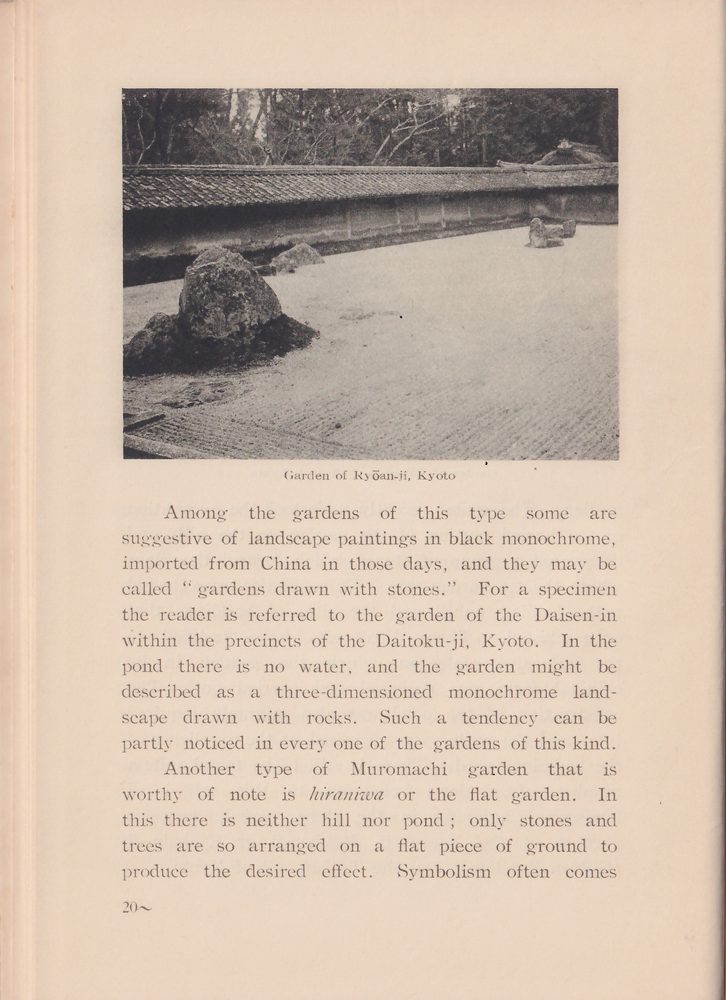
Among the gardens of this type some are suggestive of landscape paintings in black monochrome, imported from China in those days, and they may be called “gardens drawn with stones.” For a specimen the reader is referred to the garden of the Daisen-in within the precincts of the Daitoku-ji, Kyoto. In the pond there is no water, and the garden might be described as a three-dimensioned monochrome landscape drawn with rocks. Such a tendency can be partly noticed in every one of the gardens of this kind.
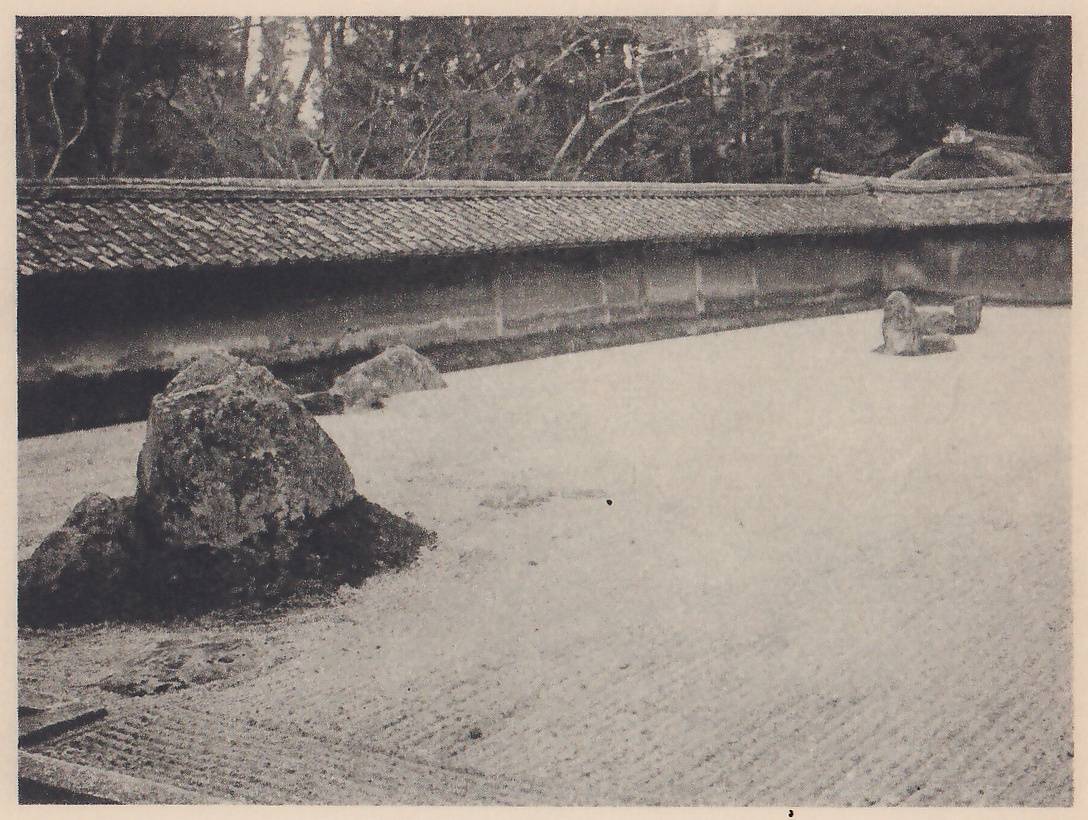
Another type of Muromachi garden that is worthy of note is hiraniwa or the flat garden. In this there is neither hill nor pond; only stones and trees are so arranged on a flat piece of ground to produce the desired effect. Symbolism often comes
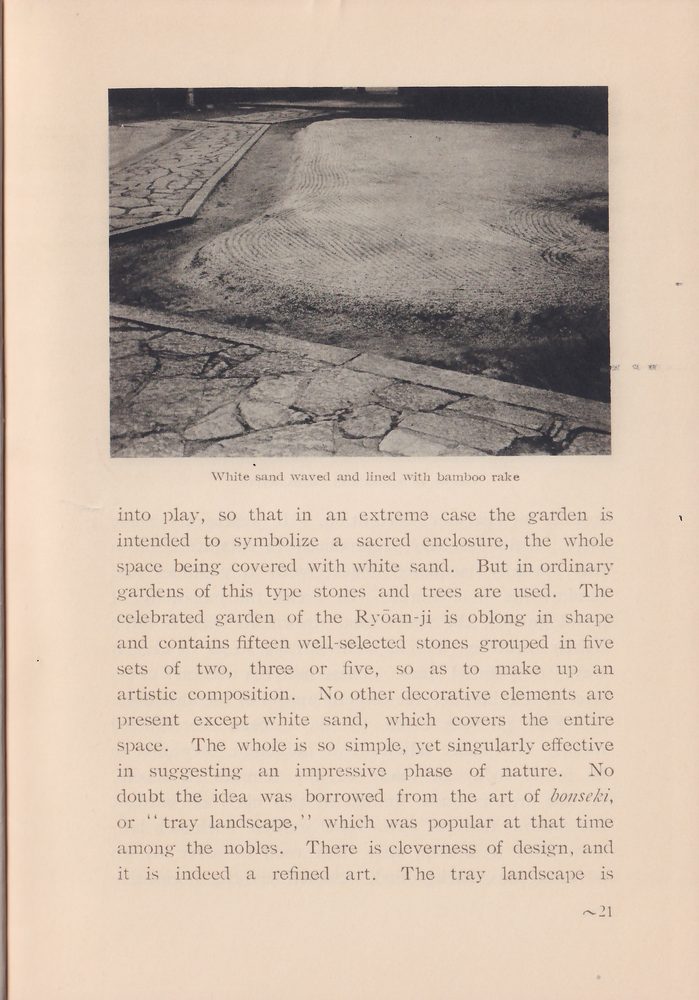
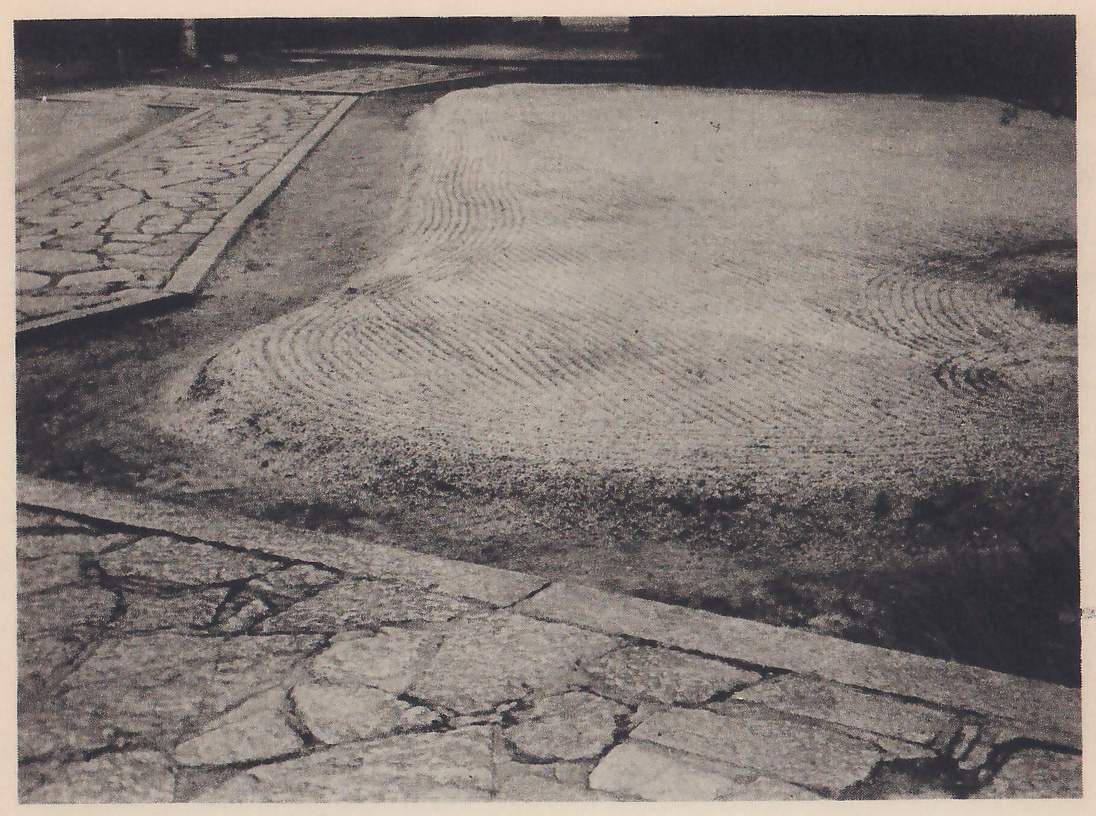
into play, so that in an extreme case the garden is intended to symbolize a sacred enclosure, the whole space being covered with white sand. But in ordinary gardens of this type stones and trees are used. The celebrated garden of the Ryōan-ji is oblong in shape and contains fifteen well-selected stones grouped in five sets of two, three or five, so as to make up an artistic composition. No other decorative elements are present except white sand, which covers the entire space. The whole is so simple, yet singularly effective in suggesting an impressive phase of nature. No doubt the idea was borrowed from the art of bonseki, or “tray landscape,” which was popular at that time among the nobles. There is cleverness of design, and it is indeed a refined art. The tray landscape is
meant for parlour decoration. It represents some piece of fine scenery, reproduced in miniature on a tray, usually lacquered black, with tiny stones and sand, white or coloured. To break the monotony of a flat garden, the white sand strewn all over is often lightly scratched with a bamboo rake so as to give it waves or parallel lines. These patterns are very effective in heightening the esthetic appeal of the ensemble.
Flat gardens seem to have been constructed usually in a space adjoining a building; they are to be found today in many of the temples in Kyoto. As the area is quite limited in this class of garden, the natural features outside the garden, such as a hill, a wood or a stream, are often used to serve as an advantageous background. Sometimes the decorative
elements within the garden are so designed as to combine with the outside scenic features, some of which are arranged to convey the impression of distance, with significant continuity to weave a fine piece like tapestry. This trick, technically called shakkei, or “borrowed scenery,” was frequently resorted to by garden designers.
Thus in the Muromachi Period (1335–1573), both the hill and flat gardens progressed, and there came, in the succeeding Momoyama Period (1573–1603), another change in the popular taste for garden-making. In that period the heroic spirit of the age found its expression in the grand scale of architecture. Castles were built in rapid succession. These were decorated with carvings and other striking features, simulating in richness of form and

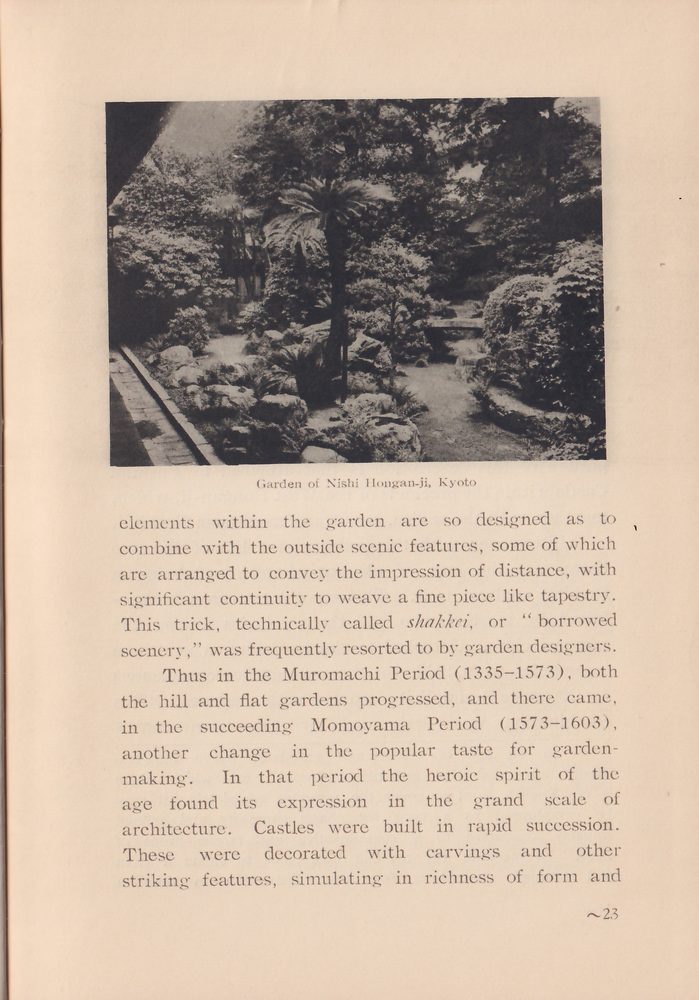
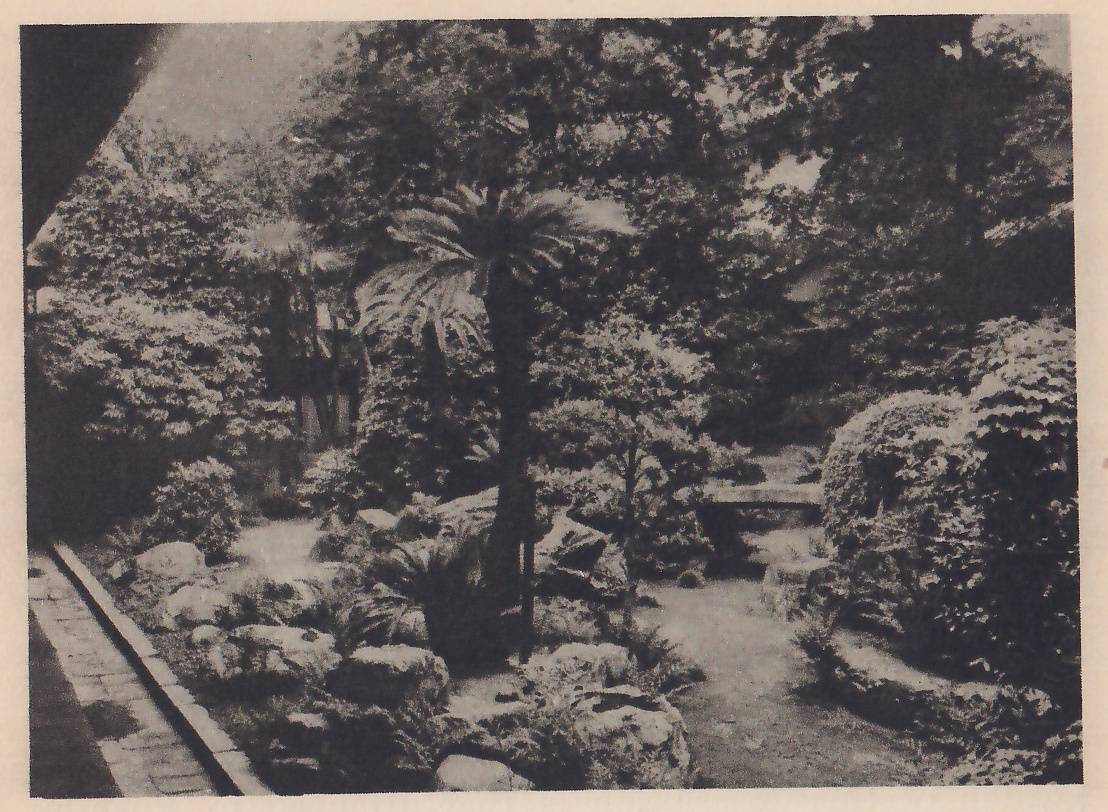
colour the luxurious architecture of the Buddhist temple. How splendid were Azuchi Castle built by Nobunaga, and the two castles of Osaka and Fushimi and Juraku Palace built by Hideyoshi, may be gathered from the fragments forming part of certain temples in Kyoto. This change of fashion in architecture naturally had its influence on gardens, the nature of which was modified to meet the new requirements in taste. The general tone of landscape gardening was transformed at a bound from that of repose, highly savouring of Zen Buddhism, to that of colour and vigour. The result was that huge stones and plants, with bold outlines such as sotetsu or the cycad were preferred as decorative features. A typical garden of this description is that attached to Fushimi Castle within the precincts of the West Hongan-ji, which, together with the edifice, was transferred from Fushimi.
Interwoven with this extravagant life of the age there was the cult of elegant simplicity forming a striking contrast to it. This was the tea ceremony professed by masters who had their votaries among the samurai class. Attached to the tea-house, where these ceremonies were held, there was a garden conspicuous for its austere simplicity coupled with elegance. This combination was designated by the term wabi.*
* In an age of colour and grandeur, Rikyū the tea-master advocated the estheticism “wabi,” for which there is no English word to cover the meaning completely. It may be paraphrased as a taste for chaste simplicity and refined frugality conducive to a contemplative and serene frame of mind. Devotees of the tea cult take pains to create a calm and tranquil atmosphere free from distraction in the tea
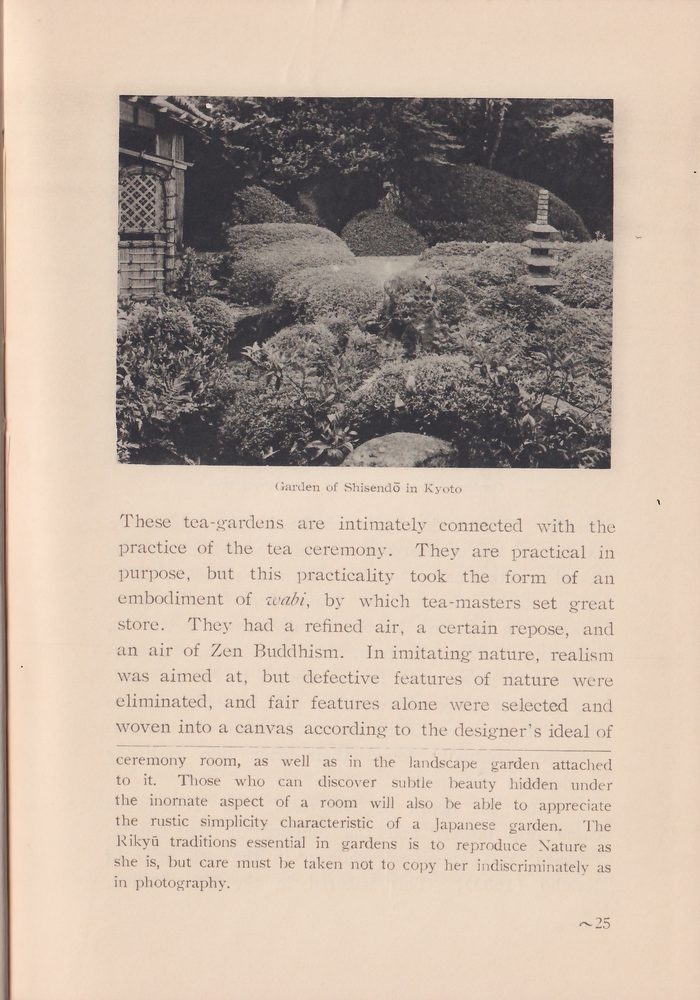
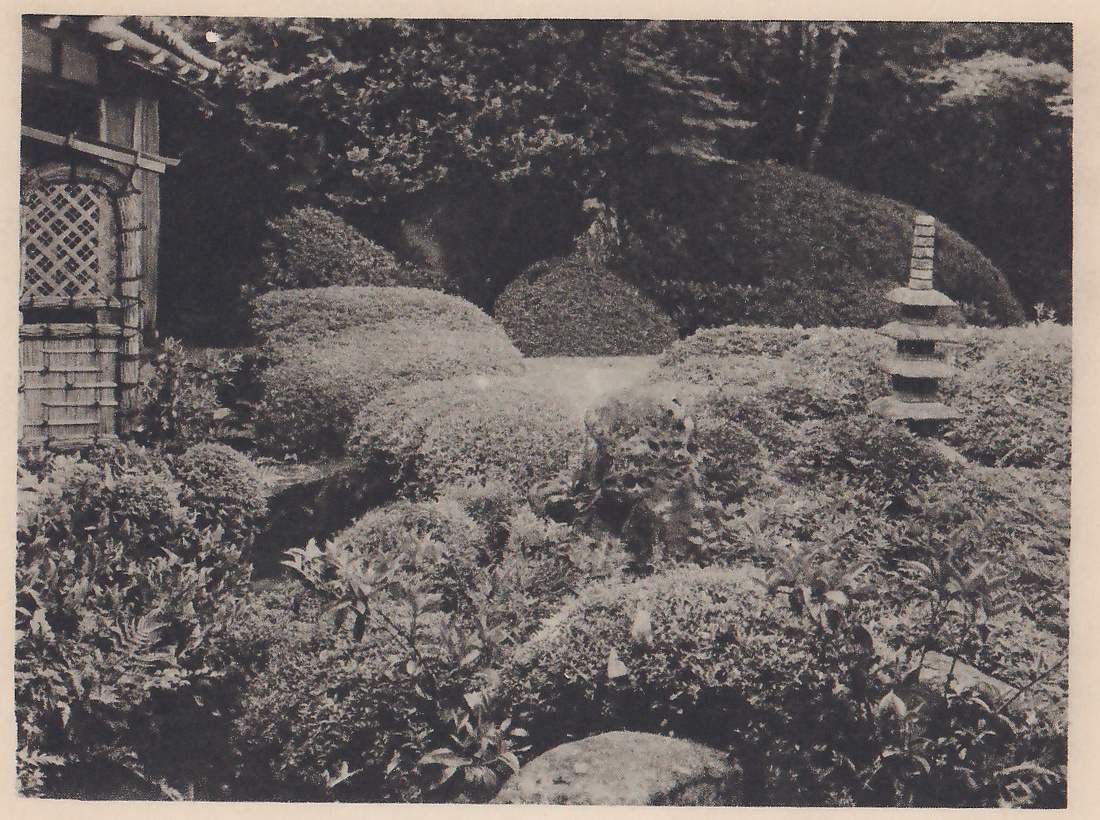
These tea-gardens are intimately connected with the practice of the tea ceremony. They are practical in purpose, but this practicality took the form of an embodiment of wabi, by which tea-masters set great store. They had a refined air, a certain repose, and an air of Zen Buddhism. In imitating nature, realism was aimed at, but defective features of nature were eliminated, and fair features alone were selected and woven into a canvas according to the designer’s ideal of
ceremony room, as well as in the landscape garden attached to it. Those who can discover subtle beauty hidden under the inornate aspect of a room will also be able to appreciate the rustic simplicity characteristic of a Japanese garden. The Rikyū traditions essential in gardens is to reproduce Nature as she is, but care must be taken not to copy her indiscriminately as in photography.
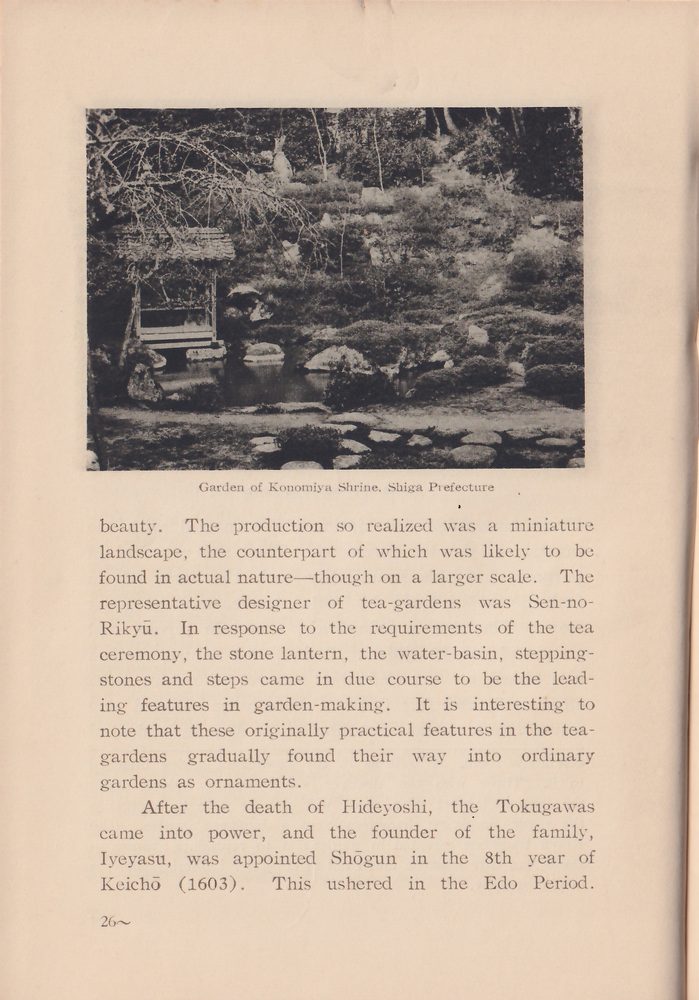
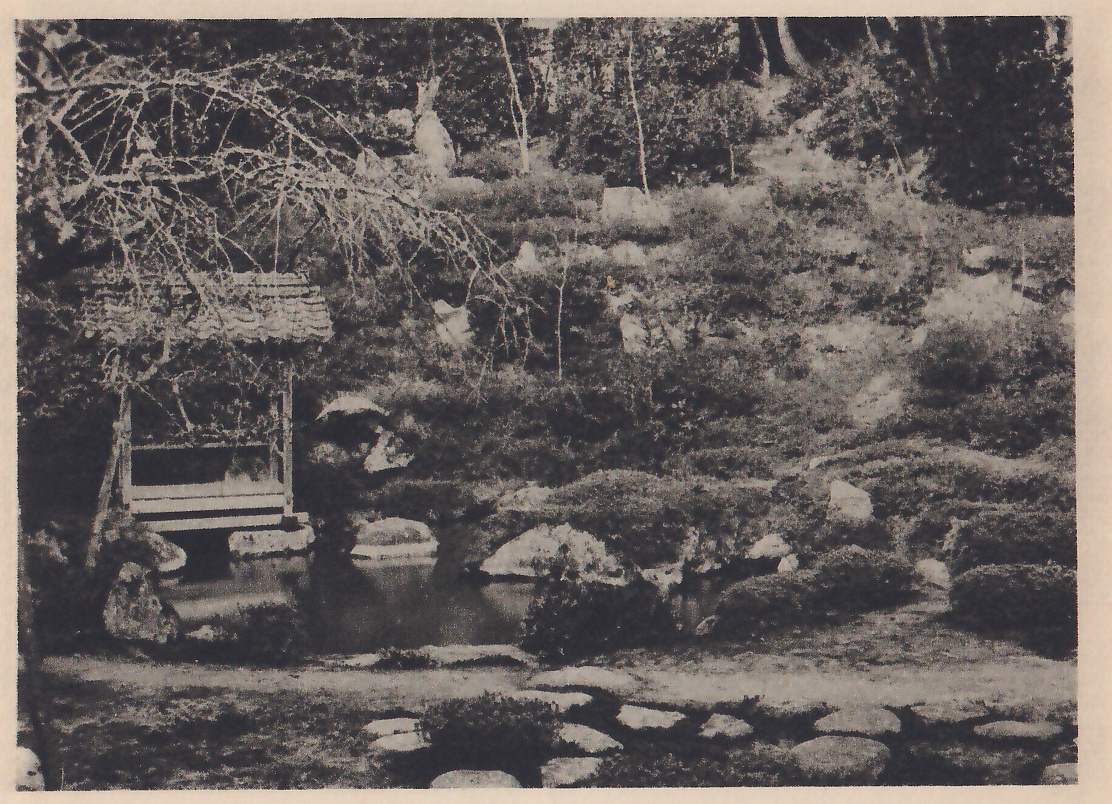
beauty. The production so realized was a miniature landscape, the counterpart of which was likely to be found in actual nature—though on a larger scale. The representative designer of tea-gardens was Sen-no-Rikyū. In response to the requirements of the tea ceremony, the stone lantern, the water-basin, stepping-stones and steps came in due course to be the leading features in garden-making. It is interesting to note that these originally practical features in the tea-gardens gradually found their way into ordinary gardens as ornaments.
After the death of Hideyoshi, the Tokugawas came into power, and the founder of the family, Iyeyasu, was appointed Shōgun in the 8th year of Keichō (1603). This ushered in the Edo Period.
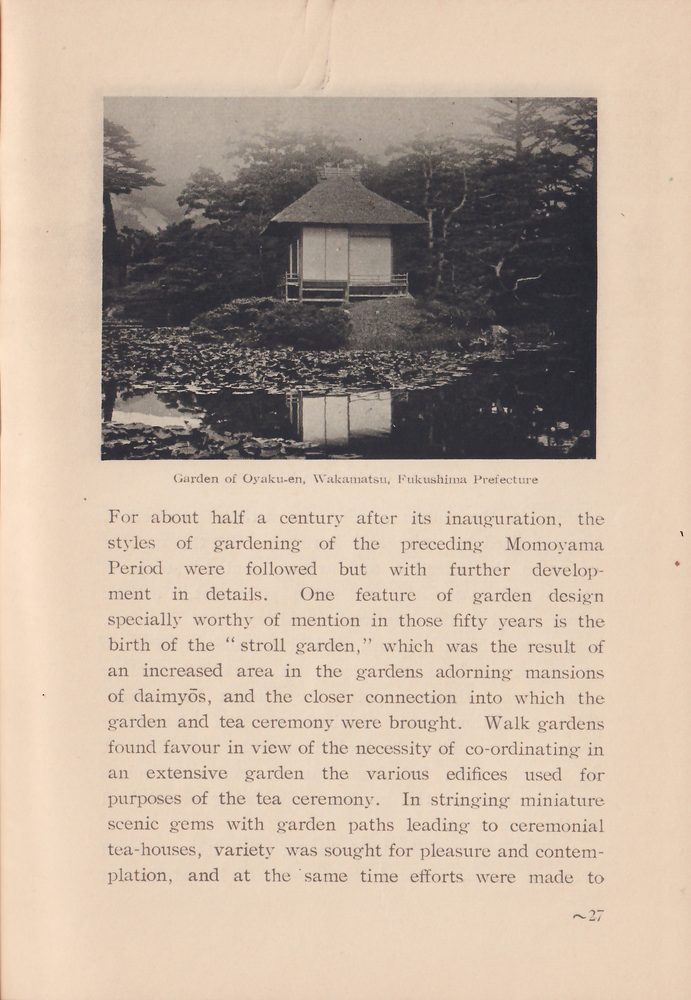
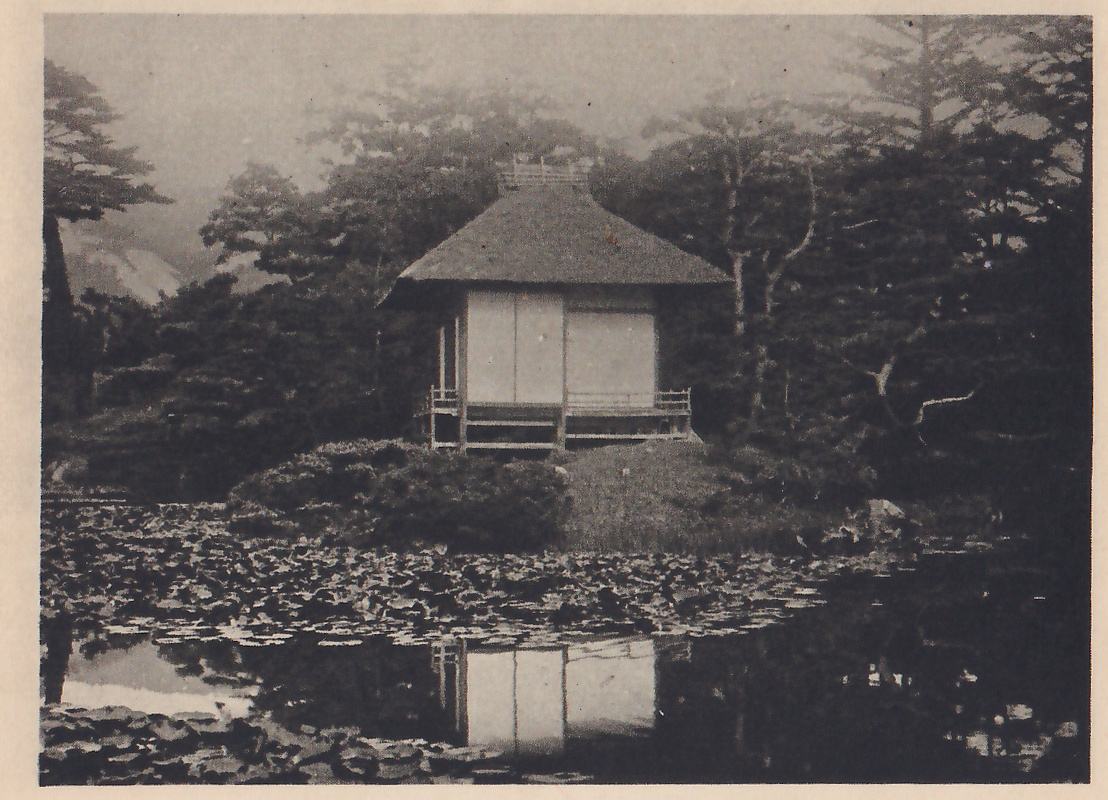
For about half a century after its inauguration, the styles of gardening of the preceding Momoyama Period were followed but with further development in details. One feature of garden design specially worthy of mention in those fifty years is the birth of the “stroll garden,” which was the result of an increased area in the gardens adorning mansions of daimyōs, and the closer connection into which the garden and tea ceremony were brought. Walk gardens found favour in view of the necessity of co-ordinating in an extensive garden the various edifices used for purposes of the tea ceremony. In stringing miniature scenic gems with garden paths leading to ceremonial tea-houses, variety was sought for pleasure and contemplation, and at the same time efforts were made to
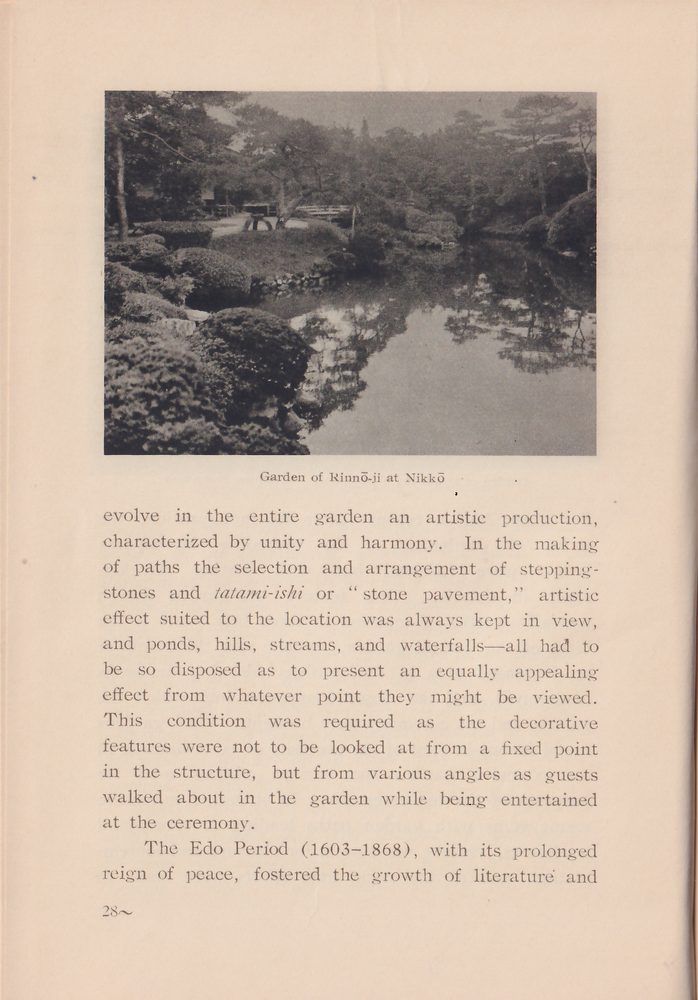
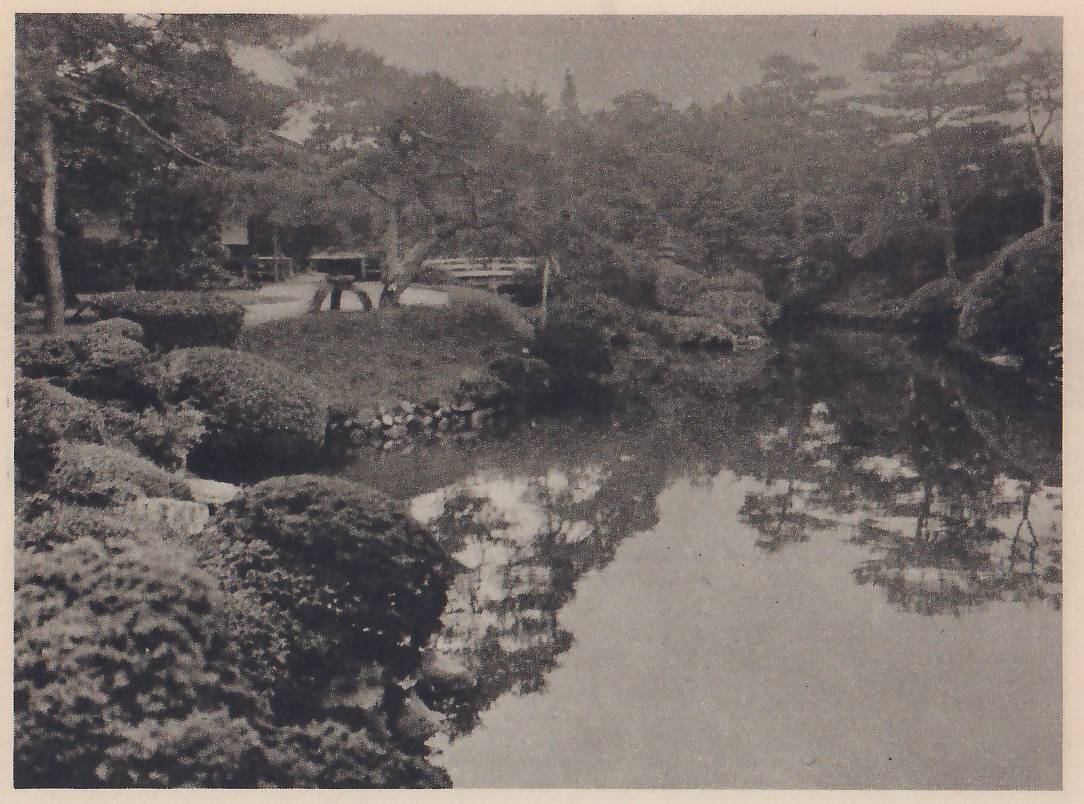
evolve in the entire garden an artistic production, characterized by unity and harmony. In the making of paths the selection and arrangement of stepping-stones and tatami-ishi or “stone pavement,” artistic effect suited to the location was always kept in view, and ponds, hills, streams, and waterfalls—all had to be so disposed as to present an equally appealing effect from whatever point they might be viewed. This condition was required as the decorative features were not to be looked at from a fixed point in the structure, but from various angles as guests walked about in the garden while being entertained at the ceremony.
The Edo Period (1603–1868), with its prolonged reign of peace, fostered the growth of literature and
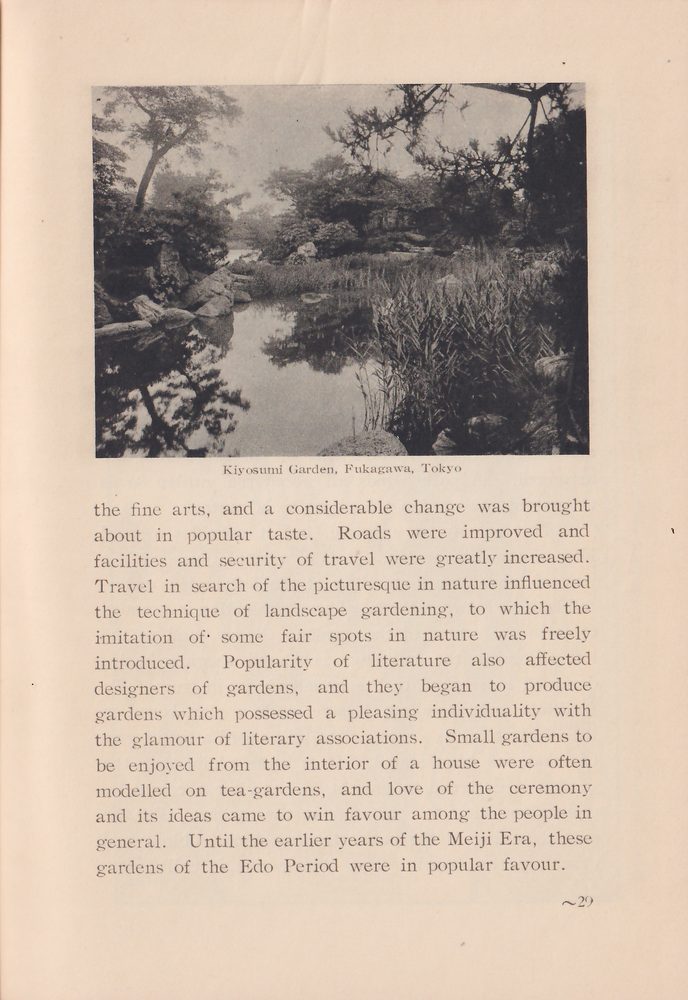
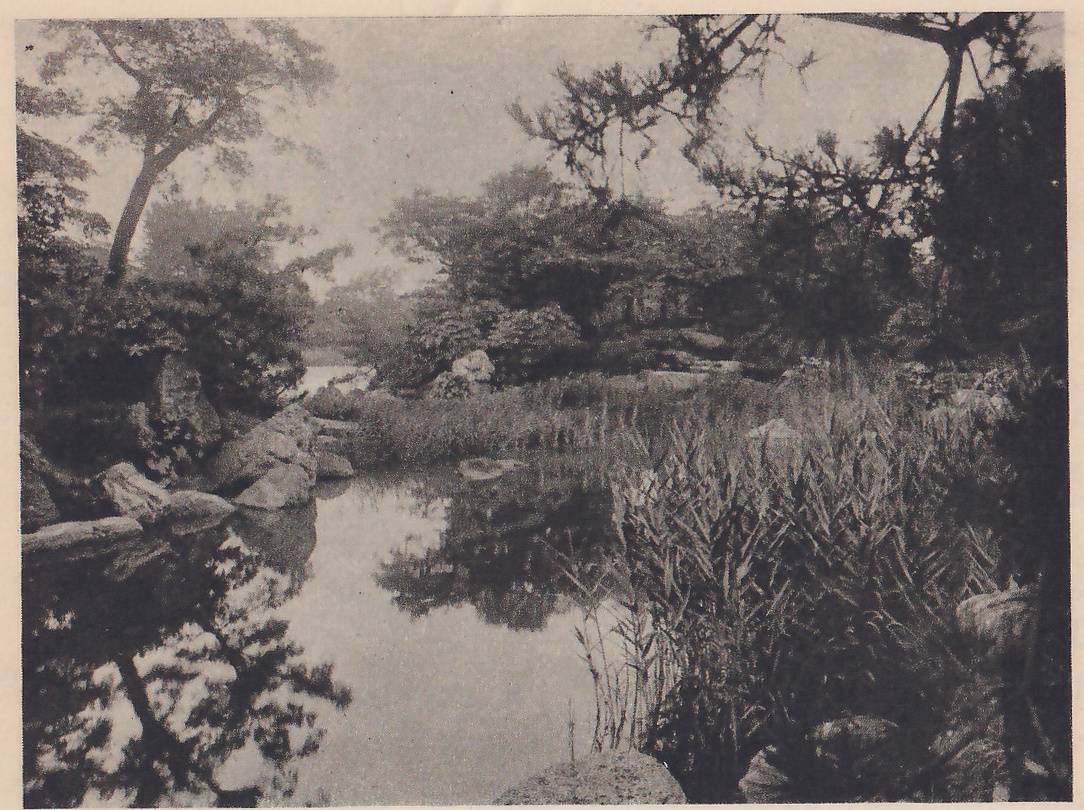
the fine arts, and a considerable change was brought about in popular taste. Roads were improved and facilities and security of travel were greatly increased. Travel in search of the picturesque in nature influenced the technique of landscape gardening, to which the imitation of some fair spots in nature was freely introduced. Popularity of literature also affected designers of gardens, and they began to produce gardens which possessed a pleasing individuality with the glamour of literary associations. Small gardens to be enjoyed from the interior of a house were often modelled on tea-gardens, and love of the ceremony and its ideas came to win favour among the people in general. Until the earlier years of the Meiji Era, these gardens of the Edo Period were in popular favour.