
IV PLACES NOTED FOR CHERRY BLOSSOM
In addition to those places noted for cherry flowers since early times, there are many other places that have risen to fame in our modern era for a similar reason, and on that account are frequented by flower-loving people or holiday-makers in springtime. The following description covers only the more prominent cherry resorts, either old or new:—
1 Yoshinoyama
The famous cherry groves of Yoshino are on Mount Yoshino in Yamato province (Nara Prefecture), and the oldest of their kind boast of a long history of over one thousand years. The place can now be easily reached by electric-car or motor-car. There is also the convenience of cable-cars in the mountain. The cherry groves extend for approximately 4 miles and contain tens of thousands of cherries, all being of the white mountain cherries belonging to that group known as the Yoshino form. The cherry groves at Yoshino are divided into several groups or sections. The section called Hitome-sembon or “one thousand cherries at a glance”, where the cherry trees are most numerous, is the chief attraction, and the most noted. They are followed by other sections called Naka-no-sembon, Kami-no-sembon and Oku-no-sembon respectively. The flowers at Hitome-sembon and Naka-no-sembon are surpassingly beautiful, and in the flower season present a superb sight. Surely the places are worth while
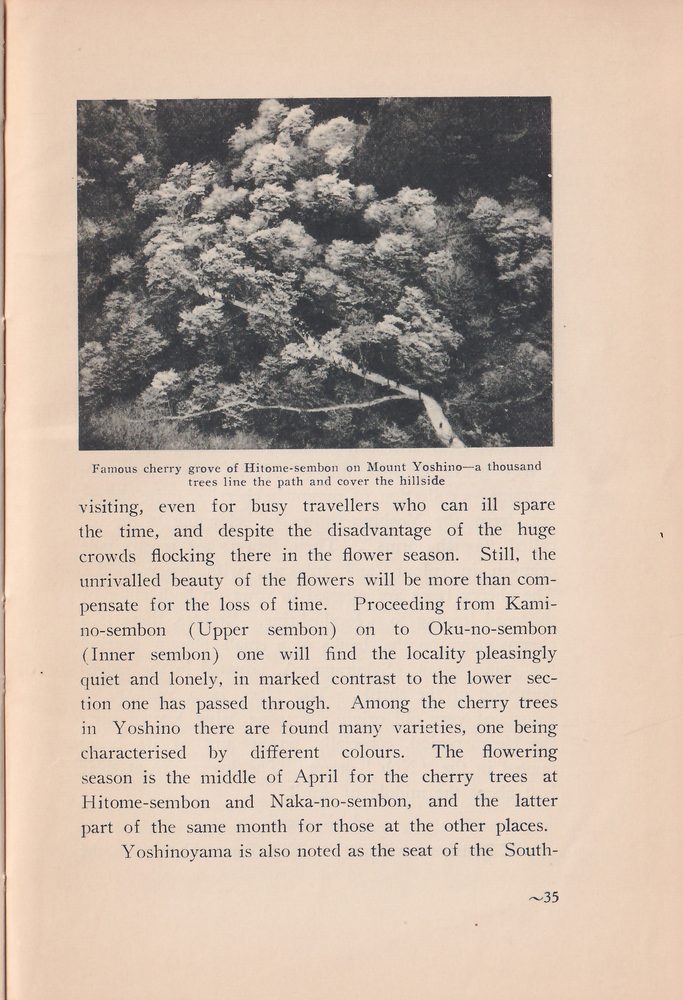
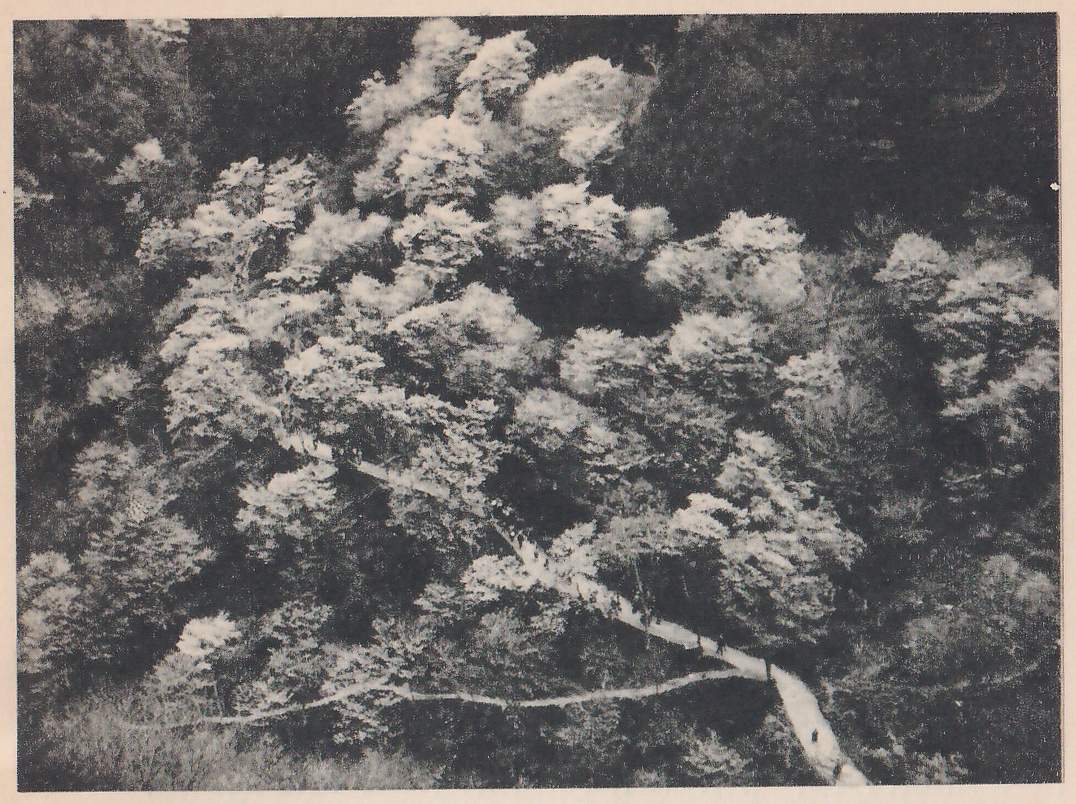
visiting, even for busy travellers who can ill spare the time, and despite the disadvantage of the huge crowds flocking there in the flower season. Still, the unrivalled beauty of the flowers will be more than compensate for the loss of time. Proceeding from Kami-no-sembon (Upper sembon) on to Oku-no-sembon (Inner sembon) one will find the locality pleasingly quiet and lonely, in marked contrast to the lower section one has passed through. Among the cherry trees in Yoshino there are found many varieties, one being characterised by different colours. The flowering season is the middle of April for the cherry trees at Hitome-sembon and Naka-no-sembon, and the latter part of the same month for those at the other places.
Yoshinoyama is also noted as the seat of the South-
ern Court established there during the turbulent days of the drawn-out civil wars in the reign of Emperor Godaigo, and its name stands out prominently in the ancient history of the Empire.
2 Sakuragawa
These cherry groves are in Higashi-Nakamura, a village in Nishi-Ibaraki County, Ibaraki Prefecture. The place can be reached in a few hours by train from Tokyo, plus the aid of a motor-car. To be more precise, by taking a train for Mito leaving the Oyama station on the Tōhoku (north-eastern) Line of the Government Railways, the visitor will alight either at Iwase or Haguro station, whence about one mile’s ride in a motor-car will bring him to Sakuragawa. The cherry grove consists mostly of the white mountain cherries—a collection of mountain cherries, quite different from the Yoshino form, but belonging to the so-called “north forms”. Their flowers are mostly pale crimson in colour, and fragrant, with hairy stalks. The cherry trees are planted in rows on both sides of the road leading to a local shrine. Besides, there is a cherry grove on the banks of a small stream bearing the same name (Sakuragawa), situated in the neighbourhood of the shrine. The place is a well-known resort of very old origin, its name being known since the Heian period, especially on account of its being quoted in the “Noh” drama. The flowers are at their best about the middle of April.
3 Koganei
Koganei, a village in Kita-Tama County in the
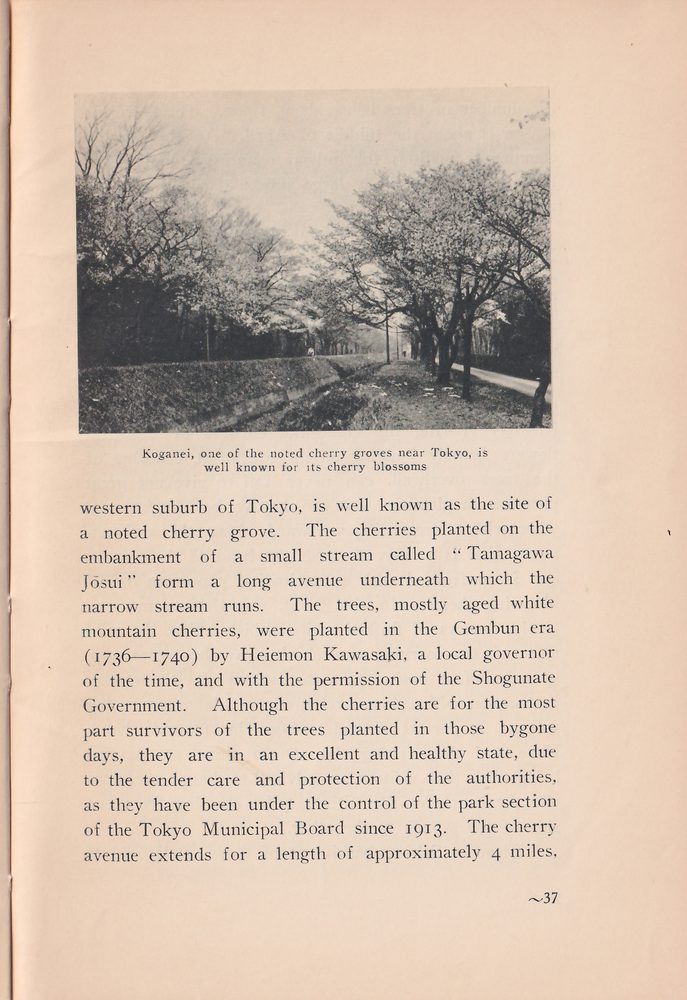
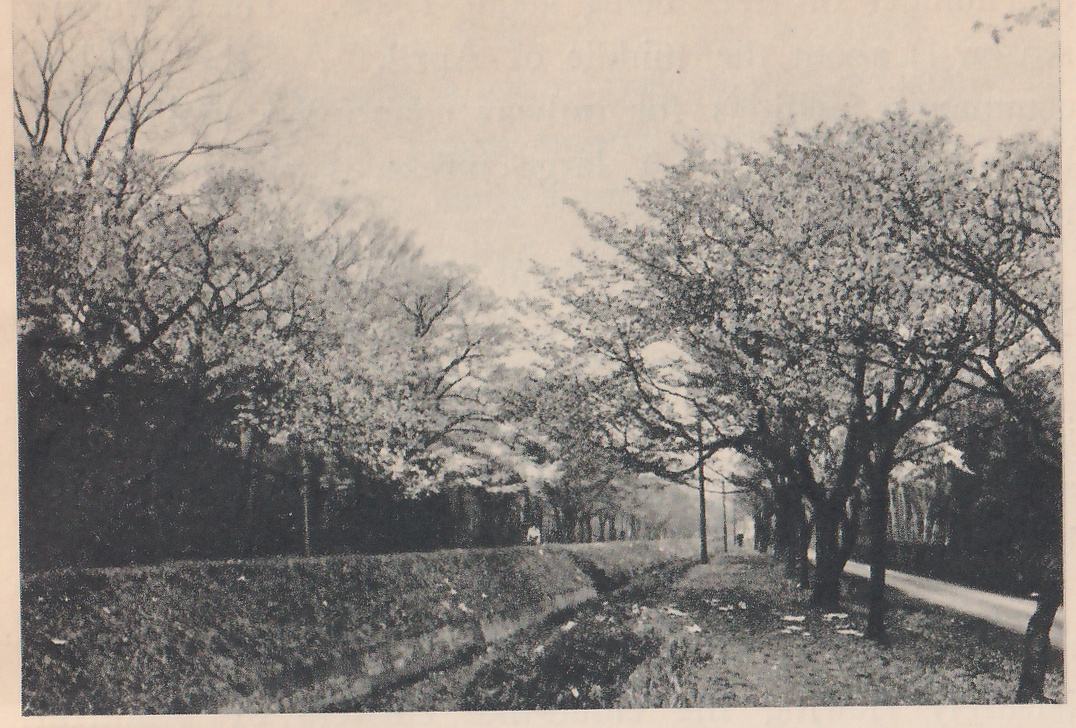
western suburb of Tokyo, is well known as the site of a noted cherry grove. The cherries planted on the embankment of a small stream called “Tamagawa Jōsui” form a long avenue underneath which the narrow stream runs. The trees, mostly aged white mountain cherries, were planted in the Gembun era (1736—1740) by Heiemon Kawasaki, a local governor of the time, and with the permission of the Shogunate Government. Although the cherries are for the most part survivors of the trees planted in those bygone days, they are in an excellent and healthy state, due to the tender care and protection of the authorities, as they have been under the control of the park section of the Tokyo Municipal Board since 1913. The cherry avenue extends for a length of approximately 4 miles,
the number of trees being about 1,500. The flowering season is about the middle of April. As the locality commands facilities for railway connection, motor-cars, buses, etc. there is a large influx of visitors during the season.
Koganei is within about 2/3 of a mile from Musashi-Sakai station on the ChūōPrinted: Chuō Line of the Government Railways, on which run electric trains at regular intervals. The distance between MusashiPrinted: Musahi-Sakai station and the cherry avenue can be covered in about 5 minutes by motor-car.
A stroll beneath the long avenue of blooming cherries which skirts the straggling rivulet, while leisurely viewing the cloud-like clusters of beautiful flowers heavily hanging on the overladen branches of the trees overhead, can never fail to give one great pleasure—a pleasure that can hardly be sought anywhere else. Proceeding westward along the embankment, that is to say, towards the head of the stream, one is confronted with a fascinating panorama of the blooming cherries to the front, one glorious mass of lovely flowers of flushed white, which reflect the mild rays of the morning sun shining in the azure sky, spreads before one’s eyes a vast screen of rich tapestry interwoven with crimson-coloured or pale green young foliage, a perfect brocade woven by nature’s hand. Here and there along the stream there are several bridges, so that visitors are advised to change occasionally the course of their itinerary by crossing from one side of the stream to the other.
Close to Seki-no-bashi, one of those small bridges
spanning the stream, there is, on the northern (right) bank of the stream, a giant tree named “Hinode-no-sakura.” In the flower season every twig and bough is laden with fleecy white flowers, which, intermingled with the crimson-coloured young leaves, offer one of nature’s most marvellous works. The trees on the upper reaches of the stream are mostly aged ones, greater in size than those on the lower course. These were planted over a century ago and are the giants of theirPrinted: thier species. When one proceeds the way leads to Kogane-bashi, another bridge which spans the stream at a point about the middle of the long cherry avenue. This spot attracts large crowds of holiday-makers in the flower season. On the northern bank near the bridge there stands a monument erected in memory of Emperor Meiji who visited the district on April 23 in the 16th of His Majesty’s reign (1883).
The cherry avenue on the upper reaches beyond Kogane-bashi extends for about two miles. The surrounding country is a peaceful slumbering hamlet with picturesque scenery in the background.
Tradition says the trees at Koganei were brought partly from Yoshinoyama and partly from Sakuragawa in olden days, and transplanted there. This may be true, for some difference is noticeable among the trees in respect of the colour of young leaves, the size of petals, the form of the corolla, the flowering season, etc., one tree differing from another in glory.
Again, among the trees at Koganei, there are not a few fragrant cherries. One who happens to walk under or pass by one of such trees will notice it on
account of the sweet smell which the flowers emit, which is conveyed to one’s nostrils by the gentle breeze. On such a tree one may find numberless bees, or other honey-hunting winged insects, buzzing and humming among the clusters of flowers. In a word, therefore, Koganei in the cherry season is a veritable miniature exhibition of nature’s handiwork.
The flowering season at Koganei begins about the middle of April and lasts about a week.
4 Arakawa-tsutsumi
As to the kinds of cherries on the Arakawa embankment, and the origin of this noted cherry resort, mention has been made in the previous section. At a certain section of the embankment where reconstruction
work was carried out in 1917 the trees were removed and taken elsewhere. The rest are preserved and exist in three separate groups which form an avenue on the embankment of the Arakawa.
Busy motor traffic on the embankment in recent years has done much harm to the trees, so that measures are being taken for their protection, and with a view to replacing old damaged trees by young ones, replanting has been started. The flowering season begins about April 20.
5 Arashiyama
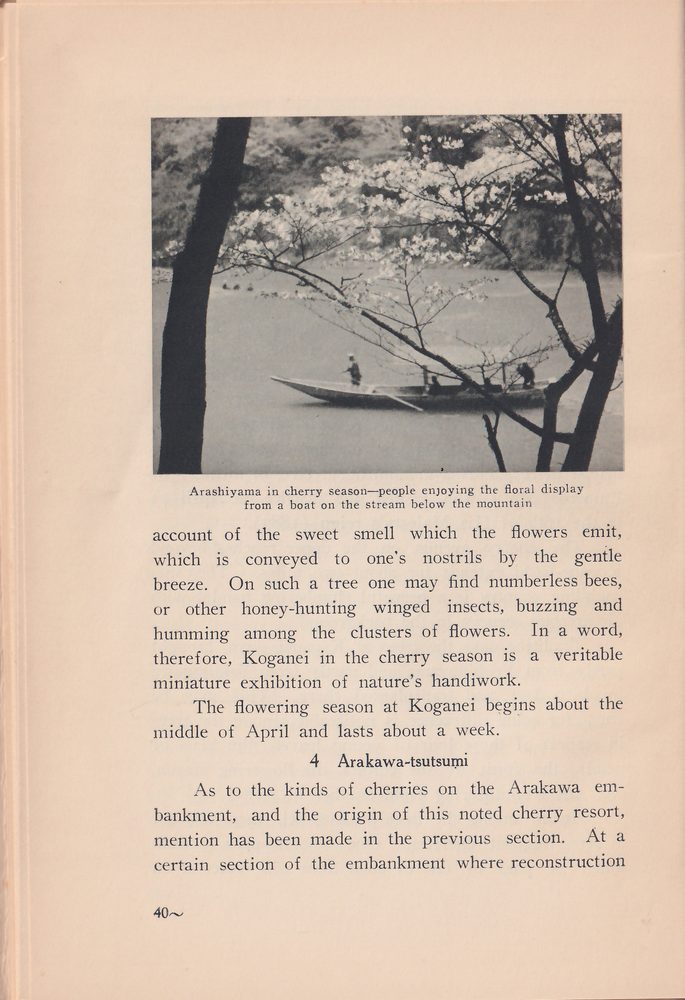
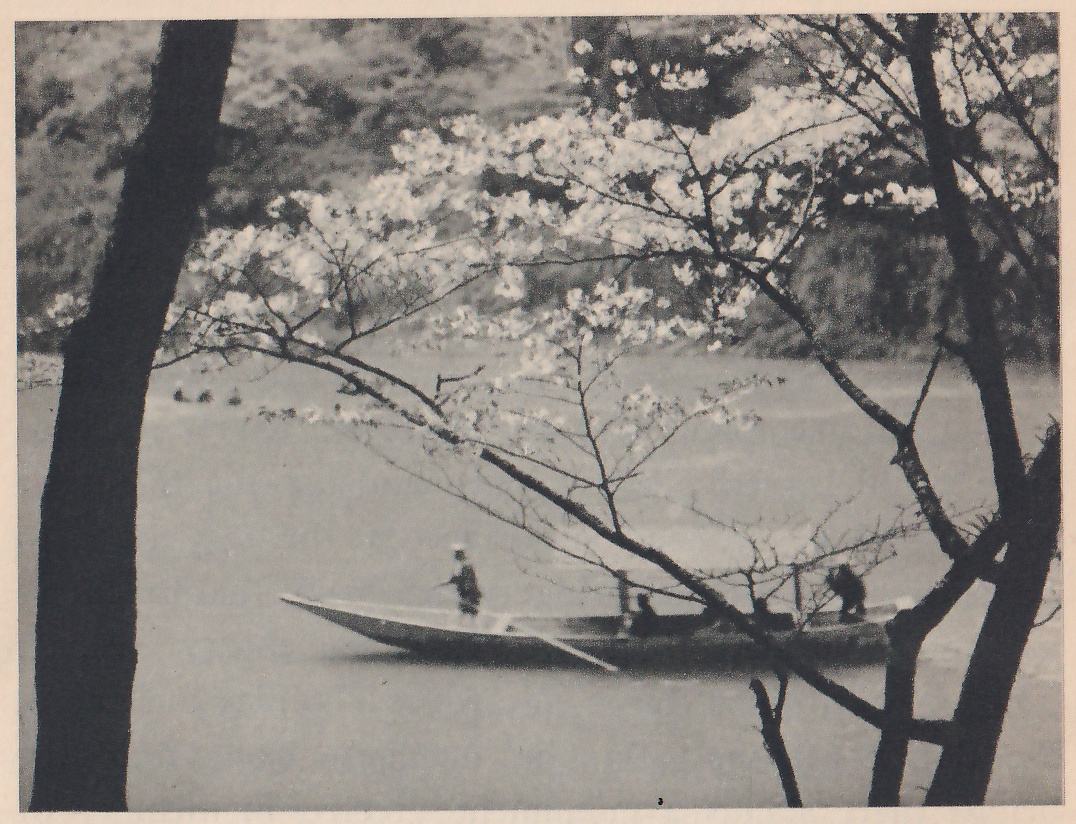
Arashiyama or Mount Arashi (very often called Ranzan) is situated on the western bank of the Katsuragawa (Katsura River) flowing through the western
section of Kyoto City. The place is noted for its beauty as well as for the glory of the cherry flowers. The woodland abounds in Yama-zakura, or mountain cherries, which were transplanted from other places in ancient times. The flowering season here begins after April 10. Many old trees have died in recent years, and re-afforestation has recently been started on a large scale with a view to making Arashiyama an excellent beauty spot for mountain cherries.
6 Omuro
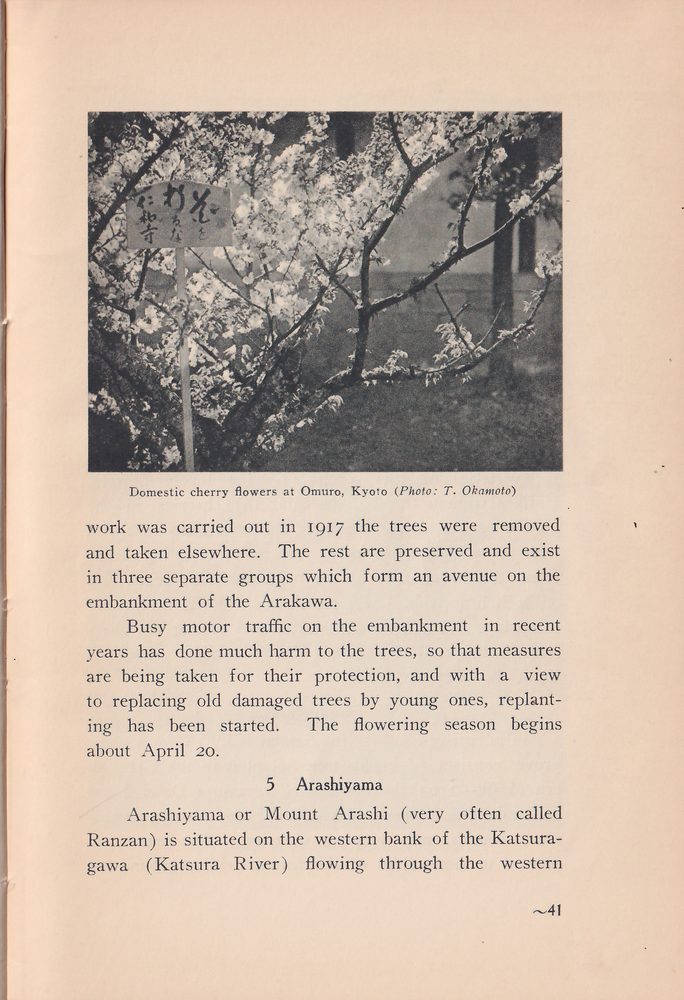
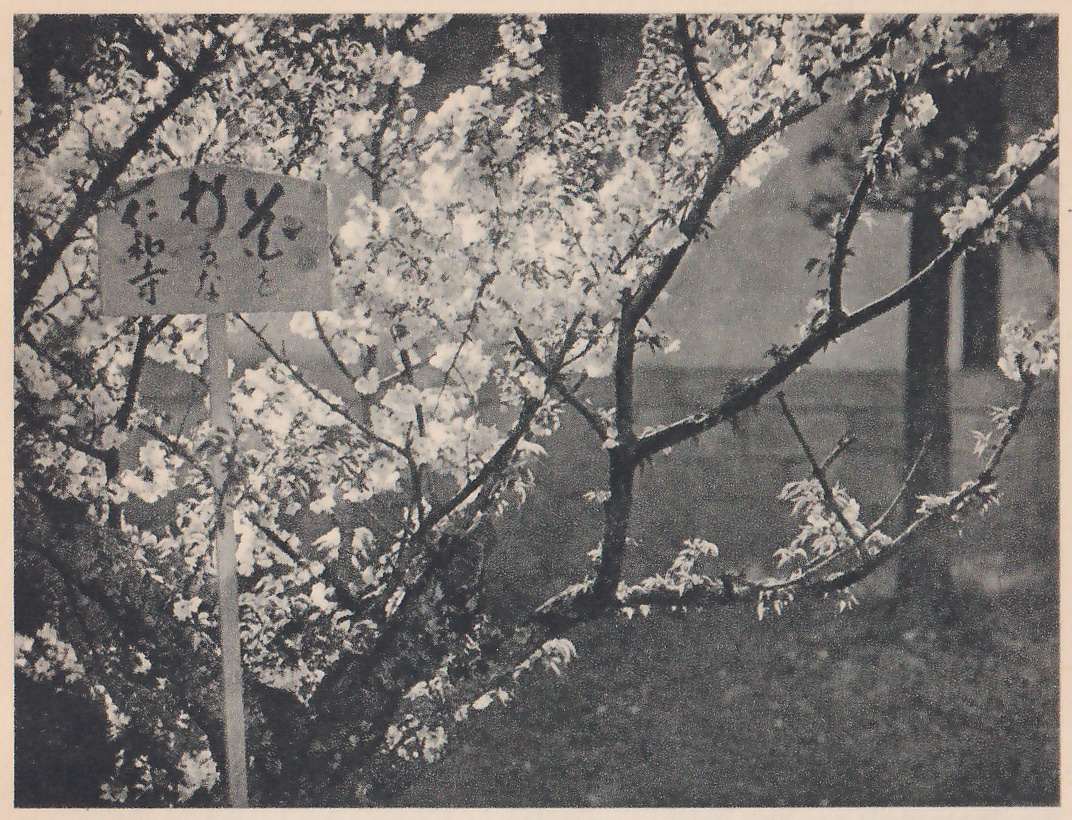
The cherries in the compounds of the Ninna-ji Temple, an ancient Buddhist temple in Kyoto, have been famed since very olden times as a collection of fine Sato-zakura, or domestic cherries. They are beautiful varieties of this species, bearing lovely flowers. Unlike common trees of the kind the cherries in the garden of the temple resemble rhododendrons in form, with many slender branches or stems shooting forth from the lower part of the trunk near the roots, and on each branch and twig the flowers bloom in clusters in spring. The trees find no parallel among the cherries of this kind elsewhere. The flowering season is about the 20th of April.
7 Tsutsuji-ga-oka
Tsutsuji-ga-oka is in Sendai City. The cherry grove consists of aged trees planted in the Genroku era (1688—1703) by order of Tsunamura Date, Lord of Sendai fief, an assemblage of Higan-zakura, or equinox cherries and weeping cherries. The trees are planted on both sides of the former riding-ground or
race-course, and form an avenue. The colour of the flowers is either white or pale crimson. Such a large group of giant trees of the kind is found nowhere else. The flowering season is the latter part of April.
8 Kumagaya-tsutsumi
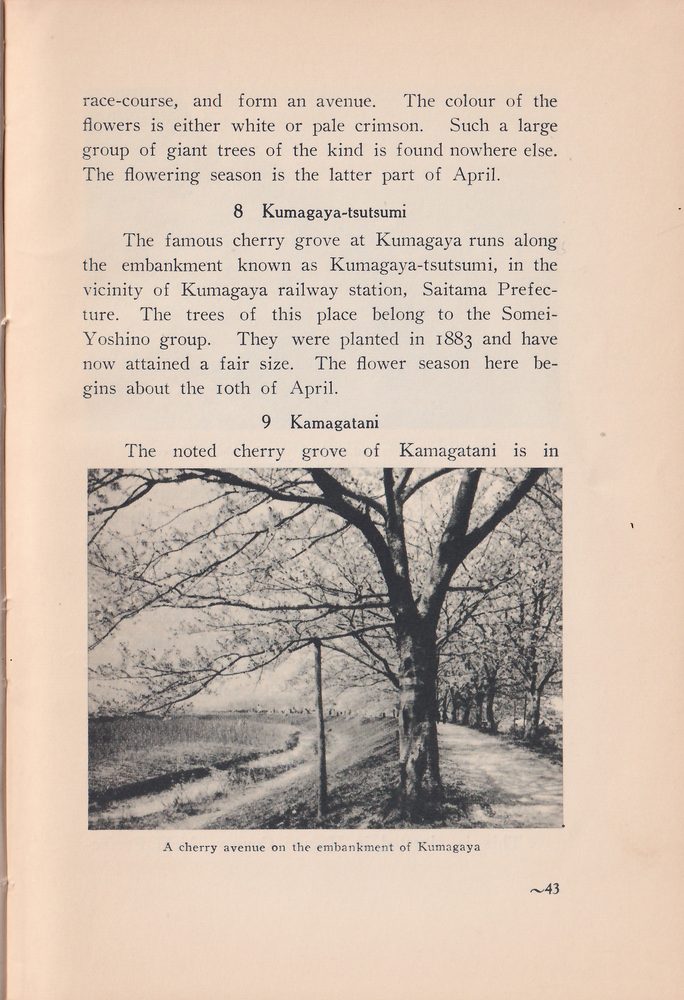
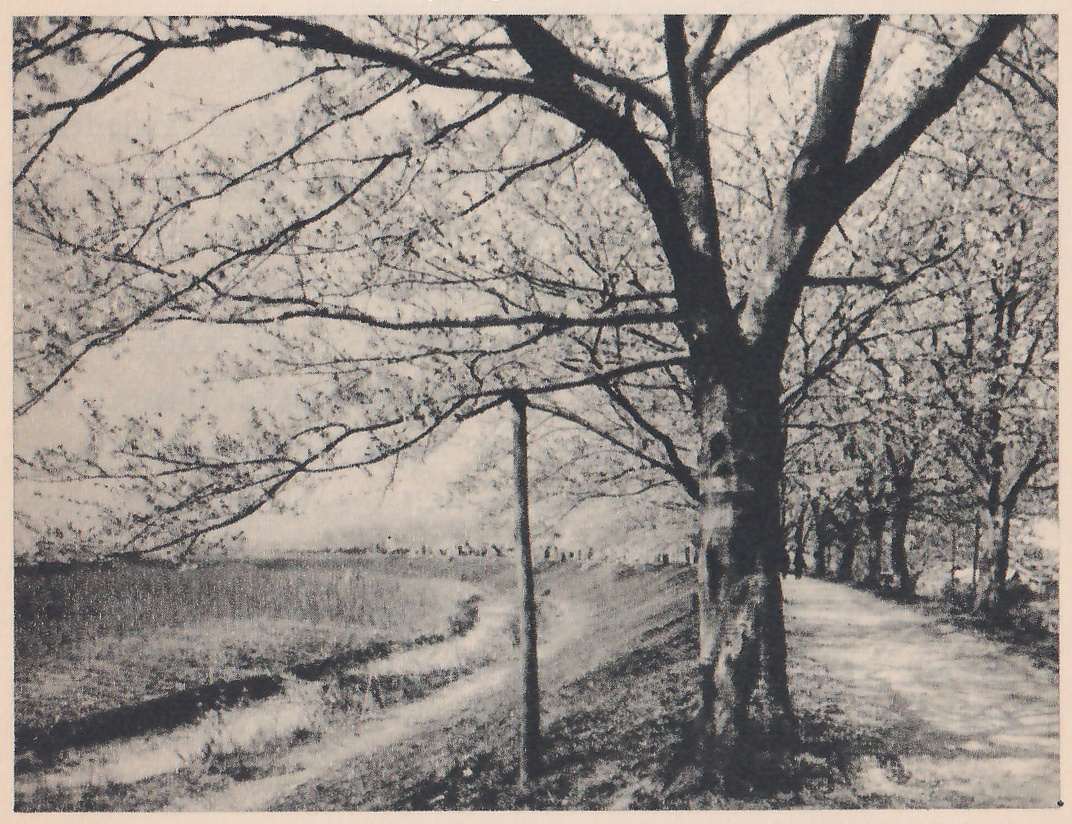
The famous cherry grove at Kumagaya runs along the embankment known as Kumagaya-tsutsumi, in the vicinity of Kumagaya railway station, Saitama Prefecture. The trees of this place belong to the Somei-Yoshino group. They were planted in 1883 and have now attained a fair size. The flower season here begins about the 10th of April.
9 Kamagatani
The noted cherry grove of Kamagatani is in
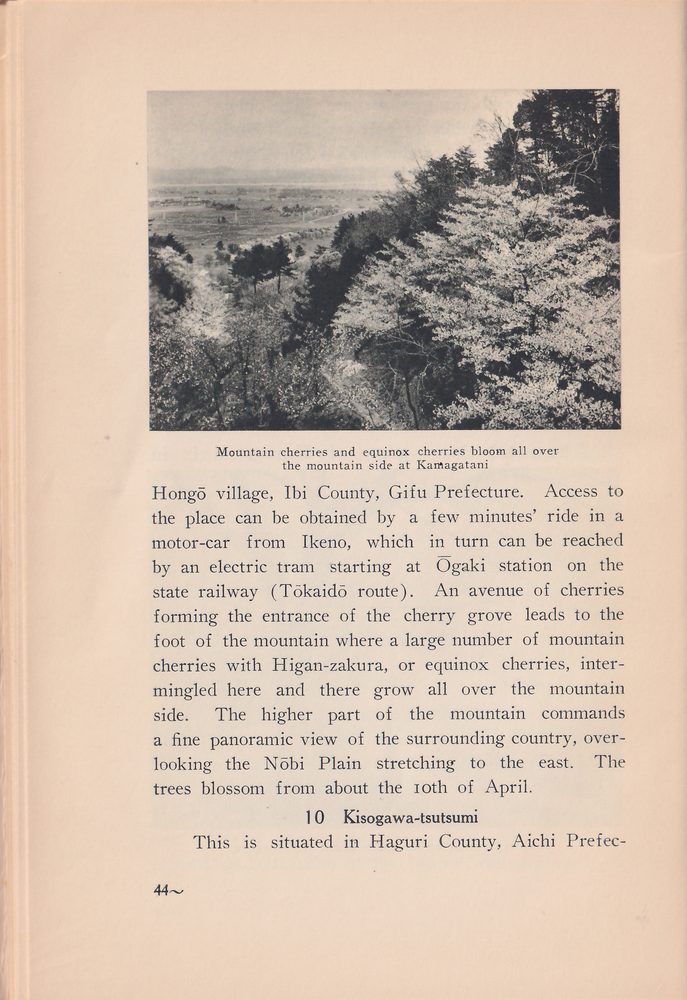
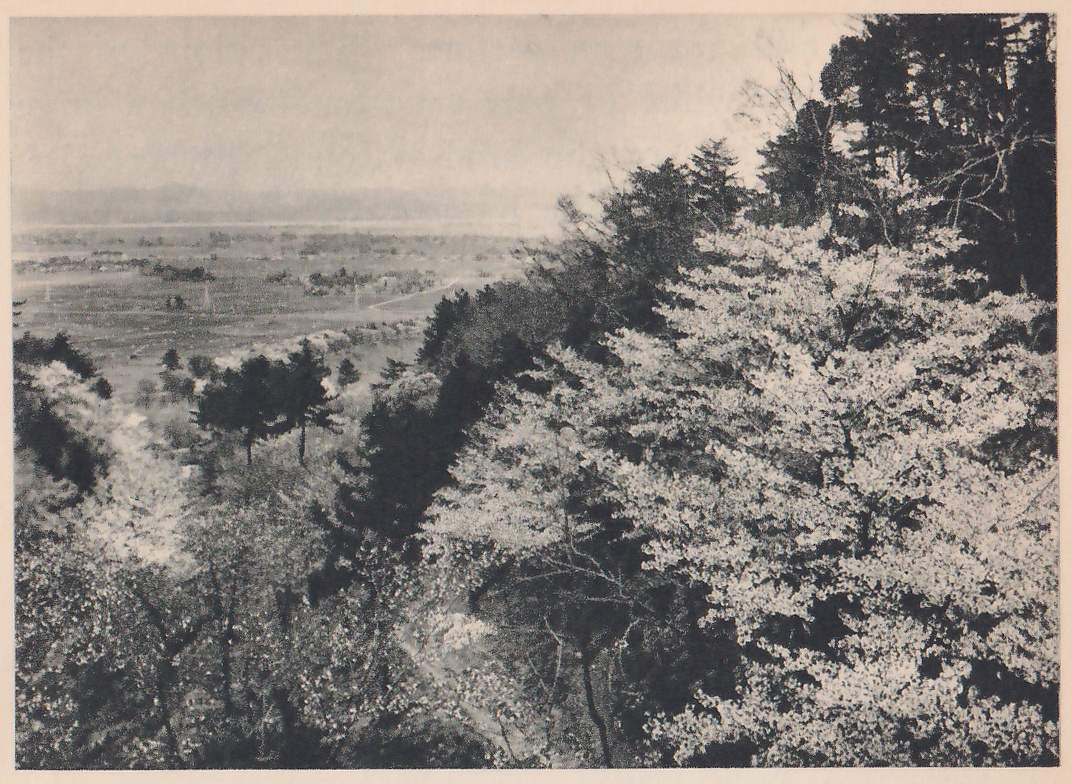
Hongō village, Ibi County, Gifu Prefecture. Access to the place can be obtained by a few minutes’ ride in a motor-car from Ikeno, which in turn can be reached by an electric tram starting at Ōgaki station on the state railway (Tōkaidō route). An avenue of cherries forming the entrance of the cherry grove leads to the foot of the mountain where a large number of mountain cherries with Higan-zakura, or equinox cherries, intermingled here and there grow all over the mountain side. The higher part of the mountain commands a fine panoramic view of the surrounding country, overlooking the Nōbi Plain stretching to the east. The trees blossom from about the 10th of April.
10 Kisogawa-tsutsumi
This is situated in Haguri County, Aichi Prefec-
ture, and is close to the Kisogawa station of the state railway line on the TōkaidōPrinted: Tokaidō route. On the embankment along the River Kiso are planted a large number of cherries consisting mostly of Higan-zakura, or equinox cherries, and Shidare-zakura, or weeping cherries, with some mountain cherries, all forming a long avenue extending about 5 miles. The trees were planted in 1885 and have since attained full growth. In flower season, the embankment is a flower-show in itself. The season is about the middle of April.
Each of the noted places listed above has been designated as protected by law, either on account of the excellence of its floral beauty or because of its great age. Besides these, there exist throughout the land quite a number of places famed for the beauty of their cherry blossom, most of which are, however, of comparatively recent origin, the trees belonging, for the greater part, to Somei-Yoshino. The cherry groves on the bank of the Edo-gawa in Tokyo, and those at Inada in the neighbourhood of Yokohama, at Kowakudani in Hakone, on the Kaji-kawa embankment near Shibata, Niigata Prefecture, on Kaiseizan in Kōriyama, Fukushima Prefecture, and in other places, are all cherry resorts of local fame. Of the above-mentioned places, the grove on Kaiseizan contains splendid trees of Somei-Yoshino and a large number of Yama-zakura and Higan-zakura, all planted in the early years of the Meiji era.