
II VARIOUS KINDS OF CHERRIES
True to the name “Cherry Land” Japan is rich in species of cherry trees. A brief description of the principal kinds is as follows:—
(1) Yama-zakura (the Mountain Cherries)
These grow in mountain forests and are subdivided into two large groups:
(a) Shiro-Yamazakura (the White Mountain Cherries; Prunus mutabilis)
These are the commonest species of all Japanese cherries and are found almost everywhere throughout the length and breadth of the land, i. e. from the north-eastern end to the south-western extremity of the country. They attain a great height and a giant size, and frequently live to the age of several hundred years. White flowers are common. Of course, some difference is noticeable in the size of petals and the forms of trees. A great variety in the colour of the young foliage in different individual trees is the characteristic feature peculiar to this species, some being reddish, others yellowish-brown and others green. Young leaves burst out almost at the same time as the flower buds, and present a unique and beautiful sight. Some kinds have hairy peduncles or flower-stalks; others have fragrant flowers.
(b) Beni-Yamazakura (the Red Mountain Cherries; Prunus sachalinensis)
This species has crimson-coloured flowers, from which the name is derived. Its characteristic is the
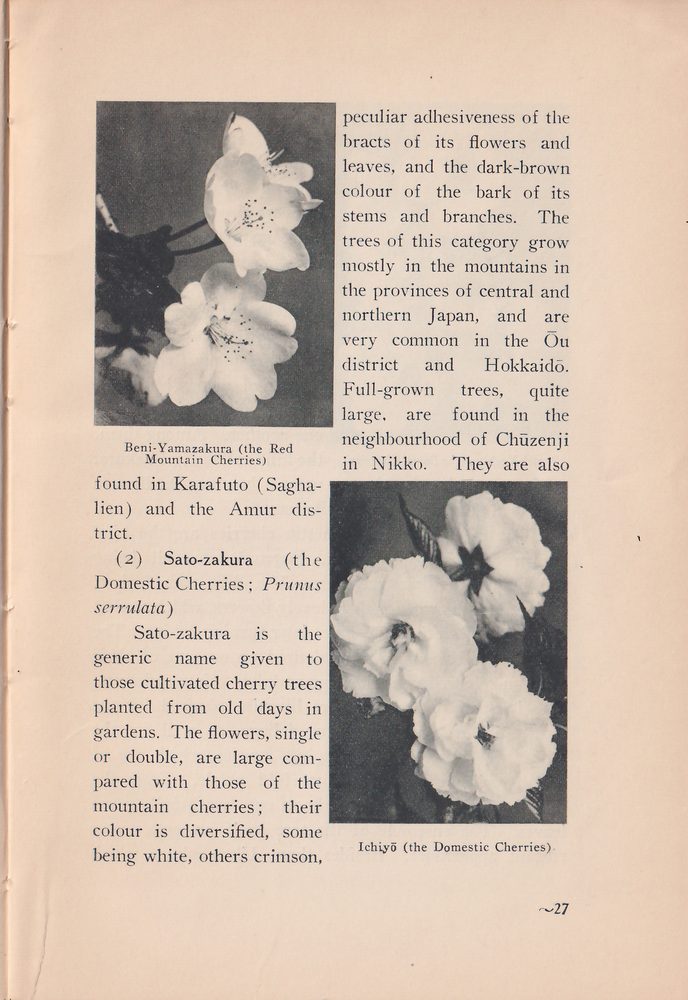
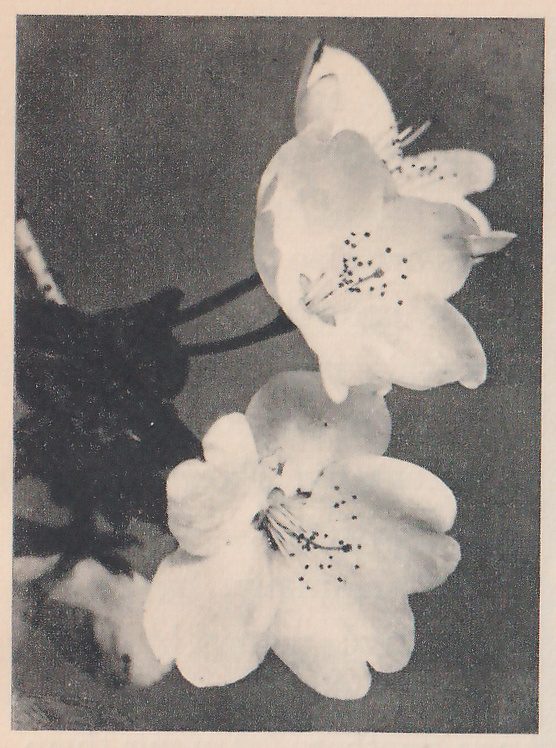
peculiar adhesiveness of the bracts of its flowers and leaves, and the dark-brown colour of the bark of its stems and branches. The trees of this category grow mostly in the mountains in the provinces of central and northern Japan, and are very common in the Ōu district and Hokkaidō. Full-grown trees, quite large, are found in the neighbourhood of Chūzenji in Nikko. They are also found in Karafuto (Saghalien) and the Amur district.
(2) Sato-zakura (the Domestic Cherries; Prunus serrulata)
Sato-zakura is the generic name given to those cultivated cherry trees planted from old days in gardens. The flowers, single or double, are large compared with those of the mountain cherries; their colour is diversified, some being white, others crimson,
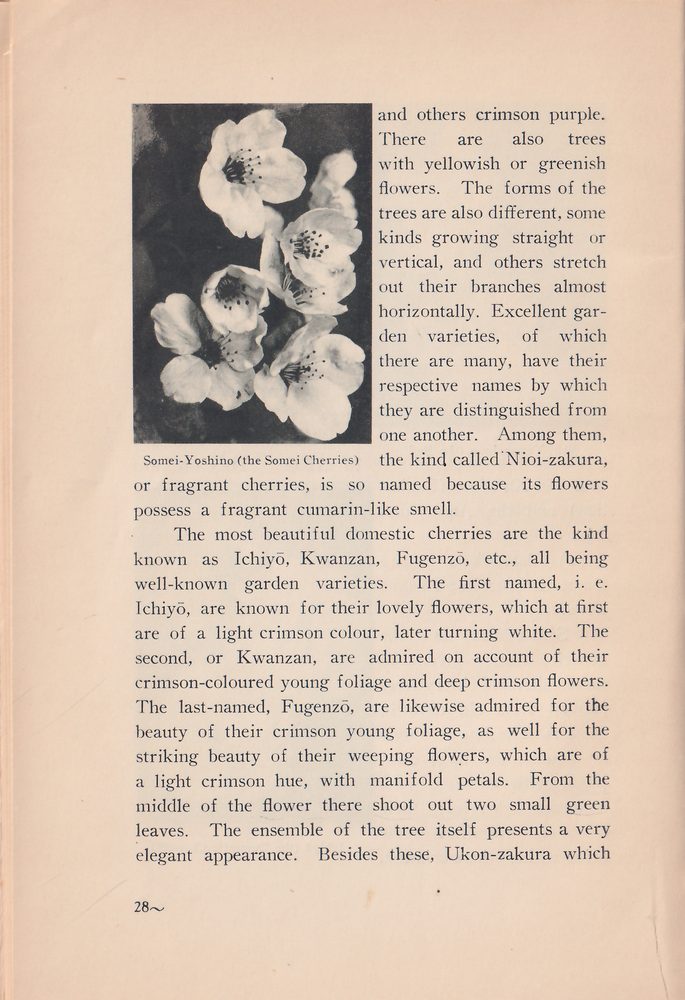
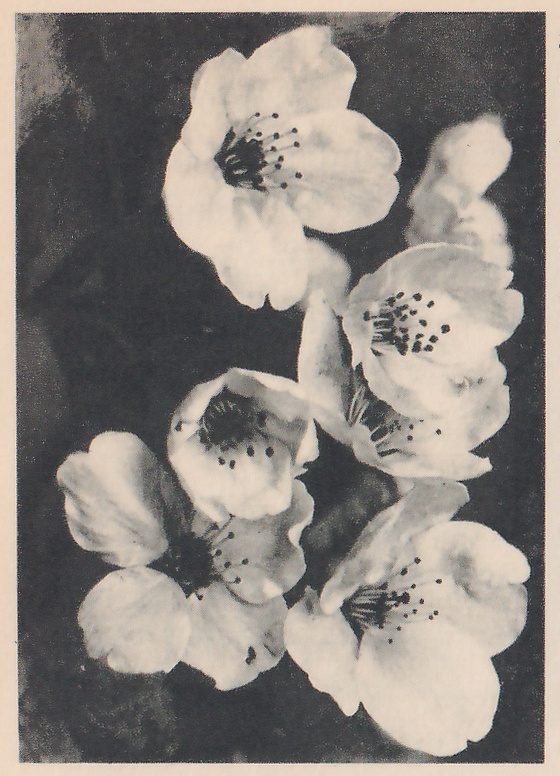
and others crimson purple. There are also trees with yellowish or greenish flowers. The forms of the trees are also different, some kinds growing straight or vertical, and others stretch out their branches almost horizontally. Excellent garden varieties, of which there are many, have their respective names by which they are distinguished from one another. Among them, the kind called Nioi-zakura, or fragrant cherries, is so named because its flowers possess a fragrant cumarin-like smell.
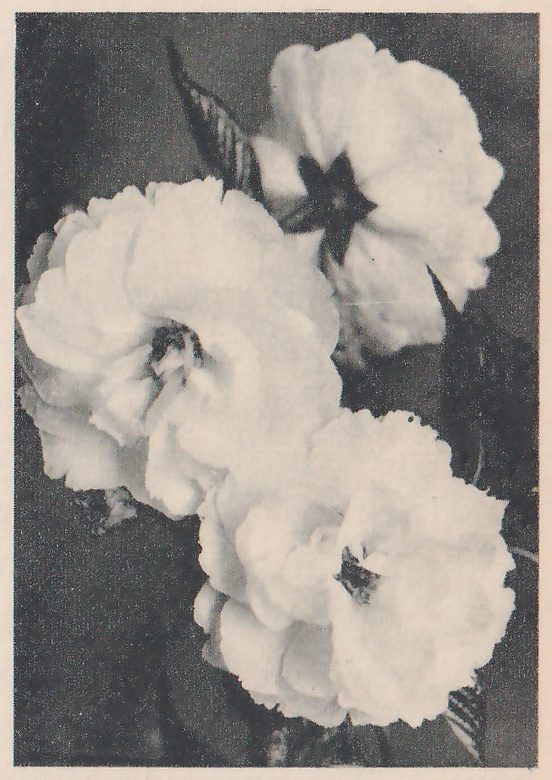
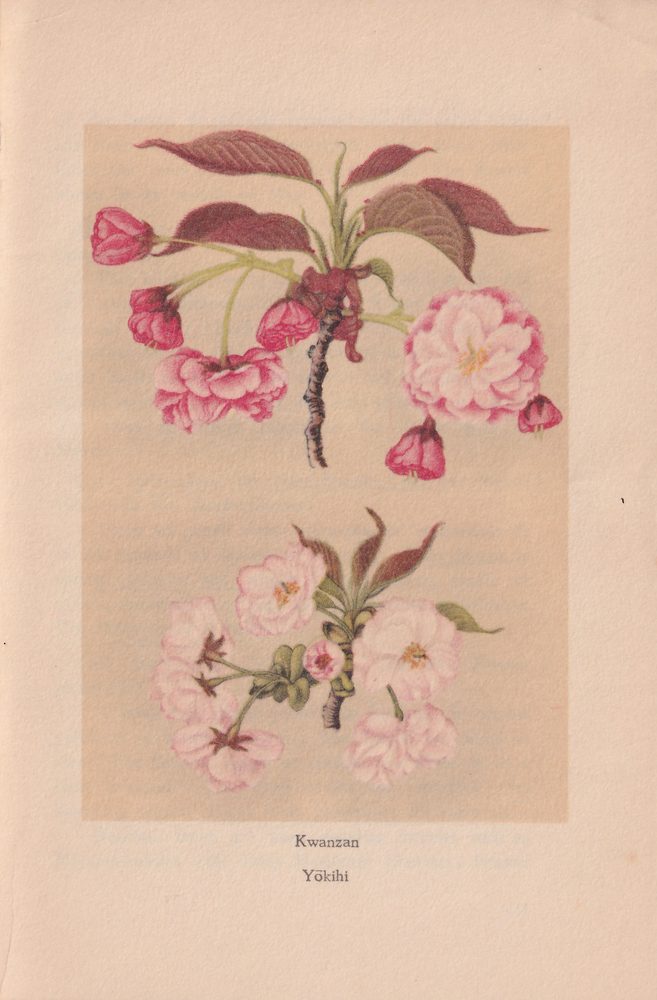
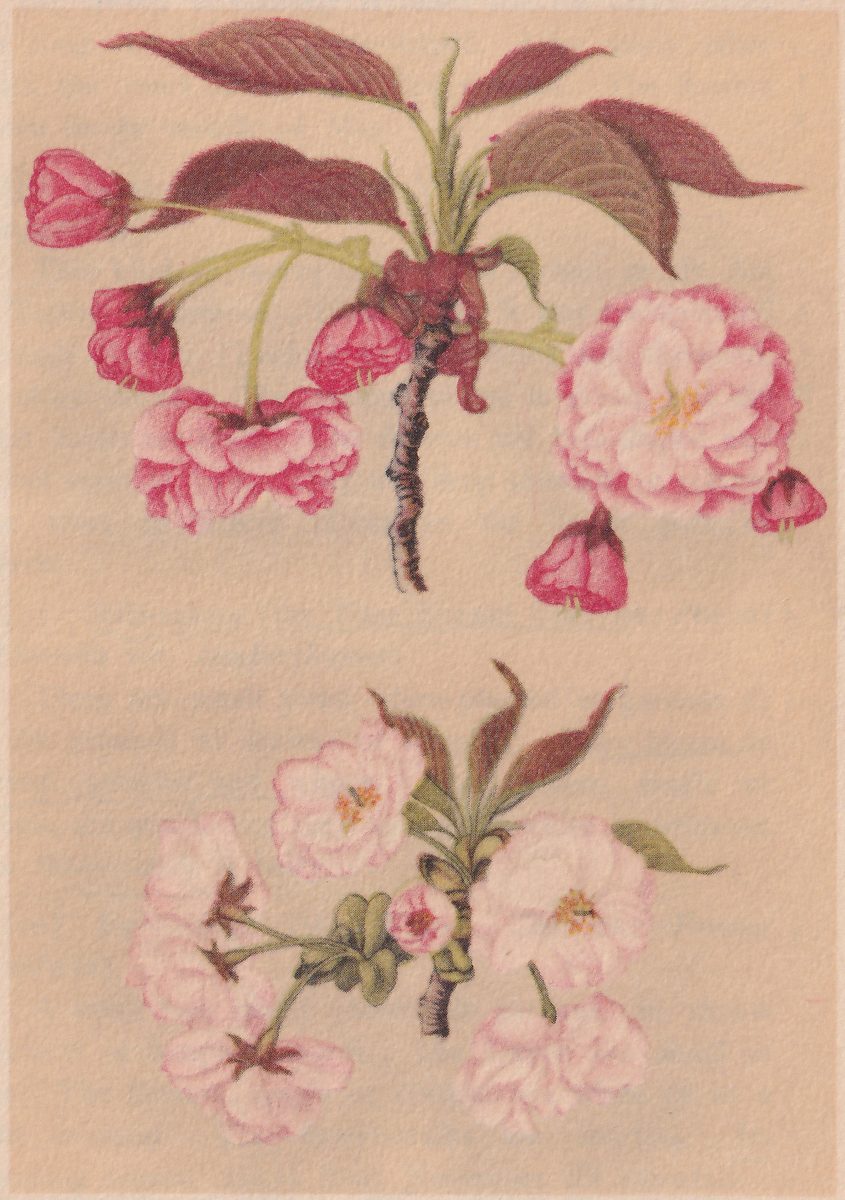
The most beautiful domestic cherries are the kind known as Ichiyō, Kwanzan, Fugenzō, etc., all being well-known garden varieties. The first named, i. e. Ichiyō, are known for their lovely flowers, which at first are of a light crimson colour, later turning white. The second, or Kwanzan, are admired on account of their crimson-coloured young foliage and deep crimson flowers. The last-named, Fugenzō, are likewise admired for the beauty of their crimson young foliage, as well for the striking beauty of their weeping flowers, which are of a light crimson hue, with manifold petals. From the middle of the flower there shoot out two small green leaves. The ensemble of the tree itself presents a very elegant appearance. Besides these, Ukon-zakura which
has light yellow flowers, and Gyoikō, which has also yellowish flowers dotted with green and crimson spots and lines, belong to the Sato-zakura.
(3) Somei-Yoshino (the Somei Cherries; Prunus yedoensis)
This is a cherry of rather modern origin, having made its appearance in Tokyo from about the beginning of the Meiji Era (1868). Nothing was known of this kind of cherry in the pre-Meiji or Tokugawa period. Its flowers, when first blooming, are of a light crimson colour, but they turn pure white at full bloom. Leaves come out only after the flowers have faded, so that in the flowering season this kind presents a very spectacular sight, the whole tree being practically covered with clustered flowers as if enveloped in snow clouds.
The Somei cherries do not grow in mountains or forests. They are grown by gardeners or horticulturists as saplings, and are now widely cultivated everywhere and planted in parks, gardens, etc. The trees grow very fast, but are rather delicate.
(4) Higan-zakura (the Equinox Cherries; Prunus aequinoctialis)
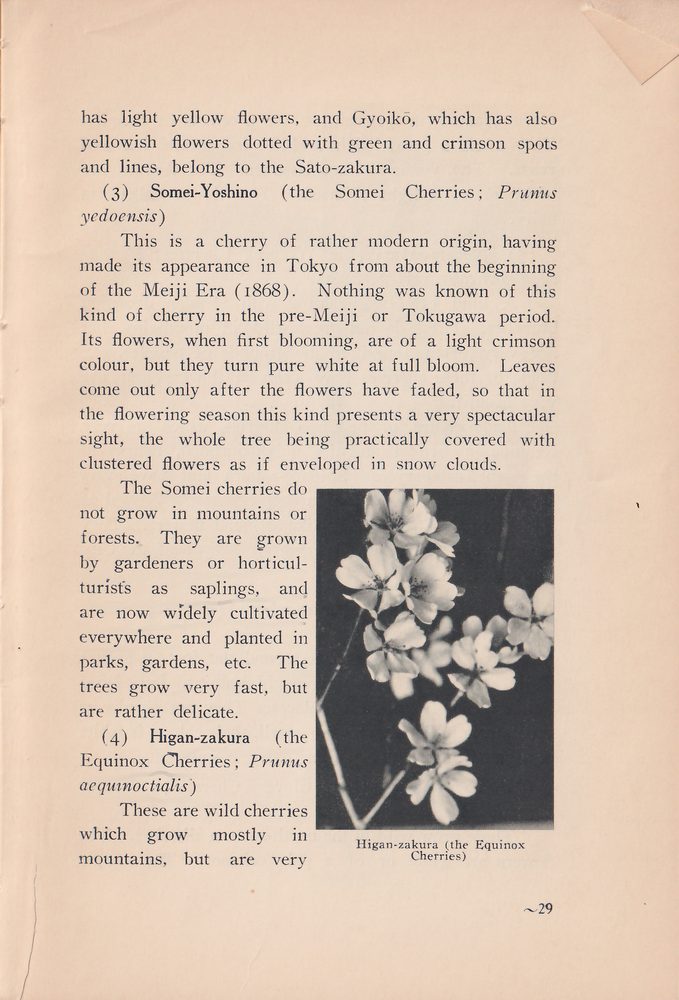
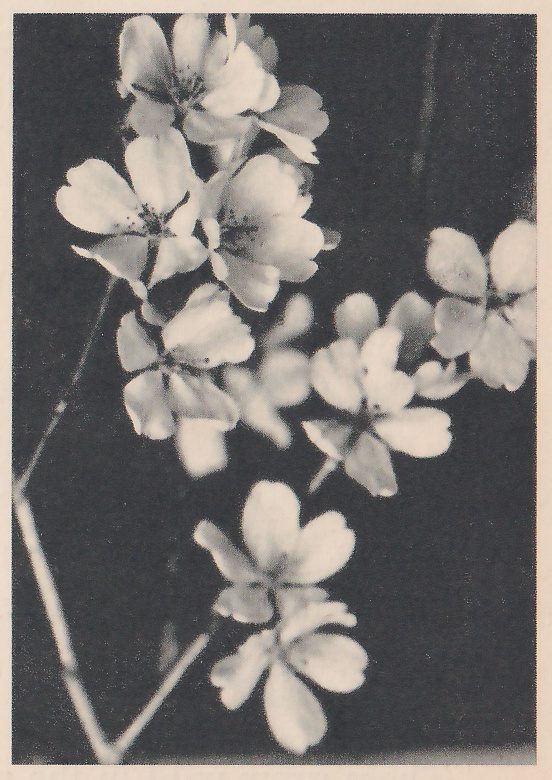
These are wild cherries which grow mostly in mountains, but are very
often planted in gardens or the precincts of temples. They attain a great height and live for several hundred years. The young foliage is green. The flowers are white or of a light crimson. The flower-stalks are hairy.
(5) Shidare-zakura (the Weeping Cherries; Prunus aequinoctialisPrinted: aequinocticalis var. pendula)
A kind of Higan-zakura with slender drooping branches. These do not grow wild in mountains, but are very often found in the grounds of temples, etc. Some of these cherries have crimson flowers and are very beautiful.
Endō-zakura, or the Endō cherries, which are very common in Sendai and its neighbourhood, belong to the same category as Shidare-zakura and have very beautiful double flowers of a deep crimson. Viewed at a distance they really look like artificial flowers. They are named after Y. Endō, formerly Mayor of the City of Sendai.
(6) Fuji-zakura or Mame-zakura (the Fuji Cherries; Prunus incisa)
These grow in abundance around the foot of Mount Fuji, as also in the Hakone Mountains, Izu, Bōsō Peninsula and some other places. They are shrubs or small trees. The flowers are small, their colour is white or light crimson. They have hairy flower-stalks.
(7) Chōji-zakura (the Clove Cherries; Prunus ceraseidos)
These grow wild in the north-eastern districts. The flowers are white or of a pale crimson. The margin
Yōkihi
of the leaves is coarsely serrated and the calyx tubes are long, broad and clove-shaped. Like many other kinds the trees have hairy flower-stalks. The flowers bloom in the middle of May.
(8) Hikan-zakura (the Red Winter Cherries; Prunus campanulata)
This kind of cherry is found on Arisan, or Mt. Ari in Taiwan (Formosa), from where it was transplanted through Riukiu (Luchu) to Kagoshima and elsewhere in olden times. The young foliage is green, and the adult leaves are thick. The flowers are bell-shaped and do not open in full. They are deep crimson in colour. The trees in Tokyo bloom in the latter part of March.
(9) Shiki-zakura (the Four Season Cherries; Prunus subhirtella var. semperflorens)
These are small trees, often planted in gardens or in the grounds of shrines or temples. They bloom in spring, autumn and winter. The flowers, single or double, are small, and their colour is white or crimson. The flower-stalk is hairy.
(10) Fuyu-zakura (the Winter Cherries; Prunus parvifolia)
A small tree rarely planted in gardens, in shrine precincts or temple grounds. The leaves are small in size. The flowers, single or double, are white or of a light crimson. The flower-stalks are hairless. Its blooming season ranges from November till snowfall.
Besides, there are some peculiar cherries such as Miyama-zakura (the Deep Mountain Cherries; Prunus
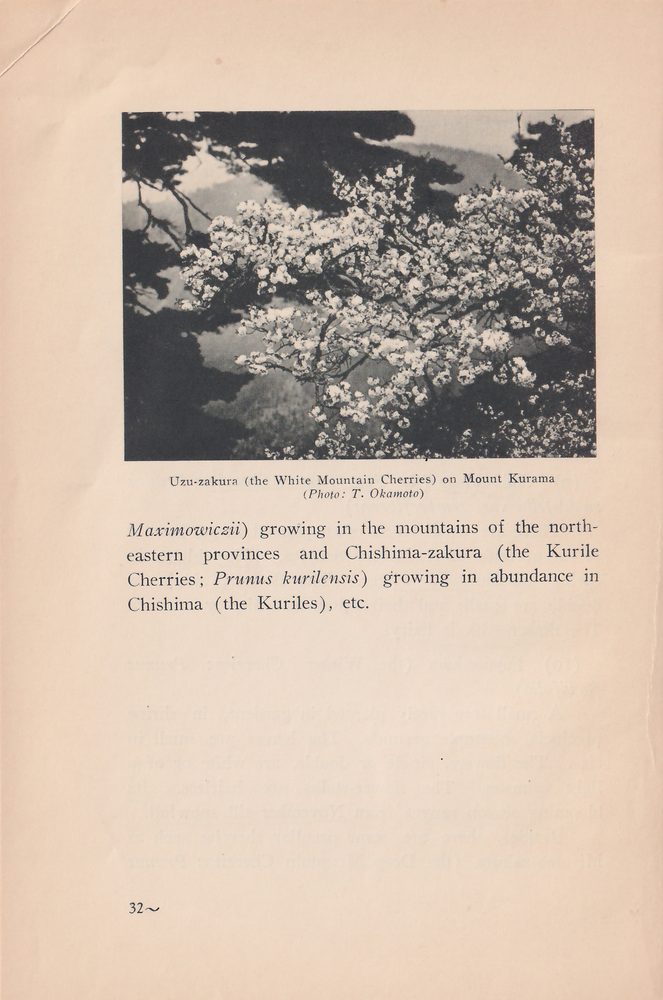
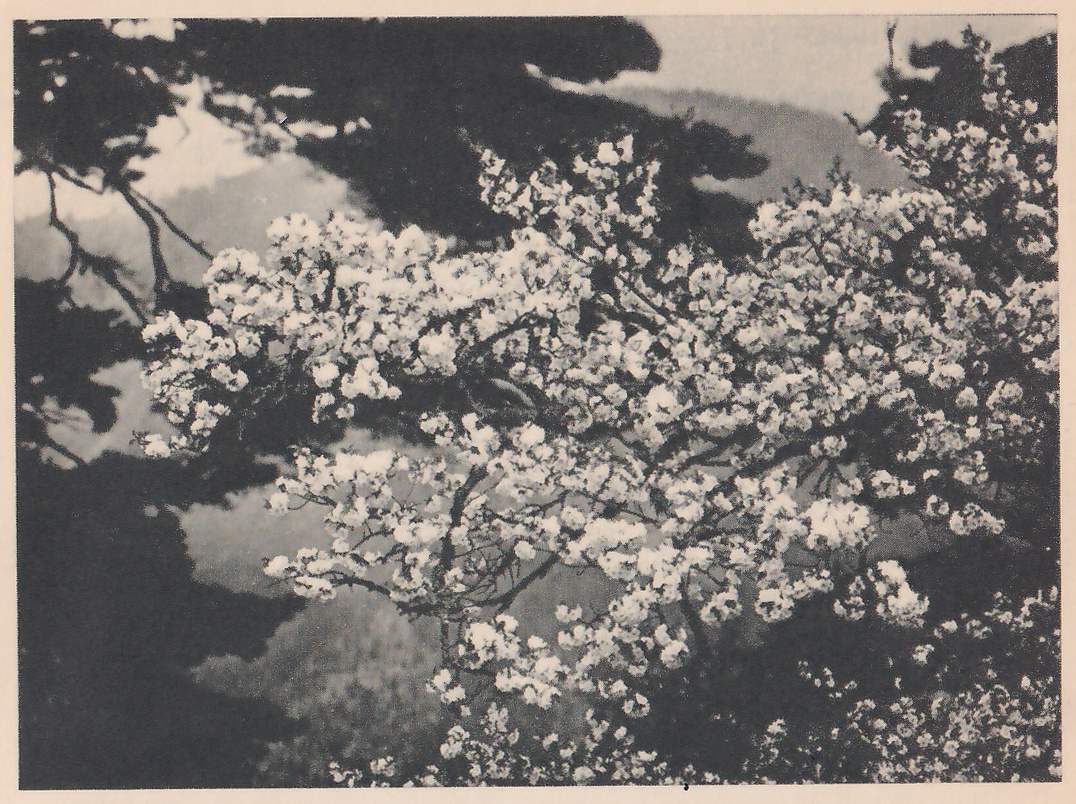
(Photo: T. Okamoto)
Maximowiczii) growing in the mountains of the north-eastern provinces and Chishima-zakura (the Kurile Cherries; Prunus kurilensis) growing in abundance in Chishima (the Kuriles), etc.