
I ORIGIN AND HISTORY OF SAKURA CULTURE
Japan is fondly called “Cherry Land” or the “Land of Cherries.” We need scarcely dwell on the abundance of cherry trees in this country. To understand why Japan abounds in cherries, and why the country is rich in the trees with such singularly beautiful flowers, one must know the very remote origin of the nation’s love of the flower and the long history—more than one thousand years—of her culture of the cherry tree.
No other country has so many species and varieties of cherry trees, particularly the flower-bearing cherries, as Japan. In fact Japan is the centre for the distribution of cherries. Besides having a large number of cherries growing wild in the mountains and forests, the Japanese people have from ancient times made efforts to cultivate their favourite trees—cherries—and to produce and multiply excellent garden varieties. These garden varieties have been planted either in gardens, on the roadside, or in the compounds of Shinto or Buddhist temples found in every nook and corner of the land, and their beautiful blossoms are admired by the public. The nation’s love of the flower has also largely contributed to the development of a cherry culture and to the propagation of superior garden varieties.
Of the numerous kinds of cherries found in the land the most common are Yama-zakura, or mountain cherries that grow in the woodlands everywhere throughout the country. Since the cherry trees blossom
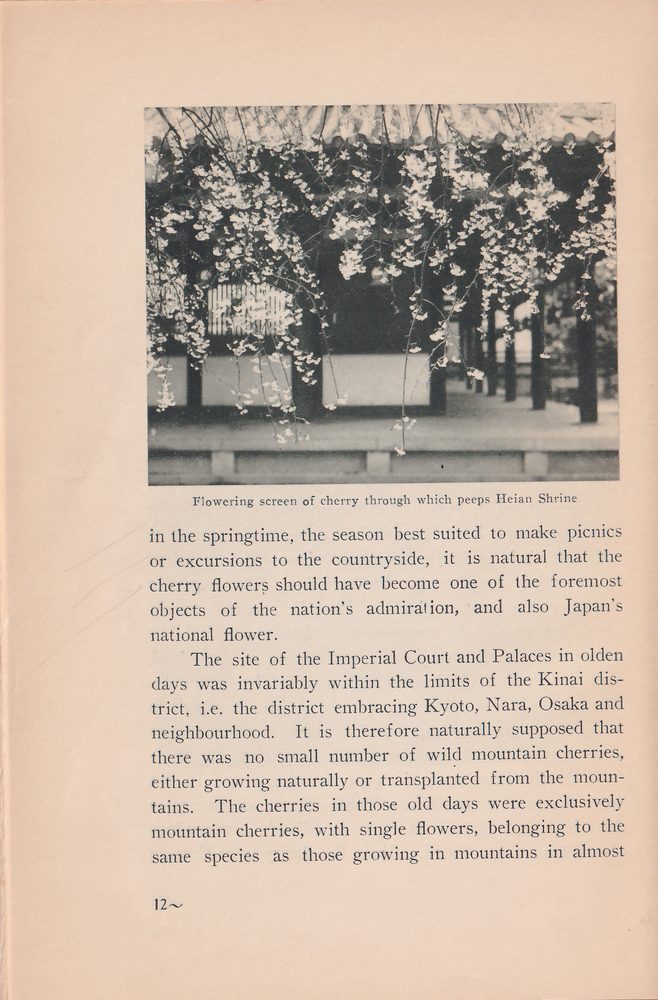
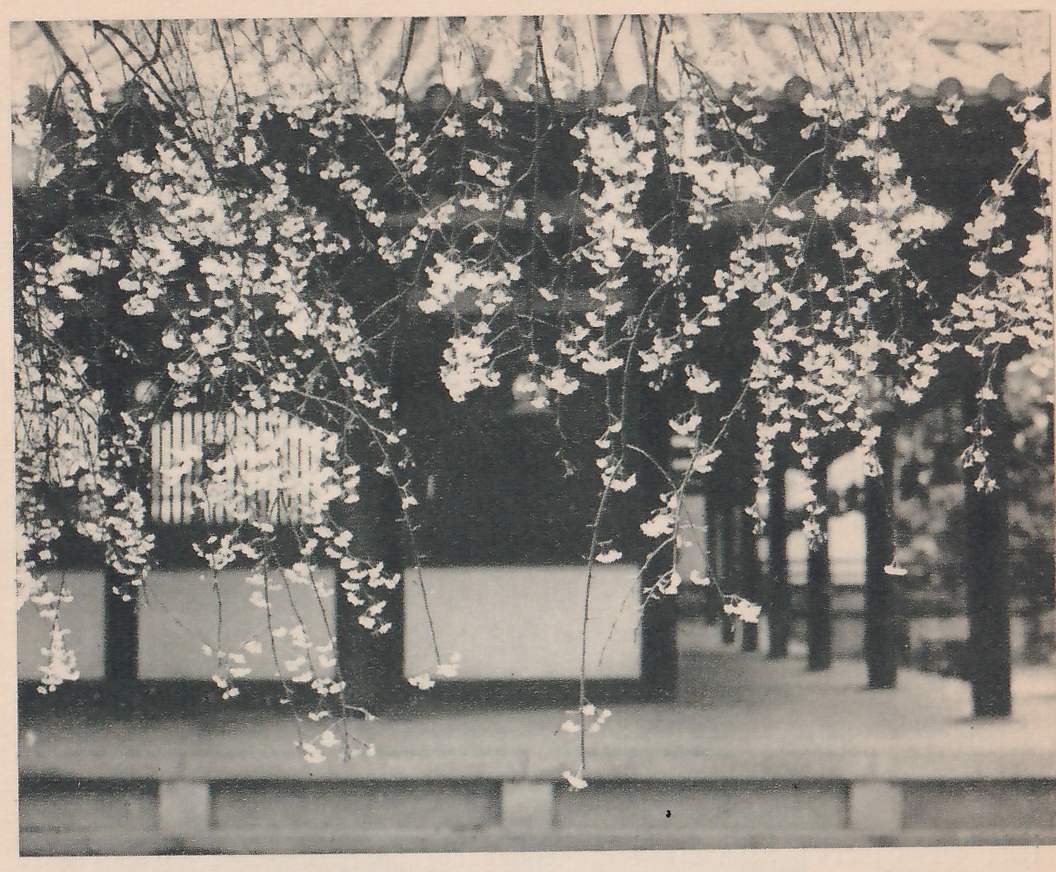
in the springtime, the season best suited to make picnics or excursions to the countryside, it is natural that the cherry flowers should have become one of the foremost objects of the nation’s admiration, and also Japan’s national flower.
The site of the Imperial Court and Palaces in olden days was invariably within the limits of the Kinai district, i.e. the district embracing Kyoto, Nara, Osaka and neighbourhood. It is therefore naturally supposed that there was no small number of wild mountain cherries, either growing naturally or transplanted from the mountains. The cherries in those old days were exclusively mountain cherries, with single flowers, belonging to the same species as those growing in mountains in almost
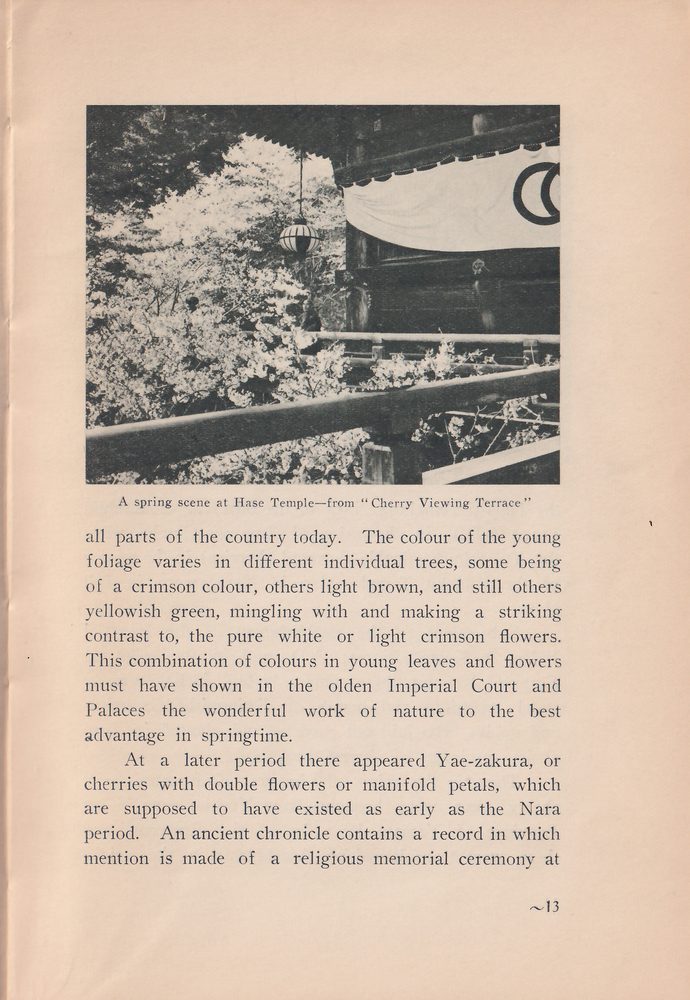
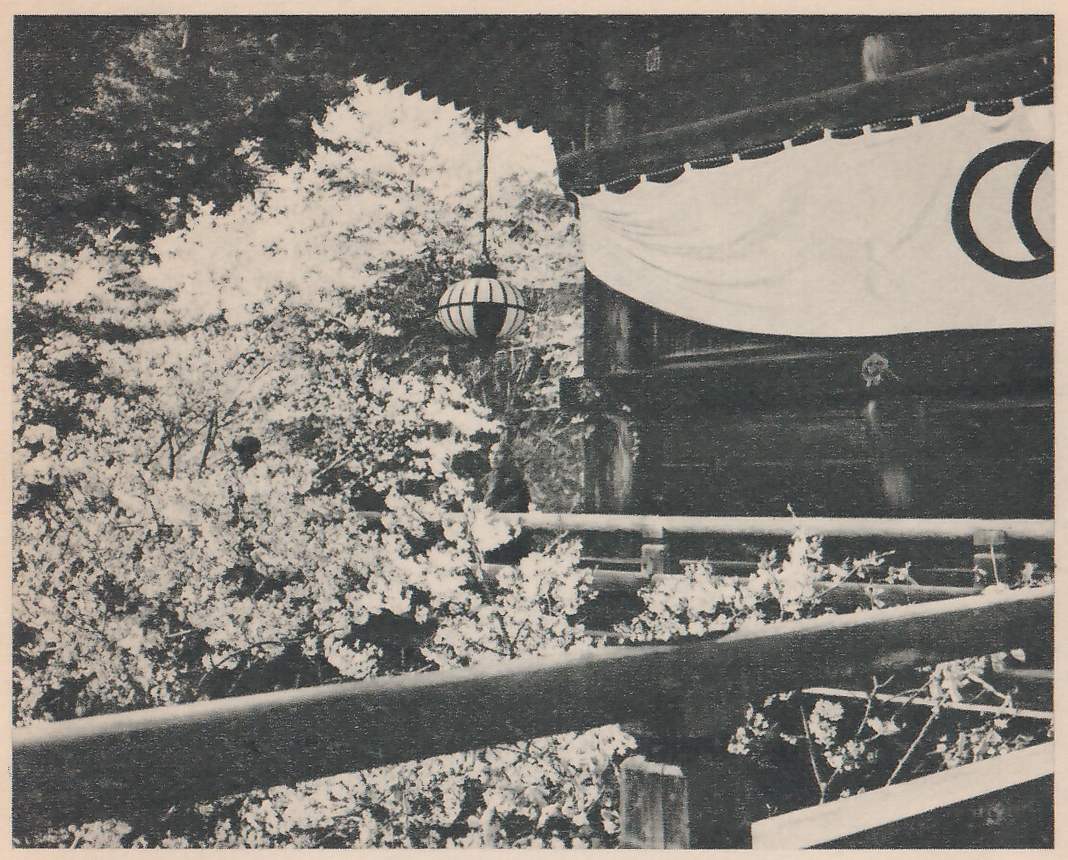
all parts of the country today. The colour of the young foliage varies in different individual trees, some being of a crimson colour, others light brown, and still others yellowish green, mingling with and making a striking contrast to, the pure white or light crimson flowers. This combination of colours in young leaves and flowers must have shown in the olden Imperial Court and Palaces the wonderful work of nature to the best advantage in springtime.
At a later period there appeared Yae-zakura, or cherries with double flowers or manifold petals, which are supposed to have existed as early as the Nara period. An ancient chronicle contains a record in which mention is made of a religious memorial ceremony at
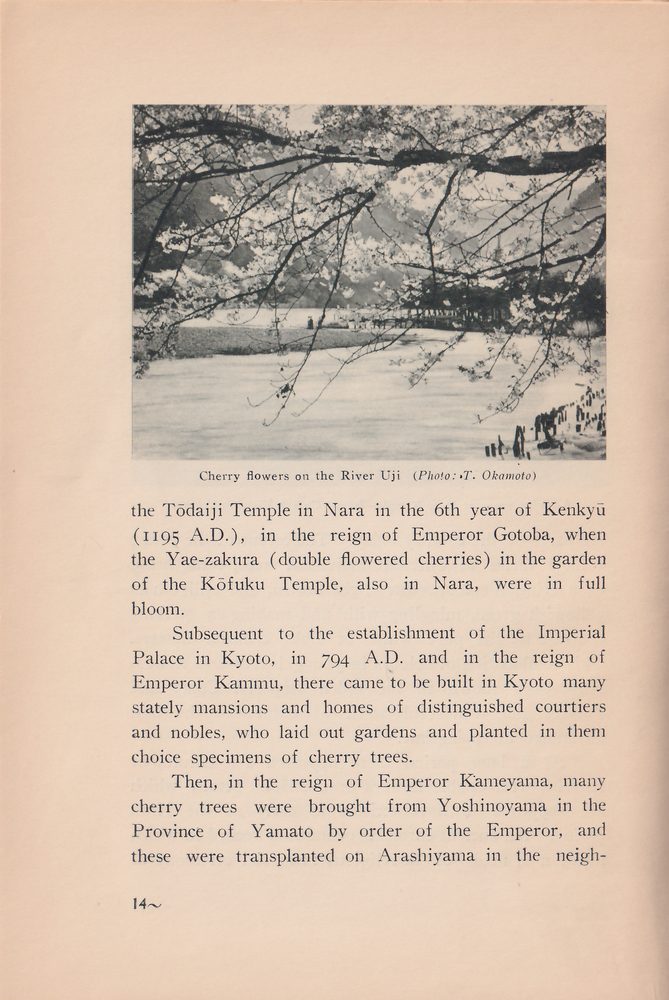
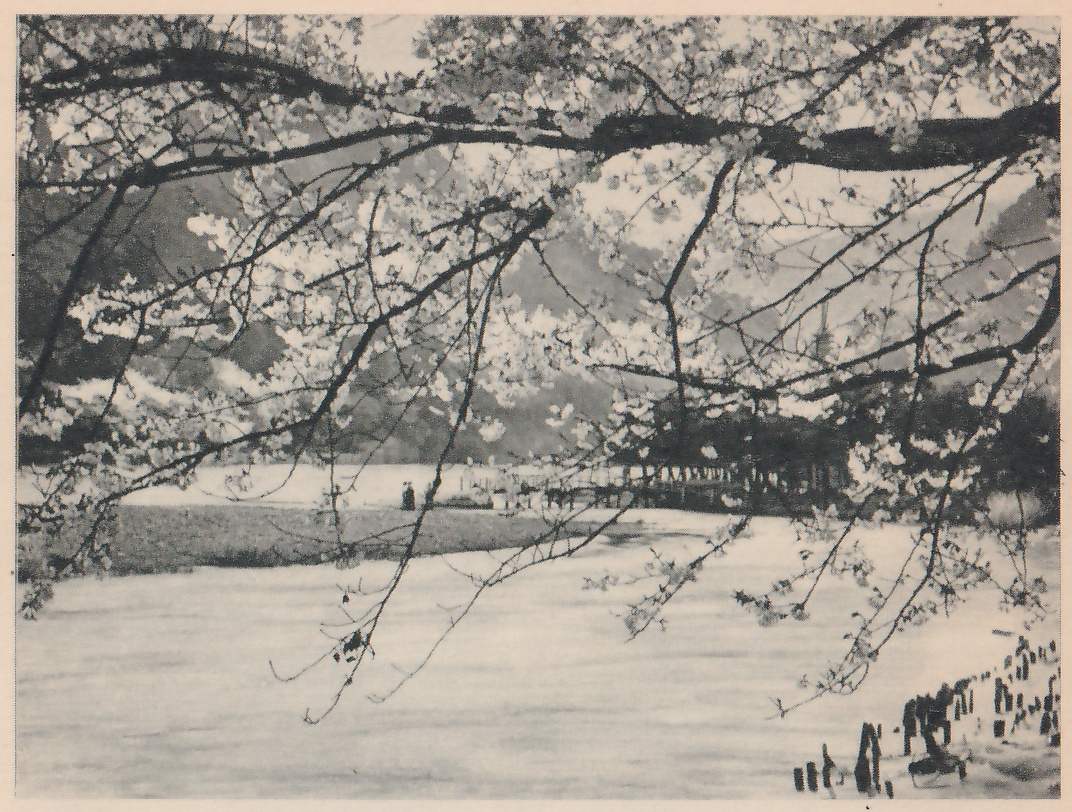
the Tōdaiji Temple in Nara in the 6th year of Kenkyū (1195 A.D.), in the reign of Emperor Gotoba, when the Yae-zakura (double flowered cherries) in the garden of the Kōfuku Temple, also in Nara, were in full bloom.
Subsequent to the establishment of the Imperial Palace in Kyoto, in 794 A.D. and in the reign of Emperor Kammu, there came to be built in Kyoto many stately mansions and homes of distinguished courtiers and nobles, who laid out gardens and planted in them choice specimens of cherry trees.
Then, in the reign of Emperor Kameyama, many cherry trees were brought from Yoshinoyama in the Province of Yamato by order of the Emperor, and these were transplanted on Arashiyama in the neigh-
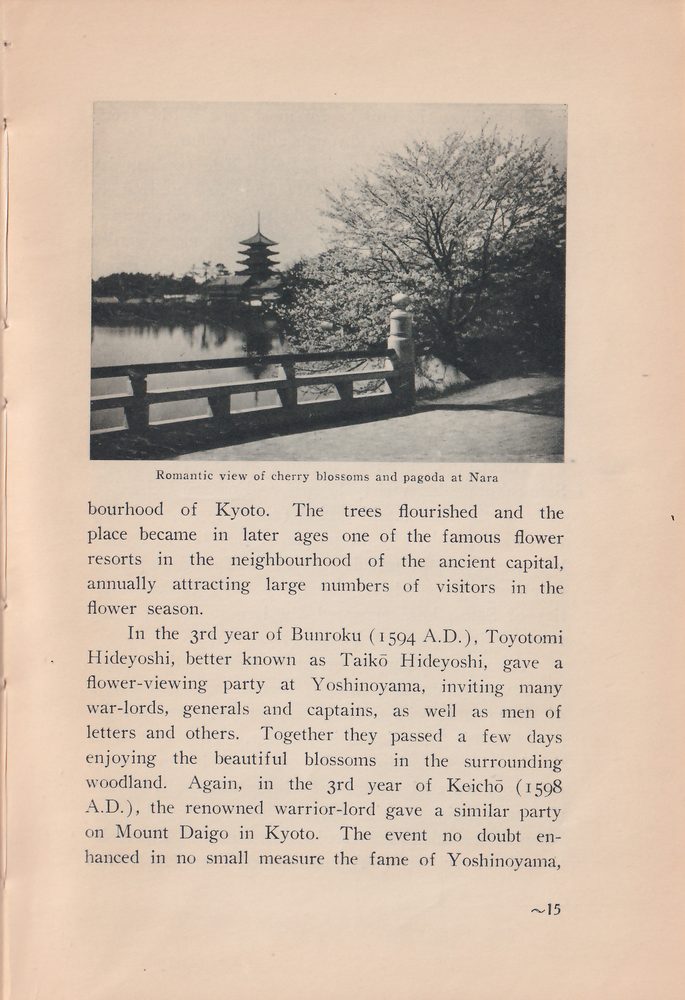
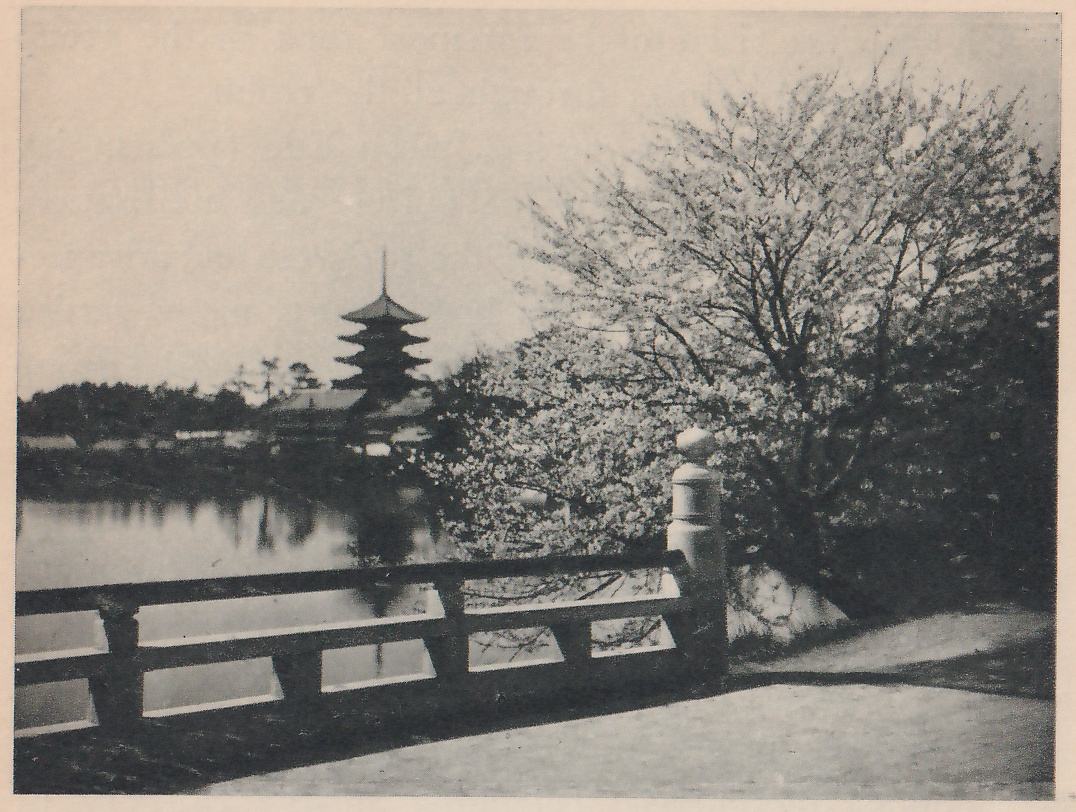
bourhood of Kyoto. The trees flourished and the place became in later ages one of the famous flower resorts in the neighbourhood of the ancient capital, annually attracting large numbers of visitors in the flower season.
In the 3rd year of Bunroku (1594 A.D.), Toyotomi Hideyoshi, better known as Taikō Hideyoshi, gave a flower-viewing party at Yoshinoyama, inviting many war-lords, generals and captains, as well as men of letters and others. Together they passed a few days enjoying the beautiful blossoms in the surrounding woodland. Again, in the 3rd year of Keichō (1598 A.D.), the renowned warrior-lord gave a similar party on Mount Daigo in Kyoto. The event no doubt enhanced in no small measure the fame of Yoshinoyama,
which has since risen to the foremost rank in the group of noted flower resorts throughout the realm.
In the Tokugawa period, when Edo (present-day Tokyo) became the centre of culture and civilization, there gradually appeared, with the progress and advancement of botanical studies and horticulture, many garden varieties of cherry trees, which are known by the group name of Sato-zakura, or domestic cherries as they are now called. Different names have been given to those cherry trees which bear comparatively large flowers of a beautiful colour and emit a delightful fragrance. Those superior trees were greatly admired by the lovers of flowers, and efforts were made for their multiplication by means of grafting and other similar devices.
Among the cherries belonging to the category of Sato-zakura, the variety known as Fugenzō existed as early as the Muromachi period (about 1555), and they were much admired by the people of that time. It was, however, after the middle part of the Tokugawa period, or about 1750 and later, that many other garden varieties of Sato-zakura appeared, the largest number being recorded in the era of Bunka (1804-1817).
Among the daimyōs, or feudal lords of those days, there were many students of horticulture and lovers of cherry trees who collected saplings of rare varieties and planted them in their gardens. They even went the length of making artists sketch their flowers and prepare illustrated albums of cherry blossoms. These albums remain to this day, and are highly valued by botanists and others interested in the study of the varieties of cherry trees. A man named Ōten Kubo, who
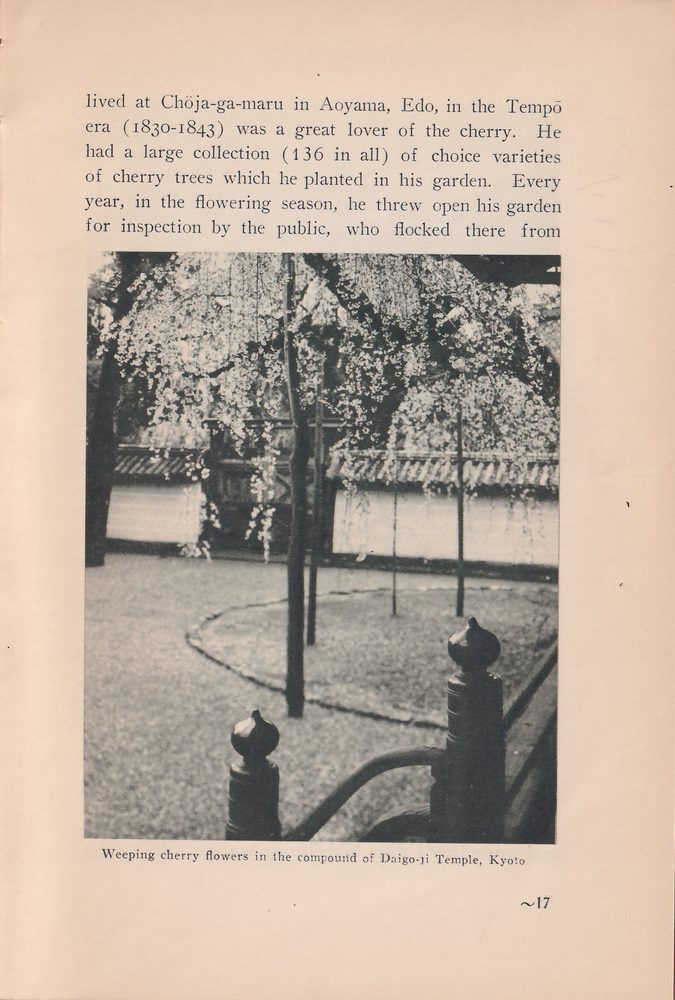
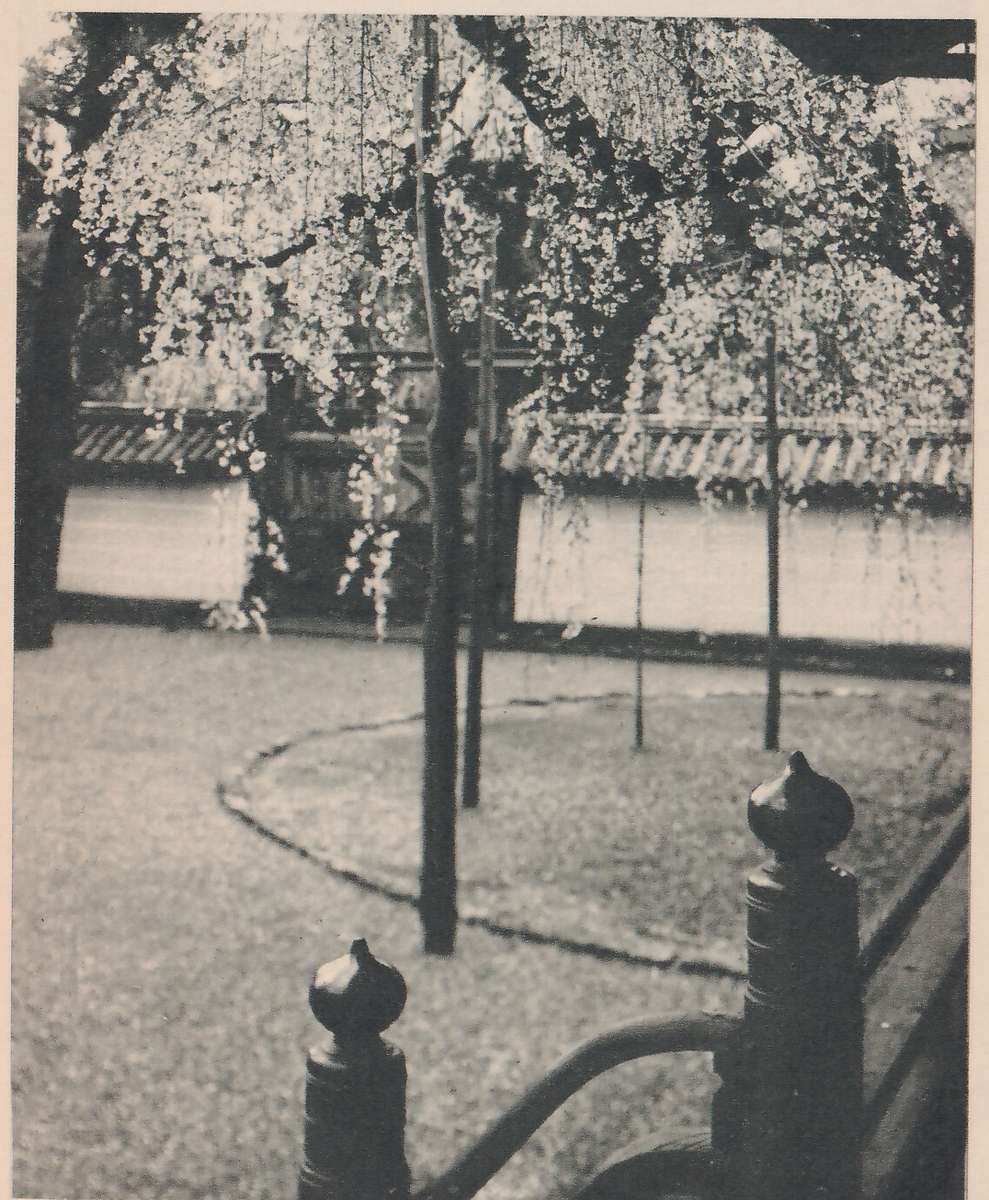
lived at Chōja-ga-maru in Aoyama, Edo, in the Tempō era (1830-1843) was a great lover of the cherry. He had a large collection (136 in all) of choice varieties of cherry trees which he planted in his garden. Every year, in the flowering season, he threw open his garden for inspection by the public, who flocked there from
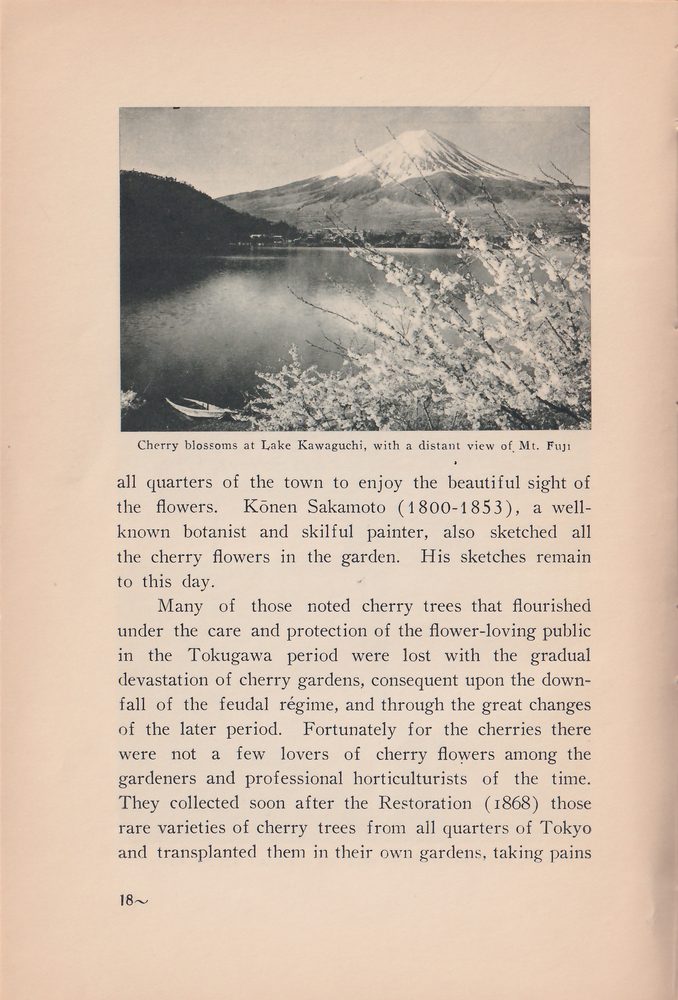
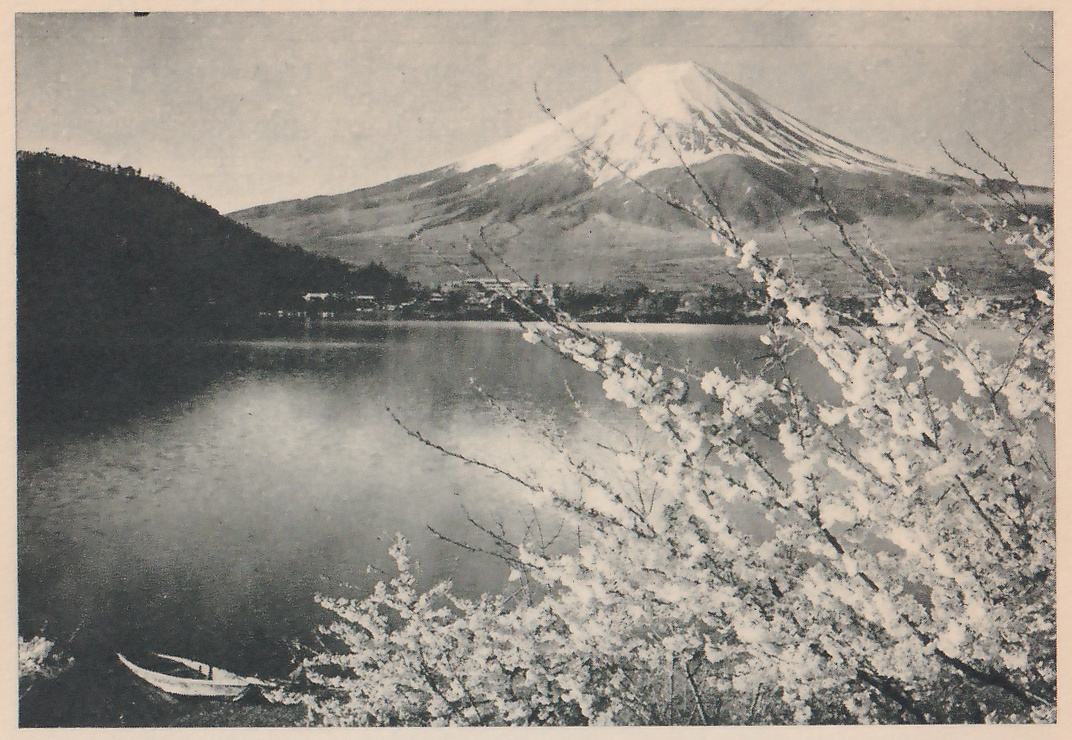
all quarters of the town to enjoy the beautiful sight of the flowers. Kōnen Sakamoto (1800-1853), a well-known botanist and skilful painter, also sketched all the cherry flowers in the garden. His sketches remain to this day.
Many of those noted cherry trees that flourished under the care and protection of the flower-loving public in the Tokugawa period were lost with the gradual devastation of cherry gardens, consequent upon the downfall of the feudal régime, and through the great changes of the later period. Fortunately for the cherries there were not a few lovers of cherry flowers among the gardeners and professional horticulturists of the time. They collected soon after the Restoration (1868) those rare varieties of cherry trees from all quarters of Tokyo and transplanted them in their own gardens, taking pains
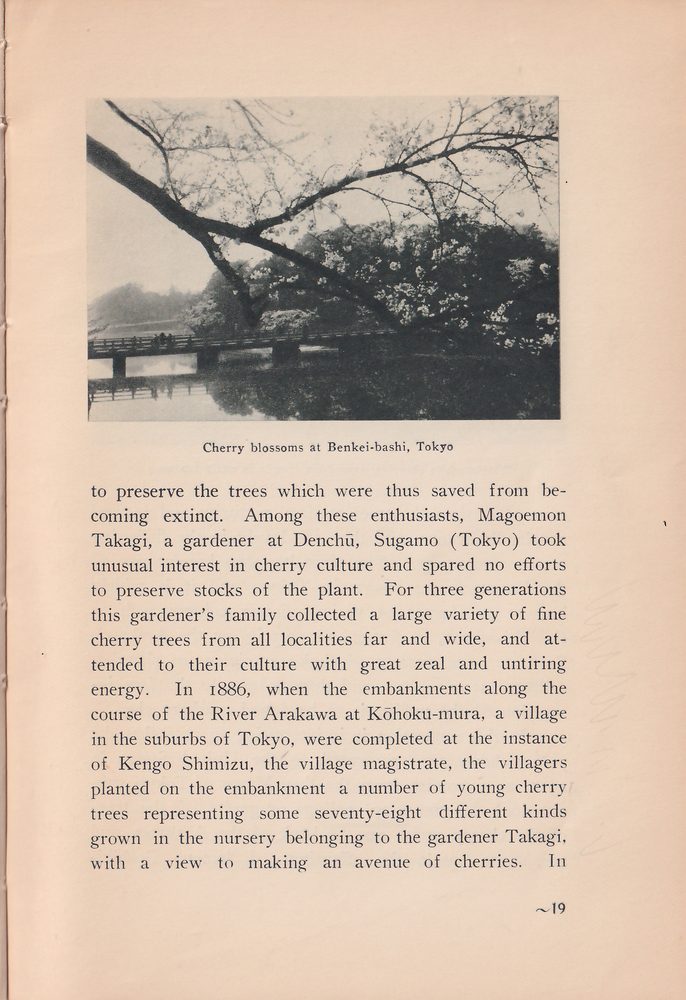
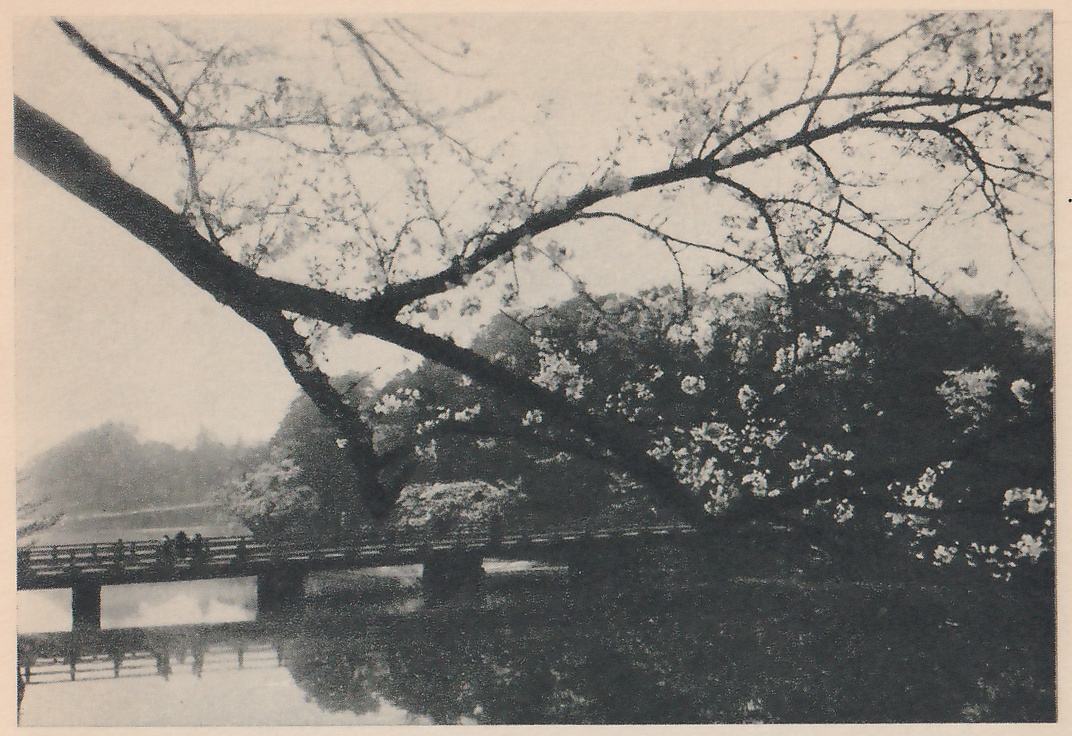
to preserve the trees which were thus saved from becoming extinct. Among these enthusiasts, Magoemon Takagi, a gardener at Denchū, Sugamo (Tokyo) took unusual interest in cherry culture and spared no efforts to preserve stocks of the plant. For three generations this gardener’s family collected a large variety of fine cherry trees from all localities far and wide, and attended to their culture with great zeal and untiring energy. In 1886, when the embankments along the course of the River Arakawa at Kōhoku-mura, a village in the suburbs of Tokyo, were completed at the instance of Kengo Shimizu, the village magistrate, the villagers planted on the embankment a number of young cherry trees representing some seventy-eight different kinds grown in the nursery belonging to the gardener Takagi, with a view to making an avenue of cherries. In
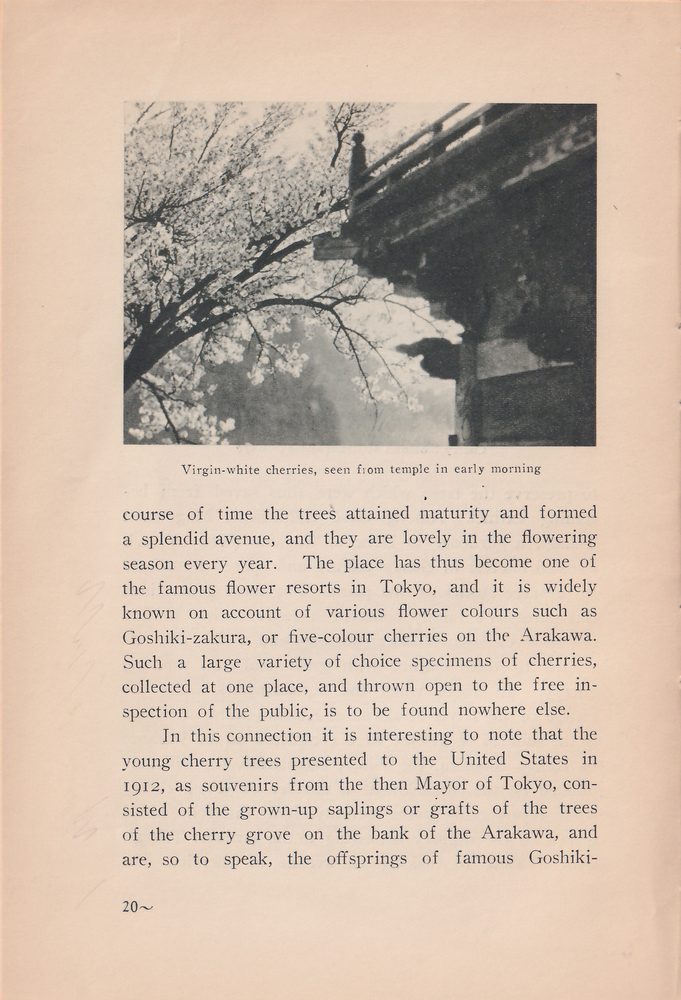
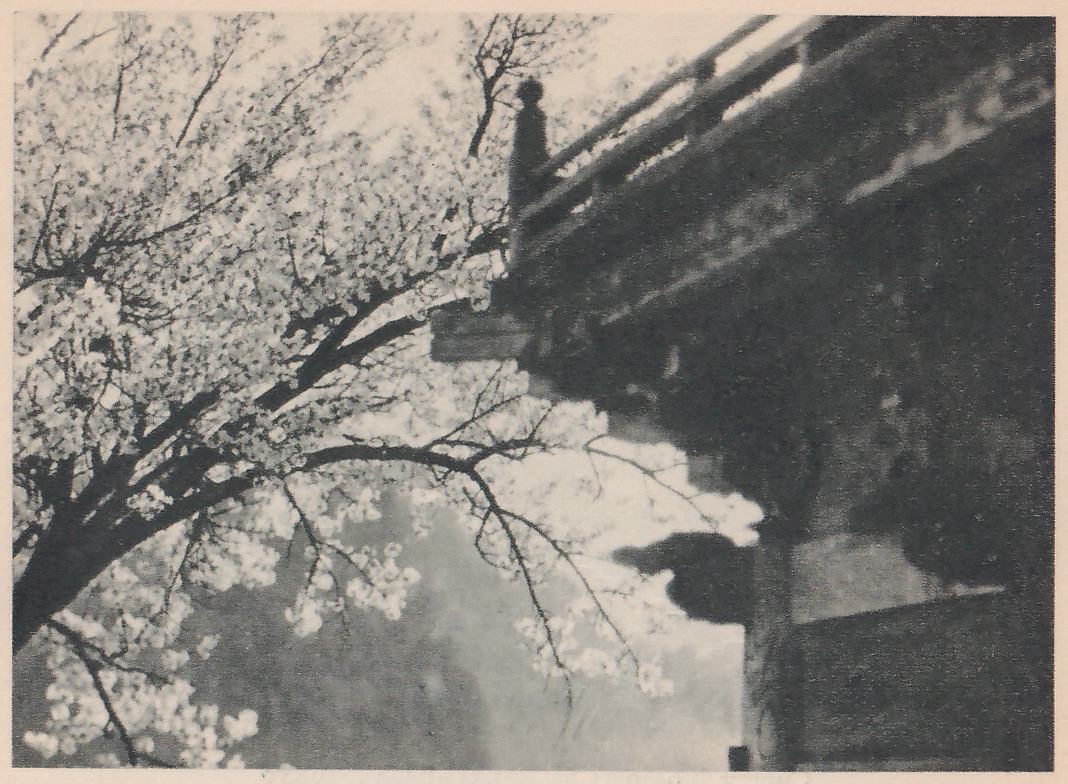
course of time the trees attained maturity and formed a splendid avenue, and they are lovely in the flowering season every year. The place has thus become one of the famous flower resorts in Tokyo, and it is widely known on account of various flower colours such as Goshiki-zakura, or five-colour cherries on the Arakawa. Such a large variety of choice specimens of cherries, collected at one place, and thrown open to the free inspection of the public, is to be found nowhere else.
In this connection it is interesting to note that the young cherry trees presented to the United States in 1912, as souvenirs from the then Mayor of Tokyo, consisted of the grown-up saplings or grafts of the trees of the cherry grove on the bank of the Arakawa, and are, so to speak, the offsprings of famous Goshiki-
zakura. Those souvenir trees, planted along the tidal basin of the Potomac River, Washington, for a distance of six miles, have since attained full growth and developed into a splendid cherry grove, due to the care and protection of the authorities concerned, and with their beautiful blooms year after year, they please the eyes of Washington’s admiring citizens.
Since the enactment in 1919 of the Law for the Preservation of Places of Scenic Beauty and the Protection of Historic and Natural Monuments, most of the noted flower resorts, and many giant or noted cherry trees in different parts of the country, have come to receive special care and attention as “protected” under this measure.
As stated above, the origin and history of the culture of cherries in this country are very old and remote. The love of cherry blossoms has become interwoven in the national characteristics of the Japanese people, and the cherry flower has come to be looked upon as the national flower of the country. Of the numerous kinds of cherries, the most common and most appealing to the taste of the majority of the nation, on account of its being adapted to its environment and manifesting nature’s beauty to the fullest advantage, is the species known as Yama-zakura (the mountain cherries) that is to be found in abundance in wooded districts everywhere throughout the land. Because of the simple and dignified beauty of their flowers, and also because of their elegance, the mountain cherries have enjoyed, and still continue to enjoy, beyond all others, the privilege of being the object of universal love and admiration. In consequence many
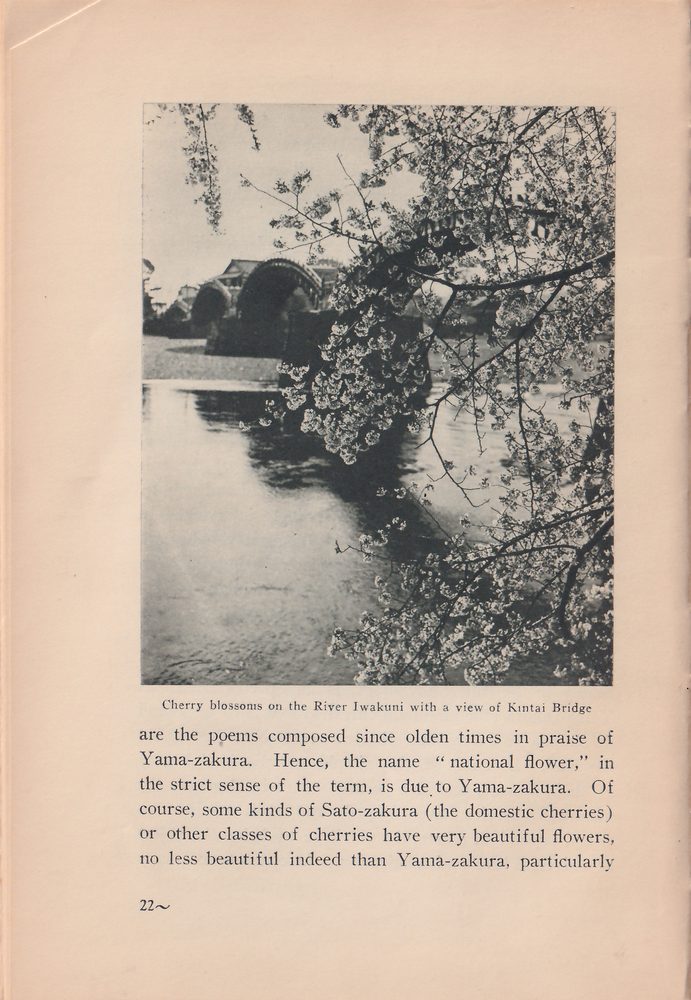
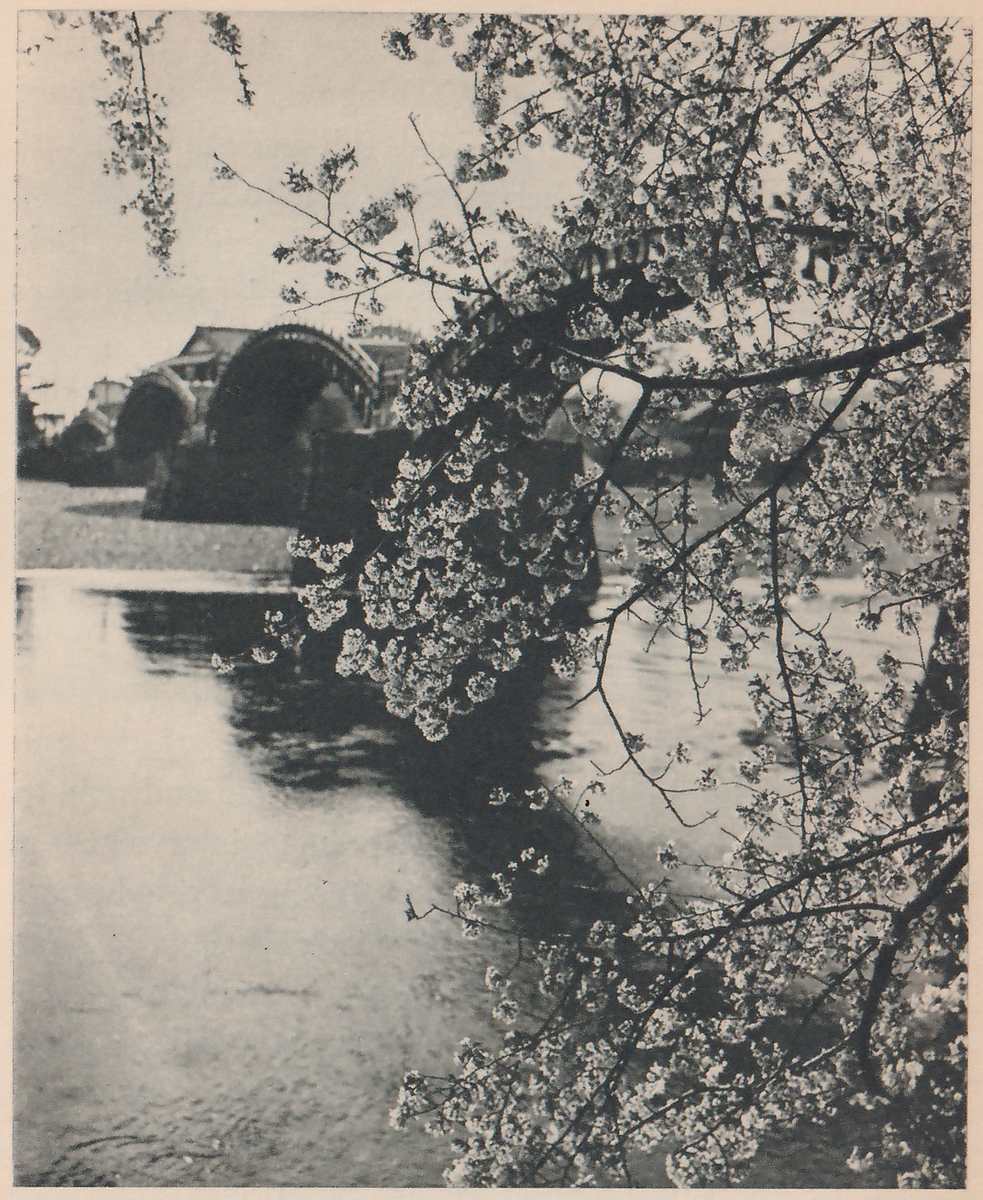
are the poems composed since olden times in praise of Yama-zakura. Hence, the name “national flower,” in the strict sense of the term, is due to Yama-zakura. Of course, some kinds of Sato-zakura (the domestic cherries) or other classes of cherries have very beautiful flowers, no less beautiful indeed than Yama-zakura, particularly
those bearing large double flowers of very rich colour, which are perhaps the queen of the garden, surpassing all other spring flowers in their loveliness.
Hanami, which means flower-viewing, is one of the chief “events” in the social life of the Japanese people. No other flowers afford so much pleasure to mankind as the cherry, and none but cherries have so close a bearing upon human life. At least, such is the relation that obtains between men and the cherry flowers in Japan. It is not only because cherries burst into bloom all at once in the midst of the genial springtime, not long after the dreary winter months are over, but also because the world of nature in this country and its environments combine to make the cherries of the land display nature’s glory, enshrined in them, to the fullest advantage.
In the old Edo days, when the Shogunate Government took the helm of state, and present Tokyo was called Edo, the townsfolk, men and women, old and young, bent on pleasure-seeking in the flower season, used to go out in gala attire on flower-viewing excursions to the cherry groves at Uyeno or Mukōjima, to noted gardens, or to the compound of temples where cherries were blooming, and spend the whole day enjoying their floral beauty to the full. This practice of pleasure-hunting and merry-making was not limited to the people of Edo, but was also common among the countryfolk throughout the land. It formed in fact a national custom. In the Genroku era (1688-1703), especially when habits of luxury and gaiety are said to have reached their zenith, the practice was indulged in
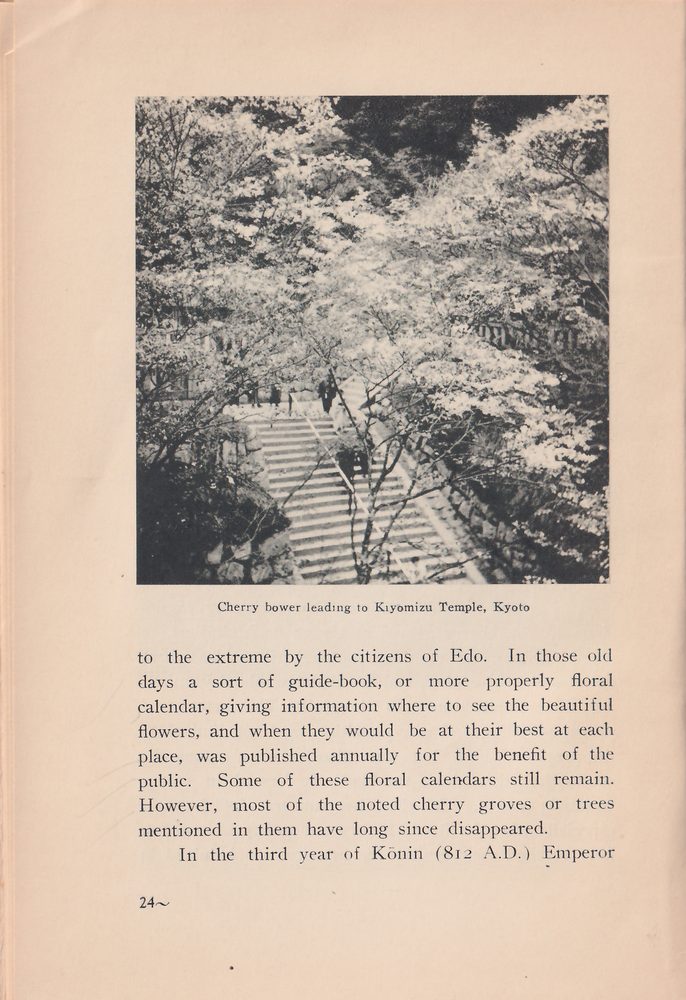
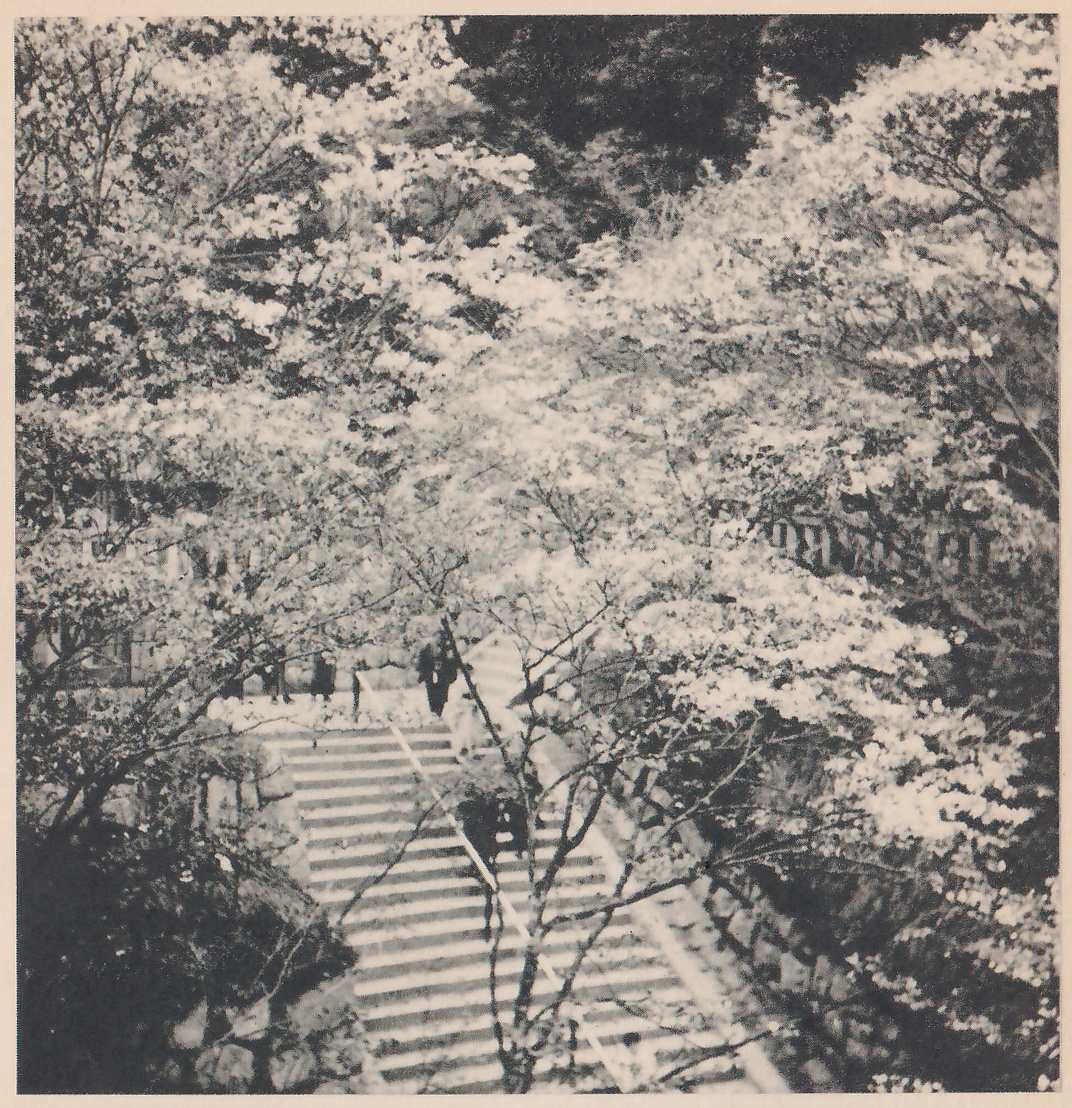
to the extreme by the citizens of Edo. In those old days a sort of guide-book, or more properly floral calendar, giving information where to see the beautiful flowers, and when they would be at their best at each place, was published annually for the benefit of the public. Some of these floral calendars still remain. However, most of the noted cherry groves or trees mentioned in them have long since disappeared.
In the third year of Kōnin (812 A.D.) Emperor
Saga visited the Shinsen-en Garden, a noted garden in Kyoto, and there viewed the cherry blossoms. It is believed that the cherry flower-viewing party given by the Imperial Court in the later periods had its origin at this time. In the present era this Court function is annually held at the Imperial Gardens in Shinjuku, Tokyo.
Thus it will be seen that in Japan, to regard the cherry national flower as symbolic of the national sentiments and traits has a very old beginning and history, and the traditional spirit of admiring the ethereal beauty and virtue of the particular species of the flower is interwoven into the national characteristics of the Japanese people as one of its essential components. This nation-wide love of the flower, which borders on adoration, is revealed in the great popularity of the flower, whose unrivalled beauty is represented in the literature, arts and crafts of the nation. In this respect, too, the cherry blossom is decidedly the flower of flowers and queen of the Japanese floral realm.