

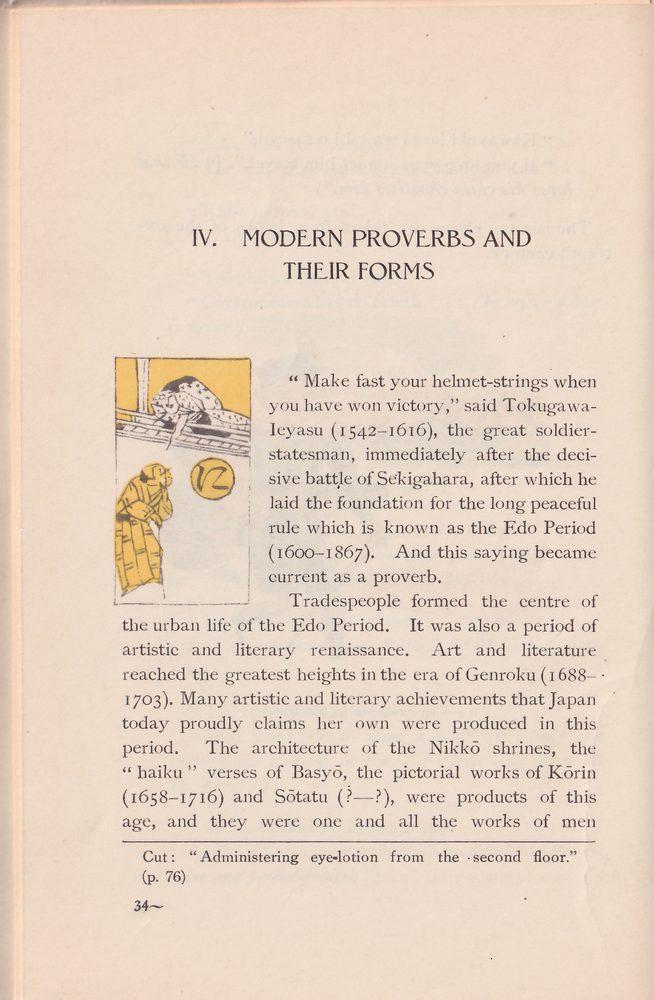
IV. MODERN PROVERBS AND THEIR FORMS
“Make fast your helmet-strings when you have won victory,” said Tokugawa-Ieyasu (1542–1616), the great soldier-statesman, immediately after the decisive battle of Sekigahara, after which he laid the foundation for the long peaceful rule which is known as the Edo Period (1600–1867). And this saying became current as a proverb.
Tradespeople formed the centre of the urban life of the Edo Period. It was also a period of artistic and literary renaissance. Art and literature reached the greatest heights in the era of Genroku (1688–1703). Many artistic and literary achievements that Japan today proudly claims her own were produced in this period. The architecture of the Nikkō shrines, the “haiku” verses of Basyō, the pictorial works of Kōrin (1658–1716) and Sōtatu (?—?), were products of this age, and they were one and all the works of men
of common stock.
The isolationist policy that the Syōgunate government was forced to adopt was not without harmful effects. But it had at least the one good result of enforcing the people of the country to become introspective and cultivate their own life deeply. Whereas there was little development of natural science under this condition of life, the life and taste of people became refined and polished in all variety and richness. A high order of cultural life developed under these circumstances, and in the social life of the commonalty was equalled only by the achievements of the aristocracy of the Heian Period (794–1185). These two illustrious periods in Japan’s history, with an intervening span of a thousand years, stand out as the two highest watermarks of native civilization.
Those who can appreciate the fair women by Utamaro (1753–1806), the likenesses of stage players by Syaraku (?–?), and the caricatures by Hokusai (1760–1849), all reproduced in colour prints, can hardly fail to see how all these subjects, though taken from everyday life, reveal the deep and subtle movements of the minds these artists depicted. Enjoyment of life, appreciation of humour, planning of creative life, these and other movements were at play as factors, though unnoticed at the time, to make an art of the language which was an element of their social life. Few intelligent tradespeople must have been strangers to the art of the “haiku” poetry of which Basyō was father and master.
Men who were respected for their fair knowledge of the world made a point of knowing and understanding the ways and minds of women. These men often enlivened
their conversation with wit and adorned it with aphorisms, as part of their accomplishments in polite learning. They had a wealth of experience of life and an intuitive sense of art, but lacked that rational attitude of mind without which no full interpretation of life is possible. But the minds of these men were generally fertile of proverbs. It may be said that conditions of life and times were favourable for the birth of proverbs through this period.
The proverbs of the Middle Ages, when religious teachers and soldiers were the leaders of the commonalty, were of necessity often didactic, and sometimes even imperative in tone and purpose. Proverbs were, in fact, not seldom maxims taken from Buddhism or Confucianism and recast in simple language. In the Edo Period, however, when urban life was centred on the tradespeople, the knowledge that was gleaned from actual experience, wisdom ripened in active society, observations made from real life demanded something more than the form which maxims and aphorisms had taken at earlier periods of history. Proverbs began to assume form in garbs of more modern patterns.
Life is not simple. There is no rule without exceptions; there is no front without its back; no sunshine without shade. It is because there are always two sides to life and to all other things in life that society is not less interesting and the world never goes as one wishes. The proverbs of the new age, as a rule, seized on these two contrasting sides of life and often attained comic and humorous effects by giving clever turns and twists to social psychology. At this stage we distinctly observe that whereas maxims are simple and present a single point of
view, proverbs of later times are often double-pointed and contrasting in idea. And these contrasting points are as true in themselves as life itself is self-contradictory. Some of these examples are shown below.
“Nyōbō to nabe-kama wa hurui hodo yoi.”
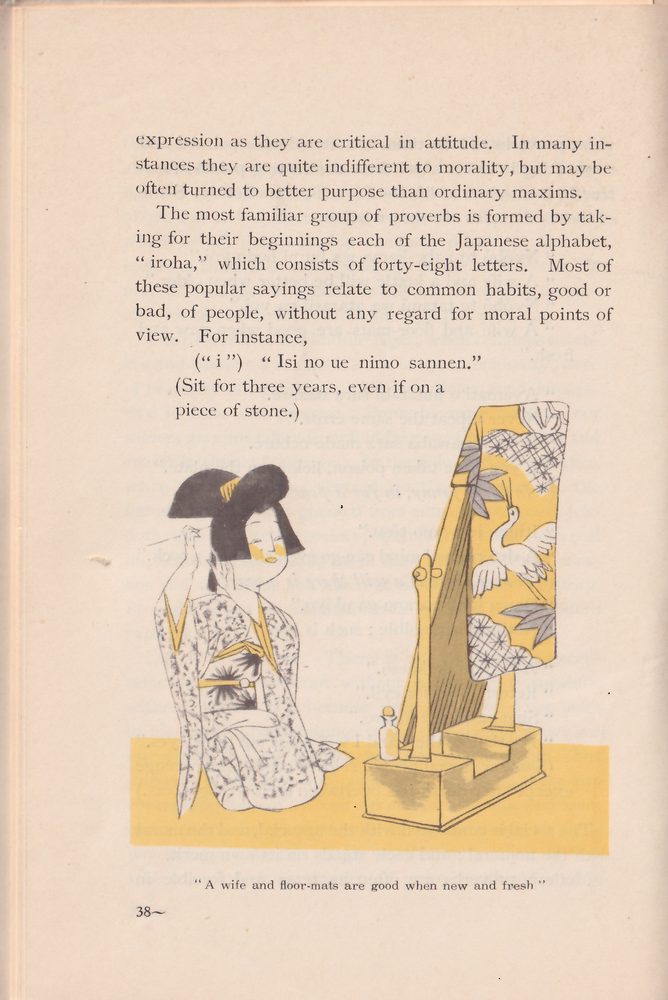
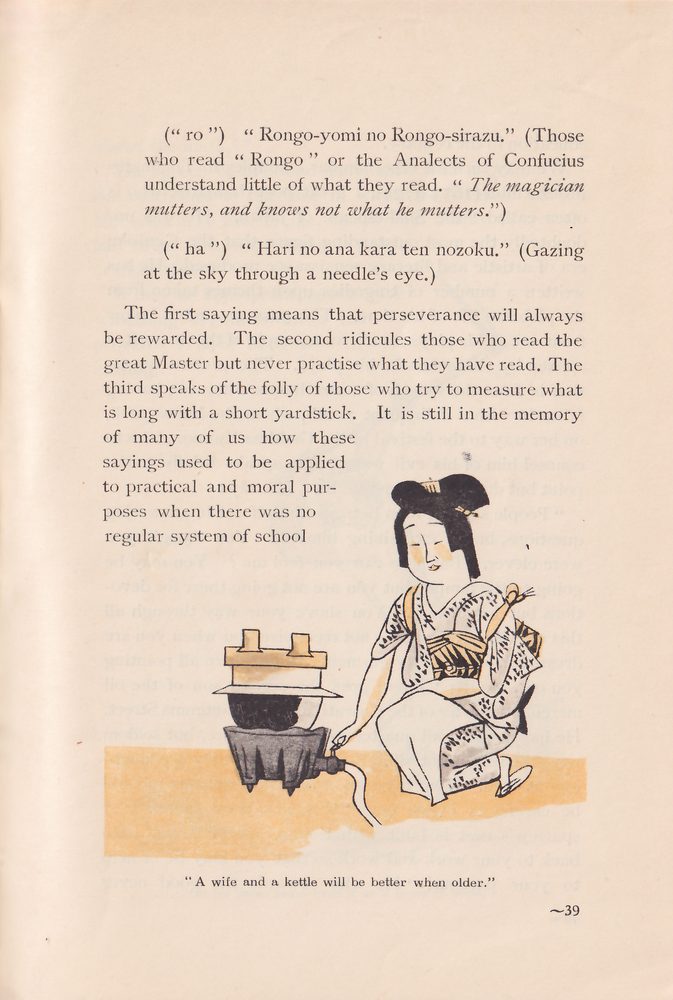
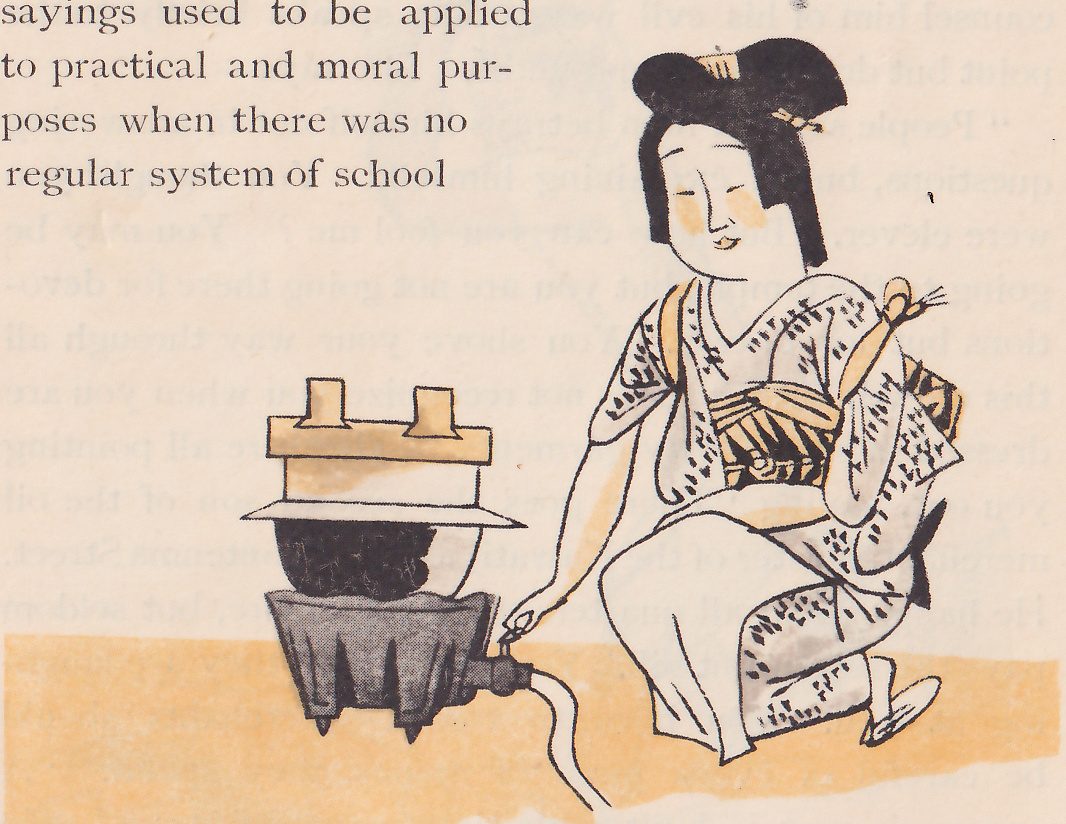
“A wife and a kettle will be better when older.”
“Nyōbō to tatami wa atarasii ga yoi.”
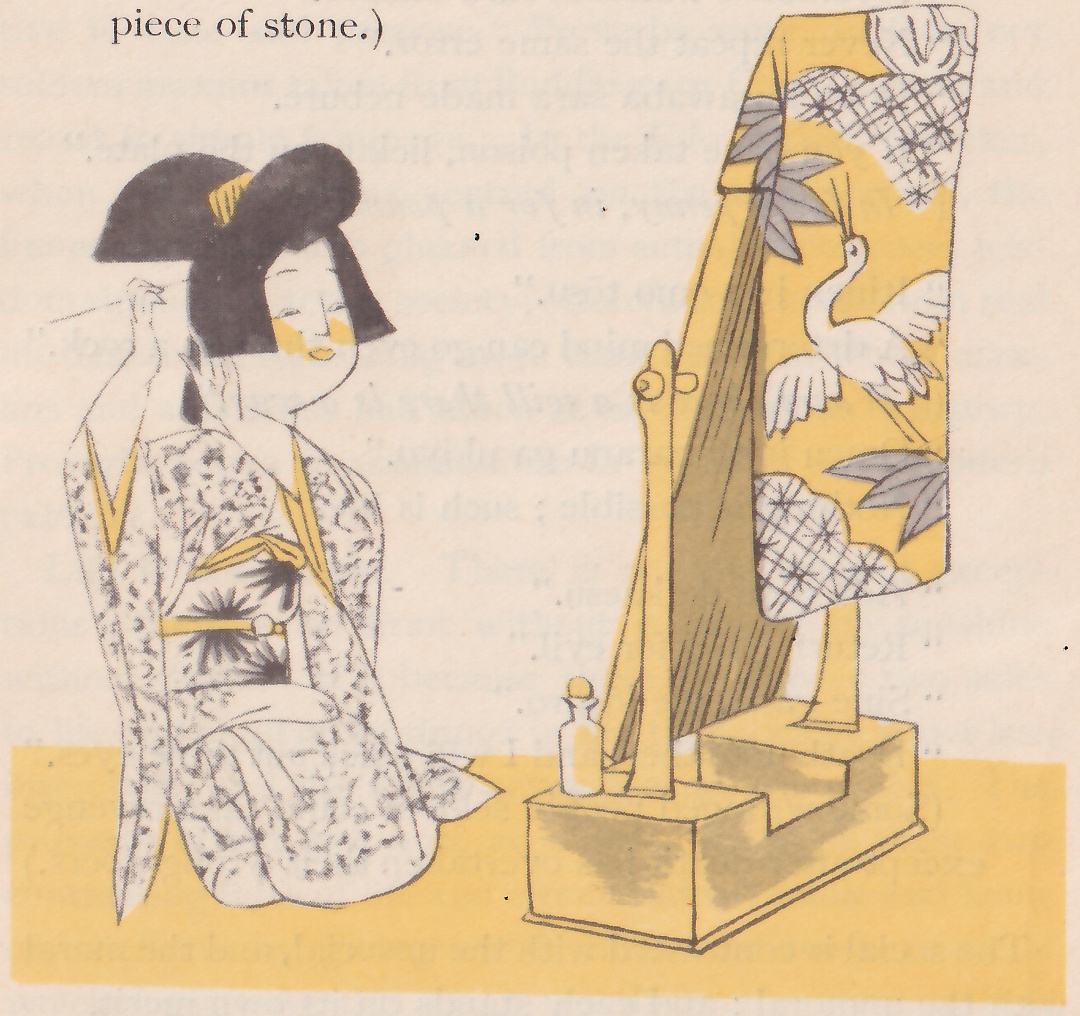
“A wife and floor-mats are good when new and fresh.”
“Ayamati o hutatabi suru nakare.”
“Never repeat the same error.”
“Doku kurawaba sara made nebure.”
“If you have taken poison, lick even the plate.”
(“In for a penny, in for a pound.”)
“Itinen iwa omo tōsu.”
“A determined mind can go even through a rock.”
(“Where there is a will there is a way.”)
“Omou koto naranu ga ukiyo.”
“Nothing is possible; such is life.”
“Ada o on de kaesu.”
“Return good for evil.”
“Sine gana, me kuziro.”
“Death unto thee, and I will pluck out thine eyes.”
(Some wronged people seldom could take revenge except after death has overtaken their wrong-doers.)
The social is contrasted with the unsocial, and the moral with the unmoral; and each stands on its own merit.
Modern proverbs are often as terse and forcible in
expression as they are critical in attitude. In many instances they are quite indifferent to morality, but may be often turned to better purpose than ordinary maxims.
The most familiar group of proverbs is formed by taking for their beginnings each of the Japanese alphabet, “iroha,” which consists of forty-eight letters. Most of these popular sayings relate to common habits, good or bad, of people, without any regard for moral points of view. For instance,
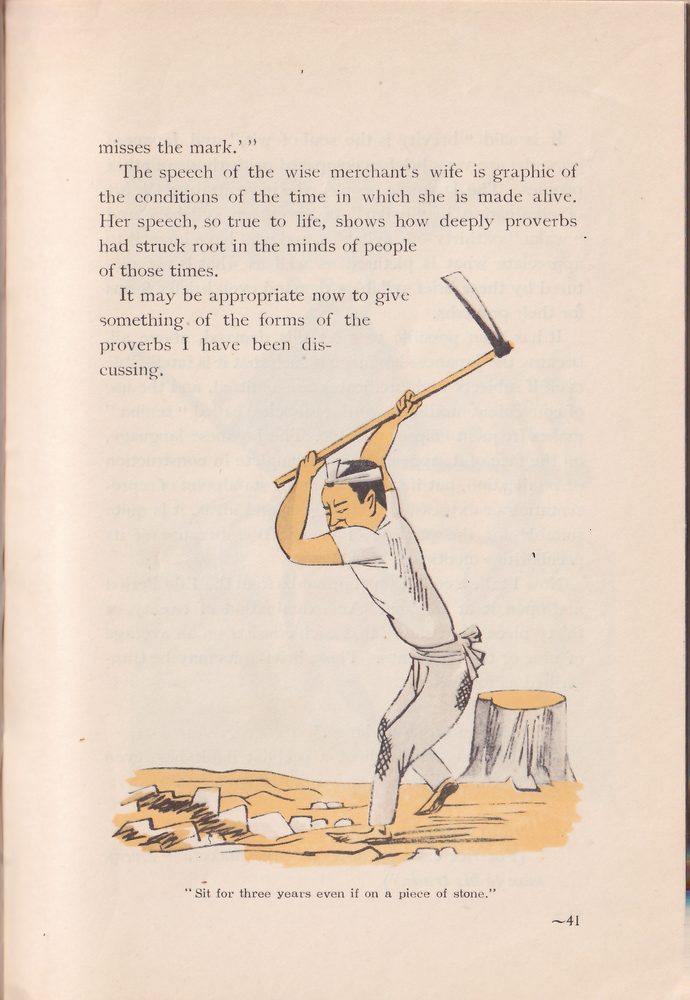
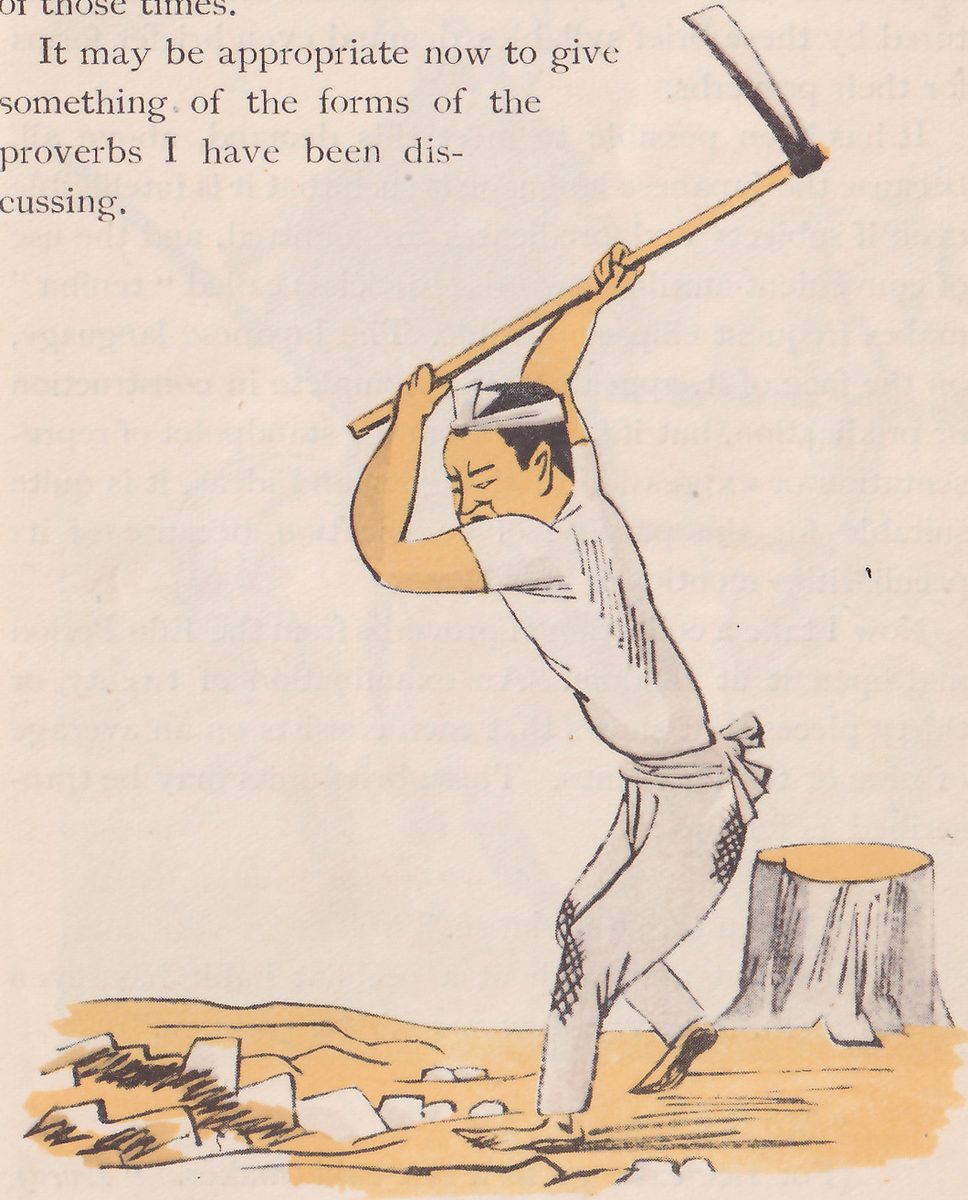
(“i”) “Isi no ue nimo sannen.”
(Sit for three years, even if on a
piece of stone.)
(“ro”) “Rongo-yomi no Rongo-sirazu.” (Those who read “Rongo” or the Analects of Confucius understand little of what they read. “The magician mutters, and knows not what he mutters.”)
(“ha”) “Hari no ana kara ten nozoku.” (Gazing at the sky through a needle’s eye.)
The first saying means that perseverance will always be rewarded. The second ridicules those who read the great Master but never practise what they have read. The third speaks of the folly of those who try to measure what is long with a short yardstick. It is still in the memory of many of us how these sayings used to be applied to practical and moral purposes when there was no regular system of school
education in the country.
We may turn for other similar examples to Tikamatu-Monzaemon (1653–1724), a great poet-dramatist who is often called “the Shakespeare of Japan.” He was undoubtedly the most outstanding figure that the Genroku era of artistic and literary renaissance produced. He has written a number of tragedies upon themes taken from the plebeian life of his time. The passage quoted below from one of his plays is only an example of the lines often spoken by characters in his plays. The present quotation is from the speech of a merchant’s wife who, having fallen in with a delinquent youth, whom she knows well, on her way to the festival of the Goddess Kannon, tries to counsel him of his evil ways. She speaks briefly to the point but deftly quotes proverbs. She says—
“People say ‘A man betrays himself not in answering questions, but in explaining himself.’ You thought you were clever. But how can you fool me? You may be going to the temple, but you are not going there for devotions but for brawls. You shove your way through all this crowd, but who does not recognize you when you are dressed in such showy garments? They are all pointing you out, saying ‘There goes the second son of the oil merchant, master of the Kawatiya of the Hontenma Street. He hangs about all quarters of light pleasure, but seldom pays the restaurant bill.’ You understand they are laughing at you. You born to trade! Merchants should be careful of every piece of money they spend. ‘A sparrow’s nest is built with tiny scraps of straw.’ Go back to your work and work so that you may be of help to your parents! ‘He who rewards the good never
misses the mark.’”
The speech of the wise merchant’s wife is graphic of the conditions of the time in which she is made alive. Her speech, so true to life, shows how deeply proverbs had struck root in the minds of people of those times.
It may be appropriate now to give something of the forms of the proverbs I have been discussing.
It is said “brevity is the soul of wit,” and Japanese proverbs are very brief as compared with those of other peoples. The Japanese people, who have attained the art of elimination in “haiku” of seventeen syllables and “waka” of thirty-one syllables, and who have learned to appreciate what is pictured as well as what is not pictured by these brief syllables demand even briefer forms for their proverbs.
It has been possible to meet this demand, above all, because the Japanese language is such that it is intelligible even if subjects and predicates are omitted, and the use of convenient auxiliary words (particles) called “teniha” makes frequent ellipses possible. The Japanese language, on the face of it, appears very incomplete in construction or predication, but if viewed from the standpoint of representation or expression of thoughts and ideas, it is quite suitable for the purpose of versification because of its peculiarities mentioned above.
Now I take a collection of proverbs from the Edo Period and open it at random. An examination of twenty or thirty pieces in it shows that each consists on an average of nine or ten phonemes. These brief units may be transcribed as follows:
“Na ku te, na na ku se.”
(Even a man without a peculiar habit has seven of them. “Every man has his hobby-horse.”)“Mo ti wa, mo ti ya.”
(For rice-cake go to a rice-cake maker. “Every man to his trade.”)
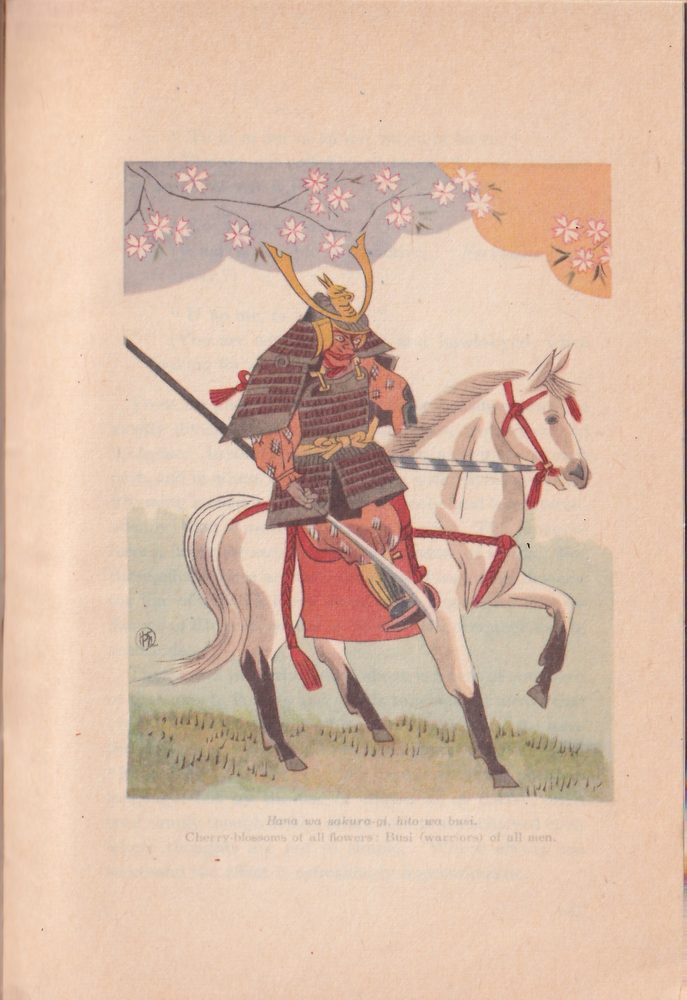
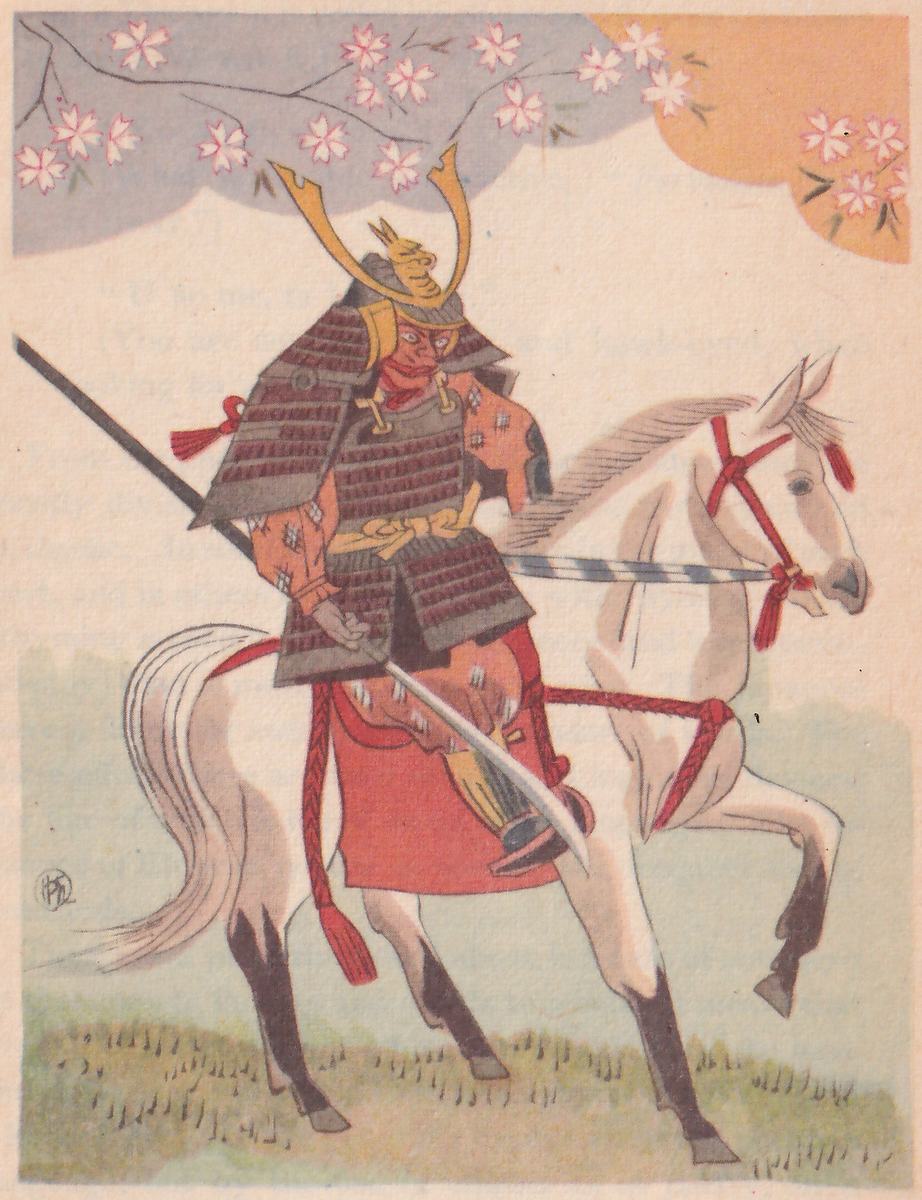
Cherry-blossoms of all flowers: Busi (warriors) of all men.
“Tu ki ni mu ra ku mo, ha na ni ka ze.”
(The moon is veiled by clouds and flowers are blown away by winds.)
“Ko wa si, mi ta si.”
(What is terrible is attractive. “Forbidden fruit is sweet.”)
“U no me, ta ka no me.”
(You are cormorant-eyed and hawk-eyed, when looking for something.)
From the phonetic standpoint, these measured lines are mostly divisible into two parts, and these parts often end in rhyme. In some cases rhyme occurs in the midst of each part, and in others each part begins with rhyming words. Rhyming is used in Japanese more freely (and less systematically) than in most European languages. The Japanese have a fancy for swing, tone and measure of words. For these effects there are used unique and ingenious devices, the like of which is found in no other language. The influence of Chinese poetry is seen in the frequent use of antithesis.
The second proverb quoted above is a case of antithesis of the moon to flowers and clouds to winds. It means that even the fairest objects of nature are destined to have their fairness marred. Compared with “waka” and “haiku,” proverbs are generally expressed in less polished language, but by the use of ellipsis as in poetry, often used simply though deftly, direct effects are achieved even where thoughts are not so simple. Where efforts are successful the effect is refreshingly impressionistic.