

III. PROVERBS AND PLEBEIAN LIFE
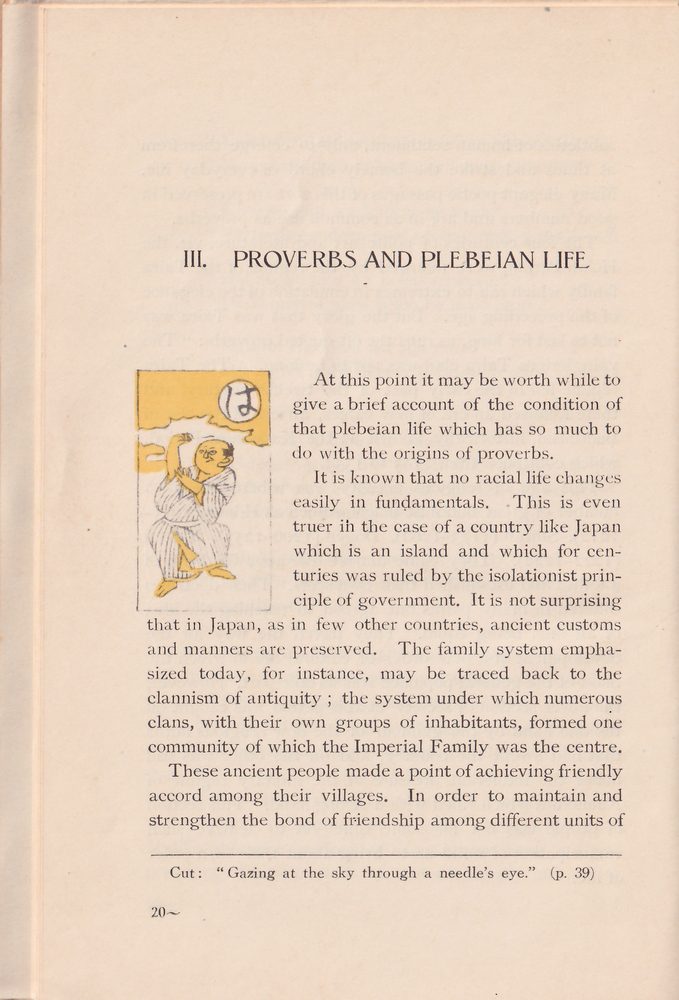
At this point it may be worth while to give a brief account of the condition of that plebeian life which has so much to do with the origins of proverbs.
It is known that no racial life changes easily in fundamentals. This is even truer in the case of a country like Japan which is an island and which for centuries was ruled by the isolationist principle of government. It is not surprising that in Japan, as in few other countries, ancient customs and manners are preserved. The family system emphasized today, for instance, may be traced back to the clannism of antiquity; the system under which numerous clans, with their own groups of inhabitants, formed one community of which the Imperial Family was the centre.
These ancient people made a point of achieving friendly accord among their villages. In order to maintain and strengthen the bond of friendship among different units of
communal life, there were men called “Kataribe.” These were the story-tellers whose duty it was to recite tales of divine ancestors and ancient heroes whom each village claimed as its own. They had their audiences not only in villages and clans but they played rôles of national importance, for the “Koziki,” the oldest of the chronicles of the people, is a collection of tales told by these raconteurs. In these tales we find, as already mentioned, not only origins of nationalist thought, pictures of ancient life, sentiment and wisdom of early ancestors of the race, but also the sources of proverbs. The clans later fell into decay, and “Kataribe” or story tellers in time ceased to entertain village audiences, though the people who learned early to listen to their stirring accounts or moving tales never lost their racial habit.
Farmers would often come together and listen to story-tellers, and as their hearts were moved by what they heard in common, their minds became united in one bond of sympathy and understanding. They themselves became disposed to be helpful to one another. These occasions in the process of time established themselves as an institution in their country, an institution that was to continue through centuries. It was in this way that the great epic telling the downfall of the once vainglorious Taira clan and recited by blind Buddhist priests became popular through the land. It was also in this way that, with the rise of Buddhism in the second half of the middle ages, Gautama’s teaching was made familiar to millions of minds. As his teaching became widely known, the thought of the vanity of life and the idea of human equality, common to all sects of his followers, brought
all minds, high and low, into unison and accord. Thus was developed a new spirit of popular collaboration in life as well as in art.
The homes of village chiefs, whose lineages could be traced back for centuries, and the residences of manorial lords, were their gathering-places. And to these places villagers came on gala occasions, for weddings, and for other public purposes. When they came together they were never without some news or stories to tell. They were only too eager to tell of what they had heard of other people, how the harvests had been, what they had observed on their journeys, or what they had discovered of the movement of the moon and stars. It is easy to imagine how on such occasions the more gifted story-tellers could command large audiences. They must have seized on almost anyone to make a butt of him; they doubtless overlooked few incidents from which to derive lessons. Almost anything and anybody must have been made the subject of ethical discourses or amusing stories. Those who could hold audiences at such times were not unlike the “Kataribe” or story-tellers of earlier times, and although they may never have posed as poets, their language must at times have been coloured by popular forms of poetry, and as often enlivened by freshly formed proverbs. Times were ripening for new crops of proverbs.
This trend was also evident in the realm of art. Where there were religious teachers of singular merits or learning, people came and gathered about them to profit from their wisdom. Men of art or letters were likewise visited by many admirers. At these times the visitors would sit and slowly sip tea as they listened to instructive and
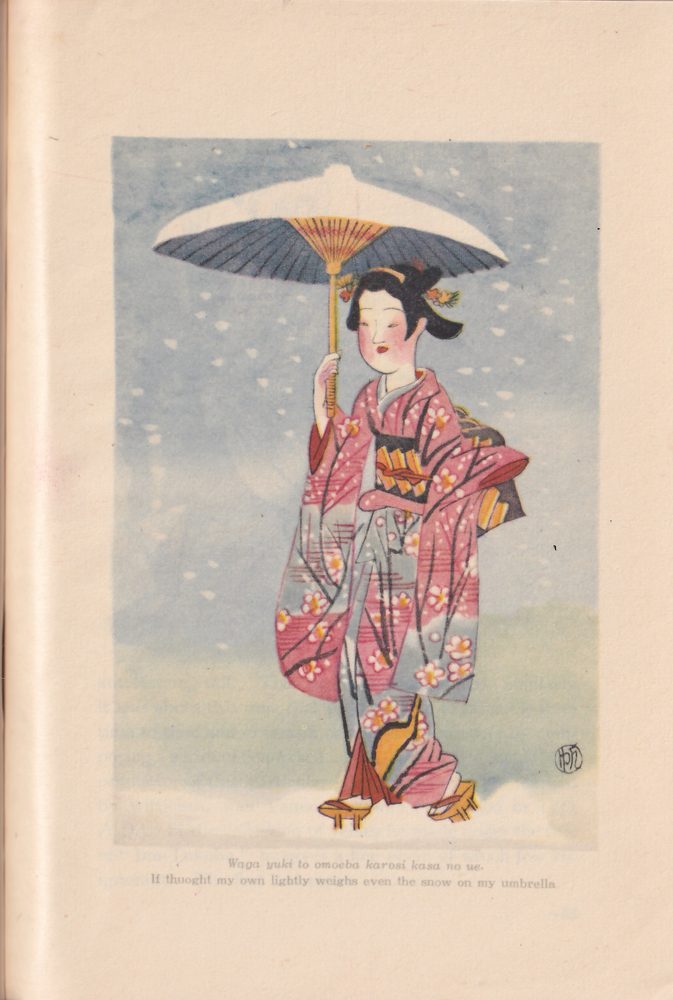
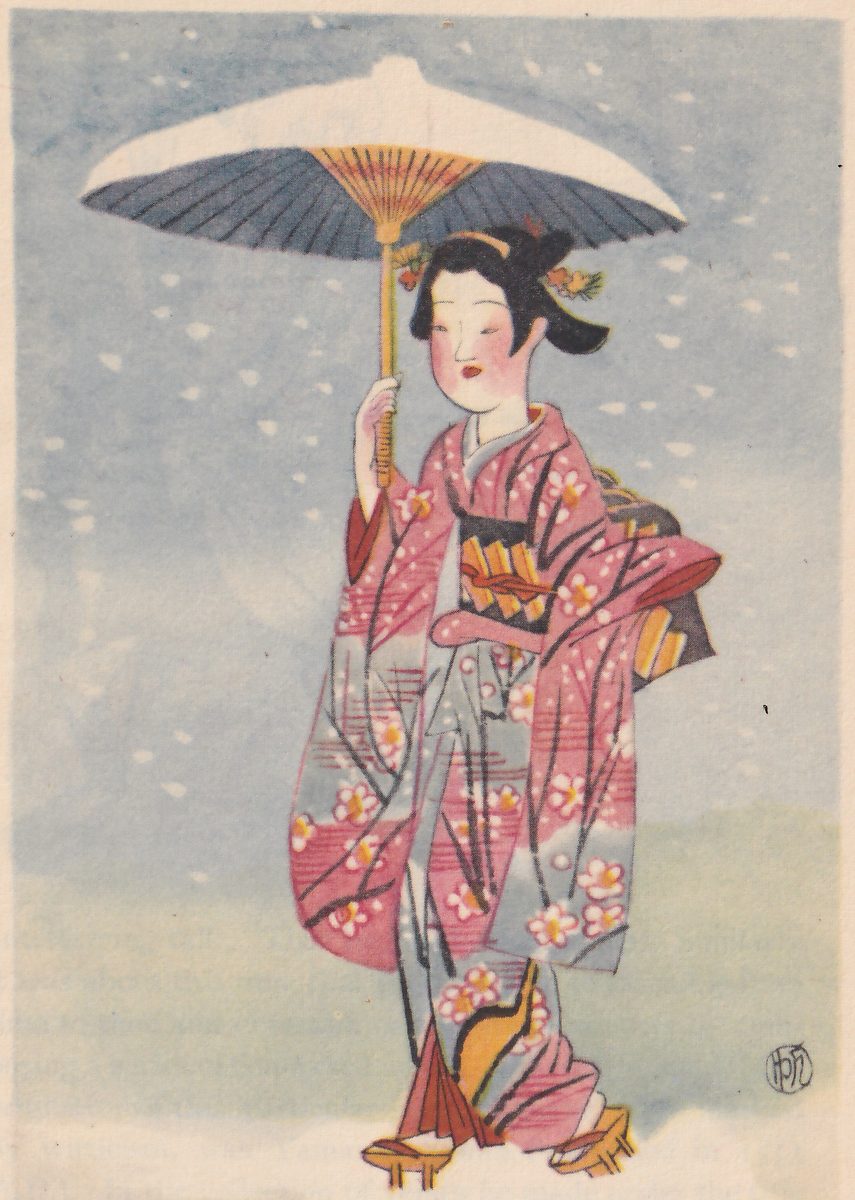
If thought my own lightly weighs even the snow on my umbrella
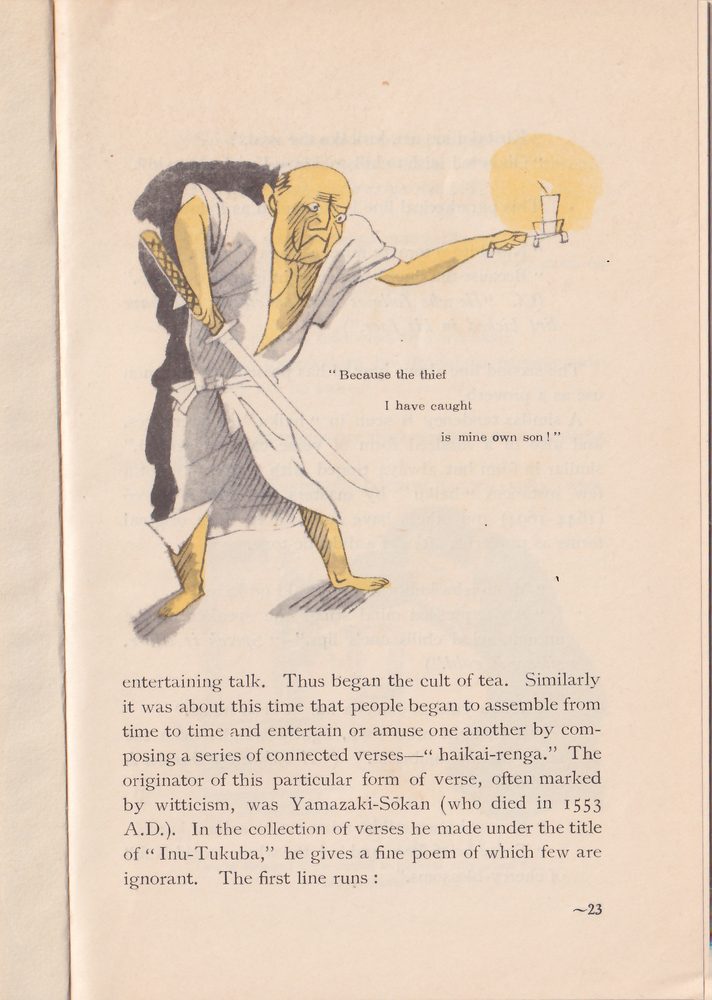
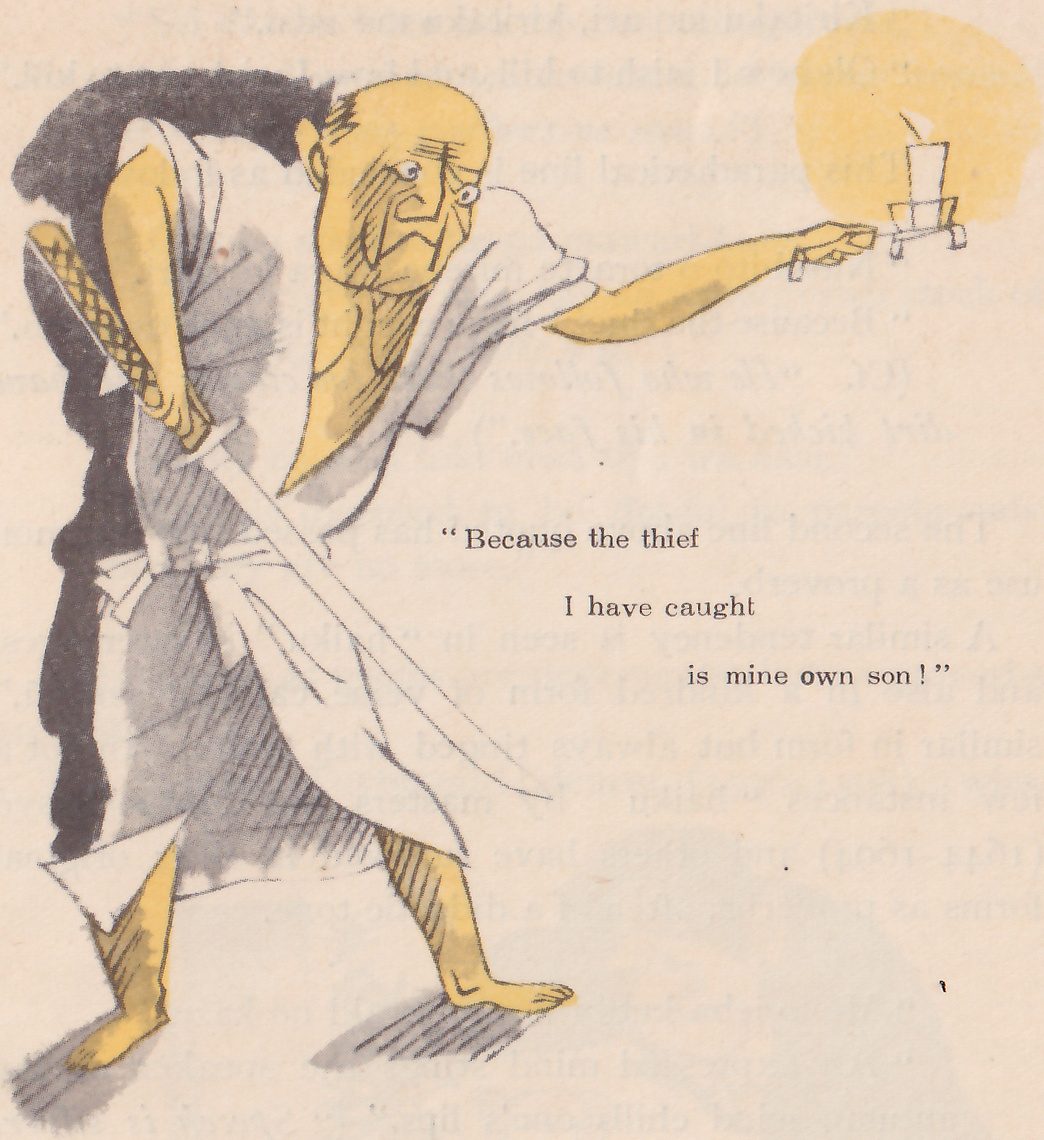
I have caught
is mine own son!”
entertaining talk. Thus began the cult of tea. Similarly it was about this time that people began to assemble from time to time and entertain or amuse one another by composing a series of connected verses—“haikai-renga.” The originator of this particular form of verse, often marked by witticism, was Yamazaki-Sōkan (who died in 1553 A.D.). In the collection of verses he made under the title of “Inu-Tukuba,” he gives a fine poem of which few are ignorant. The first line runs:
“Kiritaku mo ari, kiritaku mo nasi.”
“Oh how I wish to kill, and how I wish not to kill.”
This paradoxical line is concluded as follows:
“Nusubito o toraete mireba waga ko nari.”
“Because the thief I have caught is mine own son.”
(Cf. “He who follows truth too closely will have dirt kicked in his face.”)
The second line above quoted has passed into common use as a proverb.
A similar tendency is seen in “haiku” of later ages, and also in a kindred form of verse called “senryū,” similar in form but always tinged with satire. In not a few instances “haiku” by masters like Matuo-Basyō (1644–1694) and others have survived in their original forms as proverbs, often of a didactic tone.
“Mono ieba kutibiru samusi aki no kaze.”
“An expressed mind stings the speaker as the autumn wind chills one’s lips.” (“Speech is silver, silence is gold.”)“Waga yuki to omoeba karosi kasa no ue.”
“If thought mine own, lightly weighs even the snow on my umbrella.” (“A voluntary burden is no burden.”)“Yononaka wa mikka minu ma no sakura kana.”
“Three brief days, and lo! the whole world is full of cherry-blossoms.”
“Sei daseba kōru ma mo nasi mizuguruma.”
“A hard-worked water-wheel is never frozen.” (“A rolling stone gathers no moss.”)
“Ōotoko sōmi ni tie ga mawari-kane.”
“An overgrown man has an undergrown stock of wit.” (“Big head; little wit.”)
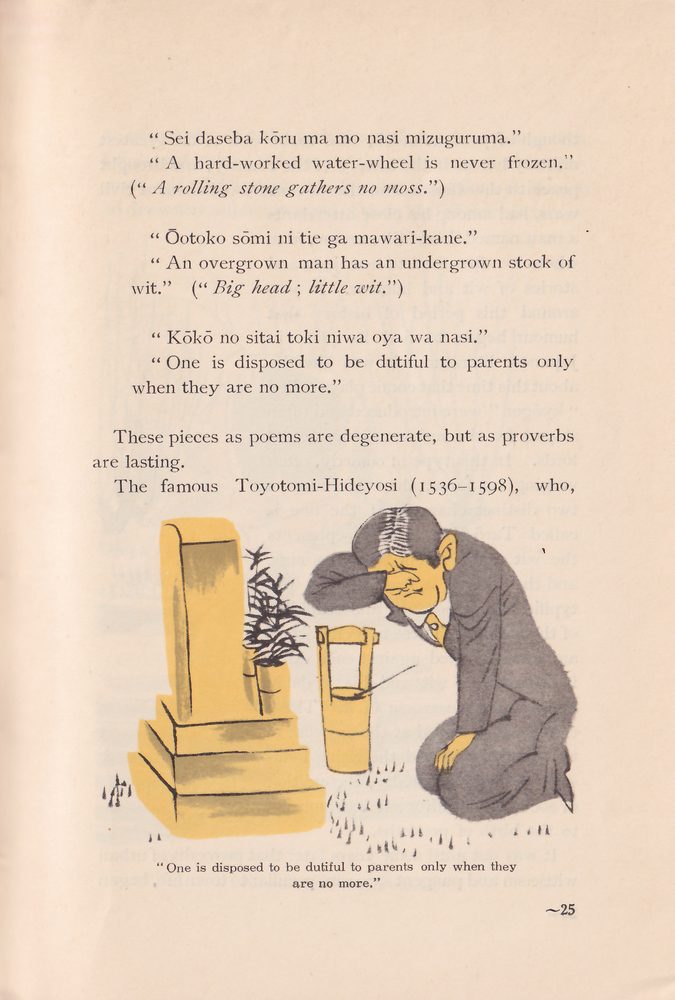
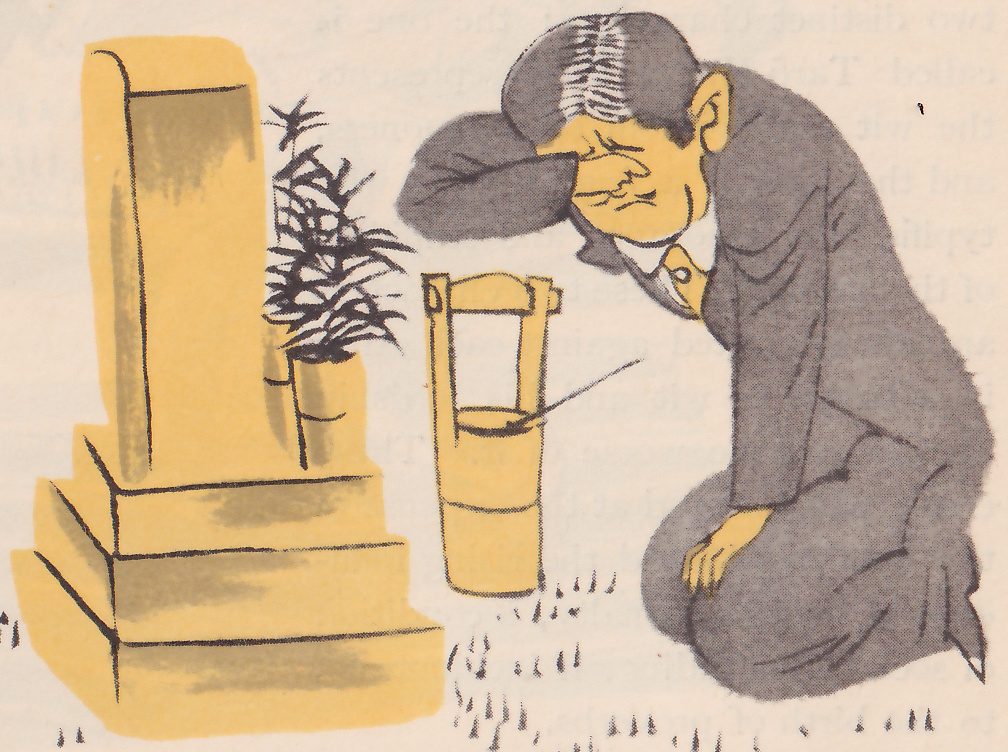
“Kōkō no sitai toki niwa oya wa nasi.”
“One is disposed to be dutiful to parents only when they are no more.”
These pieces as poems are degenerate, but as proverbs are lasting.
The famous Toyotomi-Hideyosi (1536–1598), who,
though of peasant stock, rose to be one of the greatest military heroes in the history of the country, and brought peace to the whole realm after a century of incessant civil wars, had among his close attendants a man named Sorori-Sinzaemon, from whom he often used to hear jests and stories of wit and humour. It was around this period of history that humour began to find its place in Japanese literature. It was likewise about this time that comic plays called “kyōgen” were introduced and often staged for the amusement of feudal lords. In this type of comedy, often verging on farce, there are always two distinct characters: the one is called Tarō-Kazya who represents the wit and wisdom of commoners, and the other is a feudal baron who typifies the ignorance and stupidity of the nobility. These two characters are always pitted against each other in a battle of wit and his lordship always gets the worse of it. These comic plays staged at the expense of the nobility showed the rising influence of the commonalty, a condition of social life leading, if incidentally, to the birth of proverbs.
It was not until some years later that proverbs of urban witticism and pungent sarcasm, peculiar to town life, began
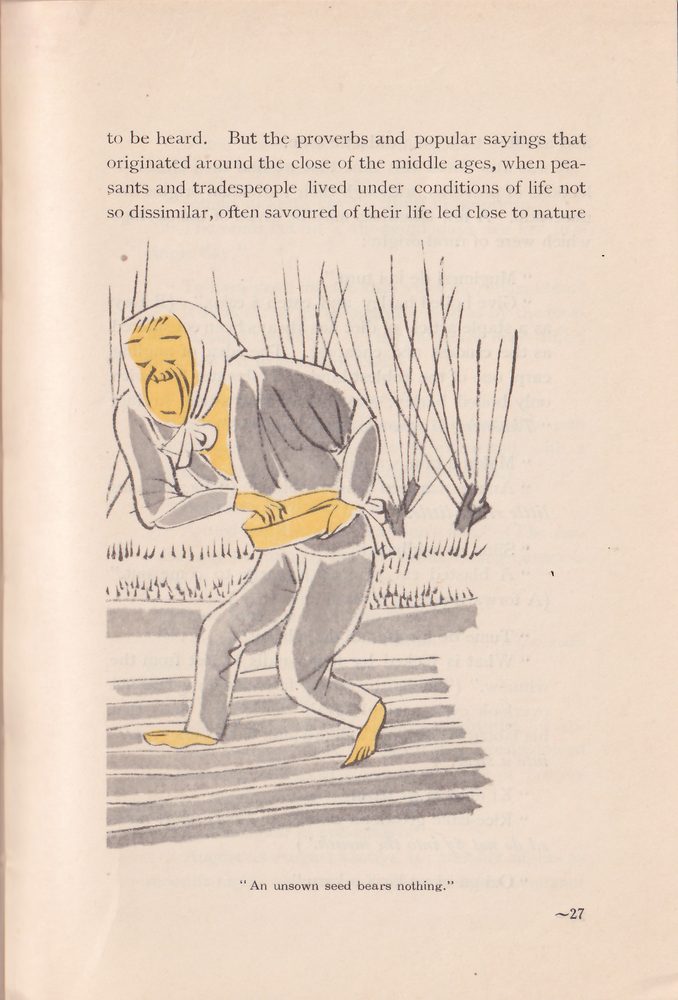

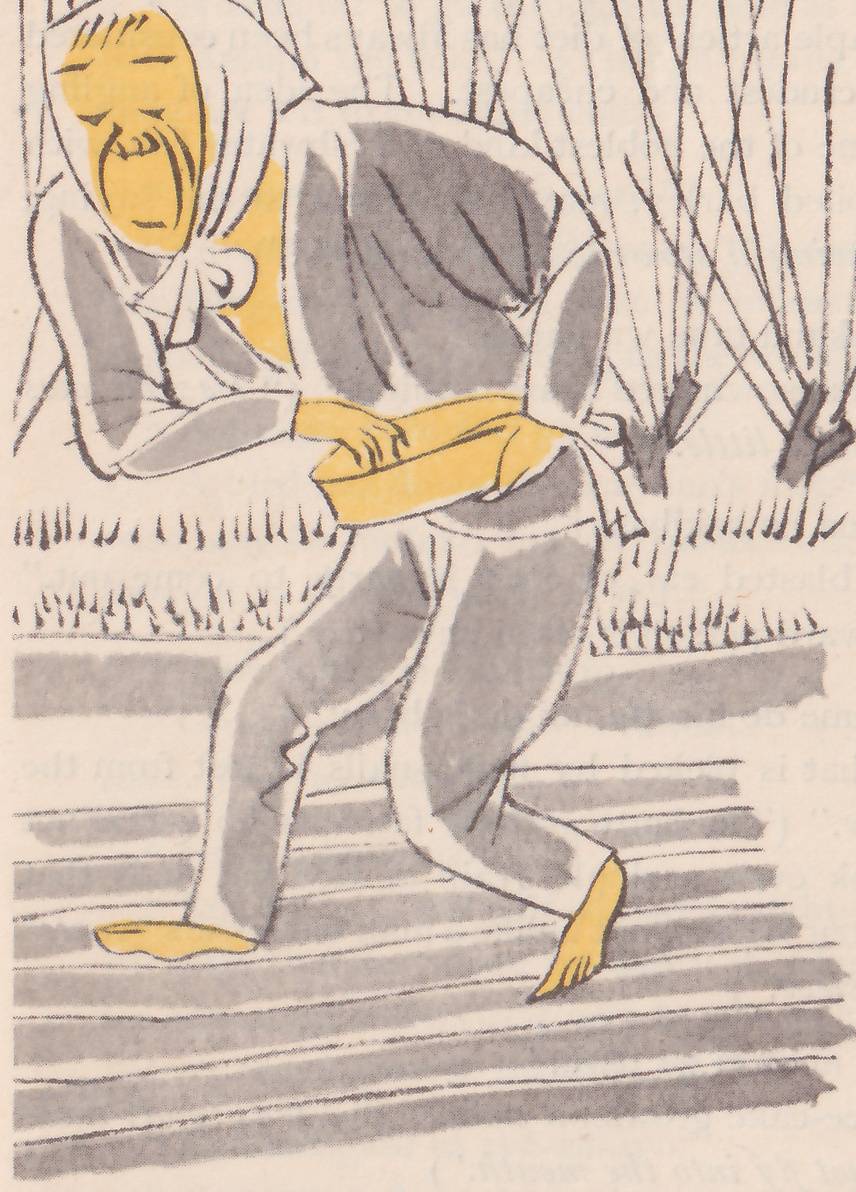
to be heard. But the proverbs and popular sayings that originated around the close of the middle ages, when peasants and tradespeople lived under conditions of life not so dissimilar, often savoured of their life led close to nature
and as often took on a didactic tone.
It was also about this time that we find the oldest collections of proverbs, although their individual origins are uncertain. A few examples may be given of the sayings which were of rural origin:
“Mugimesi de koi turu.”
“Give boiled barley and catch a carp.” (Barley as a staple article of diet has always been considered as the crudest and cheapest. The idea of angling carp, one of the noblest kind of freshwater fish, with only boiled barley, may be likened to the saying, “Throwing a sprat to catch a whale.”)
“Makanu tane wa haenu.”
“An unsown seed bears nothing.” (“He who sows little reaps little.”)
“Siina no sakibasiri.”
“A blasted ear of corn is early to come out.” (A forward person is often unworthy.)
“Tume de hirotte, mi de kobosu.”
“What is picked by finger-nails is lost from the winnow.” (The hard-working farmer who would not overlook even a single grain of rice but finds that his labour is lost is not unlike a man who pours “water into a sieve.”)
“Ki ni moti ga naru.”
“Rice-cake grows on trees.” (“Birds ready cooked do not fly into the mouth.”)
“Ozi ga oi no kusa o karu.”
“Uncle mows grass for his nephew.” (Life has often been topsyturvy.)
“Senniti ni katta kaya o itiniti ni horobosu.”
“The reeds cut in a thousand days are lost in a single day.”
“Ta kara yuku mo aze kara yuku mo, onazi koto.”
“It is as far to go through the field as by the footpath around the field.” (Though means may differ, they are led to the same end.)
“Ta mo yarō, aze mo yarō.”
“Giving away rice-fields and the footpaths into the bargain.” (A man who is infatuated with a woman will give everything to the woman.)
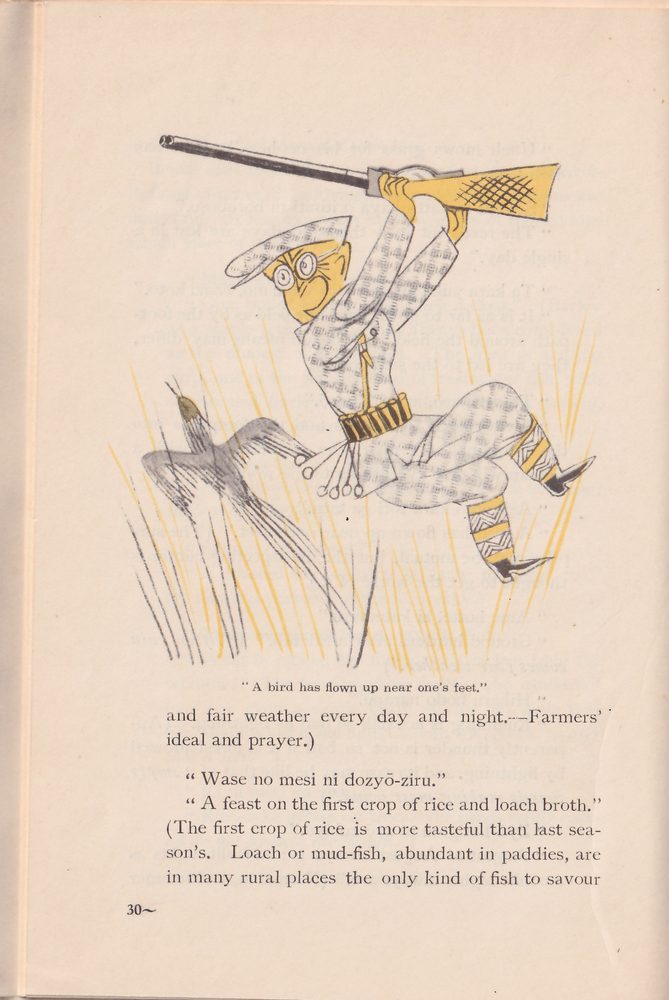
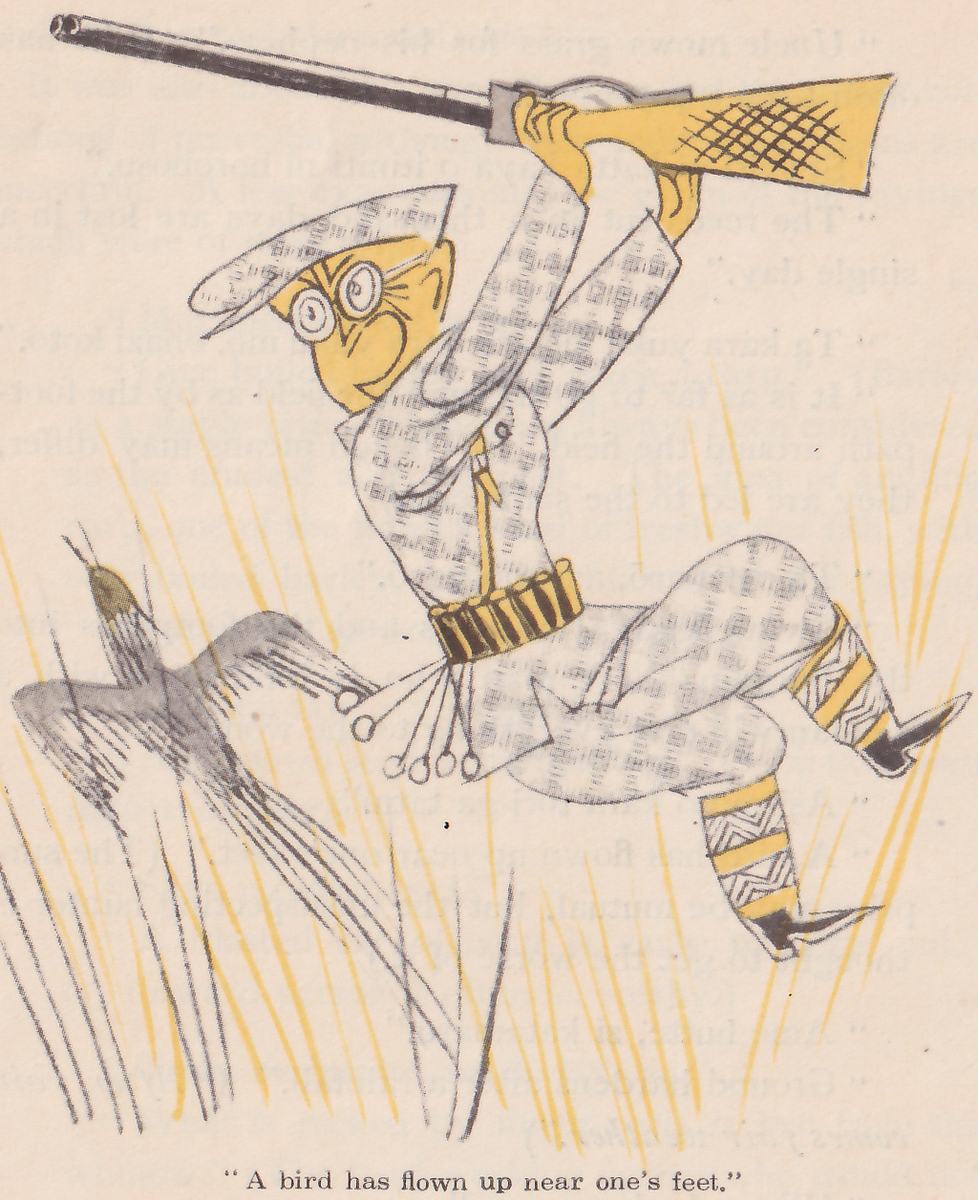
“Asi-moto kara tori ga tatu.”
“A bird has flown up near one’s feet.” (The surprise may be mutual, but the unsuspecting hunter is thought to get the worse of it.)
“Ame hutte, zi katamaru.”
“Ground hardens after a rainfall.” (“After rain comes fair weather.”)
“Hikaru hodo naranu.”
“Rumbling is not half so bad as lightning.” (Apparently thunder is not so bad if it is foreshadowed by lightning, and its case may be like that of “empty vessels making most sound.”)
“Zyō-hatigatu ni zyō-zukiyo.”
“August as August always is; moonlit nights as moonlit nights always are.” (Normal heat of summer
and fair weather every day and night.—Farmers’ ideal and prayer.)
“Wase no mesi ni dozyō-ziru.”
“A feast on the first crop of rice and loach broth.”
(The first crop of rice is more tasteful than last season’s. Loach or mud-fish, abundant in paddies, are in many rural places the only kind of fish to savour
the table.)
“Nyōbō zyū-hati, ware hatati.”
“My wife is eighteen and I am twenty.” (Young farmer boys thought of such happy matrimonial arrangements as the dream of their life.)
The following sayings are didactic:—
“Suku miti yori yaburu.”
“The way that attracts most leads to ruin.”
“Kabe ni mimi ari.”
“Walls have ears.”
“Yoku niwa itadaki nasi.”
“Covetousness has no zenith.” (“The miser’s bag is never full.”)
“Kakusu koto wa senu ga yoi.”
“Do nothing that you would hide.”
“Sitasiki naka nimo reigi ari.”
“There should be no intimacy without politeness.” (“Familiarity breeds contempt.”)
“Waga mi tumette, hito no itasa o sire.”
“Pinch thyself and know how painful others may be.” (“Do as you would be done by.”)
“Hana ōkereba, mi sukunasi.”
“Many blossoms, few fruits.” (“Much cry, little wool.”)
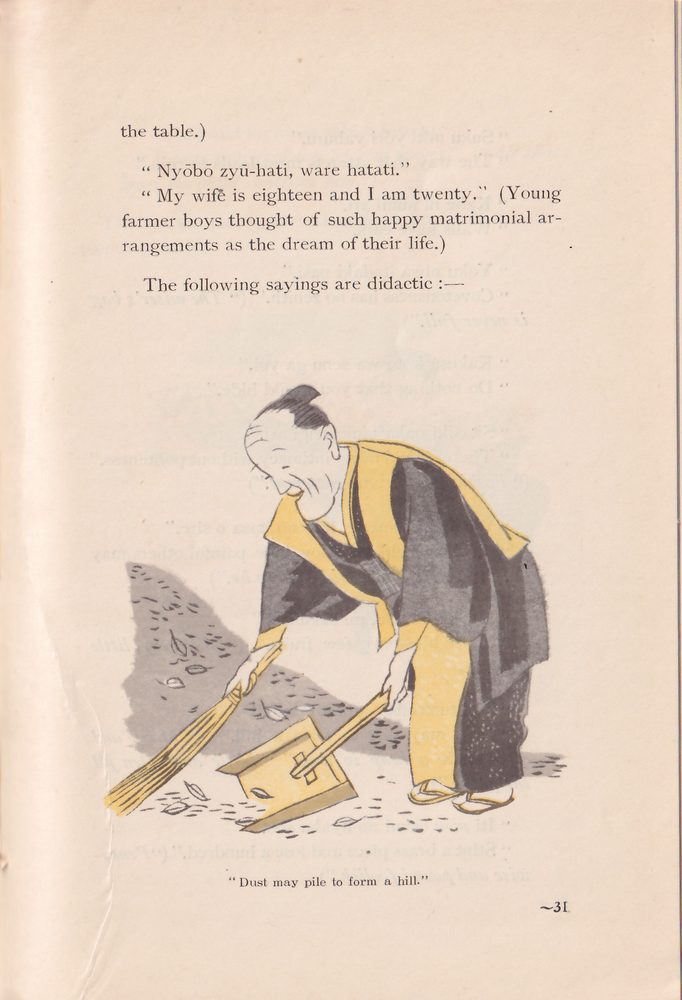
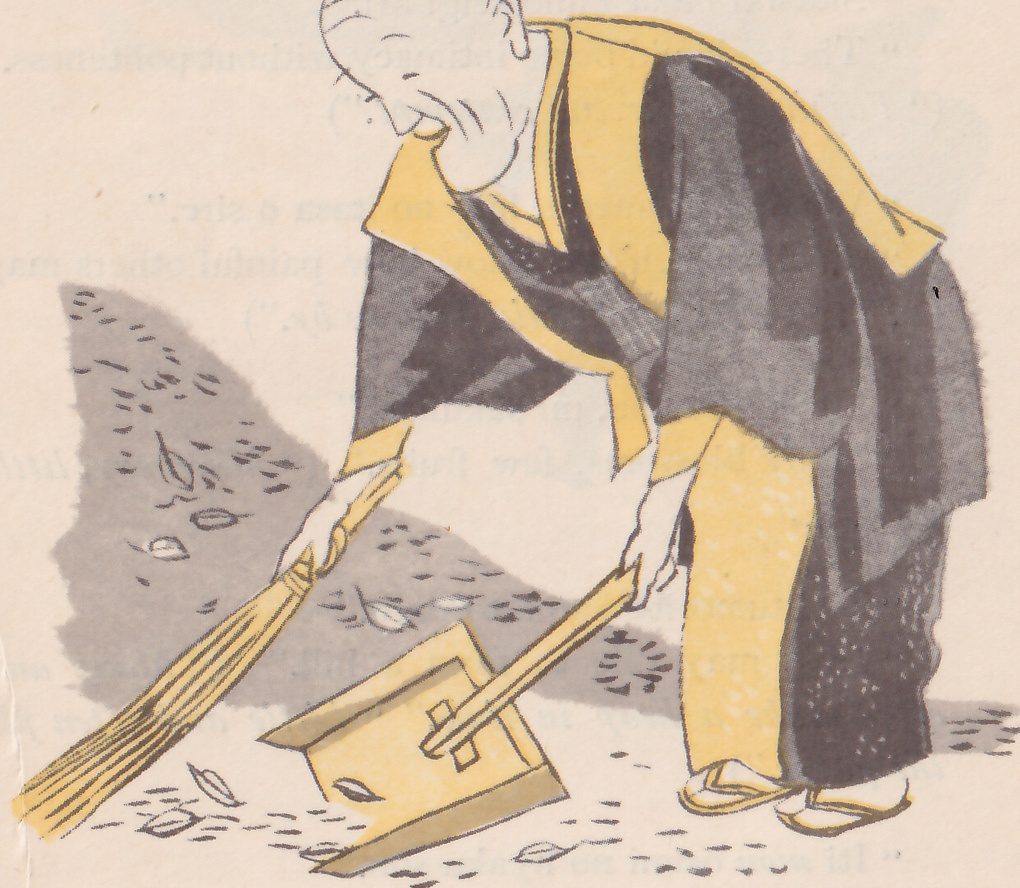
“Tiri tumorite yama to naru.”
“Dust may pile to form a hill.” (“Many and often make a heap in time.” “Little and often fill the purse.”)
“Iti mon osimi no hyaku son.”
“Stint a brass piece and lose a hundred.” (“Penny-wise and pound-foolish.”)
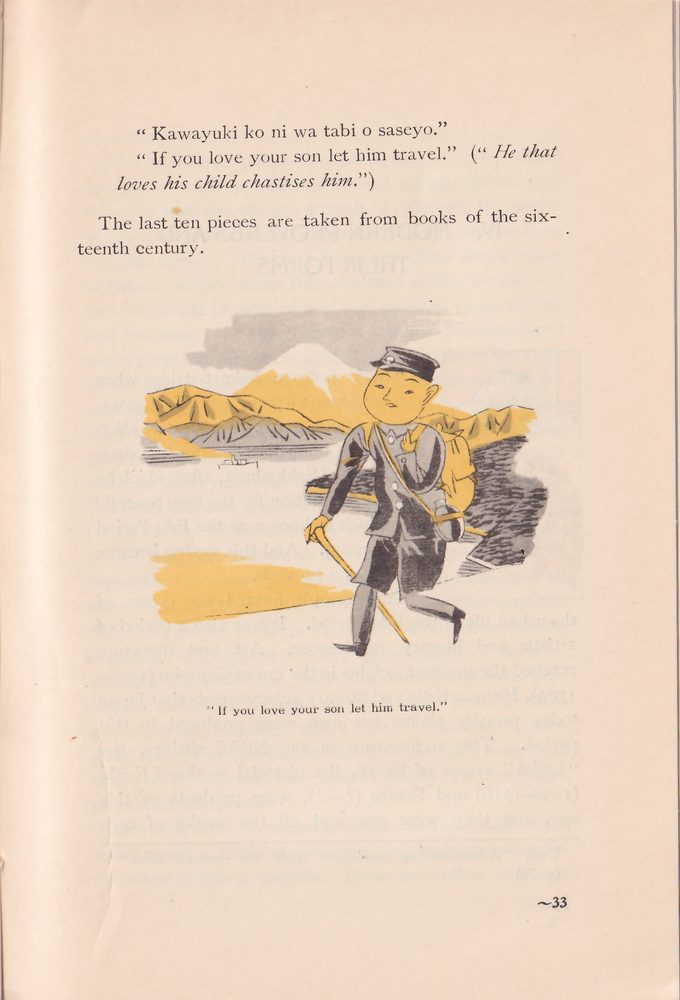
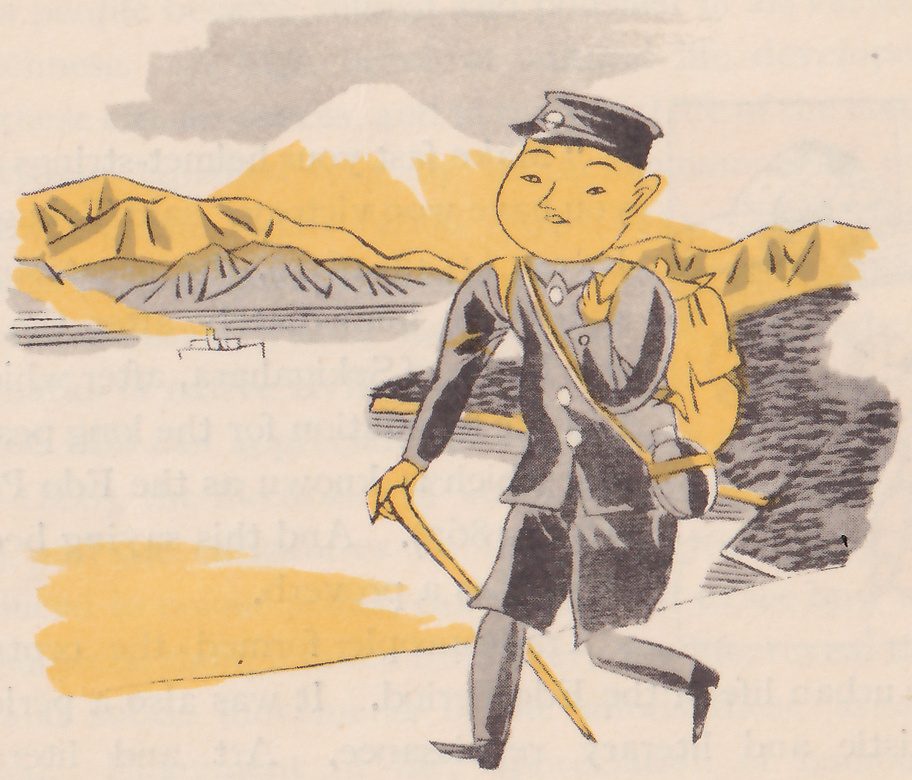
“Kawayuki ko ni wa tabi o saseyo.”
“If you love your son let him travel.” (“He that loves his child chastises him.”)
The last ten pieces are taken from books of the sixteenth century.