

V. PROVERBS, THEIR KINDS AND CHARACTERISTICS
Attention may now be drawn to the variety and characteristics of Japanese proverbs. As already stated, the most favourable conditions for the birth of proverbs developed in the Edo Period (1600–1867), which came down to the threshold of the modern age of Meizi. The social and political institutions of those times present important points in any study of proverbs. The conditions of life and society of those times account for the varieties of forms which proverbs of the time took.
The social and cultural life that flourished in Edo (the present Tōkyō) at the time was owing to its bourgeoisie for the most part. But, as a matter of fact, the warrior class formed half of the community. The upper section of society was represented by court nobles who, if small in number, jealously guarded ancient traditions in their life and outlook on life. There were also groups of Buddhist
priests and Confucian scholars who were intellectual leaders of the time. The farmers were now decidedly more retiring in their outlook and negative in their attitude than they were in the Middle Ages. Most of them, with all that their ancestors had bequeathed in the field of culture, were in time absorbed and effaced in the bourgeois life of the time.
The education and training of the warriors were conducted with main emphasis on the importance of loyalty to their masters, contempt of death, and indifference to money. The class of men who were taught to deny themselves and to hold pleasures of life beneath their dignity, naturally had little to do with the making of proverbs. Nevertheless, the century of civil wars or its experience had not been lost on the minds of people at large of the Edo Period.
This may be said also with regard to the bourgeoisie who formed the bulk of the urban population. Their minds were by no means foreign to conflicting problems of life such as duty and worldly ambition, pleasure and self-denial, pursuit of life and resignation therefrom, indulgence and self-examination. In thinking over these and other conflicting problems, their life was deepened. It should be noted, therefore, that the section of society which was most fertile of proverbs at this period bore the impress of thoughts and experiences of the warrior class, priests and court nobility.
To begin with, I may give some of the proverbs which seem to be traceable to warrior life.
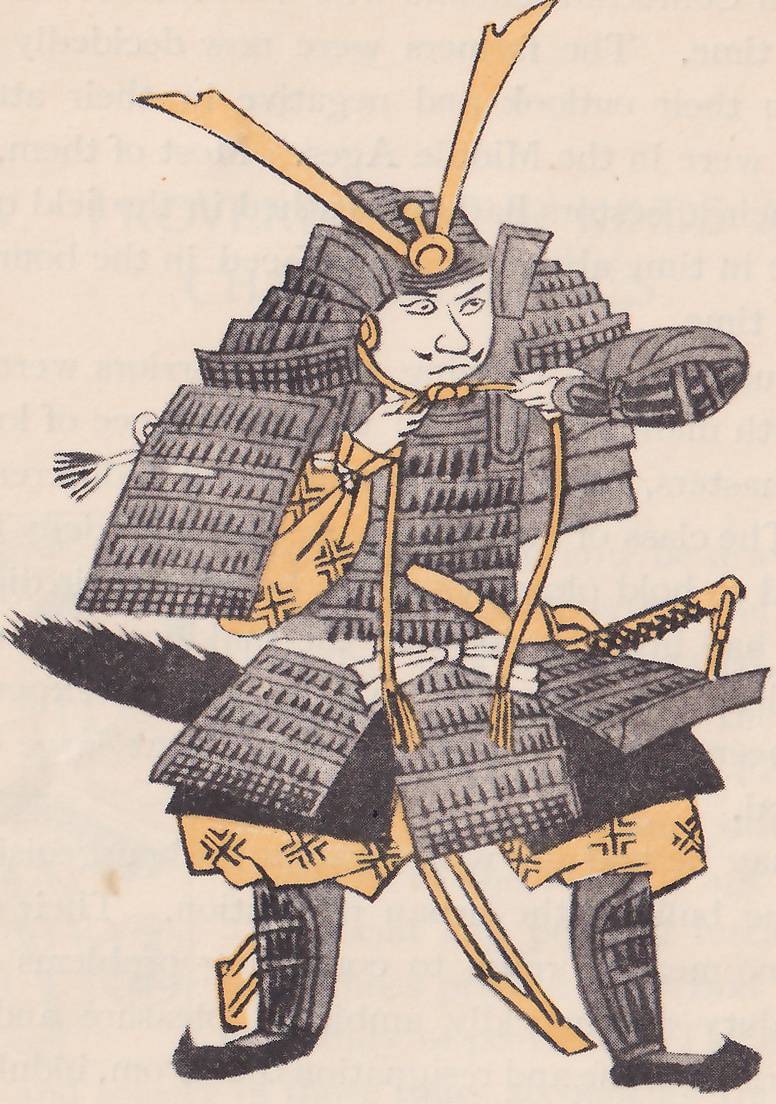
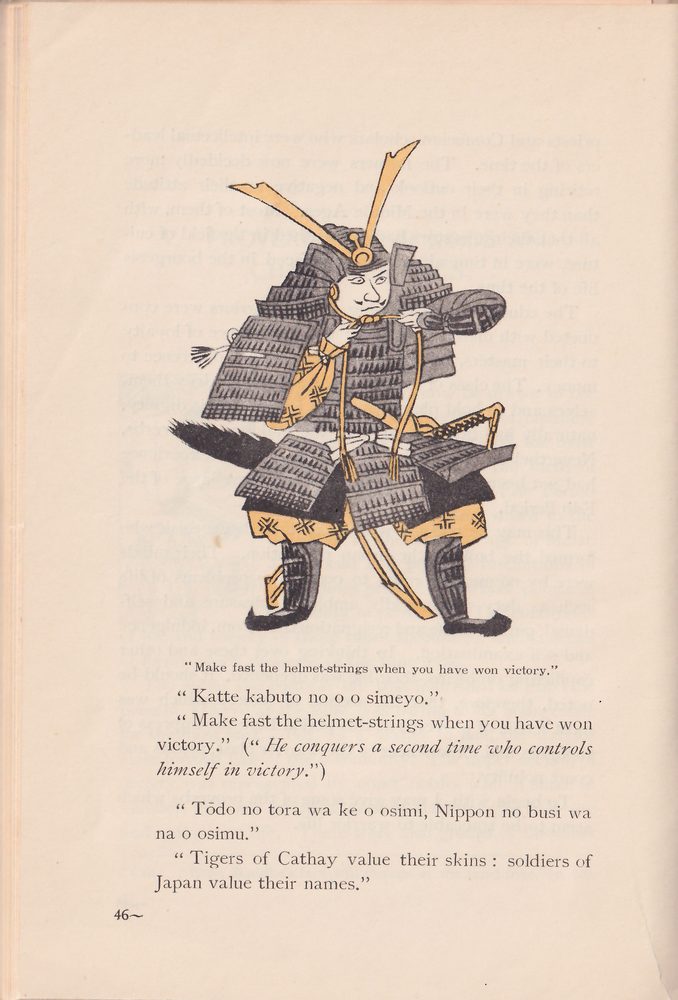
“Katte kabuto no o o simeyo.”
“Make fast the helmet-strings when you have won victory.” (“He conquers a second time who controls himself in victory.”)
“Tōdo no tora wa ke o osimi, Nippon no busi wa na o osimu.”
“Tigers of Cathay value their skins: soldiers of Japan value their names.”
“Katana wa busi no tamasii.”
“The sword is the soul of the soldier.”
“Busi ni nigon nasi.”
“A warrior’s lips utter not two words (lies).”
“Busi no itigon kintetu no gotosi.”
“A warrior’s word is unchanging as steel.”
(“A warrior never goes back on his words.”)
“Busi to kogane wa kutitemo kutinu.”
“Warriors and gold may rest but never rust.”
“Inoti wa gi ni yotte karosi.”
“One’s life weighs lightly against duty.”
“Hana wa sakura-gi hito wa busi.”
“Cherry-blossoms of all flowers: Busi (warriors) of all men.”
“Nasake o siru ga makoto no busi.”
“He who has sympathy with human nature is a true soldier.”
“Nasake ni hamukau yaeba nasi.”
“No blade is sharp where charity rules.” (“Love knows no enemy.”)
“Busi wa kuwanedo, taka-yōzi.”
“A warrior picks his teeth even when he has had no meal.” (He is expected to rise above privations.)
“Busi no ko wa kutuwa no oto ni me o samasu.”
“A soldier’s child awakens at the noise of a bridle.”
“Issun no musi nimo gobu no tamasii.”
“No worm is so small but has a soul half as large.” (“There is no eel so small but it hopes to become a whale.” “Even a fly has its spleen.”)
“Ie o izureba sitinin no teki ari.”
“A step out of his own home, a man should be ready to face seven enemies.” (Soldiers were exhorted to face death everywhere and at any time.)
“Ada o on de hōzeyo.”
“Return good for evil.”
“Namabyōhō wa ōkizu no moto.”
“A smattering knowledge of strategy is the cause of a great disaster.”. (“A little knowledge is a dangerous thing.”)
The above sayings more or less deal with warrior psychology. There are others touching certain aspects of the social life of the armed gentility.
“Mi kara deta sabi.”
“The blade itself has become rusty.” (The flaw was in the thing itself and nothing else is to blame. “As you make your bed, so you must lie on it.”)
“Mukasi no turugi wa ima no nagatana.”
“The sword once worn is now for kitchen use.” (An armed gentleman, if deprived of his fief, could descend fast and very low. “Today a man, tomorrow a mouse.”)
“Kabuto o nugu.”
“Taking off one’s helmet.” (Also, “Furling one’s flag.” The idea in each case being somewhat like a knight reversing his shield.)
“Nino ya ga tugarenu.”
“There is no way of shooting a second arrow.” (The adversary. is nowise to be assailed.)
“Uti-Benkei.”
“Benkei at home.” (Benkei was a priest-warrior of great valour. Men of small valour could be formidable in their own homes. “Argus at home, a mole abroad.” “At home an elephant, abroad a cat.”)
“Saya-ate.”
“Scabbard against scabbard.” (When one man’s scabbard touched another’s there was often a duel fought. Hence, “scabbard against scabbard” means rivalry or antagonism.)
“Ukedati ni naru.”
“To be parrying.” (To be put on the defensive. Odds are against the one who is put on the defensive.)
“Yoko-yari o ireru.”
“A spear thrust from side.” (This is possible when the other is taken off his guard. The expression originated on the field of battle.)
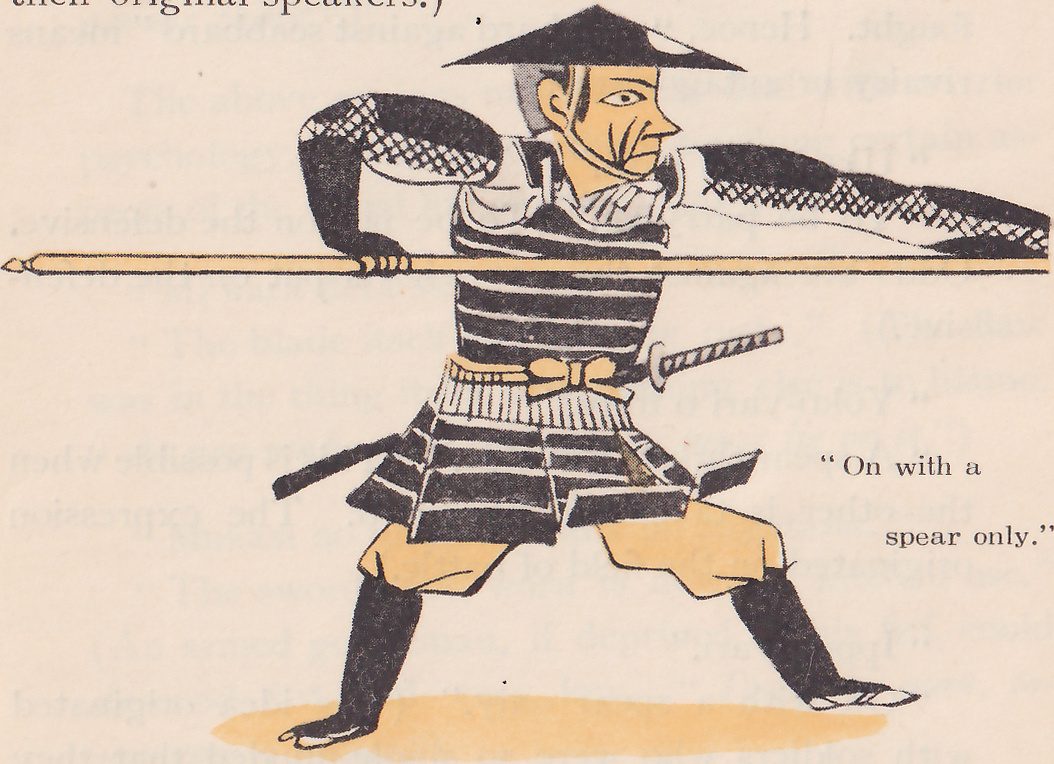
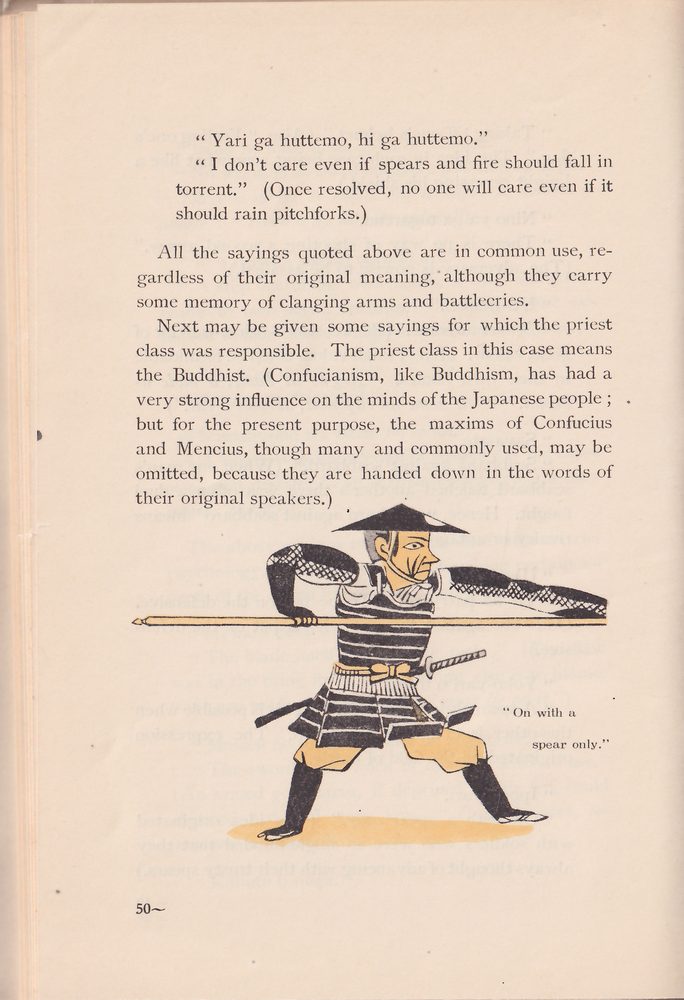
“Ippon-yari.”
“On with a spear only.” (The idea originated with soldiers who were so single-minded that they always thought of advancing with their trusty spears.)
“Yari ga huttemo, hi ga huttemo.”
“I don’t care even if spears and fire should fall in torrent.” (Once resolved, no one will care even if it should rain pitchforks.)
All the sayings quoted above are in common use, regardless of their original meaning, although they carry some memory of clanging arms and battlecries.
Next may be given some sayings for which the priest class was responsible. The priest class in this case means the Buddhist. (Confucianism, like Buddhism, has had a very strong influence on the minds of the Japanese people; but for the present purpose, the maxims of Confucius and Mencius, though many and commonly used, may be omitted, because they are handed down in the words of their original speakers.)
Buddhism teaches a faith in the law of causation running through the three successive worlds. It denies the present world so as to attain a state of resignation. Thoughts of vanity, therefore, are often apparent in its sayings.
“Asita no kōgan, yūbe no hakkotu.”
“A ruddy face in the morning, white bones in the evening.” (“Today red, tomorrow dead.”)
“Itizyu no kage, itiga no nagare.”
“The shade of a tree, the water of a river.” (Life’s wayfarers happen together to lay down their weary limbs in the shade of a tree, and they happen to drink from one and the same stream; all because of the predestination of the former world.)
“Itiren-takusyō.”
“Sitting together on one lotus flower.” (To depart from this vain world and sit together on a lotus flower in Paradise is lovers’ dream.)
“Yume no uki-hasi.”
“The float-bridge of dream.” (Life is thought no more certain.)
“Kyō wa hito no mi, asu wa waga mi no ue.”
“Today somebody, tomorrow myself.” (“Today to me, tomorrow belongs to you.”)
“Nagai ukiyo ni, mizikai inoti.”
“The world is long, life is short.” (“Life is but a span.”)
“Issun saki wa yami.”
“An inch ahead is all darkness.” (Such is life. “The future is a sealed book.”)
“Meido no miti ni ō nasi.”
“There is no king on the journey to the other world.” (“Death spares neither pope nor beggar.” “Death is the grand leveller.”)
“Oyako wa isse, hūhu wa nise.”
“Parent and child are for one world: man and wife are for two worlds.” (The idea is based on the principle of human destinies being subject to the same law of causation for three worlds. Conjugal love is thought stronger and more lasting than the affection between parents and children.)
“Awase-mono wa hanare-mono.”
“What is joined must separate.” (Such is the beginning and the end of life.)
“Sode no hureau mo, tasyō no en.”
“Sleeve touches sleeve, because predestined in the former world.” (Two souls may pass each other on the street, but that is no accident.)
The above-mentioned sayings, which may be multiplied almost to any number, are mostly from the Middle Ages.
Coming down to the ages of bourgeois activity, proverbs show a more vital interest in life and are often more
critical in attitude.
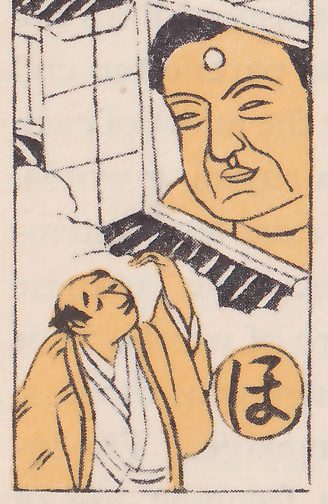
“Hotoke tukutte, manako o irezu.”
“Buddha’s image is made, but no eyes are given thereto.” (What is done thoughtlessly for others is no better than an image left without eyes.)
“Rainen no koto o ieba, oni ga warau.”
“Speak of the year to come and even the devil laughs.” (“Boast not thyself of tomorrow, for thou knowest not what a day may bring forth.”)
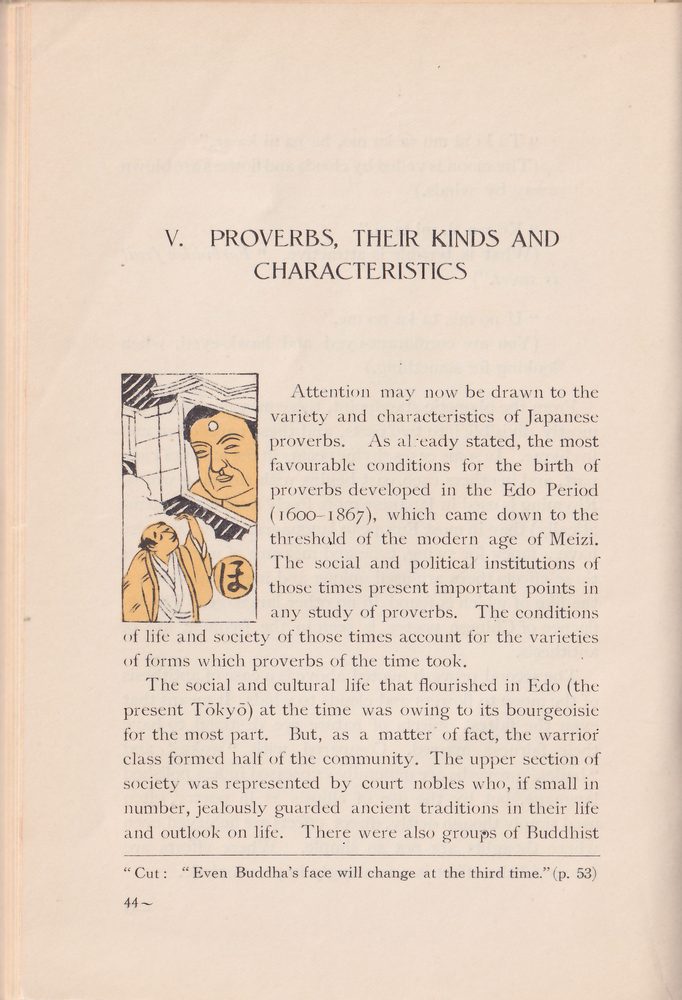
“Hotoke no kao mo sando.”
“Even Buddha’s face will change at the third time.” (Buddha’s face is meek but will frown upon a thrice-repeated insult. “The trampled worm will turn.”)
“Neta ma ga gokuraku.”
“Sleep, and it were paradise.” (One is in hell, while awake and working.)
“Uso mo hōben.”
“Lying may be a pious fraud.” (Gautama found it necessary sometimes to tell what was false in order to lead the benighted minds of the masses. “A necessary lie is harmless.”)
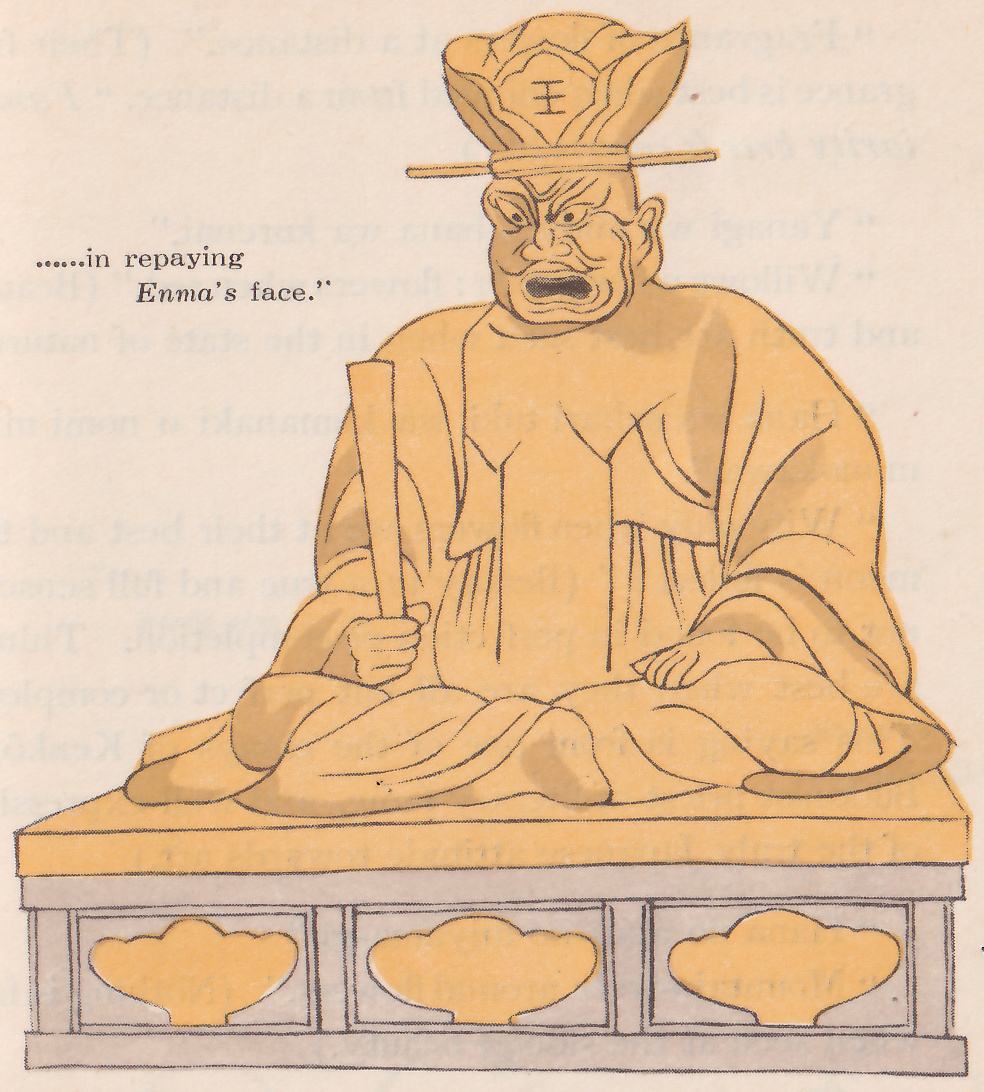
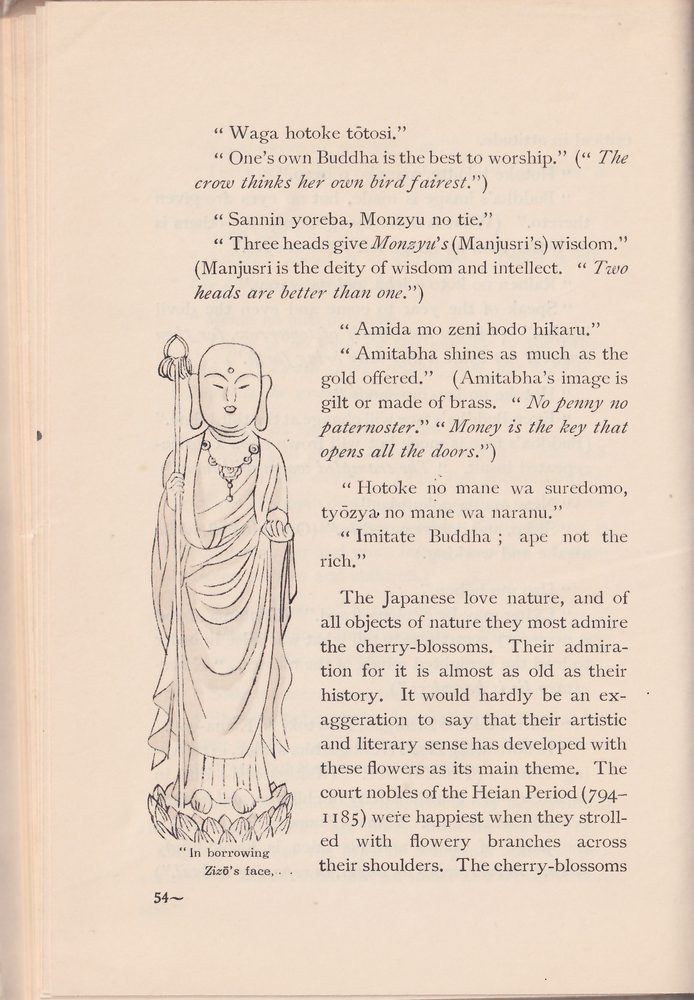
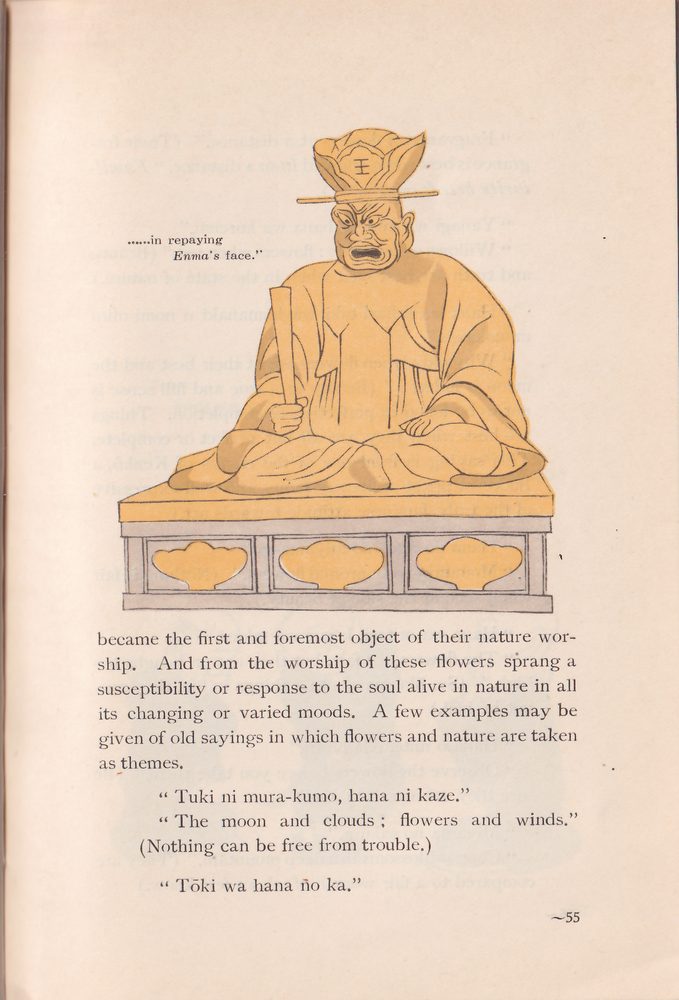
“Kariru toki no Zizō-gao, nasu toki no Enma-gao.”
“In borrowing Zizō’s (Ksitigarbha’s) face, in repaying Enma’s (Yama’s) face.” (Ksitigarbha—Zizō in Japanese—is a guardian deity of children, and his face is kind and cheerful. Yama—Enma in Japanese—is the judge of Hades and his mien is forbiddingly stern. “In borrowing an angel, in repaying a devil.”)
“Waga hotoke tōtosi.”
“One’s own Buddha is the best to worship.” (“The crow thinks her own bird fairest.”)
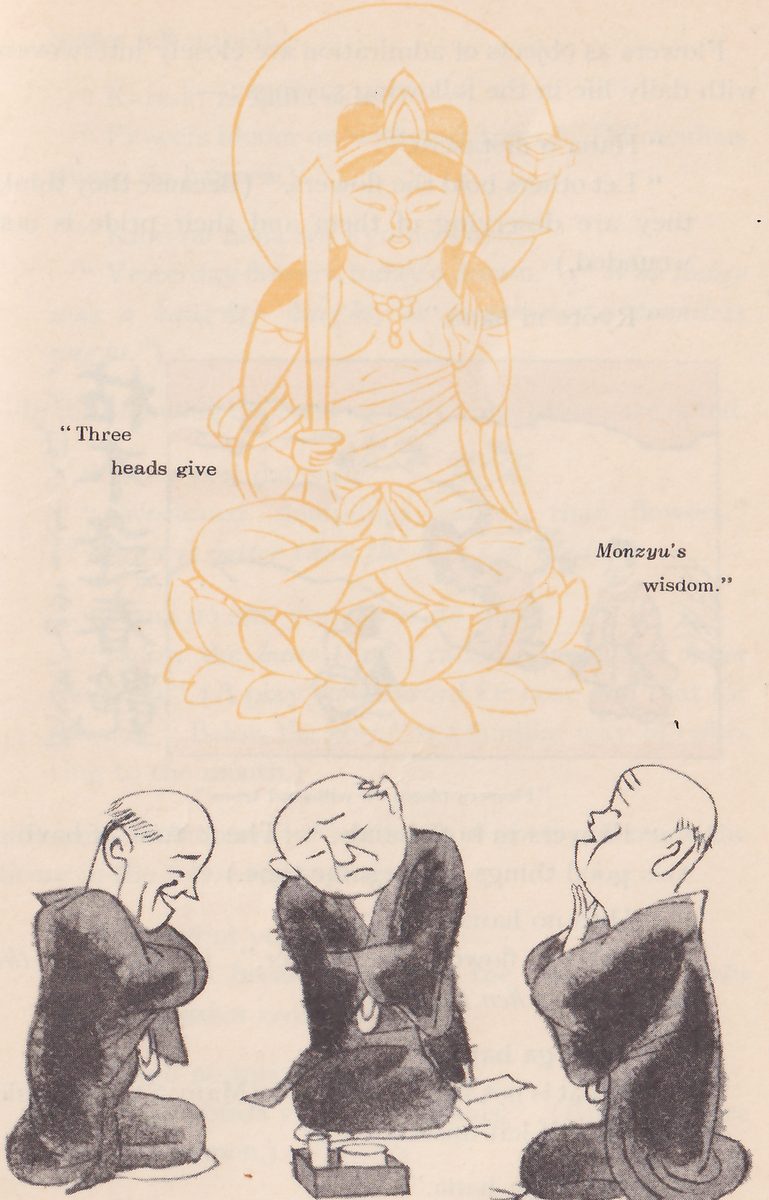
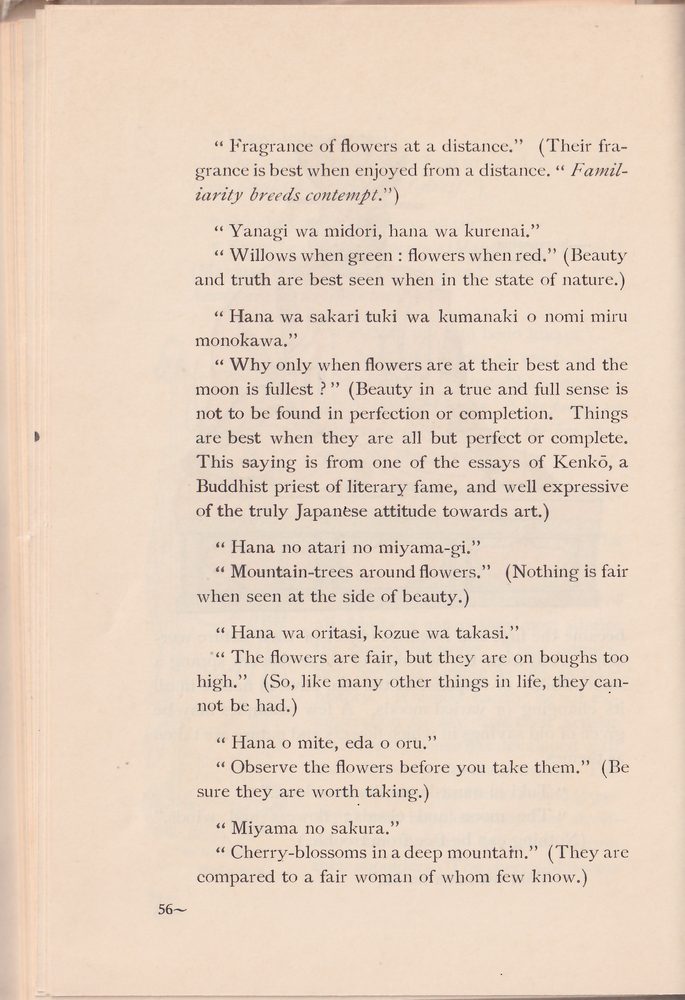
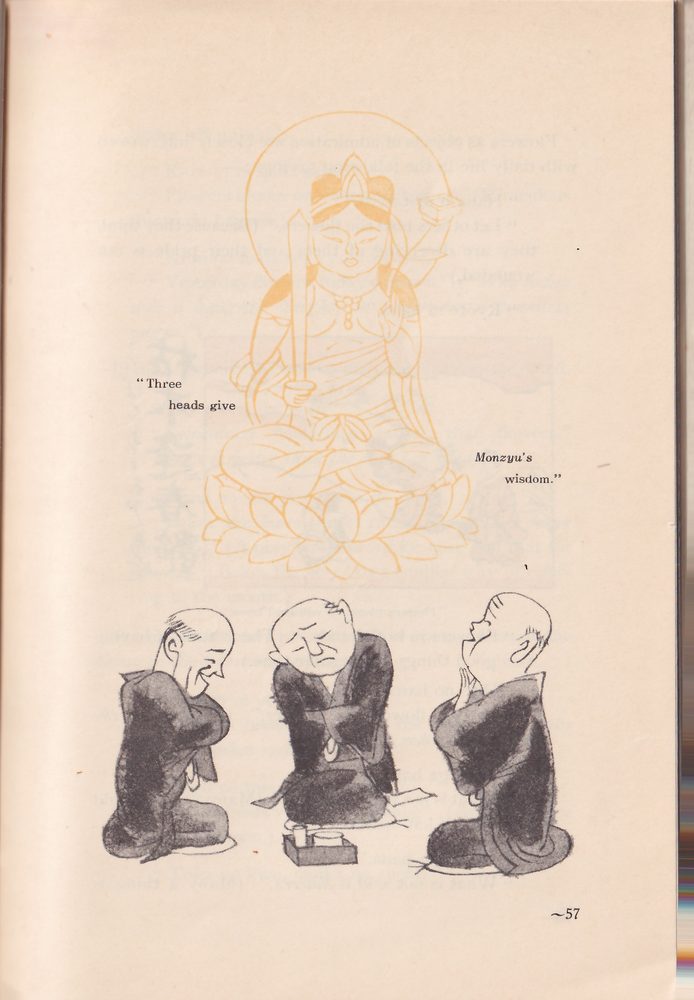
“Sannin yoreba, Monzyu no tie.”
“Three heads give Monzyu’s (Manjusri’s) wisdom.” (Manjusri is the deity of wisdom and intellect. “Two heads are better than one.”)
“Amida mo zeni hodo hikaru.”
“Amitabha shines as much as the gold offered.” (Amitabha’s image is gilt or made of brass. “No penny no paternoster.” “Money is the key that opens all the doors.”)
“Hotoke no mane wa suredomo, tyōzya no mane wa naranu.”
“Imitate Buddha; ape not the rich.”
The Japanese love nature, and of all objects of nature they most admire the cherry-blossoms. Their admiration for it is almost as old as their history. It would hardly be an exaggeration to say that their artistic and literary sense has developed with these flowers as its main theme. The court nobles of the Heian Period (794–1185) were happiest when they strolled with flowery branches across their shoulders. The cherry-blossoms
became the first and foremost object of their nature worship. And from the worship of these flowers sprang a susceptibility or response to the soul alive in nature in all its changing or varied moods. A few examples may be given of old sayings in which flowers and nature are taken as themes.
“Tuki ni mura-kumo, hana ni kaze.”
“The moon and clouds; flowers and winds.”
(Nothing can be free from trouble.)
“Tōki wa hana no ka.”
“Fragrance of flowers at a distance.” (Their fragrance is best when enjoyed from a distance. “Familiarity breeds contempt.”)
“Yanagi wa midori, hana wa kurenai.”
“Willows when green : flowers when red.” (Beauty and truth are best seen when in the state of nature.)
“Hana wa sakari tuki wa kumanaki o nomi miru monokawa.”
“Why only when flowers are at their best and the moon is fullest?” (Beauty in a true and full sense is not to be found in perfection or completion. Things are best when they are all but perfect or complete. This saying is from one of the essays of Kenkō, a Buddhist priest of literary fame, and well expressive of the truly Japanese attitude towards art.)
“Hana no atari no miyama-gi.”
“Mountain-trees around flowers.” (Nothing is fair when seen at the side of beauty.)
“Hana wa oritasi, kozue wa takasi.”
“The flowers are fair, but they are on boughs too high.” (So, like many other things in life, they cannot be had.)
“Hana o mite, eda o oru.”
“Observe the flowers before you take them.” (Be sure they are worth taking.)
“Miyama no sakura.”
“Cherry-blossoms in a deep mountain.” (They are compared to a fair woman of whom few know.)
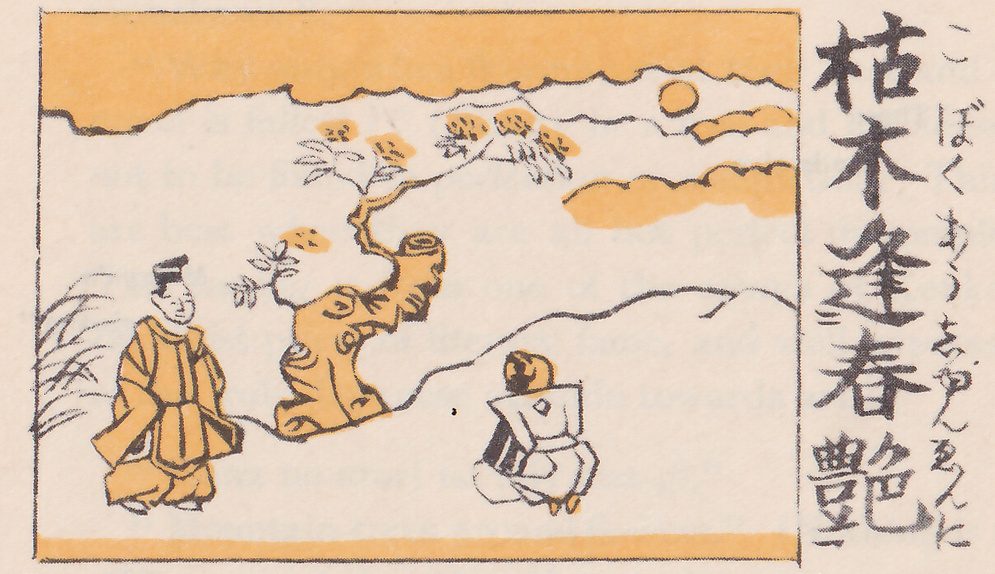
Flowers as objects of admiration are closely interwoven with daily life in the following sayings:—
“Hana o motaseru.”
“Let others hold the flowers.” (Because they think they are deserving of them and their pride is not wounded.)
“Ryōte ni hana.”
“Flowers in both hands.” (The fortune of having two good things at the same time.)
“Hito no hana wa akai.”
“Others’ flowers are redder.” (“Better is the neighbour’s hen than mine.”)
“Minu ga hana.”
“What is not seen is flowers.” (Many a thing would be better if left unseen:)
“Iwanu ga hana.”
“What is not said is flowers.” (Many a thing is
better left unsaid.)
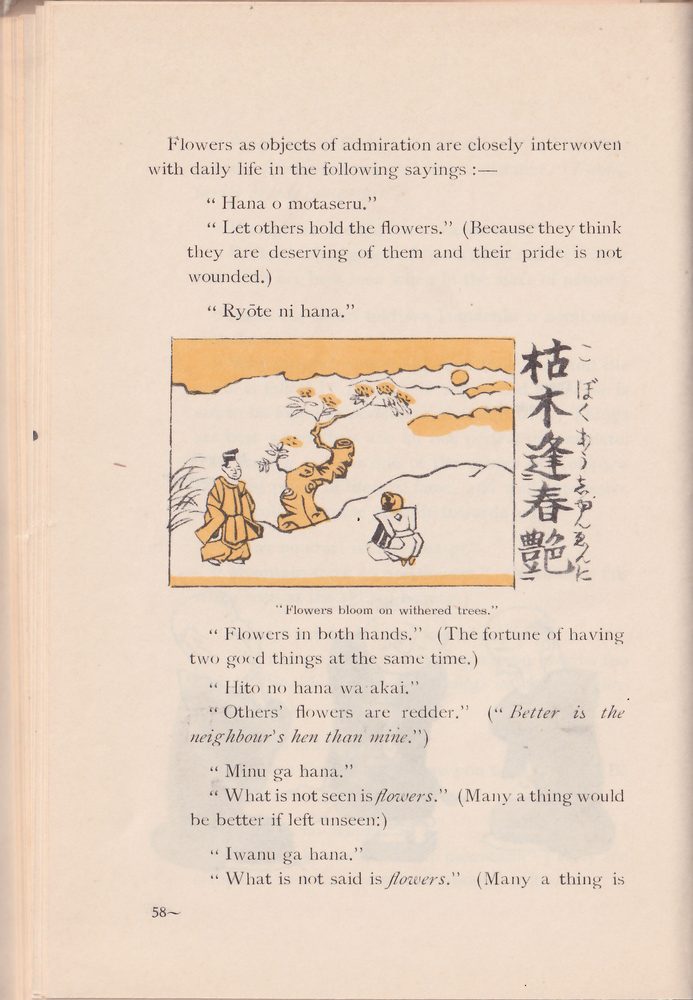
“Kare-ki ni hana saku.”
“Flowers bloom on withered trees.” (Miraculous things do happen.)
“Kinō no hana wa kyō no yume.”
“Yesterday flowers, today a dream.” (“Who today was a haughty knight, is tomorrow a penniless wight.”)
In the following expressions more vulgar tones are noted.
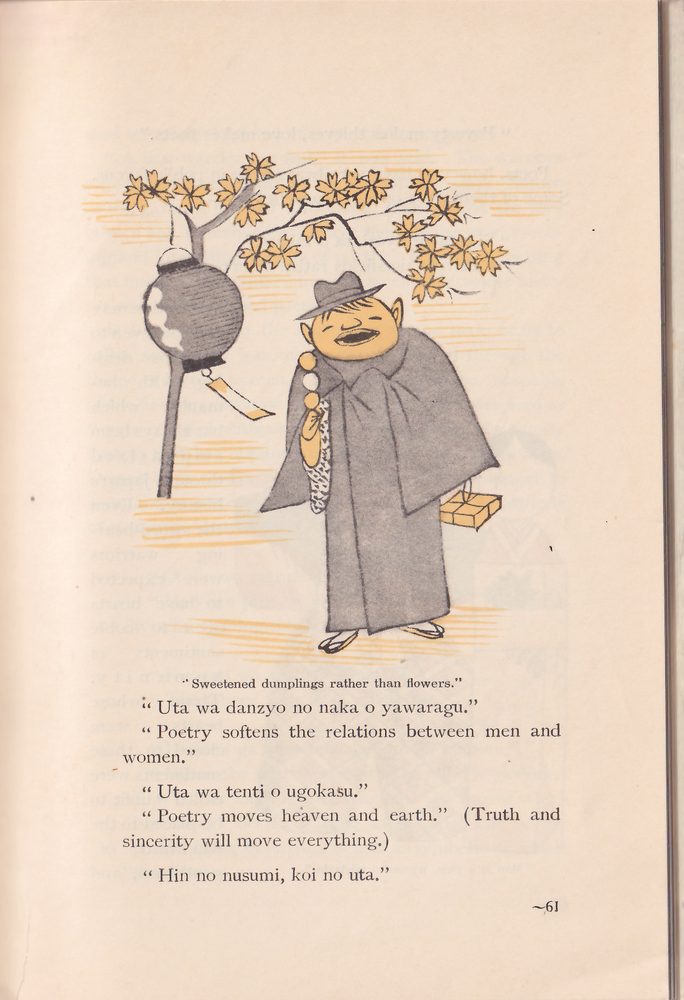
“Hana yori dango.”
“Sweetened dumplings rather than flowers.” (“Bread is better than the songs of birds.”)
“Hana no sita yori, hana no sita.”
“Below the hana (nose) rather than under hana (flowers).” (A play on the word for nose and that for flowers. “Below the nose” is a familiar way of referring to the mouth.)
Nature, with a more or less touch of poetry, is made the theme in the following sayings.
“Yanagi ni yukiore nasi.”
“Willows break not under the snow.” (“Oaks may fall when reeds stand.”)
“Kago no tori, kumo o sitau.”
“Caged birds yearn for clouds.” (Applied more often to women.)
“Tōka no kiku, muika no syōbu.”
“Chrysanthemums on the 10th day, flag-leaves on the 6th day.” (The 9th of September is the annual festival of chrysanthemum, and the 5th of May is that of flag-leaves. “After meat comes mustard.”)
“Deityū no hatisu.”
“The lotus flowering in the mire.” (“A jewel in a dung hill.”)
“Yanagi ni kaze.”
“Willows in the wind.” (Softly elude the attack as a willow bends to the wind.)
“Mizu no ue ni kazu kaku.”
“Writing in water.” (Similar ideas are found in John Keats and others.)
“Kiri hitoha.”
“One leaf of paulownia.” (These leaves begin to fall in early autumn. They herald the coming of the cold season. One falling leaf of paulownia is sufficient to portend some evil.)
There are a number of sayings in praise of poets, some of these pieces unmistakably being cases of self-praise.
“Kazin wa tōtokarazu-site kōi ni maziwaru.”
“The poet without rank associates with dignity.” (Because he is respected.)
“Kazin wa inagara-ni-site meisyo o siru.”
“Poets, without stirring, know of noted places.” (Because of their power of imagination. The expression is also used in boasting of unusual reasoning power.)
“Uta wa danzyo no naka o yawaragu.”
“Poetry softens the relations between men and women.”
“Uta wa tenti o ugokasu.”
“Poetry moves heaven and earth.” (Truth and sincerity will move everything.)
“Hin no nusumi, koi no uta.”
“Poverty makes thieves, love makes poets.”
Poets, however, have not always been in public favour. Some of them were openly counselled in—
“Si o tukuru yori, ta o tukure.”
“Cultivate rice-fields rather than poetry.”
Attention may next be given to proverbs dealing with humanity which has always been emphasized through Japan’s history. Even the sword-bearing warriors were expected to have hearts open to noble sentiments of humanity. Those whose hearts were closed to these sentiments were called “unfit to be placed to the windward of gentlemen,” and
thus scornfully kept out of respectable company.
“A true warrior can feel,” it was said. The warriors refined their sensibilities by the pursuit of poetry. Nature in the garbs of the four alternating seasons, and the love of men and women, were always thought the most touching and interesting themes of poetry. It is not surprising that many of the military heroes known in Japanese history were accomplished poets.
It is natural that the movement of the male heart to softer sentiments was most often expressed through the theme of love of women. The men who were incapable of the finer appreciation of this sentiment were despised as “cups of jewel without bottom.” But under the family system that has obtained in the country for many ages, women have always played a passive rôle, submissive to men, and expected to guard their chastity. This attitude of men towards women is manifest in proverbs.
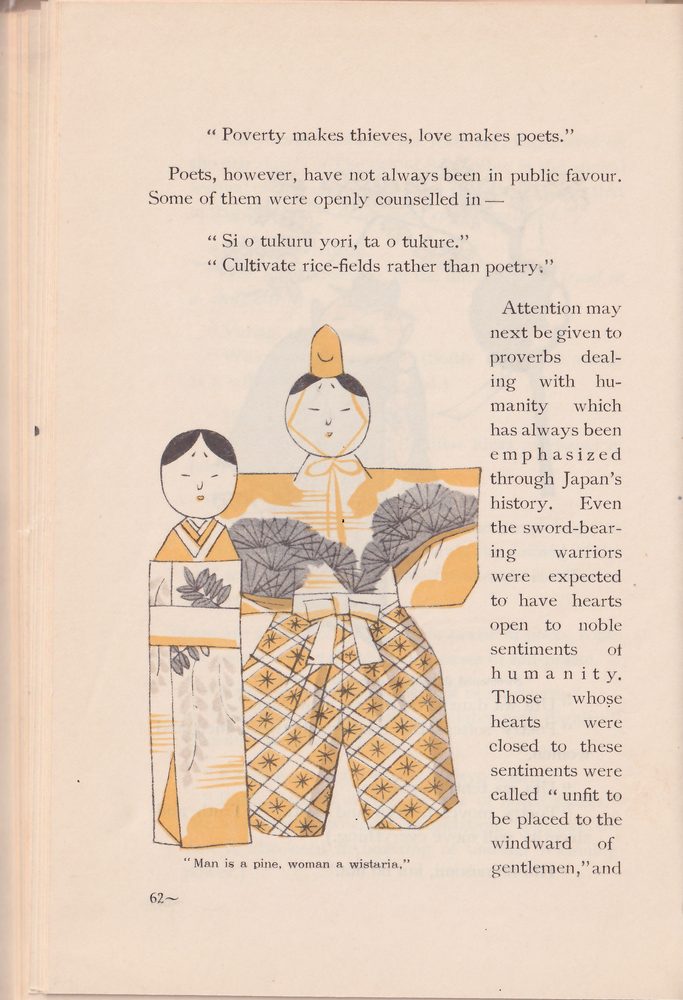
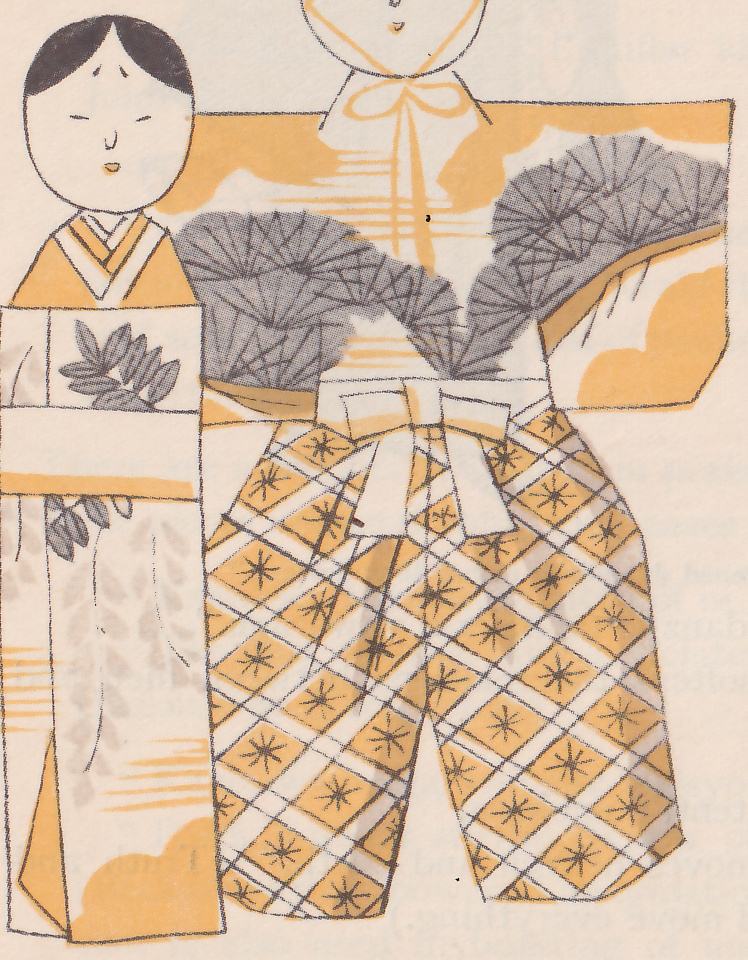
“Otoko wa matu, onna wa huzi.”
“Man is a pine, woman a wistaria.” (The latter lives by twining round the former.)
“Kagami wa onna no tamasii.”
“The mirror is the soul of women.”
“Kagami ga kumoreba kokoro ga kumoru.”
“When the mirror is cloudy, the mind is gloomy.” (One of the three Imperial Regalia is a mirror which has always been regarded as sacred. The highly polished face of mirrors is held as symbolic of female chastity.)
“Koi ni zyōge no hedate nasi.”
“None is high or low where love rules.” (“Love lives in cottage as in court.”)
“Tōkute tikaki wa nannyo no naka.”
“Men and women are never placed too far apart to be near.”
“Matareru tomo, matu mi ni naruna.”
“Better be waited for than wait.” (Many a love-lorn woman has passed weary hours in waiting. “A watched pot is long in boiling.”)
“Wasureneba koso, omoidasazu.”
“I never remember because I never forget.” (A paradoxical way of saying that some thought is always on one’s mind.)
“Aki no sika wa hue ni yoru.”
“Deer of autumn come at the blowing of a horn.” (Male deer of the autumn or mating season, compared to love-lorn men, are often taken as themes of poetry.)
“Nikui nikui wa kawai no ura.”
“To say ‘I hate’ is to mean ‘I love.’”
“Rinki wa koi no inoti.”
“Jealousy is the soul of love.” (Women who are not jealous are sometimes compared to a ball that does not bound.)
“Otoko-gokoro to aki no sora.”
“A man’s heart is as changeful as the autumn sky.” (Complaint is apparently on the other side in the
country which has, “A woman’s mind and winter wind change oft” or “Woman is as fickle as April weather.”)
“Aki no ōgi.”
“A fan in autumn.” (When the hot season is past. the fan is no longer wanted. It is compared to a deserted woman.)
Women are seen in unenviable positions in the lines quoted above, but those who speak of them are not without a sense of sympathy or chivalry. Yet where the influence of Buddhism is apparent there is no note of gallantry or even of charity. The Buddhists look down on women as creatures whose sinful nature is openly condemnable.
“Onna wa sangai ni ie nasi.”
“Women have no house of their own through the three states of existence.” (No woman is good enough to be granted her own place to live in.)
“Onna no tie wa hana no saki.”
“Women’s thoughts go as far as the tip of their noses.” (They are so short-sighted. “Women are wise impromptu, fools on reflection.”)
“Onna no tie wa saru-zie.”
“Women have no more thought than an ape.” (They are shallow and cunning.)
“Onna no kami no ke niwa taizō omo tunagu.”
“Women’s hair is strong enough to keep an elephant tied.” (Women are thought so tenacious. “One
hair of a maiden’s head pulls harder than ten yokes of oxen.”)
“Gaikotu no ue o yosōte hanami kana.”
“A bag of bones decked and adorned is out to see flowers.” (A Buddhist sees young women and sees nothing but the bones to which they will be reduced in time.)
Some special features of womanhood are played on in the following:
“Oni mo zyū-hati, zya mo hatati.”
“Even the devil at eighteen, and the serpent at twenty.” (Women are thought fairest at eighteen or twenty. The devil was handsome when he was young. “Sweet seventeen.”)
“Uzi nakusite, tama no kosi.”
“Without a family name, a woman may ride a bejewelled palanquin.” (Even if born of low stock, a woman may rise only if she finds favour in the eyes of some man high in power. “A woman of no birth may marry into the purple.”)
“Yome, tōme, kasa no uti.”
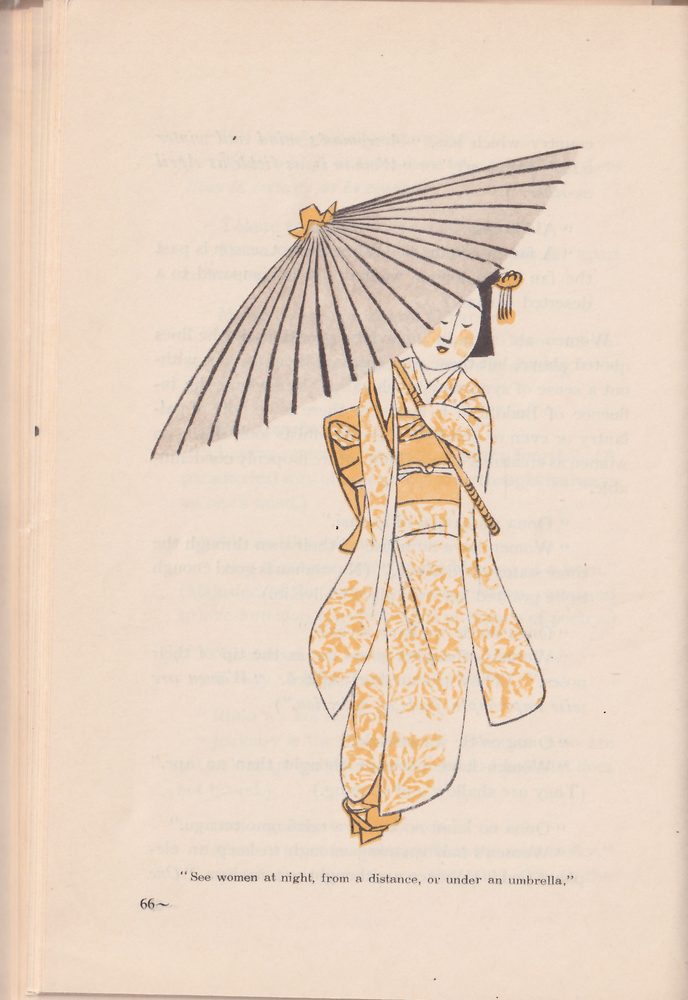
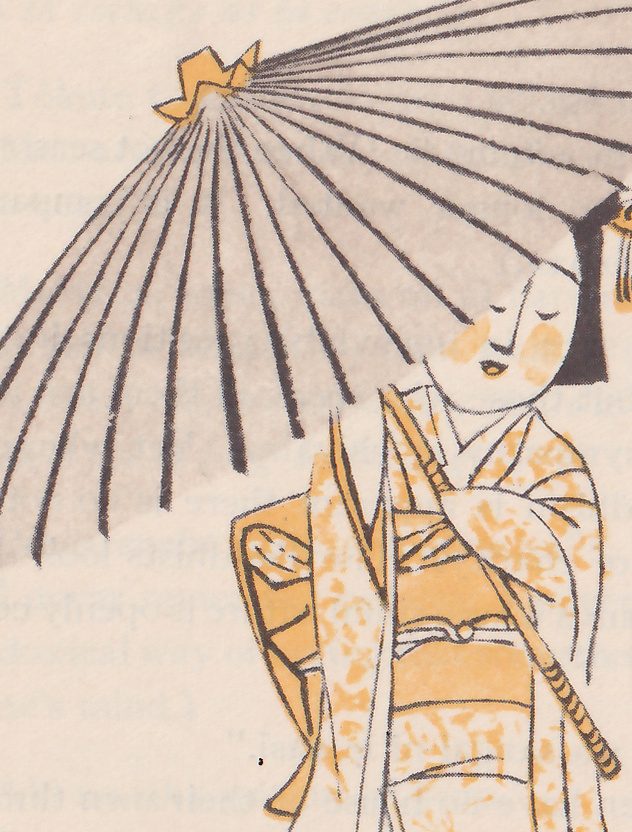
“See women at night, from a distance, or under an umbrella.” (They never appear better than when seen under these conditions. “At night all cats are grey.”)
“Mei-mei no Yōki-hi.”
“Each man has Yang Chi.” (Every man thinks that he has a wife or a sweetheart as beautiful as
Princess Yang Chi, the fabled beauty of ancient China.)
“Sanzyū hurisode, sizyū simada.”
“Long swinging sleeves at thirty, Simada style hair dressing at forty.” (Long sleeves are only for maidens. So is the hair dressed in Simada fashion. But some women never know enough to outgrow them.)
Unlike poets, proverb-makers are more cynical and critical of love.
Next I may give some proverbs touching on parental affection and humanity in general.
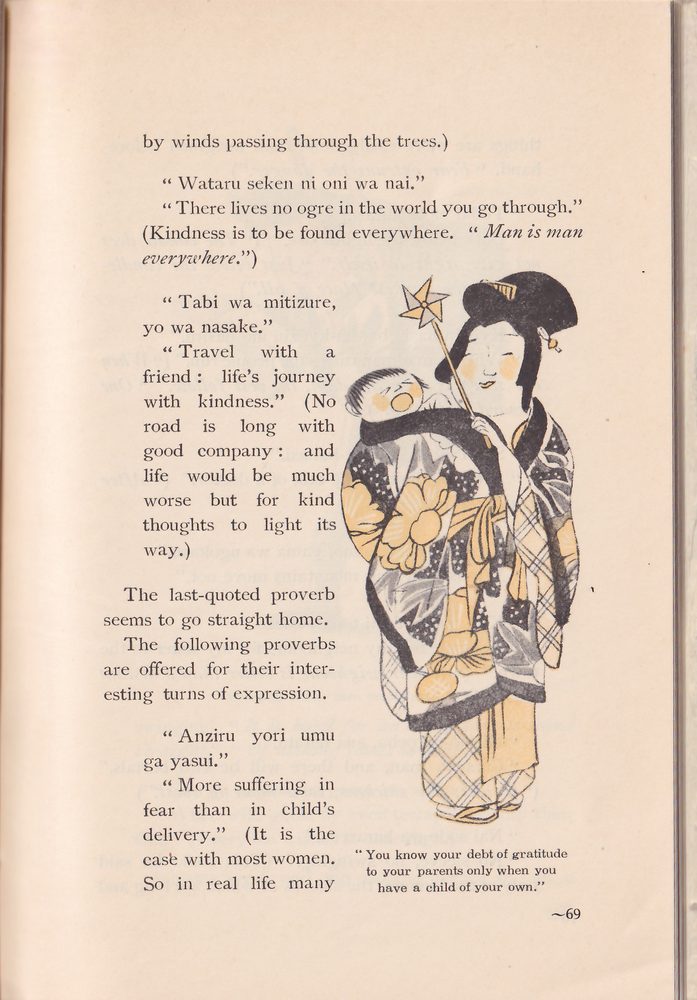
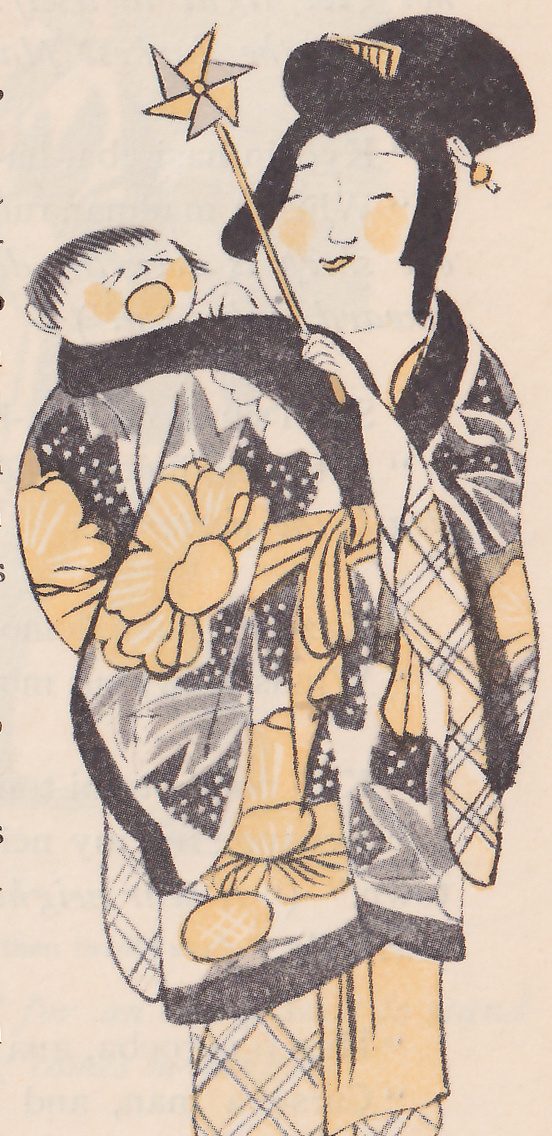
“Ko o motte siru oya no on.”
“You know your debt of gratitude to your parents only when you have a child of your own.” (“He knows not what love is that has not children.”)
“Oya no hikari wa nana-hikari.”
“Parental influence is lasting.”
“Sinu ko wa mime yosi.”
“A dead child was always well featured.”
“Ko yue no yami.”
“Blindness because of the child.” (A mother is often blind because of her love.)
“Ku wa iro kawaru, matu no kaze.”
“Trouble has changed into winds blowing through the pines.” (One may withdraw into a mountain forest to evade trouble, but he will be disturbed there
by winds passing through the trees.)
“Wataru seken ni oni wa nai.”
“There lives no ogre in the world you go through.” (Kindness is to be found everywhere. “Man is man everywhere.”)
“Tabi wa mitizure, yo wa nasake.”
“Travel with a friend: life’s journey with kindness.” (No road is long with good company: and life would be much worse but for kind thoughts to light its way.)
The last-quoted proverb seems to go straight home.
The following proverbs are offered for their interesting turns of expression.
“Anziru yori umu ga yasui.”
“More suffering in fear than in child’s delivery.” (It is the case with most women. So in real life many
things are more easily done than imagined beforehand. “Fear outruns the danger.”)
“Tōdai moto kurasi.”
“Dark below the lighthouse.” (“The candle does not give light to itself.” “Just below the candlestick is the darkest place of all.”)
“Kyōzin hasireba, hu-kyōzin mo hasiru.”
“When a madman runs sane people run.” (“When one sheep is over the dam, the rest follow.” “One coward makes ten.”)
“Sōrei sunde no isya-banasi.”
“After the funeral the talk of a doctor.” (“After death the doctor.”)
“Kaze wa huke domo, yama wa ugokazu.”
“Winds blow, but mountains move not.”
“Kyō no imōto ni tonari kaezu.”
“I change not my neighbours for my sister in the town.” (“A near neighbour is better than a distant cousin.”)
“Hito o noroeba, ana hutatu.”
“Curse a man, and there will be two burials.” (“Curses, like chickens, come home to roost.”)
“Nai sode wa hurarenu.”
“No sleeve, no swinging.” (This could be said only of the kimono, the sleeves of which are long and
swinging. “It is hard for an empty sack to stand straight.” “Of nothing comes nothing.”)
“Gan ga tobeba, isi-game mo zidanda.”
“When wild-geese fly even terrapins stamp their feet.” (Everyone wishes to soar high.)
“Naku semi yori mo nakanu hotaru ga mi o
kogasu.”
“Cicadas are loquacious, but silent fire-flies suffer more from their own consuming fire.” (A woman deep in love is often compared to a fire-fly which is said to be aflame with some consuming desire.)
“Sumeba miyako.”
“Where I live is always the best town.” (“To every bird its own nest is charming.” “A man’s house is his castle.”)
“Uzi yori sodati.”
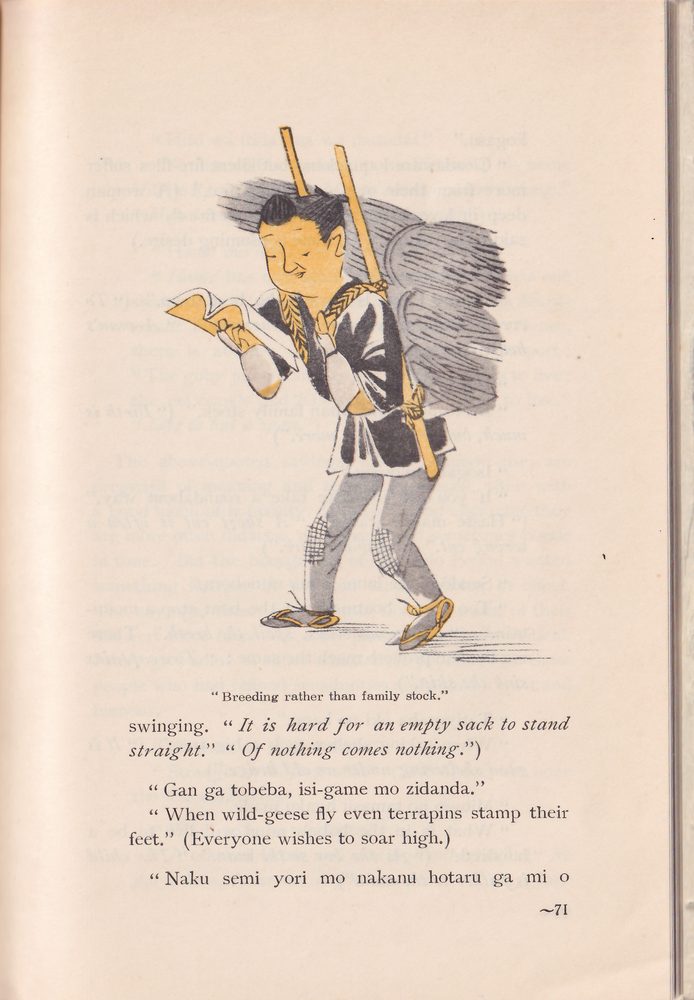
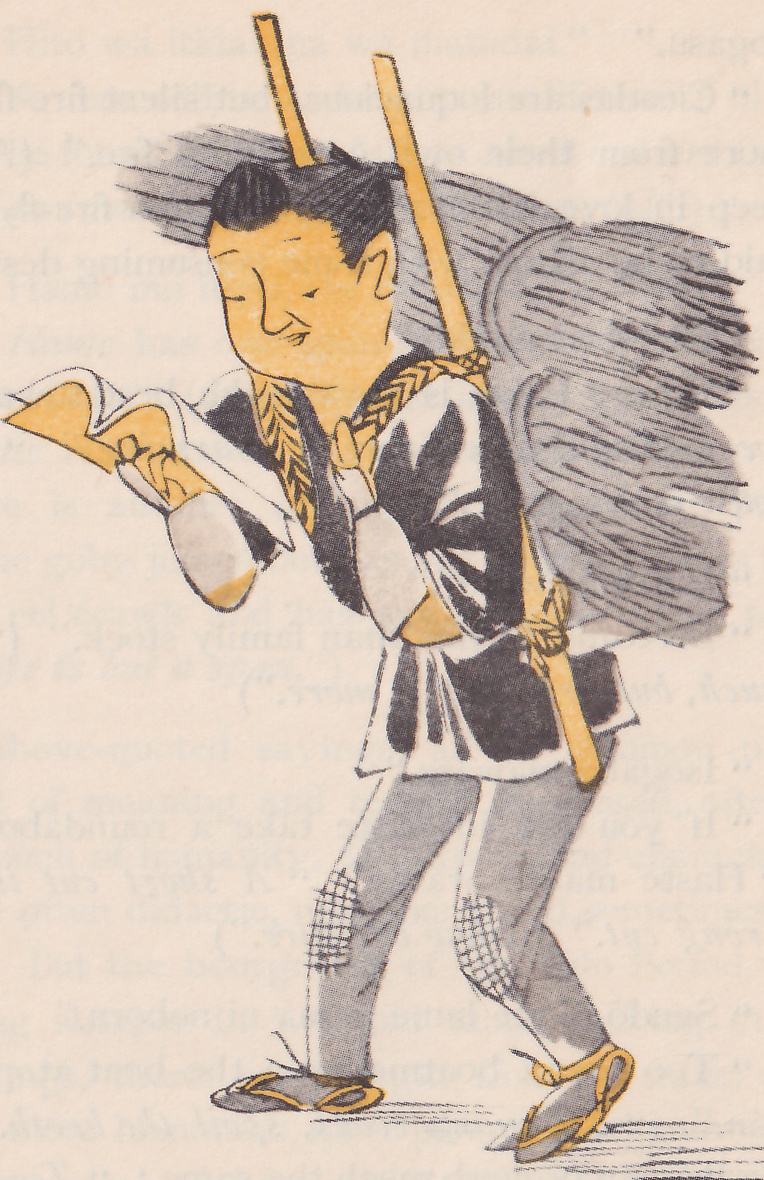
“Breeding rather than family stock.” (“Birth is much, but breeding is more.”)
“Isogaba maware.”
“If you are in haste take a roundabout way.” (“Haste makes waste.” “A short cut is often a wrong cut.” “Slow but sure.”)
“Sendō ōkute hune yama ni noboru.”
“Too many boatmen run the boat atop a mountain.” (“Too many cooks, spoil the broth.” There is a Persian proverb much the same: “Two captains sink the ship.”)
“Tatiyoraba ōki no kage.”
“When taking shelter seek a big tree.” (“It is good sheltering under an old hedge.”)
“Mitugo no tamasii hyaku made.”
“What is in the babe’s mind will live to be a hundred.” (“As the boy so the man.” “The child is father to the man.”)
“Hito wa itidai, na wa matudai.”
“A man will be as long as his lifetime: his name will be for all time.” (“Life is short but art is long.” “Man is mortal, but fame is immortal.”)
“Hamo mo itigo, ebi mo itigo.”
“Hamo has one span of life: the lobster has one span of life.” (Hamo—scientifically known as Muraenesox cinereus—is not unlike a large eel. Hence, there is another saying with the same purport: “The goby jumps but has just so many years to live: the eel crawls and has just so many years to live.” “Life is but a span.”)
The above-quoted sayings, all in common use, are pregnant of meaning and tersely expressed, often with a good touch of humanity. In purpose and character they are more often didactic, moralizing and sometimes poetic in tone. But the bourgeoisie of the Edo Period wanted something sharper in wit and more striking in effect. The sayings, therefore, brought from the midst of their life were more humorous, more pungent, and more critical. I may give some of those which were popular with those people who had refined sensibilities and a turn for wit and humour.
“Mawata de kubi simeru.”
“Strangle with floss-silk.” (Soft of feel but none the less effective.)
“Ware-nabe ni tozi-buta.”
“A cracked kettle and a string-bound lid.” (“No pot is so ugly as not to find a cover.” “Every Jack
has his Jill.”)
“Noren to ude-osi.”
“Trying strength against a shop-front curtain.” (It is akin to beating the air.)
“Nemimi ni mizu.”
“Water flows suddenly into a sleeper’s ears.” (It can be one of the worst surprises of one’s lifetime.)
“Obi ni mizikasi tasuki ni nagasi.”
“Too short to be a sash: too long to be used for girding up one’s sleeves.” (Neither good for one thing nor for the other.)
“Kusai mono ni huta o suru.”
“Cover up what is stinking.” (It may do for the time being but no proper way of doing things.)
“Hana-ge o yomu.”
“Count the hairs in his nostrils.” (Pretty women are often said to have done this with their men. No man in his proper senses would suffer another man to take such liberty.)
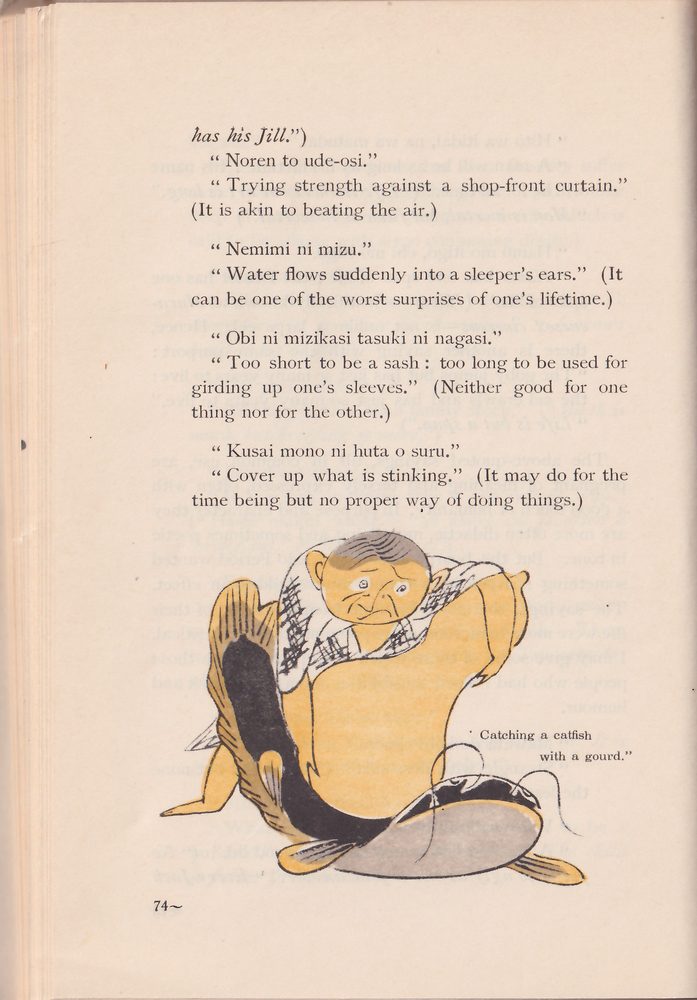
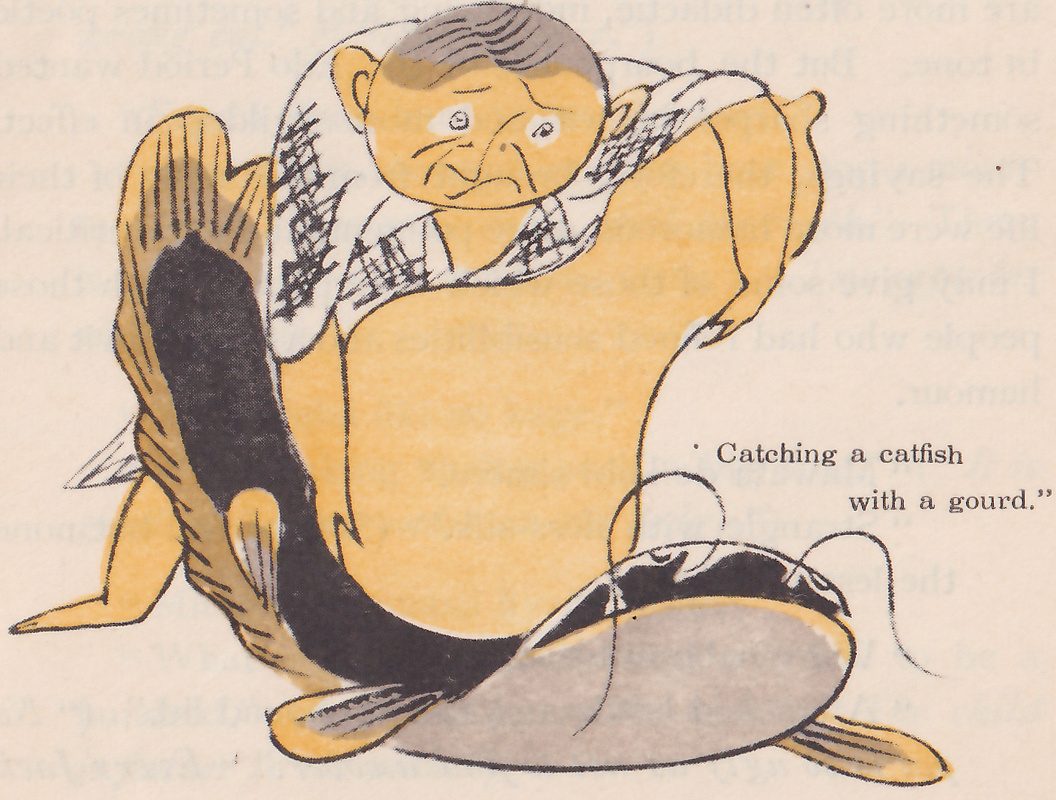
“Hyōtan de namazu o osaeru.”
“Catching a catfish with a gourd.” (Catfish and eels are slippery things, and so is a gourd which has no handle. All labour must be lost.)
“Heso ga yadogae suru.”
“The navel moves elsewhere.” (This is said likely to happen when one’s sides split with laughter.)
“Tōhu ni kasugai.”
“A clamp-joint into bean-curd.”
“Nuka ni kugi.”
“Driving a nail into rice-bran.” (No better than “ploughing the waves” or “pouring water into a sieve.”)
“Hidari utiwa.”
“A fan in the left hand.” (A man is thought to be living rather comfortably when he is able to sit at table and move a fan with his left hand, while his right hand is holding a wine-cup.)
“Tume ni hi o tomosu.”
“Burn one’s finger-nails.” (A miser is said to do this in order to save oil for lighting.)
“En no sita no mai.”
“A dance under the floor.” (It will be seen by nobody. What one does to help another is often that way. “Asses carry the oats and horses eat them.”)
“Tana kara botamoti.”
“A rice-cake covered with bean-jam comes falling down from the cupboard shelf.” (It is very much like the case of a roasted bird flying into an open mouth: but some man has the devil’s own luck.)
“Nurete de awa.”
“Grasping millet with wet hands.” (More can be grasped than with dry hands. An easy gain.)
“Imo-gara de asi tuku.”
“Spearing one’s feet with stems of the taro plant.” (Unusual since they are so soft.)
“U no me taka no me.”
“Cormorant-eyed, hawk-eyed.” (So sharp are eyes of one who is looking for something, even if it is not for a needle in a haystack.)
“Neko ni koban.”
“A gold piece for a cat.” (No better than casting pearls to swine.)
“Saru nimo isyō.”
“Fine clothes make a fine monkey.” (“Fine feathers make fine birds.”) (See the cover.)
“Nikai kara megusuri.”
“Administering eye-lotion from the second floor.” (Indirect and useless! “Fanning the sun with a
peacock’s feather.”)
All these sayings are based on workaday life, and on that account are all the more striking. There is good-natured laughter behind most of them. The fountain of worldly wisdom bubbles forth with a cheerful note. They are more homely and therefore impressive. They go home because there is no didactic tone as in older sayings. They are proverbs in the truest sense.
The people of the present time who are decidedly individualistic in their outlooks into all things of life, and who must have theories and formulas for every thought or art, would be quite incapable of creating proverbs of this sort. These sayings are amusing, sharp witted, and sometimes highly delicate. But they are in common use in the country and are accepted in good part. Those who use them hardly remember that they are a heritage from the past, freely used but none the less valuable.
In concluding, I would give a few of the European sayings that have been introduced into Japan since the beginning of the Meizi Era. They have since established themselves in common usage.
“A sound mind dwells in a sound body.”
“Blood is thicker than water.”
“God helps those who help themselves.”
“He who pursues two hares catches neither.”
“Honesty is the best policy.”
“Killing two birds with one stone.”
“Learning knows no frontier.”
“Necessity is the mother of invention.”
“Strike while the iron is hot.”
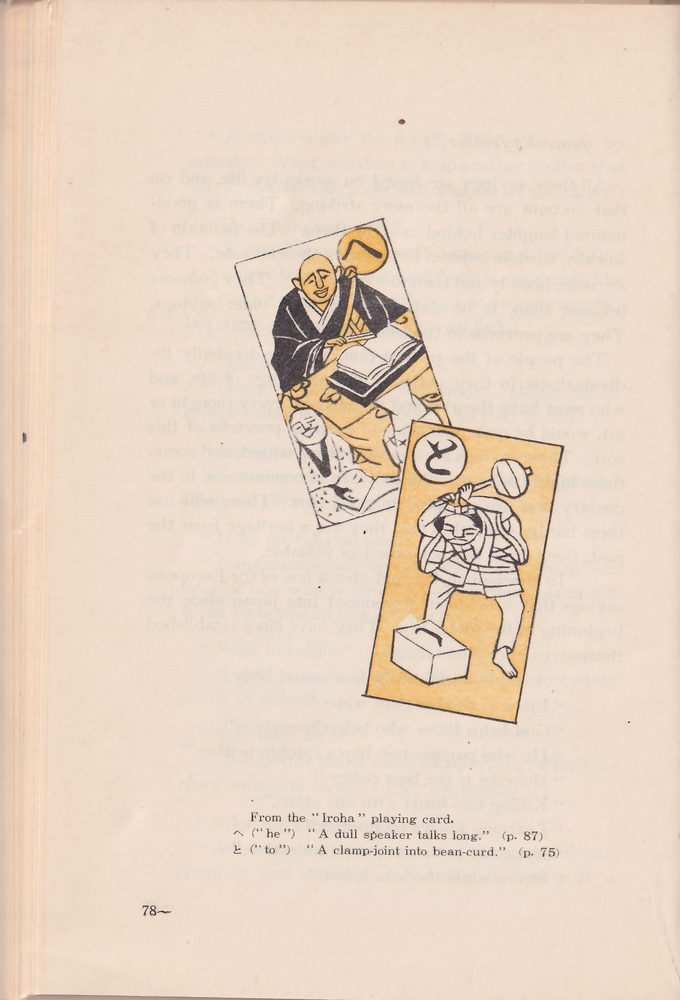
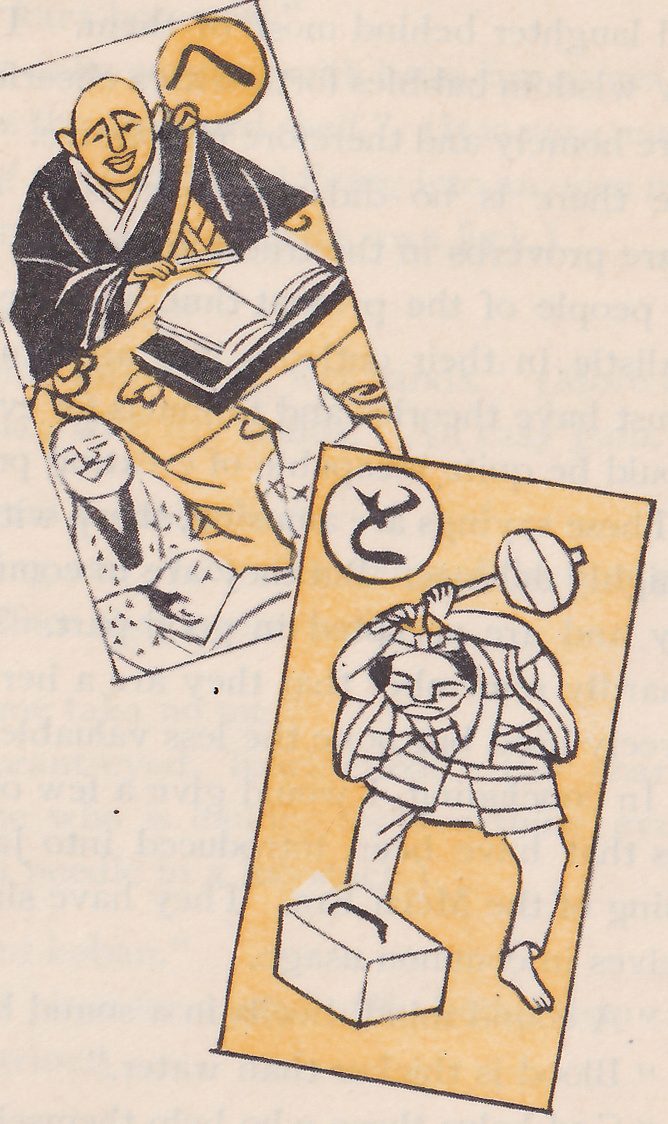
へ (“he”) “A dull speaker talks long.” (p. 87)
と (“to”) “A clamp-joint into bean-curd.” (p. 75)