




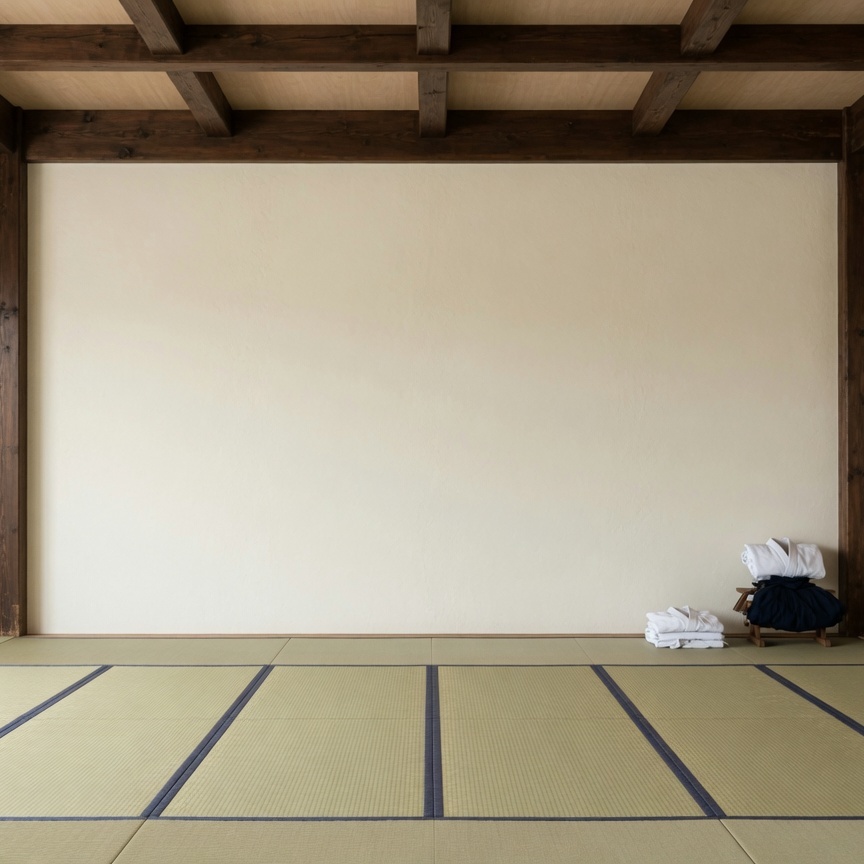
Cursive · sōsho 草書 · VC5J
Cursive or sōsho (草書) styles are the most simplified styles and Master Takase's favorite. While very beautiful, these styles are often difficult to read even by specialists.
千日の稽古を鍛とし万日の稽古を錬とす
sennichi no keiko o tan to shi, mannichi no keiko o ren to su
A Thousand Days to Forge, Ten Thousand to Refine
Miyamoto Musashi's line on hard training, from the Book of Five Rings: a thousand days of practice to forge, ten thousand to refine.
Master Takase creates this beautiful scroll when your order is placed, personally preparing the ink and brushing your art, which proudly bears her signature and seal. This is an original work of art.
Description
千日の稽古を鍛とし、万日の稽古を錬とす (sennichi no keiko o tan to shi, mannichi no keiko o ren to su): Miyamoto Musashi's line on hard training in the Book of Five Rings, a thousand days of practice to forge and ten thousand to refine.
The line takes apart 鍛錬 (tanren), the word for hard training and for forging metal. It calls a thousand days of practice 鍛, smithing, and ten thousand days 錬, refining metal. The word was in use in both senses before the Book of Five Rings.
The copies of the book divide between 錬, refining metal, and 練, refining silk, as one research group transcribes them. Two prints of 1909 divide the same way, one setting the metal radical and one 練. The dictionaries enter 鍛錬 and 鍛練 as one word.
Later writers put the days into years, a thousand as about three and ten thousand as about thirty. Musashi's sentence counts days.
Ōyama Masutatsu gave his Kyokushin karate a form of the line by 1975: a thousand days make a beginner, ten thousand make mastery. By the 1980s the line had gained a third clause, that the bout is decided in an instant. In the National Diet Library's full text, searched to 2000, the clause is a politician's motto in 1981. In 1984 a baseball coach is in print with a form of the same pairing under his signature. In the copies read for the history, the line has two clauses, a thousand days and ten thousand days.
In English, Alexander Bennett gives forge and refine, William Scott Wilson temper and refine, and Kenji Tokitsu develop and polish. Victor Harris's translation of 1974 does not carry the line.
The closing sentence of the Water scroll of Miyamoto Musashi's Book of Five Rings, written between 1643 and 1645 and handed to his pupil Terao Magonojō; Musashi's own manuscript is lost, and the line is read in the copies, the best of them a scroll Terao passed on in 1667.
We want you to be as happy with the meaning as you are with Master Takase's art. To learn more, visit Philology of 千日の稽古を鍛とし万日の稽古を錬とす.
Delivery
Your scroll is brushed when you order it and completed within 1 to 3 business days. It ships by USPS Priority Mail from Master Takase's studio in Washington State, boxed and ready to hang, with a printed page giving the art's English, romaji and Japanese.
Sending it as a gift? Add your message at checkout and we will include it.
Shipping is calculated at checkout from your address; within the United States it is $13 to $23. We ship worldwide, and any import charges for your country are shown at checkout before you pay.
Every order is covered by our 30-day money-back guarantee. If your scroll arrives damaged, or we made an error, we replace it or refund you in full, including shipping. Refund policy
About Our Scrolls
Master Japanese Calligrapher Eri Takase brushes your scroll by hand when you order it. Each scroll bears her red seal, 英利, and her signature.
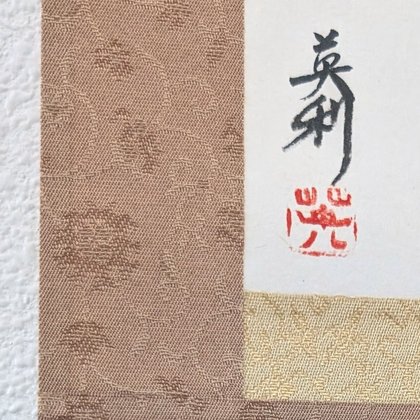
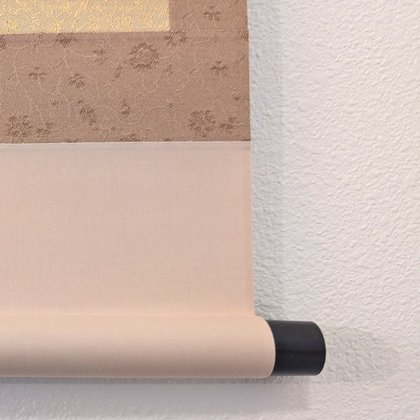
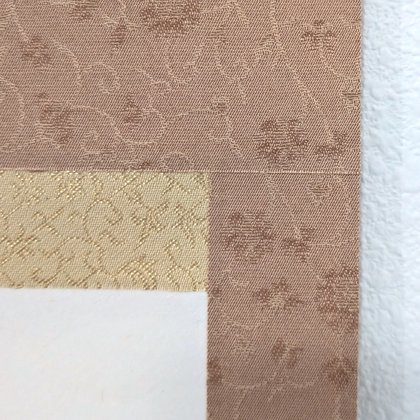
The scrolls are 12 1/4" W × 43" H (31 × 109 cm) with woven damask borders and Japanese paper that are layered so the scroll hangs straight and will not warp over time. The scrolls themselves are made by a scroll maker in Gifu, Japan, and we have worked with them for over two decades.
Eri Takase was born and raised in Osaka, Japan, and holds the rank of Shihan, the highest rank in Japanese calligraphy, from the Bokuteki-kai and the Bunka-shodo. About Master Takase


