



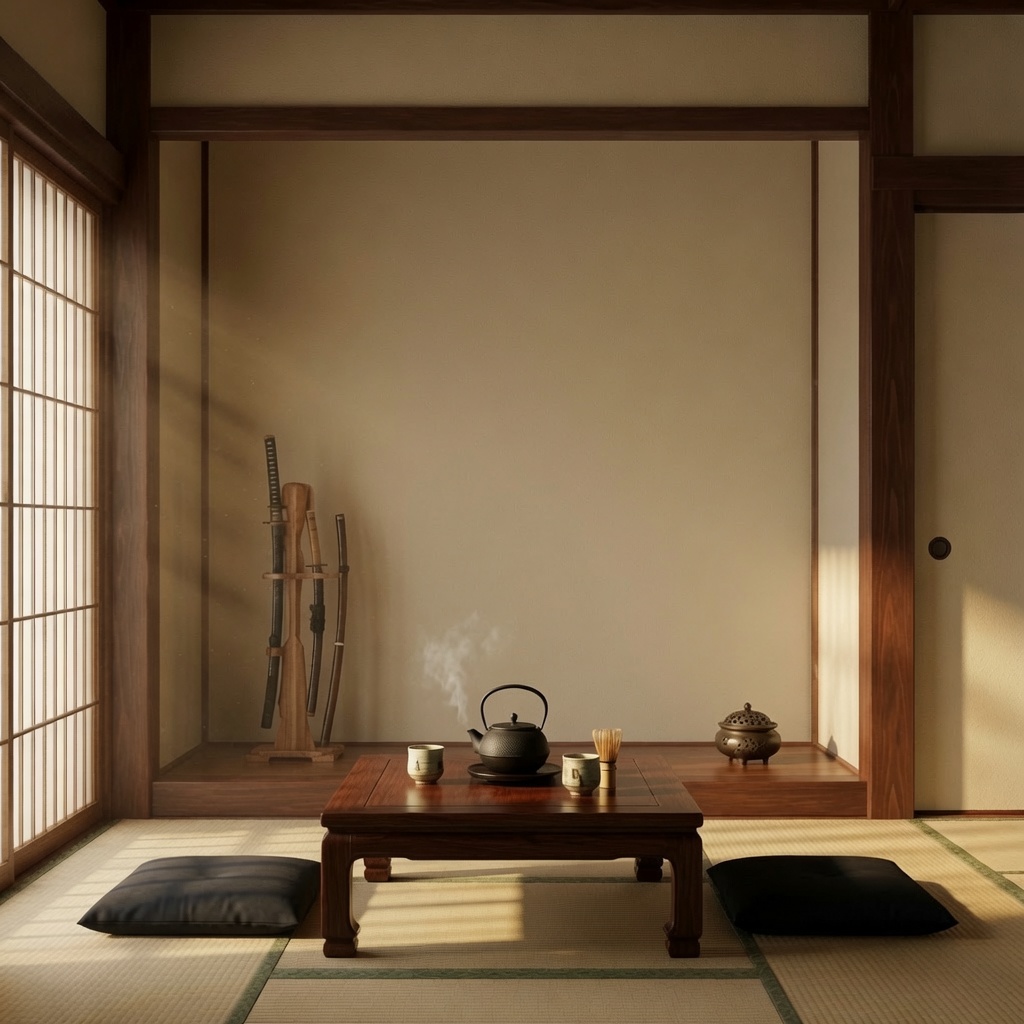

Block · kaisho 楷書 · VB6C
Block or kaisho (楷書) styles are the most common and recognizable styles. Block styles are easily read and are noted for their angular form and their vertical and horizontal lines.
武者修行
mushashugyō
Warrior Training
Warrior training, a warrior's journey through the provinces to train in the martial arts. Today the word also means going to another place or abroad to train in a field of study or an art.
Master Takase creates this beautiful scroll when your order is placed, personally preparing the ink and brushing your art, which proudly bears her signature and seal. This is an original work of art.
Description
武者修行 (mushashugyō): warrior training, a warrior's journey through the provinces to train in the martial arts.
Two Japanese dictionaries define 武者修行 as a warrior's going round the provinces to train in the martial arts. One gives a second sense, going to another place or abroad to train in a field of study or an art. An encyclopedia adds that today the word is also said of going into another place to polish an art. JMdict, which most English-language tools draw on, gives traveling about to gain skill in combat.
武者 (musha) is a warrior, one whose duty is the martial arts. In the 日本国語大辞典, 修行 (shugyō) is putting into practice, and in a later sense going round the provinces to polish an art or a martial way. The word is also written 武者修業, with 修業, learning and acquiring a field of study or an art. The two spellings stand side by side from the Edo period on.
In the tales of 義残後覚 (1596), a master of the half-bow reaches Ise on 武者修行 and meets the governor's master of the halberd in a bout. In three chronicles printed in the 1600s, the road leads somewhere. In a life of Oda Nobunaga, completed in 1604, warriors out on 武者修行 happen to be in Kyoto and join the vanguard. In a life of Hideyoshi, prefaced in 1625, Ise Shinkurō sets out on it for the Kantō and becomes lord of a castle in Izu.
The military chronicle 甲陽軍鑑 was put in order before 1621. In the three passages read for the history, it calls the journeys of the sword masters Kamiizumi Nobutsuna and Tsukahara Bokuden 兵法修行. 兵法修行 is training in the art of arms. Bokuden, it says, traveled with a great hawk carried on the fist, three spare horses and some eighty men. The same chronicle uses 武者修行 of a masterless warrior whom Nobunaga calls into his pay. An encyclopedia of 1830 files passages of both names under the one heading 武者修行.
Edo writers judged the journey. A book of 1764 finds two kinds of traveler. One goes to learn from a famous teacher and rejoices to lose; the other would beat other schools and make his name. A book of 1839 says the old journey was a way to see the provinces: their customs, their lords, the strength of their soldiers. The travelers of its own day, it says, learned no more than a scrap of the sword's handwork.
In the preface of the 五輪書, Miyamoto Musashi tells of his own journey without naming it 武者修行. He tells of more than sixty bouts, from his thirteenth year to his twenty-eighth or twenty-ninth. A study of 1918 counts his travels to spread his school as 武者修行, and a book of 2004 gives his journey the name.
In Kyokutei Bakin's novel 椿説弓張月 (1807–11), the warrior on the road is a figure the reader is expected to know. The dictionary 言海 (1889–91) gives the word one sense: a warrior's going through the provinces to train and temper himself in the martial arts.
By 1888 the word is in print in a comparison that reaches beyond the warrior. That year The Japan Weekly Mail, translating a Japanese newspaper's article on Japanese seekers after learning in America, used the phrase somewhat in the fashion of musha shugyo. In magazine snippets read for the history, a shopkeepers' magazine of 1938 writes of the 武者修行 of trade. A baseball weekly of 1963 writes of a player's 武者修行 abroad.
English has no word of its own for 武者修行. Brinkley's dictionary of 1896 describes it: travelling about different places for acquiring skill in fencing or other military arts. Dictionaries of 1904 and 1918 set the European knight-errant beside it, and JMdict gives samurai drill; knight errantry for the spelling 武者修業. The knight shares the road and the showing of skill; 武者修行 names a training. D. T. Suzuki's book on Zen of 1959 renders it training in warriorship. Suzuki gives the custom as one the swordsmen learned from the Zen monks; no Japanese source read for the history says so.
Whether you take it as the warrior's road or as a journey to train in a field of study or an art is yours.
武者修行 has no known maker: its earliest use known here is in Gizan kōkaku, a collection of tales of 1596, where a master of the half-bow sets out on it at twenty-seven, and its second half, 修行, is in its Buddhist senses the word for practice and for a monk's road through the provinces.
We want you to be as happy with the meaning as you are with Master Takase's art. To learn more, visit Philology of 武者修行.
Delivery
Your scroll is brushed when you order it and completed within 1 to 3 business days. It ships by USPS Priority Mail from Master Takase's studio in Washington State, boxed and ready to hang, with a printed page giving the art's English, romaji and Japanese.
Sending it as a gift? Add your message at checkout and we will include it.
Shipping is calculated at checkout from your address; within the United States it is $13 to $23. We ship worldwide, and any import charges for your country are shown at checkout before you pay.
Every order is covered by our 30-day money-back guarantee. If your scroll arrives damaged, or we made an error, we replace it or refund you in full, including shipping. Refund policy
About Our Scrolls
Master Japanese Calligrapher Eri Takase brushes your scroll by hand when you order it. Each scroll bears her red seal, 英利, and her signature.
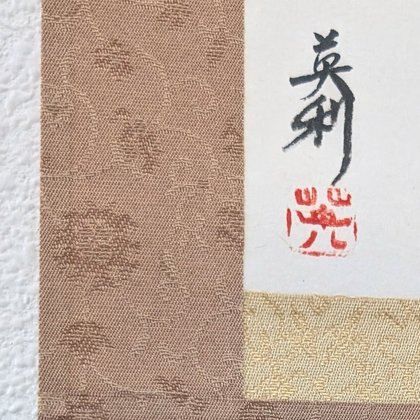


The scrolls are 12 1/4" W × 43" H (31 × 109 cm), with woven damask borders and layered Japanese paper, designed to last generations. The scrolls themselves are made by a scroll maker in Gifu, Japan, and we have worked with them for over two decades.
Eri Takase was born and raised in Osaka, Japan, and holds the rank of Shihan, the highest rank in Japanese calligraphy, from the Bokuteki-kai and the Bunka-shodo. About Master Takase


