



Semi-Cursive · gyōsho 行書 · VS5J
Semi-Cursive or gyōsho (行書) styles are a simplified and softer form of the kaisho styles. Gyōsho styles can be read by most Japanese.
佛神は貴し佛神をたのまず
busshin wa tōtoshi busshin o tanomazu
The Buddhas and Gods Are to Be Revered; I Do Not Rely on Them
A line attributed to Miyamoto Musashi: the buddhas and gods are to be revered; I do not rely on them.
Hand-brushed by Master Eri Takase
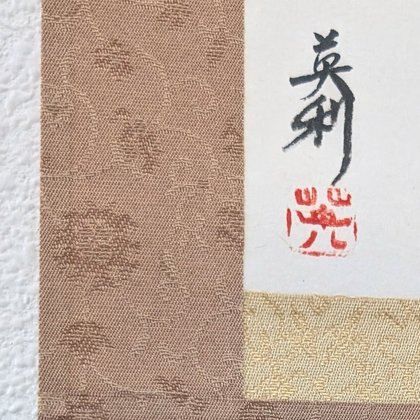
Master Japanese Calligrapher Eri Takase brushes your scroll by hand when you order it. Each scroll bears her red seal, 英利, and her signature.
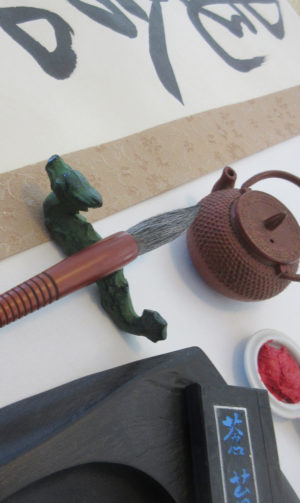
Eri Takase was born and raised in Osaka, Japan, and holds the rank of Shihan, the highest rank in Japanese calligraphy, from the Bokuteki-kai and the Bunka-shodo.
12 1/4" × 43" Japanese Scroll
The scrolls are 12 1/4" W × 43" H (31 × 109 cm), with woven damask borders and layered Japanese paper (washi), designed to last generations. The scrolls themselves are made by a scroll maker in Gifu, Japan, and we have worked with them for over two decades.


Ships in 1-3 days from Washington State
Your scroll is brushed when you order it and completed within 1 to 3 business days.
Your scroll ships from Master Takase's studio in Washington State. Shipping is calculated at checkout. We ship worldwide.
Includes detailed explanation, gift-ready
Your scroll arrives boxed, with a printed insert describing the words in detail.
Sending it as a gift? Add your message at checkout and we will include it with the insert.
30-day money-back guarantee
Every order is covered by our 30-day money-back guarantee. If your scroll arrives damaged, or we made an error, we replace it or refund you in full, including shipping.
Explanation
佛神 is the buddhas and the gods, in the 日本国語大辞典. 貴し is worthy of reverence, to be held in honor. たのむ is to rely on or count on; the dictionary's second sense is to put one's faith in.
A chronicle with a preface of 1776, the Nitenki, tells of Musashi on his way to a fight. At a shrine of Hachiman he reaches for the rope of the gong to pray for victory, and stops.
In the chronicle Musashi's thought is I have not, as a rule, put my faith in the buddhas and gods, and the chronicler then cites this article.
Among the books read for this history, five from 1886 to 1936 put the gods ahead, 神佛, Yoshikawa Eiji's 『現代青年道』 of 1936 among them. The sheet writes 佛神, the buddhas ahead.
The Tale of Genji uses 佛神をたのむ. A man leaving for the mountains entrusts to the buddhas and gods what remains in doubt.
Readers have heard the line as self-confidence that relies on its own arm, as Zen that seeks nothing of the Buddha, and as self-mastery.
Attributed to Miyamoto Musashi: the nineteenth of the twenty-one articles on the sheet headed 獨行道 in the Kumamoto Prefectural Museum of Art, dated 1645, whose date, signature and seal the prefecture holds more naturally a later insertion; the phrase 佛神をたのむ, to turn to the buddhas and gods in faith and in prayer, is far older.
Learn More About These Words
We want you to be as happy with the meaning as you are with Master Takase's art. To learn more, visit Philology of 佛神は貴し佛神をたのまず.


