



Semi-Cursive · gyōsho 行書 · VS5J
Semi-Cursive or gyōsho (行書) styles are a simplified and softer form of the kaisho styles. Gyōsho styles can be read by most Japanese.
不惜身命
fushaku shinmyō
Sparing Neither Body nor Life
Sparing neither body nor life: holding nothing back for the Buddhist way, or for another pursuit.
Hand-brushed by Master Eri Takase
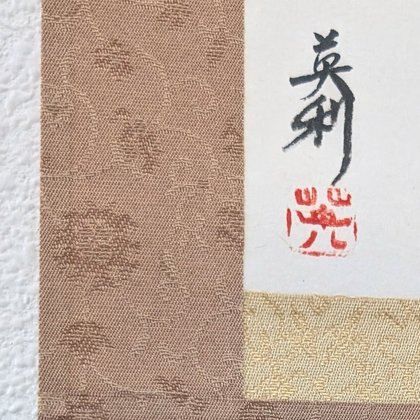
Master Japanese Calligrapher Eri Takase brushes your scroll by hand when you order it. Each scroll bears her red seal, 英利, and her signature.
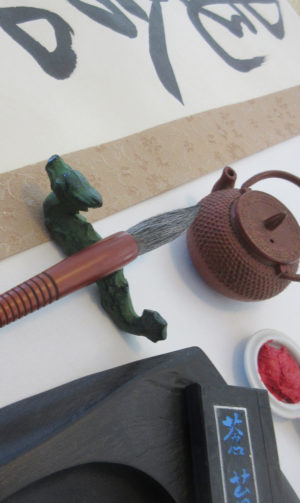
Eri Takase was born and raised in Osaka, Japan, and holds the rank of Shihan, the highest rank in Japanese calligraphy, from the Bokuteki-kai and the Bunka-shodo.
12 1/4" × 43" Japanese Scroll
The scrolls are 12 1/4" W × 43" H (31 × 109 cm), with woven damask borders and layered Japanese paper (washi), designed to last generations. The scrolls themselves are made by a scroll maker in Gifu, Japan, and we have worked with them for over two decades.


Ships in 1-3 days from Washington State
Your scroll is brushed when you order it and completed within 1 to 3 business days.
Your scroll ships from Master Takase's studio in Washington State. Shipping is calculated at checkout. We ship worldwide.
Includes detailed explanation, gift-ready
Your scroll arrives boxed, with a printed insert describing the words in detail.
Sending it as a gift? Add your message at checkout and we will include it with the insert.
30-day money-back guarantee
Every order is covered by our 30-day money-back guarantee. If your scroll arrives damaged, or we made an error, we replace it or refund you in full, including shipping.
Explanation
不惜身命 (fushaku shinmyō): sparing neither body nor life, devoting oneself wholly to the Buddhist way, and also to other pursuits.
不惜身命 is not sparing even body and life. In Buddhism it is the resolve to practice the way without holding oneself back. One Japanese dictionary says the phrase is also said of things other than the Buddhist way. Another calls it a resolve that does not shrink even from death. Whether you take it for the Buddhist way or for the way of an art is yours.
A haikai anthology printed in 1664 has a verse on the bush warbler. It reads: The warbler: not sparing body or life, the voice of the dharma. In 1965 a Japanese-English Buddhist dictionary gave 不惜身命 in English as Not to hold one's life dear for the cause of the law.
On 23 November 1994, accepting promotion to yokozuna, the sumo wrestler Takanohana said he would hold to 不惜身命 in the way of sumo. An English-language magazine wrote that the phrase was spreading like wildfire throughout the country. In English the phrase has also been written fushaku-shinmyo and fushaku shimmyo.
The four characters are a phrase of the Chinese Buddhist translations from the second century on, and the Japanese dictionaries take them from the Lotus Sutra in Kumārajīva's translation of 406, where the Buddha says the sutra may be preached to one who is diligent, compassionate and does not spare body and life; in Japan the 日本書紀 of 720 already uses them of a man's service to the emperor in war.
Learn More About These Words
We want you to be as happy with the meaning as you are with Master Takase's art. To learn more, visit Philology of 不惜身命.


