




Cursive · sōsho 草書 · VC5J
Cursive or sōsho (草書) styles are the most simplified styles and Master Takase's favorite. While very beautiful, these styles are often difficult to read even by specialists.
心技体
shingitai
Mind, Technique and Body
Mind, technique and body: strength of spirit, skill and physical strength, the three qualities of a martial artist or athlete.
Master Takase creates this beautiful scroll when your order is placed, personally preparing the ink and brushing your art, which proudly bears her signature and seal. This is an original work of art.
Description
心技体 (shingitai): mind, technique and body, strength of spirit, skill and physical strength taken together. The Daijisen dictionary notes that the word is often used in sport.
The word puts technique second. In older sumo and sword texts the three stand in another order: mind, body and technique.
A sumo teaching text of the 1716–36 era says that sumo technique is not hampered by armor. When one is practiced in mind, body and technique, it says, the technique follows.
Yamaoka Tesshū taught the sword through a carpenter's plane, in which mind, body and technique are the plane, the man and the pillar.
In sumo writing after the war, the word became the measure of a yokozuna. A magazine of 1952 wrote that when mind, technique and body become one, a yokozuna's presence comes of itself. The Yokozuna Deliberation Council's rules, in their present form, ask for dignity and strength, and do not use the word.
In judo, a study of 2025 finds the word through Michigami Haku. The study says Michigami used the word teaching in Shanghai in 1940 and brought it to France in 1953. The same study finds it in the title of a Niten-ryū text printed in 1909, whose page reads mind, ki and body.
The sumo wrestler Takamiyama's book of 1973 explains the word as shin, mind, heart, spirit; gi, art, technique; and tai, the body, physique. The New York Times, writing of a sumo wrestler in 1987, put it as spirit, skill and power.
A twentieth-century Japanese word of sumo and budō, beside two older triads: 心體業, mind, body and technique, in an Edo sumo text (享保 era, 1716–36) and in Yamaoka Tesshū (1884), and 心氣體, mind, ki and body, in a Niten-ryū text first printed in 1909 and in budō and sumo books into the 1950s; 心技體 itself, in the oldest instance the National Diet Library's full-text search returns, in a sumo report of May 1942, and in English through sumo, in 1973.
We want you to be as happy with the meaning as you are with Master Takase's art. To learn more, visit Philology of 心技体.
Delivery
Your scroll is brushed when you order it and completed within 1 to 3 business days. It ships by USPS Priority Mail from Master Takase's studio in Washington State, boxed and ready to hang, with a printed page giving the art's English, romaji and Japanese.
Sending it as a gift? Add your message at checkout and we will include it.
Shipping is calculated at checkout from your address; within the United States it is $13 to $23. We ship worldwide, and any import charges for your country are shown at checkout before you pay.
Every order is covered by our 30-day money-back guarantee. If your scroll arrives damaged, or we made an error, we replace it or refund you in full, including shipping. Refund policy
About Our Scrolls
Master Japanese Calligrapher Eri Takase brushes your scroll by hand when you order it. Each scroll bears her red seal, 英利, and her signature.
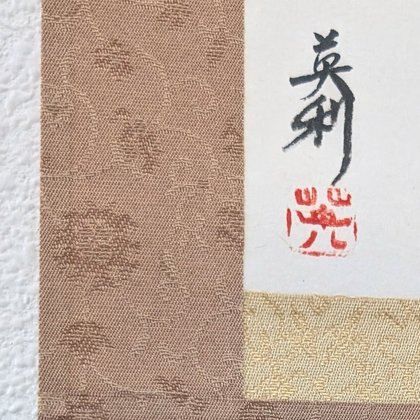


The scrolls are 12 1/4" W × 43" H (31 × 109 cm), with woven damask borders and layered Japanese paper, designed to last generations. The scrolls themselves are made by a scroll maker in Gifu, Japan, and we have worked with them for over two decades.
Eri Takase was born and raised in Osaka, Japan, and holds the rank of Shihan, the highest rank in Japanese calligraphy, from the Bokuteki-kai and the Bunka-shodo. About Master Takase


