




Semi-Cursive · gyōsho 行書 · VS2C
Semi-Cursive or gyōsho (行書) styles are a simplified and softer form of the kaisho styles. Gyōsho styles can be read by most Japanese.
拳法 kenpō Kempo
Kempo, the Chinese fighting art chiefly of blows with the fist and kicks. Japanese arts such as 少林寺拳法, shōrinji kenpō, carry the name as well.
Master Takase creates this beautiful scroll when your order is placed, personally preparing the ink and brushing your art, which proudly bears her signature and seal. This is an original work of art.
Description
拳法 (kenpō): kempo, the Chinese fighting art chiefly of blows with the fist and kicks.
Two Japanese dictionaries define 拳法 as a fighting art chiefly of thrusts and blows with the fist, and kicks with the foot. One adds that it developed in China from ancient times. JMdict, which most English-language tools draw on, gives Chinese martial arts; kung fu; wushu; quanfa, then kenpō (martial arts); kempo.
拳 (ken) is the fist, and 法 (hō) a method, a rule or a law, read pō after ん, as in 拳法.
In Qi Jiguang's 紀效新書, 拳法 is a general word, and the chapter goes on to picture its postures. 拳法 seems to have no part in the arts of great battle, yet it is the gate by which a beginner enters the arts. The staff, the sword, the spear and the bow all begin from 拳法, the chapter says: the fist is the source of the martial arts.
In some Edo books, 拳法 was also a written name for Japan's own art of seizing, yawara. A primer of 1710 lists 拳法 among the arts a samurai's son should learn, beside the bow, the horse, the sword and the halberd. A picture-book of China of 1719 lists sixteen figures of 拳法 and notes under the opening figure: in Japan it is called yawara torite.
The national catalogue lists books of the martial-arts schools with 拳法 in their titles. The 則辰 school's book, with an afterword the national catalogue dates 1840, calls its art 死活拳法, the 拳法 of killing and reviving, passed down by mouth. A book of 1829 names 澁川伴五郎 a scholar's master in 拳法, where a book of 1716 names him a master of 柔術.
Edo writers did not settle what 拳法 named. In 1791 林子平 used the word for a technique of Chinese fighters: under the name 拳法, they thrust at the eyes with the clenched fist. The dictionary 倭訓栞 files 拳法 among the arts of seizing. A later part, printed in 1887 and perhaps partly its editors', says of the art some trace to 陳元贇 that it is 把勢, different from 拳法.
The story of 陳元贇 changed. In a book of 1716 he tells three masterless samurai in Edo of a Ming art of seizing he had seen but did not know. A book of 1816 makes him the founder of 拳法 in Japan.
The national dictionary 言海 (1889–91) gives 拳法 one sense, in China, it is said, the art of striking a man with the fist, and sends the reader to yawara. In a paper read in 1888, T. Lindsay and Kanō Jigorō wrote that the Chinese Kempō and Japanese Jiujutsu differ materially in their methods. Brinkley's dictionary of 1896 entered 拳法 as Same as Yawara.
In 1901 a Japanese history of sumō captioned a Qing picture of sparring Shaolin monks 少林寺拳法. A preface in Funakoshi Gichin's book 唐手 of 1922 calls 唐手, karate, the 拳法 of Okinawa. 日本拳法 is dated by its own circle to 1932. By the dictionaries' account, 宗道臣 began teaching his art as 少林寺拳法 in 1947.
English borrowed the word as Kempo, Kempō and kenpo. Kempo writes ん before p as m, as Lindsay and Kanō and Brinkley spelled it. In fragments the Internet Archive's full-text search shows, a newspaper of 1963 gives kempo as law of the fist. A fragment of a book of 1966 gives it as the way of the fist. Law renders 法; 拳法 has no 道, way.
拳法, the method of the fist, is a Chinese word, which opens the chapter on the fist in the Ming general Qi Jiguang's book on war; in Japanese print it is first found, among the sources read here, in a primer of 1710 that reads it yawara, the name of Japan's own art of seizing.
We want you to be as happy with the meaning as you are with Master Takase's art. To learn more, visit Philology of 拳法.
Delivery
Your scroll is brushed when you order it and completed within 1 to 3 business days. It ships by USPS Priority Mail from Master Takase's studio in Washington State, boxed and ready to hang, with a printed page giving the art's English, romaji and Japanese.
Sending it as a gift? Add your message at checkout and we will include it.
Shipping is calculated at checkout from your address; within the United States it is $13 to $23. We ship worldwide, and any import charges for your country are shown at checkout before you pay.
Every order is covered by our 30-day money-back guarantee. If your scroll arrives damaged, or we made an error, we replace it or refund you in full, including shipping. Refund policy
About Our Scrolls
Master Japanese Calligrapher Eri Takase brushes your scroll by hand when you order it. Each scroll bears her red seal, 英利, and her signature.
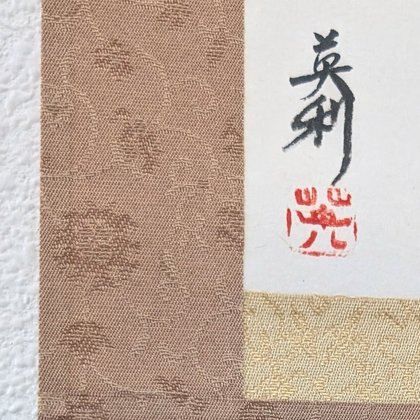


The scrolls are 12 1/4" W × 43" H (31 × 109 cm), with woven damask borders and layered Japanese paper, designed to last generations. The scrolls themselves are made by a scroll maker in Gifu, Japan, and we have worked with them for over two decades.
Eri Takase was born and raised in Osaka, Japan, and holds the rank of Shihan, the highest rank in Japanese calligraphy, from the Bokuteki-kai and the Bunka-shodo. About Master Takase


