




Cursive · sōsho 草書 · VC3B
Cursive or sōsho (草書) styles are the most simplified styles and Master Takase's favorite. While very beautiful, these styles are often difficult to read even by specialists.
柔術 jūjutsu Jujitsu
Jujitsu, the old Japanese martial art of attack and defense without weapons. Its other name is やわら, yawara.
Master Takase creates this beautiful scroll when your order is placed, personally preparing the ink and brushing your art, which proudly bears her signature and seal. This is an original work of art.
Description
柔術 (jūjutsu): jujitsu, the old Japanese martial art of attack and defense without weapons.
Two Japanese dictionaries define 柔術 as an age-old Japanese martial art of attack and defense without weapons, by striking, kicking, throwing, pinning and the like. Both close on its other name, やわら (yawara). 柔 is soft or supple, and 術 is a technique or an art, as in 剣術 (kenjutsu) and 居合術 (iaijutsu).
やわら is a native Japanese word, written 柔 as well. A Japanese dictionary gives it as softness, then gentleness, and in its third sense as 柔術 itself. A kana book of 1647, 悔草, weeds of regret, has its author wish he had yawara, seizing and the staff.
本朝武芸小伝, a book of 1716 on the lives of the masters of the martial arts, opens its volume on 柔術 by quoting a book it calls 拳法秘書. The line reads: what the present age calls 柔術 is this; the 武備志 calls it 拳. The 拳法秘書 is not identified, and the print does not mark where its words end. The 武備志 is a Ming book on war. In the copy read for the history, a later impression from its blocks, the ruby beside 柔術 is ヤハラ, yahara, the old spelling of yawara.
Books of 1759 and 1770 set 柔術, read yawara, beside 剣術, read in the Sino-Japanese way as kenjutsu. A book of 1786 by Santō Kyōden gives 柔 a Sino-Japanese ruby instead.
In 1867 J. C. Hepburn glossed 柔術 the art of wrestling, or of throwing others by sleight. He marked words of books, or obsolete words, with a dagger, and his entries for jū-jutsz and yawara carry none.
The book of 1716 also tells a story of the art's beginning. In it a newcomer to Japan, 陳元贇, tells three masterless samurai at a temple in Edo of an art of seizing men in Ming China. He has seen its techniques but does not know the art, and the three work them out themselves. A book dated 1843 has him teach it to them, and calls that the beginning of 柔術 in Japan. In 1894 H. Morinaga, writing in English, reported two opinions on the art's origin, one through 陳元贇 and a native one.
Searched in the Internet Archive's full text, English running text has the word from 1884, in Yokohama: the yawara or jiu-jitsu, a once favourite mode of wrestling, coming back into vogue. In 1888 a paper Kanō Jigorō signed with the Reverend T. Lindsay gave Jiujutsu and Yawara as the art's two names most widely known and used. In 1889 Kanō took 柔術 as the general name for now, because it was the name most widely known.
English has spelled the word many ways: jiu-jitsu in 1884, jū jitsu in 1886, Jiujutsu in 1888, jujitsu and Jujutsu in 1894. In 1904 an American manual titled Jiu-jitsu rendered the word literally as the gentle art.
Kanō named his own art 柔道 (jūdō) to set it apart from the low repute 柔術 had come to have. In Japan 柔道 became the general name. English kept the older one, as jiu-jitsu and jujitsu. In 1922 Kanō recalled that people had formerly said mostly 柔術 or yawara.
柔術 is first dated, among the sources read here, in a book of 1716 that heads a volume with it and reads the two characters yawara, the art's spoken name; books of 1759 to 1770 read them so, and Hepburn's dictionary of 1867 entered jūjutsu and yawara as words of the same meaning.
We want you to be as happy with the meaning as you are with Master Takase's art. To learn more, visit Philology of 柔術.
Delivery
Your scroll is brushed when you order it and completed within 1 to 3 business days. It ships by USPS Priority Mail from Master Takase's studio in Washington State, boxed and ready to hang, with a printed page giving the art's English, romaji and Japanese.
Sending it as a gift? Add your message at checkout and we will include it.
Shipping is calculated at checkout from your address; within the United States it is $13 to $23. We ship worldwide, and any import charges for your country are shown at checkout before you pay.
Every order is covered by our 30-day money-back guarantee. If your scroll arrives damaged, or we made an error, we replace it or refund you in full, including shipping. Refund policy
About Our Scrolls
Master Japanese Calligrapher Eri Takase brushes your scroll by hand when you order it. Each scroll bears her red seal, 英利, and her signature.
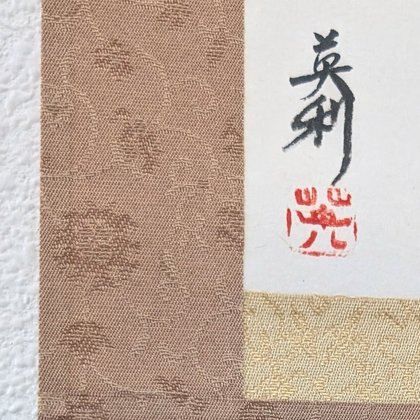


The scrolls are 12 1/4" W × 43" H (31 × 109 cm), with woven damask borders and layered Japanese paper, designed to last generations. The scrolls themselves are made by a scroll maker in Gifu, Japan, and we have worked with them for over two decades.
Eri Takase was born and raised in Osaka, Japan, and holds the rank of Shihan, the highest rank in Japanese calligraphy, from the Bokuteki-kai and the Bunka-shodo. About Master Takase


