



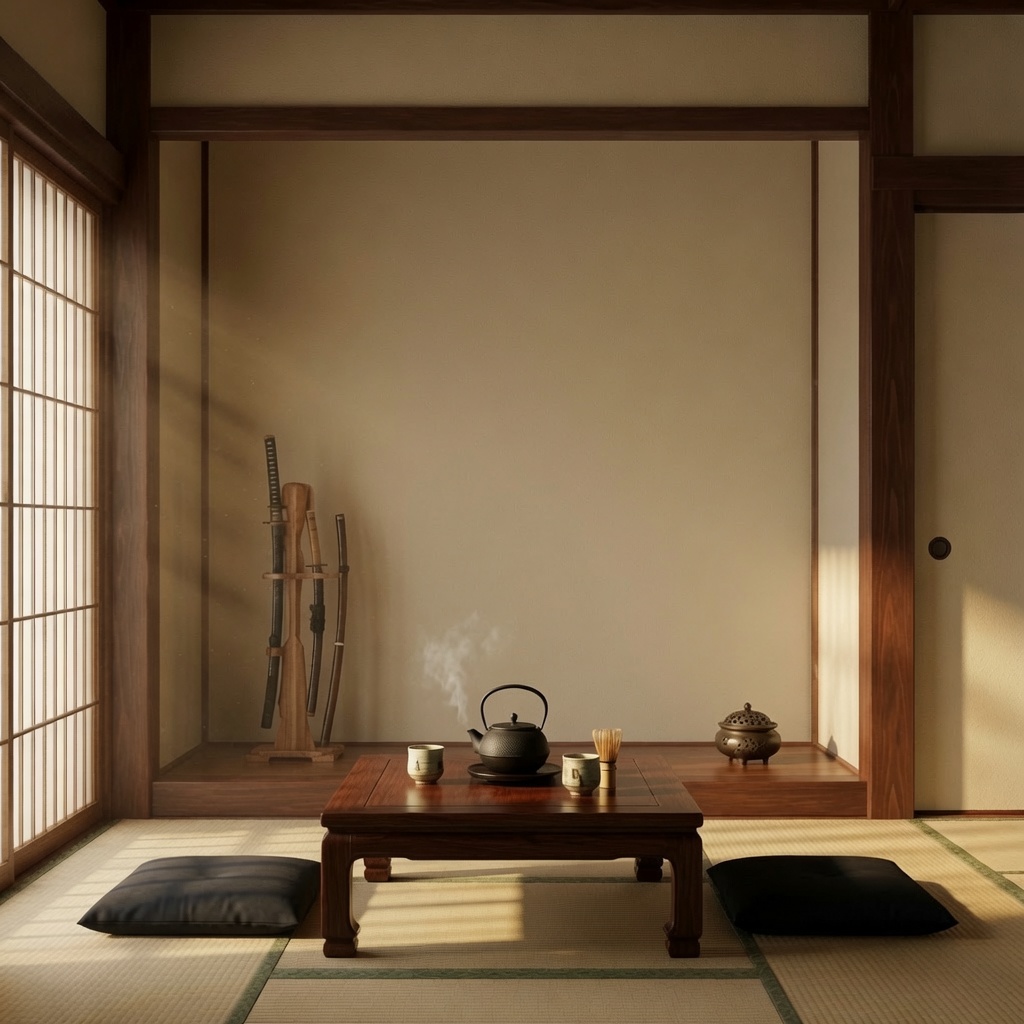

Semi-Cursive · gyōsho 行書 · VS3C
Semi-Cursive or gyōsho (行書) styles are a simplified and softer form of the kaisho styles. Gyōsho styles can be read by most Japanese.
居合術
iaijutsu
Iaijutsu
Iaijutsu, the Japanese art of drawing the sword and cutting in one act. Today the art usually goes by the name 居合道, iaidō.
Master Takase creates this beautiful scroll when your order is placed, personally preparing the ink and brushing your art, which proudly bears her signature and seal. This is an original work of art.
Description
居合術 (iaijutsu): the Japanese art of drawing the sword and cutting in one act.
A Japanese encyclopedia defines 居合術 as the art of drawing the sword swiftly, by the work of the hips, to protect oneself and master the enemy. A Japanese dictionary defines 居合 as drawing the sword swiftly from one knee and cutting the enemy, and names 居合い術 as another word for it. 術 is a technique or an art, as in 剣術 (kenjutsu) and 柔術 (jūjutsu).
Japan's national catalogue of early books dates fifteen works with 居合 in their titles, from 1630 to 1840. As the catalogue gives those titles, none writes 術.
In 1848 the keeper's diary at the Japan House in Busan, on a man's diligent service, notes above all his progress in 居合術. The same house's register still writes the word in the 1860s, of the samurai on station there.
In 1890 the Ministry of Education's survey of the old domain schools prints 居合術 for Sabae, Tosa and Yunagaya. For Yunagaya, it says that the lord in whose time the school was founded, in 1843, taught 居合術 there himself. Where the survey marks Tosa's rules of 1867 and 1868 as the original, they write 拔刀 for the art.
In the Kyoto prefecture's account of an imperial visit of 1910, the Dai Nippon Butokukai's classes still say 剣術 and 柔術. The Butokukai's titles, 範士 and 教士, already say 剣道 and 柔道, and say 居合術, with 術.
In 1918 a chapter on the Tosa line's 居合術, co-edited by Ōe Masaji, the line's seventeenth head, opens on the martial ways. It says: among these ways, 劍道 is used today in general to cultivate body and mind, and the 居合術 spoken of here is one of the 劍道. It goes on that the art is done with a live blade, and that at each cut the spirit of attack is full.
In Nakamura Tamio's account, the Butokukai renamed 剣術, 柔術 and 弓術 as 剣道, 柔道 and 弓道 in 1919. Nakamura edited a compilation of the association's records, and in his account the other arts kept 術. A Japanese encyclopedia counts 230 holders of the association's titles in 居合術 in March 1941.
A manual of 1938 by Yamanouchi Toyotake and Tanida Saichi, 図解居合詳説, chose 居合道 over 居合術 as its name for the art. Its reason was the spirit: the way, it argues, is a realm where body and mind are one. It names the aim as the cultivation of the spirit and the perfection of character. By 1943 the Butokukai's own titles said 居合道. A Japanese encyclopedia dates the settling of 居合道 in place of 居合術 from about the mid-1950s, and hedges: it can be said.
English print has iai-jutsu from 1963 and iaijutsu from 1964 in the Internet Archive rows read for the history, one unopened row of 1950 apart. In 1973 Donn F. Draeger's Classical Budo set the two words apart: iai-jutsu, the classical sword-drawing art practiced for combative purposes; iai-do, a noncombative discipline engaged in for the individual's spiritual cultivation.
Draeger's line runs parallel to the Japanese manual of 1938, and nothing read for the history shows that he took it from the manual. In 1998 G. Cameron Hurst III wrote that Draeger distinguishes between terms far more sharply than do the authors of traditional Japanese texts.
English uses iaijutsu today for the classical schools of the art, as Alexander C. Bennett does in writing of his own training in Hōki-ryū iaijutsu.
The art's older name is 居合, and Tosa's rules of 1867 write 拔刀; 居合術, with 術, art, is first dated, in the National Diet Library's full-text search of its digitized classical books, in the records of the Tsushima domain's office at the Japan House in Busan in 1848, was the name of the Dai Nippon Butokukai's titles in the art by 1910 and still in 1941, was set against 居合道 by a manual of 1938 that argued for 居合道 as a cultivation of the spirit, and gave way to 居合道 from about the mid-1950s.
We want you to be as happy with the meaning as you are with Master Takase's art. To learn more, visit Philology of 居合術.
Delivery
Your scroll is brushed when you order it and completed within 1 to 3 business days. It ships by USPS Priority Mail from Master Takase's studio in Washington State, boxed and ready to hang, with a printed page giving the art's English, romaji and Japanese.
Sending it as a gift? Add your message at checkout and we will include it.
Shipping is calculated at checkout from your address; within the United States it is $13 to $23. We ship worldwide, and any import charges for your country are shown at checkout before you pay.
Every order is covered by our 30-day money-back guarantee. If your scroll arrives damaged, or we made an error, we replace it or refund you in full, including shipping. Refund policy
About Our Scrolls
Master Japanese Calligrapher Eri Takase brushes your scroll by hand when you order it. Each scroll bears her red seal, 英利, and her signature.
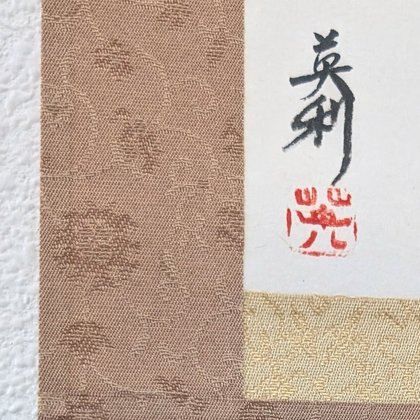


The scrolls are 12 1/4" W × 43" H (31 × 109 cm), with woven damask borders and layered Japanese paper, designed to last generations. The scrolls themselves are made by a scroll maker in Gifu, Japan, and we have worked with them for over two decades.
Eri Takase was born and raised in Osaka, Japan, and holds the rank of Shihan, the highest rank in Japanese calligraphy, from the Bokuteki-kai and the Bunka-shodo. About Master Takase


