




Jiun · 自運 · VD5J
Jiun (自運) is the calligrapher's word for writing from one's own invention. As a Shihan, Master Takase has a hand of her own, and these designs are that hand: she draws freely on the classic scripts to create exactly the look she wants.
一眼二足三胆四力
ichigan nisoku santan shiriki
First the Eye, Second the Feet, Third Courage, Fourth Strength
A saying of kendō and the martial arts that ranks what a fighter needs: the eye first, then the feet, then courage, and strength last.
Master Takase creates this beautiful scroll when your order is placed, personally preparing the ink and brushing your art, which proudly bears her signature and seal. This is an original work of art.
Description
一眼二足三胆四力 (ichigan nisoku santan shiriki): a saying of kendō and the martial arts that ranks what a fighter needs, the eye first, then the feet, then courage, and strength last.
JMdict, the open Japanese–English dictionary, enters the saying as a term of the martial arts: firstly vision, secondly footwork, thirdly courage, fourthly technique. The Japanese texts read for the saying's history that explain the fourth place make 力 strength, not technique. A book of 1896 says the term puts the use of strength in last place.
The second place has been read two ways. Read soku, 足 is the feet; read sasoku, written 早足 or 早速, it is quickness. The 日本国語大辞典 enters さそく with two senses: fleetness of foot, and quickness of action or of wit.
A book printed at Osaka in 1701 explains an older count of three, eye, mind and feet: with the eye you see the enemy's color, with the mind you weigh victory, and then you leap in, step in, run in, and strike the enemy. Its writer teaches it instead as one mind and two bodies, since eye and foot both move from the mind.
In a puppet play of 1742, 男作五雁金, a pupil splits a falling wooden pillow with his foot. His master cries ho! the eye, then quickness.
A book of 1896 sets out four places with quickness second: swordsmen say eye, quickness, courage, strength. In the books on kendō read for the saying's history, the second place is the feet from 1930.
A farming magazine of 1917 prints a story of the young Yamamoto Kansuke, whose left eye is crushed. One man says that with one eye he is ill fitted to learn the martial arts. The other answers with the saying, and the joke reads 一眼, the eye first, as one eye, making the one-eyed man the fittest of all.
A magazine of 1973 tells of the words left framed in the salon of the Takarazuka club. A piece of 1991 tells of a hand towel dyed with them, in a journalist's brushwork.
In English, Sasamori Junzō and Gordon Warner's This Is Kendo (1964) gives the saying as The eyes first, the footwork next, the courage third, and the strength fourth.
Whether you take the second place as the feet, as kendō now teaches, or as quickness, as the Edo stage read it, is yours.
A counting saying of the Japanese fighting arts; an older count of three, 一眼二心三足, is printed as a received saying in a book of 1701 signed with 山本勘介's name, the count of four is in print by 1896, and the four words as written here from 1917; credits to 千葉周作, 宮本武蔵 and 柳生 (宗矩 by name in 1991) are late and do not agree.
We want you to be as happy with the meaning as you are with Master Takase's art. To learn more, visit Philology of 一眼二足三胆四力.
Delivery
Your scroll is brushed when you order it and completed within 1 to 3 business days. It ships by USPS Priority Mail from Master Takase's studio in Washington State, boxed and ready to hang, with a printed page giving the art's English, romaji and Japanese.
Sending it as a gift? Add your message at checkout and we will include it.
Shipping is calculated at checkout from your address; within the United States it is $13 to $23. We ship worldwide, and any import charges for your country are shown at checkout before you pay.
Every order is covered by our 30-day money-back guarantee. If your scroll arrives damaged, or we made an error, we replace it or refund you in full, including shipping. Refund policy
About Our Scrolls
Master Japanese Calligrapher Eri Takase brushes your scroll by hand when you order it. Each scroll bears her red seal, 英利, and her signature.
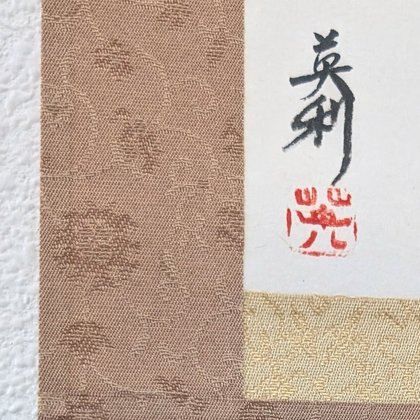


The scrolls are 12 1/4" W × 43" H (31 × 109 cm), with woven damask borders and layered Japanese paper, designed to last generations. The scrolls themselves are made by a scroll maker in Gifu, Japan, and we have worked with them for over two decades.
Eri Takase was born and raised in Osaka, Japan, and holds the rank of Shihan, the highest rank in Japanese calligraphy, from the Bokuteki-kai and the Bunka-shodo. About Master Takase


