




Block · kaisho 楷書 · VB5J
Block or kaisho (楷書) styles are the most common and recognizable styles. Block styles are easily read and are noted for their angular form and their vertical and horizontal lines.
役に立たぬ事をせざる事
yaku ni tatanu koto o sezaru koto
Do Not Do What Does Not Serve
A rule attributed to Miyamoto Musashi: do not do what does not serve.
Hand-brushed by Master Eri Takase
Master Japanese Calligrapher Eri Takase brushes your scroll by hand when you order it. Each scroll bears her red seal, 英利, and her signature.
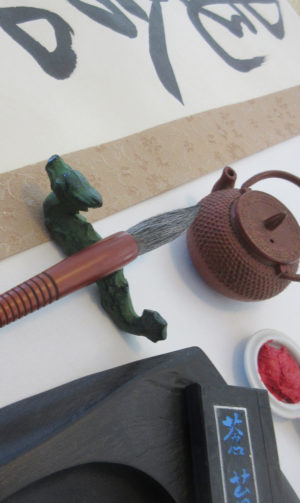
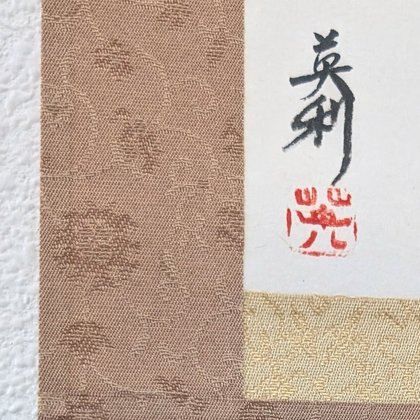
Eri Takase was born and raised in Osaka, Japan, and holds the rank of Shihan, the highest rank in Japanese calligraphy, from the Bokuteki-kai and the Bunka-shodo.
12 1/4" × 43" Japanese Scroll
The scrolls are 12 1/4" W × 43" H (31 × 109 cm), with woven damask borders and layered Japanese paper (washi), designed to last generations. The scrolls themselves are made by a scroll maker in Gifu, Japan, and we have worked with them for over two decades.


Ships in 1-3 days from Washington State
Your scroll is brushed when you order it and completed within 1 to 3 business days.
Your scroll ships from Master Takase's studio in Washington State. Shipping is calculated at checkout. We ship worldwide.
Includes detailed explanation, gift-ready
Your scroll arrives boxed, with a printed insert describing the words in detail.
Sending it as a gift? Add your message at checkout and we will include it with the insert.
30-day money-back guarantee
Every order is covered by our 30-day money-back guarantee. If your scroll arrives damaged, or we made an error, we replace it or refund you in full, including shipping.
Explanation
Word for word, it is the matter of not doing what does not serve. 役に立つ is to be useful, to have effect when used, in the デジタル大辞泉, the 日本国語大辞典 and JMdict.
役 is, in the 日本国語大辞典's fourth sense, the work in one's charge: a duty, a post.
The rules before it are for one who would learn Musashi's strategy: think on what is not crooked, train in the way, touch the arts.
The rules go on: know the ways of the trades, tell gain from loss, learn to judge all things. Then perceive what the eye does not see, and take care over small things.
Fukurai Tomokichi, in a book of 1916, quoted it alone and called it the foremost precept Musashi teaches one learning the sword.
Fukurai Tomokichi's book of 1916 quotes the Book of Five Rings on a weapon, in a passage using the kindred 役に立てる: to die with a tool unused, sheathed at the waist, cannot be what one intends.
Attributed to Miyamoto Musashi: the ninth of the nine rules that close the Earth scroll of the Book of Five Rings, whose colophon in the copies read is dated 1645; its earliest print in the National Diet Library's full-text search is a typeset of 1909.
Learn More About These Words
We want you to be as happy with the meaning as you are with Master Takase's art. To learn more, visit Philology of 役に立たぬ事をせざる事.


