




Jiun · 自運 · VD5J
Jiun (自運) is the calligrapher's word for writing from one's own invention. As a Shihan, Master Takase has a hand of her own, and these designs are that hand: she draws freely on the classic scripts to create exactly the look she wants.
交剣知愛
kōken chiai
Cross Swords, and Come to Know Love
Through kendō, come to understand one another and grow as people.
Master Takase creates this beautiful scroll when your order is placed, personally preparing the ink and brushing your art, which proudly bears her signature and seal. This is an original work of art.
Description
交剣知愛 (kōken chiai): a kendō saying, that through kendō we understand one another and seek to grow as people.
Word by word, 交剣 is to cross swords and 知愛 is to know how to love. In Japanese, 愛 may also be read おしむ, to hold dear and be loath to part with.
In a section headed 交剣知愛 in a kendō book of his own of 1953, Takano Hiromasa argued that kendō is love. Elsewhere in the book he wrote that the love kendō speaks of is not merely peace and keeping out of trouble. A father's or teacher's whip hurts, but tears of blood brim within it, and kendō's love too holds a spirit of strength and plain sincerity.
In texts from 1964 to 1999, the kendō teachers Yuno Masanori, Sakuma Saburō and Okamura Tadanori give the 愛 of 交剣知愛 as おしむ. In 1964 a piece printed after Yuno's byline closes: 愛, I was taught, is おしむ. A graduate of a university kendō club, in its history of 2000, gives 交剣知愛 as a motto: to make someone think, I want to practice with that person once more.
The All Japan Kendo Federation's dictionary gives two senses: understanding one another and growing as people. The second is the wish to practice or compete again with a partner one has crossed swords with. Neither sense names 愛 or おしむ. In 2007 the federation's guidance for teachers made widening the circle of 交剣知愛 a point of instruction. The federation's own English for that guidance gives the phrase as the desire to achieve mutual understanding and betterment of humanity through kendo.
A kendō saying of modern Japan, made of two classical Chinese words not found together in the Chinese texts searched; the earliest page opened is a Nagoya school manual of 1943, and a compiler of 1980 credits it to Takano Hiromasa's kendō textbook of 1930.
We want you to be as happy with the meaning as you are with Master Takase's art. To learn more, visit Philology of 交剣知愛.
Delivery
Your scroll is brushed when you order it and completed within 1 to 3 business days. It ships by USPS Priority Mail from Master Takase's studio in Washington State, boxed and ready to hang, with a printed page giving the art's English, romaji and Japanese.
Sending it as a gift? Add your message at checkout and we will include it.
Shipping is calculated at checkout from your address; within the United States it is $13 to $23. We ship worldwide, and any import charges for your country are shown at checkout before you pay.
Every order is covered by our 30-day money-back guarantee. If your scroll arrives damaged, or we made an error, we replace it or refund you in full, including shipping. Refund policy
About Our Scrolls
Master Japanese Calligrapher Eri Takase brushes your scroll by hand when you order it. Each scroll bears her red seal, 英利, and her signature.
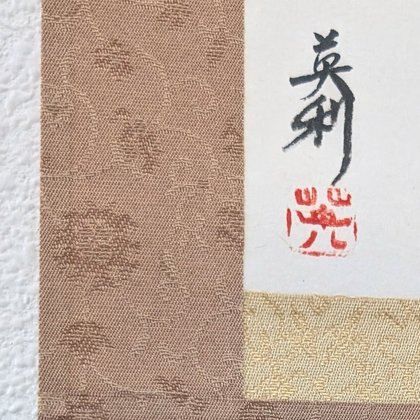


The scrolls are 12 1/4" W × 43" H (31 × 109 cm), with woven damask borders and layered Japanese paper, designed to last generations. The scrolls themselves are made by a scroll maker in Gifu, Japan, and we have worked with them for over two decades.
Eri Takase was born and raised in Osaka, Japan, and holds the rank of Shihan, the highest rank in Japanese calligraphy, from the Bokuteki-kai and the Bunka-shodo. About Master Takase


