




Semi-Cursive · gyōsho 行書 · VS5J
Semi-Cursive or gyōsho (行書) styles are a simplified and softer form of the kaisho styles. Gyōsho styles can be read by most Japanese.
射は仁の道なり
sha wa jin no michi nari
Archery is the Way of Humaneness
Archery is the way of humaneness, the Confucian virtue of caring for others.
Master Takase creates this beautiful scroll when your order is placed, personally preparing the ink and brushing your art, which proudly bears her signature and seal. This is an original work of art.
Description
射は仁の道なり (sha wa jin no michi nari): archery is the way of humaneness, the Confucian virtue of caring for others.
Word by word, 射 is archery, 仁 is humaneness and 道 is the way. The words that follow the sentence say why. The archer seeks what is right in himself before he shoots. When he misses, he does not resent the one who beat him, but turns and seeks the fault in himself.
Readers have weighed the sentence differently. The Tang commentator Kong Yingda reads it as seeking within oneself and doing no harm to others. The commentator Chen Hao reads it through being humane comes from oneself: whether the arrow hits comes from oneself too. The Edo scholar Ogyū Sorai takes humaneness as giving the people peace, a way walked after the self is made right.
By 1931 the kyūdō rank examinations asked what archery is the way of humaneness means. A model answer printed in 1937 replies that archery is examining oneself without contending with others. A women's normal school in Tokushima named its archery hall 求正道場, the Hall of Seeking the Right, after the passage that opens with the sentence. Its history gives the year as 1931. In 2021 a municipal kyūdō association described an extract including the sentence, framed at the front of its hall beside a second piece, the 射法訓.
In English, James Legge's 1885 translation reads Archery suggests to us the way of benevolence, and Edward Slingerland's 2003 Analects, translating an early commentator who quotes the sentence, reads Archery is the way of benevolence (ren).
A sentence of the 射義, the chapter on archery in the 禮記 (the Book of Rites, compiled in the Former Han); a Japanese scroll pointed in 1257 already ends it in nari, and sha wa jin no michi nari is how the Meiji school editions read it aloud.
We want you to be as happy with the meaning as you are with Master Takase's art. To learn more, visit Philology of 射は仁の道なり.
Delivery
Your scroll is brushed when you order it and completed within 1 to 3 business days. It ships by USPS Priority Mail from Master Takase's studio in Washington State, boxed and ready to hang, with a printed page giving the art's English, romaji and Japanese.
Sending it as a gift? Add your message at checkout and we will include it.
Shipping is calculated at checkout from your address; within the United States it is $13 to $23. We ship worldwide, and any import charges for your country are shown at checkout before you pay.
Every order is covered by our 30-day money-back guarantee. If your scroll arrives damaged, or we made an error, we replace it or refund you in full, including shipping. Refund policy
About Our Scrolls
Master Japanese Calligrapher Eri Takase brushes your scroll by hand when you order it. Each scroll bears her red seal, 英利, and her signature.
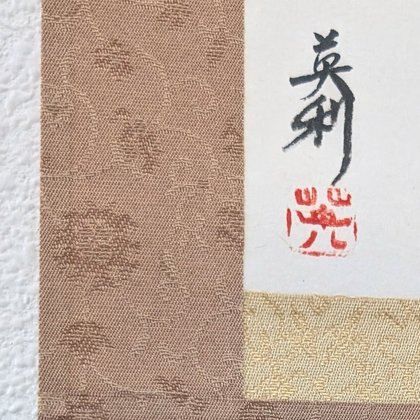


The scrolls are 12 1/4" W × 43" H (31 × 109 cm), with woven damask borders and layered Japanese paper, designed to last generations. The scrolls themselves are made by a scroll maker in Gifu, Japan, and we have worked with them for over two decades.
Eri Takase was born and raised in Osaka, Japan, and holds the rank of Shihan, the highest rank in Japanese calligraphy, from the Bokuteki-kai and the Bunka-shodo. About Master Takase


