



Font Design · VD5J
Font Designs are Master Takase's unique designs. Often she will use her own style or a combination of fonts and, without a classification limit, create exactly the look she wants.
明鏡止水
meikyō shisui
A Clear Mirror, Still Water
A mind clear and still, with nothing weighing on it, like a spotless mirror and still water.
Master Takase creates this beautiful scroll when your order is placed. Personally preparing the ink and brushing your art that proudly bears her signature and seal. This is an original work of art.
Description
明鏡止水 (meikyō shisui): a mind with nothing weighing on it, clear and still, like a clear mirror and still water.
The 日本国語大辞典 gives the same picture: a mirror with no clouding and quiet water, a clear and still state of mind. Whether you take it as a calm to keep or as a mind clear enough to answer what comes is yours.
In a book printed in 1705, the Kyoto scholar Itō Jinsai set the phrase aside. Mencius, he wrote, likened the mind to flowing water and to sprouts, never to a clear mirror and still water. A living thing may be compared to a living thing, he went on, but may not be likened to a dead one.
A treatise on the martial arts printed in 1729 says the mind is like a clear mirror and still water. When the slightest intention lies across the mind, it goes on, the mind's clear working is blocked and cannot move freely. The mirror here is a mind ready to answer an opponent, with no plan in the way.
In 1897 an editor published a book of Katsu Kaishū's talk, which he says he rewrote or altered piece by piece. As the editor gives the words, the clear mirror and still water was the secret of the swordsmanship Katsu learned young. Katsu applied the same secret, the book says, to diplomacy.
A phrase from the Chinese tradition: the Zhuangzi has a still water people use as a mirror and a bright mirror that dust does not settle on, the Huainanzi sets the two in one sentence, the Song philosopher 程頤 likened the sage's mind to a mirror and to still water, and 朱熹, crediting 程頤, is the first writer in the texts read for this history to write the four characters as one phrase; in Japan it is in print by 1685.
We want you to be as happy with the meaning as you are with Master Takase's art. To learn more, visit Philology of 明鏡止水.
Delivery
Your scroll is brushed when you order it and completed within 1 to 3 business days. It ships by USPS Priority Mail from Master Takase's studio in Washington State, boxed and ready to hang, with a printed page giving the art's English, romaji and Japanese.
Sending it as a gift? Add your message at checkout and we will include it.
Shipping is calculated at checkout from your address; within the United States it is $13 to $23. We ship worldwide, and any import charges for your country are shown at checkout before you pay.
Every order is covered by our 30-day money-back guarantee. If your scroll arrives damaged, or we made an error, we replace it or refund you in full, including shipping. Refund policy
About Our Scrolls
Master Japanese Calligrapher Eri Takase brushes your scroll by hand when you order it. Each scroll bears her red seal, 英利, and her signature.
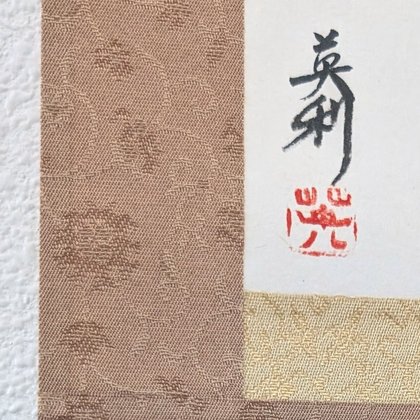
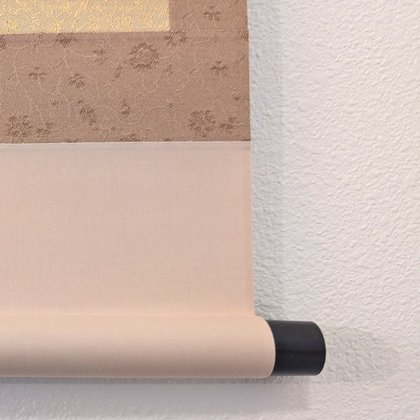
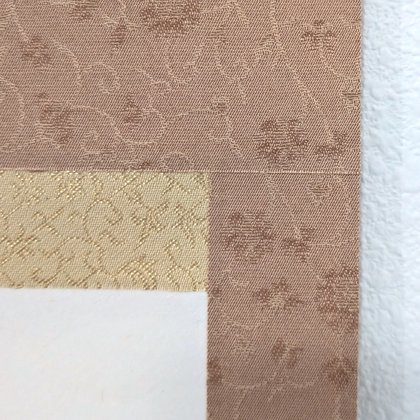
The scrolls are 12 1/4" W × 43" H (31 × 109 cm) with woven damask borders and Japanese paper that are layered so the scroll hangs straight and will not warp over time. The scrolls themselves are made by a scroll maker in Gifu, Japan, and we have worked with them for over two decades.
Eri Takase was born and raised in Osaka, Japan, and holds the rank of Shihan, the highest rank in Japanese calligraphy, from the Bokuteki-kai and the Bunka-shodo. About Master Takase


