


Font Design · VD5J
Font Designs are Master Takase's unique designs. Often she will use her own style or a combination of fonts and, without a classification limit, create exactly the look she wants.
五月雨を
あつめて早し
最上川
samidare o
atsumete hayashi
mogamigawa
bashō 芭蕉
Gathering
the early-summer rains, swift:
the Mogami River
Gathering the early-summer rains, swift: the Mogami River.
Master Takase creates this beautiful scroll when your order is placed. Personally preparing the ink and brushing your art that proudly bears her signature and seal. This is an original work of art.
Description
五月雨をあつめて早し最上川 (samidare o atsumete hayashi mogamigawa): gathering the early-summer rains, swift: the Mogami River.
五月雨, samidare, is the long rain that falls around the fifth month of the old calendar, the rainy season, the 日本国語大辞典 says. The river gathers the rain and runs swift. The same dictionary calls the Mogami one of the three swift rivers of Japan.
Eri's four scrolls write the verse as the journal has it, with 早し, swift, and あつめて in kana.
In the journal the verse follows the passage on the river, which ends with the water swollen and the boat in danger. 涼し means cool: pleasant and not stifling, the 日本国語大辞典 says. In the kasen the host, Takano Ichiei, answered with the second verse: at the bank, a boat post that moors the fireflies.
Hiroaki Sato, in 1983, wrote that the kasen naturally began with Bashō praising the host and the host deprecating himself. Haruo Shirane, in 1998, read the boat post as the host, restraining the firefly, his guest.
Five Japanese commentaries and editions, from 1916 to 1948, took cool as the earlier form and swift as the revision. One eighteenth-century report, 『芭蕉句選年考』, gives swift in the kasen and in the anthology 『雪丸げ』, whose surviving print reads cool. Higuchi Isao, in 1925, judged that the second verse fits cool and hardly swift, so the opening verse alone was revised.
Where swift was made is argued. Higuchi Isao thought the verse itself perhaps made at Ōishida, and set after the river passage. Ebara Taizō, in 1944, put the change after Bashō went down the river and saw the rapids. A commentary under Shida Gishū's name, printed in 1948 after his death, read it the same way. It added that a wish to greet the host may have helped cool. Later, a paper of 1989 cites an edition that places the change at the desk, as Bashō wrote the journal. A paper of 1995 has Bashō change the host's greeting as he wrote the journal.
In 1895 Masaoka Shiki quoted an older commentary that read a poem by Yoshida Kenkō on the Mogami behind the verse. He wrote that Kenkō's poem does not come up to Bashō's. Bashō names no poem, and the link is a commentator's proposal. In 1901, in his sickbed diary as Saitō Mokichi quotes it, Shiki called the word あつめて artful and not good at all. Beside Bashō's verse, he wrote, a verse of Buson's on the early-summer rains is far ahead.
Miyamori Asatarō put the verse into English in 1932: Collecting all the rains of May, / How swiftly flows the Mogami! R. H. Blyth, in 1952, gave the cool form as the one said to have been the original. The renderings we have read since differ chiefly in what to call the rain: May, June, summer, the wet season, monsoon.
Matsuo Bashō, at 大石田 on the Mogami River, in the fifth month of 1689, as the opening verse of a kasen with 高野一栄, 曾良 and 川水, its middle line then 涼し in the copies read; in his travel journal 『おくのほそ道』, printed in 1702, 早し.
We want you to be as happy with the meaning as you are with Master Takase's art. To learn more, visit Philology of 五月雨をあつめて早し最上川.
Delivery
Your scroll is brushed when you order it and completed within 1 to 3 business days. It ships by USPS Priority Mail from Master Takase's studio in Washington State, boxed and ready to hang, with a printed page giving the art's English, romaji and Japanese.
Sending it as a gift? Add your message at checkout and we will include it.
Shipping is calculated at checkout from your address; within the United States it is $13 to $23. We ship worldwide, and any import charges for your country are shown at checkout before you pay.
Every order is covered by our 30-day money-back guarantee. If your scroll arrives damaged, or we made an error, we replace it or refund you in full, including shipping. Refund policy
About Our Scrolls
Master Japanese Calligrapher Eri Takase brushes your scroll by hand when you order it. Each scroll bears her red seal, 英利, and her signature.
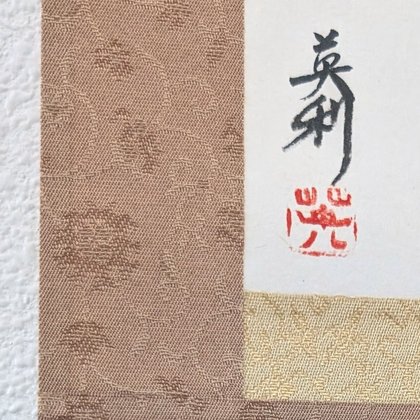
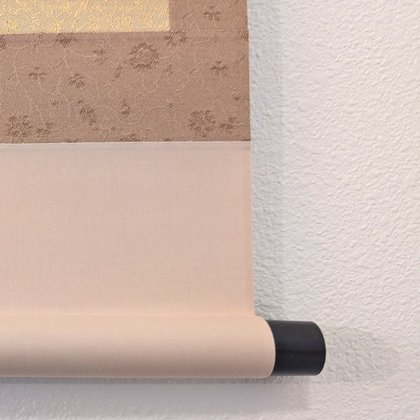
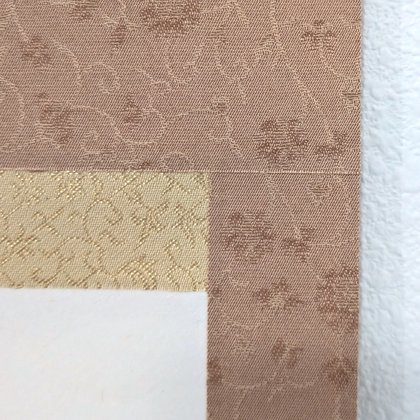
The scrolls are 12 1/4" W × 43" H (31 × 109 cm) with woven damask borders and Japanese paper that are layered so the scroll hangs straight and will not warp over time. The scrolls themselves are made by a scroll maker in Gifu, Japan, and we have worked with them for over two decades.
Eri Takase was born and raised in Osaka, Japan, and holds the rank of Shihan, the highest rank in Japanese calligraphy, from the Bokuteki-kai and the Bunka-shodo. About Master Takase
Related products

Bashō - A rough sea: lying toward Sado, the Milky Way荒海や佐渡によこたふ天河araumi ya sado ni yokotau amanogawa

Bashō - As the temple bell fades, The ringing lingers in the blossom scent, Evening鐘消えて花の香は撞く夕べ哉kane kiete hana no ka wa tsuku yūbe kana

Bashō - How admirable, to see lightning, and not think life is fleeting稲妻にさとらぬ人の貴さよinazuma ni satoranu hito no tattosa yo
