



Font Design · VD5J
Font Designs are Master Takase's unique designs. Often she will use her own style or a combination of fonts and, without a classification limit, create exactly the look she wants.
荒海や
佐渡によこたふ
天河
araumi ya
sado ni yokotau
amanogawa
bashō 芭蕉
A rough sea:
lying toward Sado,
the Milky Way
A rough sea: lying toward Sado, the Milky Way.
Master Takase creates this beautiful scroll when your order is placed. Personally preparing the ink and brushing your art that proudly bears her signature and seal. This is an original work of art.
Description
荒海や佐渡によこたふ天河 (araumi ya sado ni yokotau amanogawa): a rough sea: lying toward Sado, the Milky Way.
The line stops on the rough sea, and the Milky Way lies toward the island of Sado. The Japanese name, 天の川, sees the galaxy as a river in the sky. In the middle ages Sado was an island of distant exile, the encyclopedia ニッポニカ says.
天河, 天川, あまの川, 天の河 and 天の川 are spellings of one word, read amanogawa. Ebara Taizō printed 天の川 in 1944 and 天河 in 1947, each time the spelling of the text he was setting. Eri's block and semi-cursive scrolls write 天の川, and her cursive and design scrolls write 天河.
In the journal the verse follows one for the eve of Tanabata, and the 日本国語大辞典 ties the River to the Tanabata legend. His companion Sora's diary, as two commentaries give it, has Bashō at 出雲崎 two days before that eve, with heavy rain there in the night.
Whether Bashō saw the scene has been argued. Kawahigashi Hekigotō, in 1903, took the verse as a scene from life: the Milky Way mostly lies north and south, so lying toward Sado is not invented. One scholar, in 1949, cited another writer: at 出雲崎 the River does not run toward Sado until the middle of the night. With the diary's rain, he concluded that Bashō did not see the River run toward Sado, and called the verse imagined. A second scholar, in 1952, read the journal's pages on Echigo as written on the truth of recollection.
The verb よこたふ, to lie, is a rare form: the 日本国語大辞典 calls it quite unusual, and gives a kyōgen line older than the verse. Two commentators, in 1925 and 1926, said Bashō kept that form for its force. In 1932 Hattori Kōseki recorded his late father's reading, that God, that is, great Nature, laid the River of Heaven toward Sado, and declined it. Haruo Shirane gives a like reading in English, in 1998.
Basil Hall Chamberlain put the verse into English in 1902: A rough sea, and the Milky Way / Stretching across to Sado's isle. Harold G. Henderson, R. H. Blyth and Kenneth Yasuda called the River the Galaxy between 1934 and 1958. Henderson noted, in 1958: The Japanese name for the Milky Way, "Heaven's River," enormously helps the effect of the original. Several later translators, among them Peter Beilenson in 1962, put Heaven's River or the River of Heaven into the verse itself.
Matsuo Bashō, on the coast of Echigo, on his journey of 1689, in his travel journal 『おくのほそ道』; the first print, of 1702, writes 荒海や佐渡によこたふ天河, his scribe Soryū's other copy, by a 1960 transcription, ends 天川, and his prose preface, printed in 1706, あまの川.
We want you to be as happy with the meaning as you are with Master Takase's art. To learn more, visit Philology of 荒海や佐渡によこたふ天河.
Delivery
Your scroll is brushed when you order it and completed within 1 to 3 business days. It ships by USPS Priority Mail from Master Takase's studio in Washington State, boxed and ready to hang, with a printed page giving the art's English, romaji and Japanese.
Sending it as a gift? Add your message at checkout and we will include it.
Shipping is calculated at checkout from your address; within the United States it is $13 to $23. We ship worldwide, and any import charges for your country are shown at checkout before you pay.
Every order is covered by our 30-day money-back guarantee. If your scroll arrives damaged, or we made an error, we replace it or refund you in full, including shipping. Refund policy
About Our Scrolls
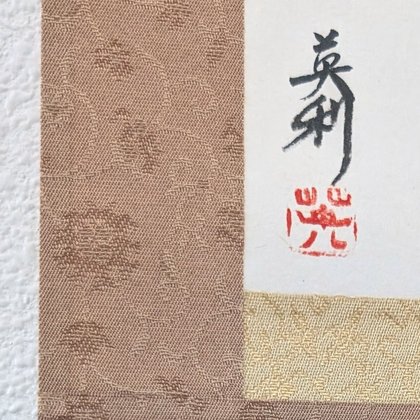
Master Japanese Calligrapher Eri Takase brushes your scroll by hand when you order it. Each scroll bears her red seal, 英利, and her signature.
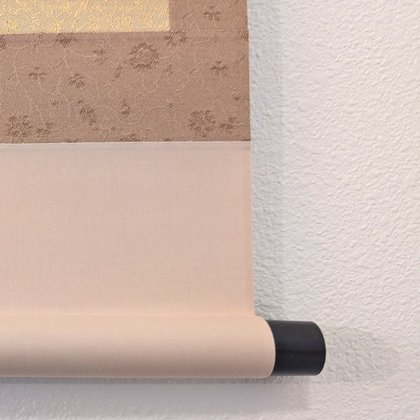
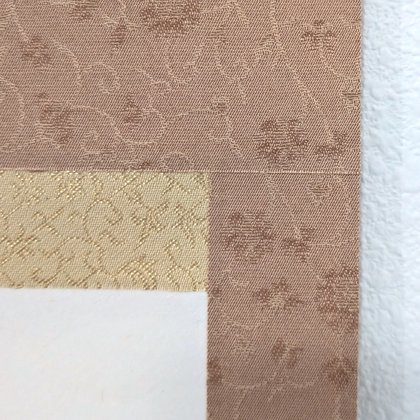
The scrolls are 12 1/4" W × 43" H (31 × 109 cm) with woven damask borders and Japanese paper that are layered so the scroll hangs straight and will not warp over time. The scrolls themselves are made by a scroll maker in Gifu, Japan, and we have worked with them for over two decades.
Eri Takase was born and raised in Osaka, Japan, and holds the rank of Shihan, the highest rank in Japanese calligraphy, from the Bokuteki-kai and the Bunka-shodo. About Master Takase
Related products

Bashō - As the temple bell fades, The ringing lingers in the blossom scent, Evening鐘消えて花の香は撞く夕べ哉kane kiete hana no ka wa tsuku yūbe kana

Bashō - Gathering the early-summer rains, swift: the Mogami River五月雨をあつめて早し最上川samidare o atsumete hayashi mogamigawa

Bashō - How admirable, to see lightning, and not think life is fleeting稲妻にさとらぬ人の貴さよinazuma ni satoranu hito no tattosa yo
