




Block · kaisho 楷書 · VB5J
Block or kaisho (楷書) styles are the most common and recognizable styles. Block styles are easily read and are noted for their angular form and their vertical and horizontal lines.
秋深き
隣は何をする人ぞ
aki fukaki
tonari wa nani o suru hito zo
Deep autumn:
what does my neighbor do?
Matsuo Bashō's haiku of deep autumn, asking what the person next door does.
Hand-brushed by Master Eri Takase
Master Japanese Calligrapher Eri Takase brushes your scroll by hand when you order it. Each scroll bears her red seal, 英利, and her signature.
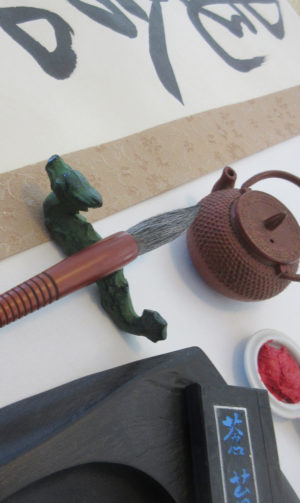
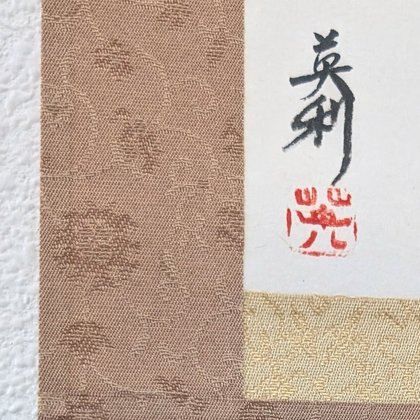
Eri Takase was born and raised in Osaka, Japan, and holds the rank of Shihan, the highest rank in Japanese calligraphy, from the Bokuteki-kai and the Bunka-shodo.
12 1/4" × 43" Japanese Scroll
The scrolls are 12 1/4" W × 43" H (31 × 109 cm), with woven damask borders and layered Japanese paper (washi), designed to last generations. The scrolls themselves are made by a scroll maker in Gifu, Japan, and we have worked with them for over two decades.


Ships in 1-3 days from Washington State
Your scroll is brushed when you order it and completed within 1 to 3 business days.
Your scroll ships from Master Takase's studio in Washington State. Shipping is calculated at checkout. We ship worldwide.
Includes detailed explanation, gift-ready
Your scroll arrives boxed, with a printed insert describing the haiku in detail.
Sending it as a gift? Add your message at checkout and we will include it with the insert.
30-day money-back guarantee
Every order is covered by our 30-day money-back guarantee. If your scroll arrives damaged, or we made an error, we replace it or refund you in full, including shipping.
Explanation
Word for word: 秋深き, autumn deep; 隣は, the house next door; 何をする人ぞ, what does that person do? The question asks both what the neighbor is doing now and what the neighbor does.
In the 日本国語大辞典, 秋深し is autumn past its middle and at its height, a season word, and the dictionary quotes this verse for it. In the same dictionary, 隣 is the houses immediately on either side, and its example after the 万葉集 is this verse again.
The prints and books read for the verse's history, down to 1774, write 秋深き or 秋ふかき. 秋ふかし is in an anthology of 1738, as the modern editions give it, and 秋深し is in twentieth-century essays.
The gathering the verse was sent to was set for the last day of autumn by the old months, as the scholar Ishigami counts it.
Bashō's fevers began on the tenth of the ninth month; by his own letter of the twenty-third, they had stopped about the twentieth. The same day he wrote that he was not yet himself. The illness that killed him began the night after he sent this verse, and he died two weeks later.
A diary printed in 1810 and later set aside as a forgery has Bashō too ill to go, sending the verse instead. That story is in English by 1932, in Miyamori's anthology. Shikō's book sends the verse ahead and does not say whether Bashō meant to go; the illness begins the night after.
In the twentieth century the words 隣は何をする人ぞ became a saying about the city, where people do not know who lives next door. The 世界大百科事典 says the expression comes to show the city's cold social relations.
In English the neighbor has been God next door for R. H. Blyth in 1942. For Makoto Ueda in 1970 the verse laments the isolation of the individual. For Daniel C. Buchanan in 1973 the neighbors are farmers with the harvest in.
Whether you take the neighbor as the next night's host and company, or as someone heard through the wall, is yours.
Matsuo Bashō, in Osaka, on the twenty-eighth of the ninth month of 1694, sent from one gathering to the host of the next night's; his disciple Shikō printed it the year after his death.
Learn More About This Haiku
We want you to be as happy with the meaning as you are with Master Takase's art. To learn more, visit Philology of 秋深き隣は何をする人ぞ.
Related products

Bashō - How admirable, to see lightning, and not think life is fleeting稲妻にさとらぬ人の貴さよ inazuma ni satoranu hito no tattosa yo

Bashō - Summer grass, all the warriors are, but the remains of dreams夏草や兵どもが夢の跡 natsukusa ya tsuwamono domo ga yume no ato

Bashō - The old pond, a frog jumps in, the sound of water古池や蛙飛込水の音 furu ike ya kawazu tobikomu mizu no oto
