

日々是好日 · nichinichi kore kōjitsu · Day after day, a good day
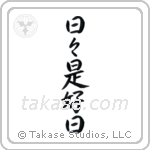
Sold as Everyday is a good day · Read nichinichi kore kōjitsu, the common reading and the catalogue's; the Zen hall says kōnichi, and both are settled below · Oldest witness the recorded sayings of the Chinese master 雲門, who died in 949; in Japan from a Zen record of 1426 · Sense every day is a good day; and, in the question the line answers, what a person can say of the days that have not yet come.
The words
日日, nichinichi, is day after day, every day; the design writes it 日々 with the repeat mark, a modern convenience for the canon's doubled character, and the same word. 是, kore, is the copula, read これ in the Japanese reading of Chinese. 好日, a good day, and 好 is good, fine, not only pleasant; a commentary of 1890 glosses the whole line in the vernacular as yesterday and today, fine weather, the day's weather standing for the day. The reading is the one thing about this line a Japanese reader argues about, and three are attested. The Zen reading is nichinichi kore kōnichi: a lecture of 1934 prints it in katakana, and the 日国 lists it beside the other. The common reading is nichinichi kore kōjitsu: first in both modern dictionaries, and the 2018 film's own romanization of its title. Hibi kore kōjitsu, with the native reading of the first two characters, is in both dictionaries as well. The house romaji is the common reading; a page that added the Zen hall reads it kōnichi would be telling the truth. The English on the page, Everyday is a good day, is the plain rendering with one slip: everyday as one word is the adjective, as in everyday clothes; the phrase is two words.
A history, from the earliest witness
Tenth century. 雲門文偃, in his own record, the 雲門匡真禪師廣錄, the middle fascicle. The master addressed the assembly: 十五日已前不問爾,十五日已後道將一句來, I do not ask you about before the fifteenth; about after the fifteenth, bring me one phrase. No one answered, and he answered for them: 日日是好日. The fifteenth is the middle of the month and the full moon; the 故事成語を知る辞典 takes it as the fifteenth of the seventh month, the day the summer retreat ends. Either way the question is what a person says about the time that has not happened yet. 雲門 died in 949; his birth is not recorded, and a 1934 lecturer estimates 852. [CBETA, Taishō volume 47, number 1988, page 563b, lines 17 to 18, at the column; text; the death date from the 1934 lecture, pid 1909179, koma 68, OCR]
1125. The 碧巌録, case 6. 雪竇重顯 chose the exchange as the sixth of his hundred cases and wrote a verse on it; 圜悟克勤's lectures on the verses are the 碧巌録, and this is where every Japanese reader met the line. 圜悟 on the answer: 此語通貫古今。從前至後。一時坐斷, this phrase runs through past and present; from before to after, it cuts everything off at once. And on the verse, a warning against taking it as a mood: 喚作日日是好日得麼。且喜沒交涉, can you call this "every day a good day"? Happily, no connection. [CBETA, Taishō volume 48, number 2003, page 146a line 29 to 146b line 6, and page 146c lines 24 to 25, at the column, re-opened on the day of writing; text]
1252. The 五燈會元, fascicle 15. The exchange in 雲門's chapter, 眾無對。自代曰。日日是好日, the assembly had no answer; he answered in their place; and four leaves on, a monk quoting the line back at another master with a second line grown onto it, 日日是好日。年年是好年, every day a good day, every year a good year. [CBETA, Xuzangjing volume 80, number 1565, page 305c lines 10 to 11 and page 309a line 13; text]
1426. The 大燈国師語録, the record of the master known as 大燈国師, the first fascicle. The first Japanese citation the 精選版日本国語大辞典 gives, and quoted by it: 大底鼻孔向下垂。多年暦日不相干。所以道日日是好日。時時是好時。交頭結尾。別有生涯, for the most part the nose hangs downward, and the calendar's days have had nothing to do with it for years; so it is said, every day a good day, every hour a good hour; from head to tail there is another life to be lived. The record itself, in Taishō volume 81 and outside the corpus opened, was not read; the quotation is the dictionary's. [kotobank.jp/word/日日是好日, the 日国 entry; text]
Fourteenth to eighteenth centuries. The Japanese Zen shelf. The full-text search of the public-domain corpus finds the four characters in some forty pre-modern books: the Chinese records in their Japanese printings, the 碧巌録 in a printing of 1400 and one of 1677, the 五燈會元 in 1635, the 禅林類聚 in 1367 and 1675; and Japanese masters' own records, 虎関師錬 in the fourteenth century, 徹翁 in 1435, 東陽英朝's 宗門正灯録 in 1630, the 宗門葛藤集 in 1657. None was opened at a leaf; they are named to show the line was in every Japanese Zen library for five hundred years before it was a proverb. [the search return, pids in the account; highlights only]
1880. A Shin preacher, 野村淳清, 帰命字訓勧誘録. Against choosing lucky days: 吉日惡日ノ差別ハナイ。古語ニモ日々是好日トアリテ天道サマニ替リハナイ, there is no difference between lucky and unlucky days; the old saying has it, every day a good day, and the heavens do not change. The line already a 古語, an old saying, in the mouth of a preacher of another school. [7]
1886 to 1906. The Meiji Zen lecturers. 白隠's 槐安国語, printed in 1886, carries the case and the every year a good year pair. 本高's 碧巌録耳林鈔 of 1890 puts the trap in the vernacular: 昨日モ今日モヨヒ天氣ヂヤト自賣リ自買レタ雲門ノ語ニダマサレルナ, "yesterday and today, fine weather"; do not be fooled by a line 雲門 sold and bought himself; and then, for the other side, 世尊四十九年ノ說モ日々好日ヨリ外ノ說ハナカツタモノ, the Buddha's forty-nine years of preaching had no sermon outside "every day a good day". 鳥尾得庵's 禅林消息 of 1895 asks of it 是レ正位カ是レ偏位カ, is this the absolute or the relative? 大内青巒's 碧巌集講話 of 1906 dwells on 圜悟's one-character comment 收, gathered in: 只この一句に無始劫來未來永劫を皆收藏して, this one phrase gathers in the beginningless past and the endless future. [pids 822896 scans 39 and 44; 823482 scan 20; 823269 scan 20; 823474 scans 54 to 56; all OCR, each confirmed at the page API by the reader]
1889. 東陽英朝's 禅林句集, the Zen phrase book, in its 文光堂 printing. 日日是好日 in the five-character section, between burning incense in the Buddha hall, joining palms at the mountain gate and the wind comes and the trees nod. The neighbors carry source notes; this line carries none, which in that book means every reader knew where it was from. [6]
1900. A poet's inscription on a painting, in 正岡子規's 俳家全集. A 自画賛 of Mount Fuji carries the line; the poet's name is lost in the OCR and the leaf was not read by eye. [pid 2546171, scan 226, OCR]
1910. 藤井乙男, 諺語大辞典. Absent. The standard proverb dictionary, which has a headword for nearly everything, has none for this line, and the four characters occur nowhere in its text: in 1910 it was still a Zen phrase and not yet a proverb. [pid 862766, scan 392, the ニチ leaf, by eye; the whole book's OCR searched]
1934. 井上秀天's 碧巌録新講話. 第六則雲門日日好日 ウンモンニチニチコウニチ: the case with its reading in katakana, kōnichi, the Zen hall's reading in print. [pid 1909179, koma 68, OCR]
Today. デジタル大辞泉: 《「碧巌録」から》毎日毎日が無事でよい日であるということ, from the 碧巌録: that every single day is an uneventful, good day, and the reading ひびこれこうじつ beside it. 精選版日本国語大辞典: 来る日も来る日も、楽しく平和なよい日が続く, day after day, pleasant and peaceful good days go on, with the readings こうじつ and こうにち and the 1426 citation. 故事成語を知る辞典 adds the moral, 一日一日を大切に生きる心構えをいう, it speaks of a resolve to live each day with care, tells the story of the question and the answer, and quotes 岡本かの子 in 1940 and 久保田万太郎 in 1953. 森下典子's essay of 2002 on twenty-five years of tea lessons took the line as its title, and the 2018 film made from it, romanized Nichinichikorekojitsu and released in English as Every Day a Good Day, put the popular sense on a poster. [kotobank.jp/word/日日是好日; text; the essay and the film not opened]
The sense across time
The line has two lives, and the witnesses show the second growing out of the first. In the Zen texts it is the answer to a question, and the commentators from 圜悟 to 本高 spend their breath keeping it from turning into a mood: it cuts off past and future, it is a line the master sold and bought himself, and if you hear it as every day is nice you have, in 圜悟's words, no connection with it. Outside the hall it became exactly that. The Shin preacher of 1880 uses it to say no day is unlucky; the modern dictionaries define it as peaceful good days going on; the 故事成語 dictionary adds the resolve to live each day with care; and the page goes one step further, every day can be made a good day and it is up to us, which is a twentieth-century reading, defensible as such, and the one the twelfth-century commentator warned against. The two lives are both real, and a page can hold both in two sentences.
What is not a source
The 碧巌録 is where Japan met the line, and the dictionaries cite it; the line is older, in 雲門's own record, and the 碧巌録 is its most famous address rather than its origin. 年年是好年, every year a good year, is a second line that grew onto it in the Chinese records and that 白隠 still quotes; it is not part of the text brushed. The tea room made the four characters a scroll, but no tea text was opened here and the account makes no claim about who first hung it. The self-help sense the page carries is a reception, not a source.
The text in English
The English came late and through the translations of the 碧巌録: Shaw in 1961, Sekida in 1977, Cleary in 1977; none was opened, all being in copyright or in lending copies the fetcher could not reach, so the English lineage here is thin and says so. Every day is a good day is the rendering the EDRDG dictionary carries, with all four readings, and the one the 2018 film took as its English title. The house title is that rendering with everyday as one word.
Today. What a rendering must keep: day after day, which is the doubled character, and good, which is plain; and, somewhere near it, the question, because the answer without the question is a greeting card and with it is a koan. Everyday should be Every day.
A reading
The design is sound, the romaji is one of the two current readings, and the English is fair with one word to fix. The page has no source, gives the modern moral as the meaning, and does not tell the customer that the line is an answer. The story is short and better than the moral: a tenth-century master asks his monks for one phrase about the days that have not come, nobody answers, and he answers for them, day after day, a good day; a twelfth-century commentator adds that if you hear this as every day is nice you have missed it; a Japanese master of the fourteenth century says the calendar has had nothing to do with him for years. That is one paragraph, with the Taishō column under it. The reading question is one line: kōjitsu in the dictionaries and the film, kōnichi in the Zen hall. Signed, 典, 2026-09-05.
How this was read
By eye: the 1889 phrase book, re-read on the day of writing, and the 1910 proverb dictionary's leaf where the line is absent. By text at the address: the three Chinese records at CBETA's columns, the 碧巌録 re-opened own-hand on the day of writing; the kotobank dictionaries, with the 1426 quotation taken from the 日国 there; the Meiji and Shōwa lectures and the Shin tract by OCR from the archive, each re-fetched at the page API by a second reader; the EDRDG entry. Not opened: the 大燈国師語録 at its own page; any of the forty pre-modern printings by eye; Shaw, Sekida and Cleary; Suzuki and Blyth; 森下's essay and its English edition; the 1900 painting inscription by eye. Every address in this history is a text address except the two leaves named by eye, each of which has a page-API text address beside it; the English translations are printed books, not opened. The full apparatus, with every address, is in the account.
References
- 雲門匡真禪師廣錄, 卷中 (雲門's own record, compiled by his disciples) (10th c. text; the Taishō edition) — T47n1988_p0563b17–18
- 碧巌録, 第六則 (雪竇's 頌古, 圜悟's 評唱, 1125) (12th c.; the Taishō edition) — T48n2003_p0146a29–b01; b05–06
- 五燈會元, 卷十五 (1252; the Zokuzō edition) — X80n1565_p0305c10–11
- The lab's classical printings (1300s–1707) — 38 pids, highlights
- 大燈国師語録 (1426) — reported, not opened
- 禅林句集 (東陽英朝 編, 文光堂) (1889) — pid 899715 scan 69, by eye ↩
- 帰命字訓勧誘録 (Shin) (1880) — pid 820245 scan 28 (OCR) ↩
- 碧巌録耳林鈔 (本高) (1890) — pid 823482 scan 20 (OCR)
- 碧巌集講話 (大内青巒) · 碧巌録新講話 (井上秀天) (1906 · 1934) — pids 823474 scans 54–56 · 1909179 scans 12, 68 (OCR)
- The catalogue and both live pages (2026) — cultural_works.csv:352