

本来無一物 · honrai muichimotsu · From the beginning, not one thing
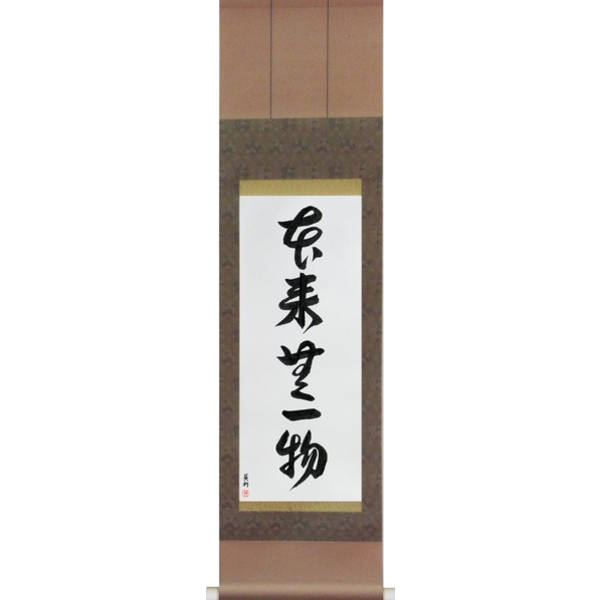
Sold as By Nature, Having Nothing · Read honrai muichimotsu · Oldest witness the 祖堂集, a Chan history of the year 952, which gives the Sixth Patriarch's verse with this as its third line; the oldest copy of the sutra the verse belongs to reads differently · Sense there was never a thing there to begin with, so there is nothing to cling to and nothing for dust to settle on: the line that, in the story, won 惠能 the robe.
The words
Five characters, two words. 本来, honrai, is from the beginning, originally: 精選版日本国語大辞典, はじめからその状態であること。もとからずっと。もともと。元来. It is not from nothing and not quite by nature; it says how things have stood all along. 無一物, muichimotsu, is not one thing: 何も持っていないこと。何ひとつ無いこと, with a first attestation in a 1477 commentary on the Book of Changes, 太極は无極ぢゃ程に无一物なぞ, the Great Ultimate is the Ultimateless, so there is not one thing in it. The word has two lives in Japanese. In daily speech it means destitute, cleaned out; the dictionary's other example is 志賀直哉's burglary victim, 泥棒に入られて今は殆ど無一物になっちまった, and two Meiji novels use the whole five-character phrase for a gambler who has lost everything. In the verse it means what it says: there is not one thing. [kotobank.jp/word/本来, /無一物, text]
The five characters together are a dictionary headword. デジタル大辞泉: 仏語。事物はすべて本来空であるから、執着すべきものは何一つないということ。禅宗でいう, a Buddhist term: since all things are empty from the beginning, there is not one thing to be attached to; said in Zen. 精選版日本国語大辞典: 存在する物は、本来すべて空であるから、わが物として執着すべきものは一つもないこと。一切のものから自由自在になった心境, adding the state of mind that is free of everything, and citing Dōgen as its first Japanese instance. Both glosses end where a Japanese reader's ear does: not on absence but on nothing to cling to. [kotobank.jp/word/本来無一物, text]
The English, side by side. The house title, By Nature, Having Nothing, takes 無一物 in its everyday sense, possessions, and 本来 as by nature; the verse's sense is the dictionaries', from the beginning there is not a single thing. Blyth's rendering, Essentially, not a "thing" exists, takes the verse's sense and puts thing in quotation marks for the same reason a Zen reader would. The page's other gloss, everything comes from nothing, is neither: 本来 is not from nothing, and the line asserts that there are no things, not that they have an origin. The page's own alternate, Actually, there is nothing, is the nearest of its three.
The design writes 本来 with the modern 来; every witness opened writes 來. They are one word in two forms, and which form a piece carries is a question for the calligrapher, recorded and not yet put to her.
A history, from the earliest witness
Eighth century, in a manuscript from Dunhuang. The 壇經, the Platform Sutra, in its oldest surviving text. The verse that the line belongs to is 惠能's answer, in the sutra's own story of itself, to the head monk 神秀's 身是菩提樹,心如明鏡臺,時時勤拂拭,莫使有塵埃, the body is the tree of awakening, the mind a bright mirror's stand; polish it always, let no dust settle. In this oldest text 惠能's reply reads 菩提本無樹,明鏡亦無臺,佛性常清淨,何處有塵埃, awakening has no tree, the bright mirror no stand; the Buddha-nature is always pure, where could dust settle?, and he is given a second verse besides. The line 本來無一物 is not here. [cbdata.dila.edu.tw stable juans, work T2007 juan 1, T48n2007_p0338a07–11, text]
952. The 祖堂集, a history of the Chan patriarchs compiled at a monastery in Quanzhou. The oldest dated text to carry the five characters. 惠能, illiterate, has a passer-by write his verse beside 神秀's: 其張日用與他書偈曰:「身非菩提樹,心鏡亦非臺。本來無一物,何處有塵埃?」, the body is no tree of awakening, the mind-mirror no stand; from the beginning not one thing, where could dust be? The master wipes it off the wall, smiles, praises nothing, and knows who has won. The book was compiled in 952 and survives through blocks carved in Korea in 1245, at 海印寺, from which it was first printed in the twentieth century. [work B0144 juan 2, B25n0144_p0341a03–04, text; kotobank.jp/word/祖堂集, text]
Ninth century, recorded 1004. 洞山良价, founder of the Sōtō line, in the 景德傳燈錄. 師有時垂語曰。直道本來無一物。猶未消得他鉢袋子, the master once said: even if you can say "from the beginning not one thing," you have not yet earned his bowl-bag. A monk asks who has; the one who does not enter the gate. The line is already a saying to be seen through, in the mouth of a master who died in 869, and the same book gives the verse itself in its chapter on the Fifth Patriarch with yet another fourth line: 菩提本非樹 心鏡亦非臺 本來無一物 何假拂塵埃, what need to brush the dust away? [work T2076 juan 15, T51n2076_p0322c09–13, and juan 3, p0223a06–07, text; the same saying in 洞山's own record, work T1986A juan 1, and in the 傳燈玉英集 of 1034, work B0082 juan 5]
Thirteenth century. 紹曇's 五家正宗贊, a hymnal of the five Chan houses. 菩提本無樹,明鏡亦非臺。本來無一物,何處惹塵埃, with the fourth line as it is read today, where could dust be drawn?. The wording the design and the dictionaries carry is fixed here. [work X1554 juan 1, X78n1554_p0577a02–03, text]
1240s. 道元, 正法眼蔵, the fascicle 古鏡, The Old Mirror. 第三十三祖大鑑禪師カツテ黃梅山ノ法席ニ功夫セシトキ壁書シテ祖師ニ呈スル偈ニイハク菩提本無樹明鏡亦非臺本來無一物何處有塵埃 シカアレハコノ道取ヲ學取スヘシ, the thirty-third patriarch, when he was practicing in the assembly on Yellow Plum Mountain, wrote on the wall and presented to the patriarch this verse: … Therefore study this saying. Dōgen keeps the older 有 and treats the verse not as a denial of the mirror but as one way of handling it; a commentary of 1891 puts it in a sentence, 神秀ハ時々勤拂拭セヨト磨キ、六祖ハ本來無一物ト磨ク, 神秀 polishes by "polish it always," the Sixth Patriarch polishes by "from the beginning not one thing." This is the first Japanese instance the dictionaries give. [dl.ndl.go.jp/pid/823075 komas 110–111, pages 180–181 of the 1885 typeset, by eye at width 3600; pid 823127 koma 114, OCR]
1268. 凝然, 八宗綱要, the primer on the eight schools that Japanese Buddhist students read for six centuries. In its short appendix on Zen, the whole school is given in five characters: 彼禪宗者、佛法玄底、甚深微妙。本來無一物、本無煩惱。元是菩提。達磨西來、不立文字。直指人心。見性成佛, that Zen school: the hidden floor of the Buddha's teaching, deep and subtle. From the beginning not one thing; from the beginning no defilements; awakening from the start. Bodhidharma came from the west and set up no words; point straight at the mind, see your nature, become Buddha. A Meiji commentary traces the words to a text attributed to Bodhidharma himself. [work B0171 juan 2, B32n0171_p0097a08–13, text; dl.ndl.go.jp/pid/817009 koma 59, the 1876 typeset, by eye; pid 817017 koma 109, OCR; kotobank.jp/word/八宗綱要, text]
1291. The 宗寶 edition of the Platform Sutra, the received text. 菩提本無樹,明鏡亦非臺;本來無一物,何處惹塵埃. From here on this is the sutra's own wording, and it is the design's. [work T2008 juan 1, T48n2008_p0349a07–08, text]
1307, printed in Japan 1367 and 1675. The 禪林類聚, a Yuan anthology of Chan sayings. 清凉復禪師云本來無一物何處有塵埃 僧禮拜 師云莫錯會, a master of 清涼 said: from the beginning not one thing, where could dust be? A monk bowed. The master said: do not misunderstand. The verse as a teacher's line, with the older 有, and a warning attached. [10]
Fourteenth century. 観阿弥, 卒都婆小町, a Noh play. A priest scolds an old beggar-woman for sitting on a stupa; she answers him line for line, and the exchange ends by reciting the Sixth Patriarch's verse between them: ワキツレ「菩提もと、シテ「植木にあらず。ワキ「明鏡また、シテ「臺に無し。上歌地「げに本來一物なき時は、佛も衆生も隔なし, the priest's companion: "awakening, from the beginning"; the woman: "is no planted tree"; the priest: "the bright mirror, likewise"; the woman: "has no stand"; the chorus: "truly, when from the beginning there is not one thing, there is no barrier between Buddha and beings." The priest bows three times, and the woman is 小野小町. The verse is in Japanese here, in a play still performed, a century after Dōgen. The 謡抄, the first commentary on the Noh, compiled about 1600, glosses the line with the verse by name: 是モサキノ六祖ノ頌ノ末ニ本來無一物ト作レル道理ヲ參得シタル眼カラハ佛モ衆生モ隔テハ有ベカラスト也, this too: to an eye that has grasped the principle written as 本來無一物 at the end of the Sixth Patriarch's verse, there can be no barrier between Buddha and beings. [11]
1889 and 1894. The 禪林句集, the phrase book Japanese Zen students carried. The five-character line is not an entry. The compiler's own cut of the idea is the four-character 一物也無, not a single thing either, sourced to 馬祖 in the 傳燈錄, and above it he sets two head notes: the Sixth Patriarch's verse, 又六祖頌云本來無一物, and a Song anecdote of a notice pinned to a bath-house door, 一物也無,洗箇甚麼?, if there is not one thing, what is there to wash? The line is for use, not for reverence. [12]
1876 to 1893. Meiji Japan. 凝然's sentence is reprinted in three editions of his primer with commentaries; the sectarian handbooks of 1886 and 1887 tell the contest of verses; 井上円了, founding a philosophy of Buddhism, defines Zen's awakening by the phrase, 其悟道ノ如キハ本來無一物ト立テヽ所有ル有物有象ノ見ヲ遣破シテ心中本具ノ自性ヲ開現スルニアリ, its awakening consists in setting up "from the beginning not one thing," sweeping away every view of things and forms, and opening the nature the mind has always had; and two popular novels of 1881 and 1886 use the five characters for a man cleaned out at the gambling table, the everyday 無一物 wearing the verse's clothes. [8]
Today. The two dictionary entries quoted under The words. The National Diet Library's public-domain books carry the five characters in six hundred and forty books, and the fourth line 何處惹塵埃 in a hundred and twenty-two. [kotobank.jp/word/本来無一物, text; lab.ndl.go.jp full-text search, derived 2026-09-05]
The sense across time
The third line of the verse became its name, and every reader has had to say what it does not mean. 洞山, within a generation or two of the verse, warns that saying it earns nothing. The 禪林類聚's master says do not misunderstand to the monk who bows. Dōgen reads it as a way of polishing the mirror, not a denial that there is one. 凝然 makes it a creed. 観阿弥's beggar-woman makes it an argument for sitting where she likes, and wins. The dictionaries end on nothing to cling to. And Japanese speech, meanwhile, kept the plain sense of 無一物, not a thing to one's name, so that the phrase could describe a gambler as well as a patriarch. What no witness does is read 本来 as from nothing: the line is about how things have always stood, not where they came from.
What is not a source
The contest of verses is the sutra's story about its own origin, and the two oldest texts disagree about what the winning verse said; no witness dates the event, and this history does not either. The 惠昕 recension of 967, which stands between the Dunhuang text and the received one, was not opened, so when the line entered the sutra itself is not said here; what is said is that a Chan history had it in 952. 神秀's verse, 時時勤拂拭, is the other half of the story and is not this text. The 禪林句集's 一物也無 is a Japanese Zen hand's own cut of the idea, sourced to 馬祖, and the bath-house notice is a Song joke on the verse; both are pairings the phrase book sets beside it. And the text attributed to Bodhidharma that the 1878 commentary names as the words' source was not opened.
The text in English
No Japanese-English dictionary on the shelf files the phrase, and the two American proverb collections do not carry it. It entered English with the sutra's translators and the Zen writers of the 1930s and after.
1930. Wong Mou-lam, the first English Platform Sutra, and 1967, Philip Yampolsky, the Dunhuang text in English, with its 佛性常清淨 reading: both recalled, neither opened.
1942. R. H. Blyth, Zen in English Literature and Oriental Classics, Hokuseido, page 320. Salvation is nothing like a tree, / Nor a clear mirror; / Essentially, not a "thing" exists; / What is there, then, for the dust to fall on? The earliest English rendering opened, and the quotation marks around thing are the translator's own gloss on 無一物. [text layer, page marker 320; a printed book, checkable by a reader who holds it]
1960. R. H. Blyth, Zen and Zen Classics, volume 1, Hokuseido, page 115. The same rendering, unchanged, and his reading of the two verses: 神秀's is the Dhammapada in four lines. It is the essence of morality and the good life; 惠能's is a pert composition that knocks the whole thing to smithereens. … However, this apparent nihilism had two thousand years of spiritual endeavour behind it. [text layer, page marker 115; a printed book, checkable by a reader who holds it]
Today. The house title, By Nature, Having Nothing, reads the phrase as a statement about possessions, which the words allow and the verse does not mean. What a rendering must keep: 本来 as from the beginning, a matter of how things have always been; 無一物 as not one thing, not having nothing; and the fact that this is the third line of a verse and answers a line about dust.
A reading
The text is right for a scroll. 本来無一物 is the line every Japanese reader knows, the received text of the sutra since 1291, the third line of the verse in the Chan histories since 952, a Japanese Zen creed since 1268 and a Japanese sentence on the Noh stage since the fourteenth century. What the account found is a story the page can carry, not a defect in the design: the line is not in the oldest copy of the sutra it comes from, which says instead that the Buddha-nature is always pure, and the version we brush is the one the tradition chose and kept. The gloss is the defect. Everything comes from nothing should go; the page should lead with the verse, the two words in their verse senses, and the dictionaries' nothing to cling to, keeping the title as the design's name. One form question is open for the calligrapher: the design writes 来 where every witness writes 來, one word in two forms, and the choice is hers.
My own reading is 洞山's and the beggar-woman's together. The line is the easiest in Zen to say and the tradition has spent eleven centuries warning that saying it is not the point; and a fourteenth-century playwright still thought a starving old woman could win an argument with it. A scroll of these five characters hangs between those two facts. Signed, 典, 2026-09-05.
How this was read
By eye: the 1889 and 1894 禪林句集 at the head note, Dōgen's 古鏡 in the 1885 typeset, 凝然's primer in the 1876 typeset, the 禪林類聚 in the 1675 print, and the 謡抄 of about 1600 at 卒都婆小町, each at the National Diet Library's page image at width 3600 on the day of writing. By text at the address: the two Platform Sutra recensions, the 祖堂集, the 景德傳燈錄 in two chapters, 洞山's record, the 傳燈玉英集, the 五家正宗贊, the 羅湖野錄 and 凝然's primer at the CBETA column; the kotobank entries for the phrase, its two words, and the three works dated above; the library's page API for the leaves; the OCR layer of the archive for the play in three typesets, the Meiji primers, 井上円了, the two novels and the counts; the text layers of Blyth's two books, and of Buchanan and Galef, which do not carry the phrase. Every address in the earlier account was re-opened by a reader before writing and the OCR quoted raw. Not opened: the 惠昕 recension of 967; the 祖堂集's Korean print of 1245 at the leaf; the play in a critical edition; the Bodhidharma text the 1878 commentary names; Wong Mou-lam and Yampolsky at their pages; the modern Zen phrase dictionaries. The printed books check only for a reader who holds them. The account beneath this history carries every address, the raw OCR beside each reading, and the page-image addresses for the leaves read by eye.
References
- 壇經, Dunhuang manuscript text (法海集) (8th c. text, ms. later) — T48n2007_p0338a07–11
- 祖堂集 巻二 (静・筠, 泉州招慶寺) (952; the surviving print 1245) — B25n0144_p0341a03–04, s37
- 景德傳燈錄 巻三, 弘忍 chapter (道原) (1004) — T51n2076_p0223a06–07, s37
- 景德傳燈錄 巻十五, 洞山良价 (807–869) (1004) — T51n2076_p0322c09–13, s37; the same in 洞山語錄 T47n1986Ap0510c11–15 and 傳燈玉英集 (1034) B14n0082_p0236b12
- 五家正宗贊 巻一, 六祖 (紹曇) (Song, 13th c.) — X78n1554_p0577a02–03
- 正法眼蔵 古鏡 (道元), as quoted by 精選版 日本国語大辞典 (1231–53) — kotobank, 初出の実例; the fascicle not opened
- 正法眼蔵 古鏡, in the 1885 typeset (1231–53; typeset 1885) — pid 823075 koma 110, pp. 180–181, by eye s37
- 八宗綱要 (凝然) (1268) — B32n0171_p0097a08–09; pid 817009 koma 59 (1876 typeset), by eye s37 ↩
- 六祖大師法寶壇經 (宗寶編) (1291) — T48n2008_p0349a07–08
- 禪林類聚 (元 善俊・智鏡・道泰) (1307; prints 1367, 1675) — pid 2559889 koma 57 (1675), by eye s37; pid 2543652 koma 56 (1367), OCR ↩
- 卒都婆小町 (観阿弥), in the 1926 typeset; the 謡抄 gloss (14th c.; 謡抄 c. 1600) — pid 1019634 koma 22, OCR; pid 11606633 koma 34, by eye s37 ↩
- 禪林句集 四言, 1889 and 1894 () — pid 899715 koma 32 · pid 875204 koma 21, by eye ↩
- The design () — cultural_works 1075