

欲望 · yokubō · Desire
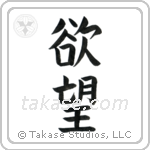
Sold as Desire · Read yokubō · Register a standard, common noun, with no slang or vulgar tag in any dictionary opened, at home in philosophy and in ordinary speech · Sense desire as craving: the longing that comes from wanting what you do not have.
The word
Two characters. 欲 is wanting: デジタル大辞泉 glosses it ほしがること。自分のものにしようと熱心に願い求めること。また、その気持ち, wanting something; eagerly wishing to make it one's own; and the feeling of that. 望 is hoping, looking toward. Together they make 欲望, and the older spelling 慾望, with the 心 radical under 欲, is the same word in a character outside the modern list. The compound's sense is the dictionaries' in one voice. 大辞泉: 不足を感じてこれを満たそうと強く望むこと。また、その心, feeling a lack and strongly wishing to fill it; and the heart that does so. 精選版日本国語大辞典: 不足を感じてこれを充足させようと望むこと。また、その心。ほしがること, the same, ending wanting. 日本大百科全書 reaches for psychology and for Sartre: desire is a motive held back, and desire is seeking what one lacks in order to become what one is not. The one thing every definition has is the lack.
The English word desire has four senses in Wiktionary: the feeling of desiring, an eager longing; the thing wished for; strong attraction, romantic or sexual; and motivation. 欲望 carries the first and the third outright. With 性的 in front of it, 性的欲望, it is sexual desire, and the dictionaries' neighbors for it are 人欲, 淫欲 and 邪欲. It rarely names the thing wished for, which is 望み or 願い. And it is not the neutral word for the fourth sense, aspiration or ambition: it can name a craving that drives, 成功に対する欲望, a desire for success, but the word for a wish one is proud of is 願望, a wish held and hoped for, and the word for a great ambition is 大望, which the catalogue sells as Ambition under the reading taimō. A buyer who means my drive is better served there; a buyer who means longing, appetite or passion is served here.
Where it is used
The example sentences a corpus gives for 欲望 run to restraint and struggle: 欲望を抑える, to hold desire down; 欲望と戦う, to fight one's desires; 欲望に打ち勝つ, to overcome desire; and beside them 彼女はもう夫に対して性的欲望は持っていない, she no longer feels sexual desire for her husband, and 成功に対する彼の欲望, his desire for success. It is the word of a wanting that has to be managed, which is what desire is in most languages. Behind it stands a Buddhist reading that is documented for the character and not for the compound: 欲 is the root of 貪欲, greed, first of the three poisons, and the 五欲 are the desires of the five senses that practice masters. A Japanese reader who knows that tradition may hear it in 欲望. Whether they do, on a wall or on skin, is not something a dictionary can say, and this history does not say it.
The word in English
The bilingual glosses are desire; appetite; lust, in that order, marked common with no usage tag, and a technical dictionary gives appetition; desire; lust; appetite. A printed 和英 gives a desire and a slave to his passions and no lust at all. So lust is a real gloss and everywhere a secondary one; a page that leads with it loses the buyer who meant longing, and a page that omits it hides a sense the word does carry. The house's present sentence keeps the order right: desire as craving, then passion and appetite, then the dictionaries' lust, and a pointer to 大望 for ambition. What a rendering of 欲望 must keep is the lack: desire as the wanting of what one does not have, and not desire as the thing one aims at.
A reading
The word means what the buyer most often means by desire, and it means it without embarrassment: a standard noun, not a vulgar one, not a clinical one. Its edge is on the far side, at ambition, where English desire still reaches and 欲望 does not. The page should say that in one sentence and point at the design that does reach there. The gloss of 望 as ambition on its own, which the character can carry, points the buyer at exactly the sense the compound does not serve, and that is the one thing on the page that should change. Signed, 典, 2026-09-05.
How this was read
By text, at the address: the entries for 欲望, 欲, 五欲, 貪欲, 三毒, 願望 and 大望 in デジタル大辞泉 and 精選版日本国語大辞典 at kotobank; 日本大百科全書 for 欲望; the EDRDG glosses through the house dictionary; the Wiktionary senses of desire; the Weblio example sentences and the two 和英 dictionaries served there; the catalogue row and the live page. Not opened: the 初出 line for 欲望 itself, which would date the compound (the 欲 entry's earliest citation is 発心集, about 1216); the OED or Merriam-Webster for desire; a printed 和英 on the shelf; a modern corpus beyond Weblio's examples. Every address in this history is a text address and a reader's AI can open it. The full apparatus, with every address, is in the account.
References
Each witness is cited in the account above, at the frame or entry where it was read. A linked list follows when the record for this text is completed.