

天地神明 tenchi shinmei Gods of Heaven and Earth
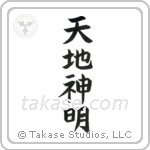
The word
天地 is heaven and earth, the whole world; 神明 is the gods, the Japanese dictionaries' first sense and a word the 続日本紀 uses in 740 (he who is unfilial and disloyal defies heaven, turns his back on earth, and is cast off by the 神明). Put together, the four graphs mean what every Japanese dictionary says they mean: 天地の神々, the gods of heaven and earth, all the gods, the same thing as the older 天神地祇 of the Nihongi and the eighth-century codes. The 大辞泉 gives the oath as its one example; the 日本国語大辞典 dates the word to the Confucian Kumazawa Banzan, about 1676, who wrote that the gentleman takes the gods of heaven and earth as his teachers and friends, and is watchful in the place no one sees; the 四字熟語 dictionary gives the oath as the word's only living use and three novelists who wrote it, Mishima in 1956 among them. That dictionary also asks the one grammatical question the phrase allows, whether it means heaven and earth, and the gods or the gods of heaven and earth, and answers that Japanese has always read it the second way, against its picture of the eight hundred myriad gods in the sky and on the land.
The English word the buyer brings, God, is one and a person. The Japanese phrase is many, and it is not the Christian God: the Congregationalist theologian Ebina Danjō wrote in 1918 that the word 天地神明 can be thought an impersonal single god or personal many gods. Where the two languages meet is the oath. English too swears by heaven and earth and calls God to witness, and that is exactly how Kenkyusha rendered the Japanese idiom in 1942: swear by heaven and earth; call heaven to witness.
Where it comes from
The four characters are Chinese before they are Japanese. They stand in the Han military classic 三略 (heaven, earth and the gods move with things), in the 忠經 whose first chapter is titled with them, in Dong Zhongshu and Yang Xiong, and by the Tang they are already the language of a man with nothing else to swear by: a dying general writes heaven, earth and the gods truly know my heart, and an emperor reproaches a Tibetan minister that the words of the covenant are forgotten in a moment; can heaven, earth and the gods be deceived? The Song prose the Japanese were printing by 1529 says that when a ruler's intent is sincere heaven, earth and all the gods can be moved.
Japan read the phrase in those books and then began to say it. The Taiheiki, the fourteenth-century war chronicle, has it for the two arrows that struck the Southern emperor's armor and did not pierce: was it the protection of the gods of heaven and earth? A Kiyohara lecture on the Nihongi has it; the Shinchōki, printed in 1622, asks of a portent at a grave is this not the gods of heaven and earth responding?; Banzan makes the gods the gentleman's unseen teachers, and Kaibara Ekiken warns his descendants that to follow the Buddhists is to sin against the way of the gods of heaven and earth and become a criminal before the gods of heaven and earth. Then, on 6 April 1868, the sixteen-year-old Meiji emperor's letter accompanying the Charter Oath said: Our country is about to undergo a change without precedent; We Ourselves, going before the people, swear by the gods of heaven and earth to fix the great policy of the nation and to establish the way of the people's security. A manuscript copy in the Diet Library writes the reading beside the graphs, テンチシンメイ. From that decade the phrase is everywhere; the public-domain library's count of it rises from a handful a decade before 1868 to more than a thousand books in the 1930s, most of them quoting or teaching the oath, and 天地神明に誓う became the ordinary Japanese way to swear.
Where it is used
Literary and formal. It is said in one construction, I swear by the gods of heaven and earth, and in a few extensions of it: to answer to them, to call on them, to be under their protection. Loyalists of the 1860s swore by it in their letters; novelists put it in the mouths of characters protesting their innocence; the Christian churches used it for before God in that same oath sense, a Congregationalist preacher telling his hearers in 1915 that one must not sin before God, before the gods of heaven and earth. It is also the phrase most Japanese speakers now get wrong. The Agency for Cultural Affairs asked in 2018 which form people use, and 53.7 percent said 天地天命に誓って, a mishearing that puts heaven's decree where the gods were; 32.1 percent said the original, and among people in their twenties the error ran to 63.8 percent. A scroll with these four graphs carries the form the dictionaries call correct, and its owner will meet people who think it is the mistake.
The word in English
Gods of heaven and earth is JMdict's gloss, Kenkyusha's for 天地の神々, and Nelson's the heavenly and earthly gods; the house title is that gloss word for word. It also stands in a long English line: Aston fixed Gods of Heaven and Earth in 1896 for the Nihongi's 天神地祇, the older synonym, in Jimmu's vow to sacrifice to them before his march; Holtom used Deities of Heaven and Earth for the enthronement rites in 1928; and the Charter Oath's own sentence reached English through Kikuchi Dairoku and J. H. Gubbins as We Ourselves here take the initiative and swear to the Deities of Heaven and Earth, which the Asiatic Society reprinted in 1913. What English loses is the oath: the four graphs alone say the gods, and a Japanese reader hears the swearing in them. A rendering for a wall should keep the plural and, if it can, the calling: by all the gods of heaven and earth.
A reading
Signed 典, 2026-09-16. This is a Chinese phrase that Japan made into its oath. In China the four graphs name the whole numinous order, and by the Tang a man calls on them when he has nothing else to swear by; Japan read them in the Chinese books, said them in the Taiheiki and the Confucians, and then the emperor swore by them in 1868, and every tenchi shinmei ni chikatte since is that oath's descendant. The phrase is plural and it is every god at once; the house title says so exactly and I would not change it. What the buyer should know is what the shelf label does not say: this is not the Christian God's name, and the one Christian who wrote about the word said so. It is the invocation a Japanese speaker makes when the truth of what they say is all they have. On a wall it says: all the gods of heaven and earth are my witness.
How this was read
By eye: the template; Banzan's sentence in the 1901 reprint; two manuscript copies of the Charter Oath, the 1622 Shinchōki, Kiyohara's Nihongi lectures, two leaves of Ekiken's precepts, the 1529 Song anthology, the 1906 Taiheiki, Ebina 1918 and Miyagawa 1915, all at the National Diet Library's image host; Kenkyusha 1942, Brinkley 1896 and Aston's Nihongi on the shelf PDFs. By text: three entries at kotobank, the Japanese-English page at Weblio, the 忠經, the 三略 and two chapters of the 禮記 at the Chinese Wikisource, the 2018 survey at page 13 of the Agency's PDF. By OCR: the NDL Lab's saved searches on six forms (about 7,500 rows) and on 天神地祇 (9,726 hits) for the Nihongi's kanbun; the local archive of 6,624 prewar English books for Gubbins, the Asiatic Society, Satoh and Holtom; the three Hepburns by gloss grep, a null that is not a witness; Nelson 1974 and 1997; de Bary's Sources on the shelf. Not opened: Hepburn's own 天地 entry; Banzan in an Edo print; the Taiheiki in a pre-Meiji witness; the 1860 assassins' manifesto in Japanese; Kikuchi's 1909 book; Mishima at the page; the full list is in the account.
References
- 精選版 日本国語大辞典, デジタル大辞泉 and 四字熟語を知る辞典 at kotobank: 天地神明; 神明; 天神地祇.
- 三略 上略 · 忠經 天地神明章第一 · 禮記 樂記, 表記 — the Chinese Wikisource; the Chinese Wikisource full-text search for 天地神明 (1,111 pages).
- 宋文鑑 卷95 (晉藩, 1529) — NDL pid 2552211, koma 75.
- 太平記 巻31 南帝八幡御退失事 — 博文館 校訂太平記 (1906), p. 917, NDL pid 1885211, koma 468.
- 日本書紀抄, 清原宣賢 講 — NDL pid 2544852, koma 71 · 信長記 巻11–12 (元和8, 1622) — NDL pid 2544603, koma 28 · 貝原先生家訓 (寛政6, 1794) — NDL pid 2536305, koma 13–14.
- 熊沢蕃山 集義和書 巻十, at 井上哲次郎・蟹江義丸 編 日本倫理彙編 巻之1 (育成会, 1901), p. 432 — NDL pid 1913233, koma 225.
- 御誓文御宸翰三枚御高札御写 — NDL pid 773325, koma 4 and 8.
- 日本書紀 (1610 print) — NDL pid 2544342 [3], 2544353 [14]; (1820 print) pid 2599704 [3].
- 宮川経輝 基督教十講 (北文館, 1915), p. 104 — NDL pid 943567, koma 58 · 海老名弾正 基督教新論 (警醒社, 1918), p. 125 — NDL pid 943957, koma 79.
- Aston, Nihongi (Kegan Paul, 1896), vol. 1, p. 113 · Gubbins, The Progress of Japan 1853–1871 (Oxford, 1911), pp. 196–197 · Transactions of the Asiatic Society of Japan 41 (1913), pp. 389–390 · Satoh, Agitated Japan (1896), p. 139 · Holtom, The Japanese Enthronement Ceremonies (1928), p. 63 · de Bary et al., Sources of Japanese Tradition, 2nd ed., vol. 2 (Columbia, 2005), The Charter Oath.
- Brinkley, An Unabridged Japanese-English Dictionary (1896), p. 1463 · Kenkyusha's New Japanese-English Dictionary (1942), p. 1963 · Nelson (1974) and Haig, The New Nelson (1997), s.v. 天.
- 文化庁 平成30年度「国語に関する世論調査」の結果について, p. 13, 問18(1).
- Weblio 和英 天地神明: 研究社新和英中辞典, JMdict, Tanaka Corpus, Wikipedia日英京都関連文書対訳コーパス.
- NDL 次世代デジタルライブラリー, saved searches: 天地神明 (5,096) · 天地神明に誓 (1,120) · 天地神明ニ誓 (987) · 天地神明に誓つて (272) · 天地神明を師友 (2) · 天地神明の御加護 (41) · 天神地祇 (9,726).