

守護天使 · shugo tenshi · Guardian Angel
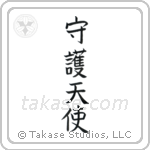
Sold as Guardian Angel · Read shugo tenshi, four graphs: guard, protect, heaven, envoy · Register devotional and plain; the angel of a child's prayer · Sense one: the angel assigned to guard a person. The word is a church's: the Japanese Orthodox Church printed it with this reading in 1905, and it has since become the everyday Japanese word; the Catholic Church in Japan writes the same idea with a particle, 守護の天使.
The words
Shugo is guarding, and its oldest Japanese sense already holds the guardian: the dictionary's first meaning is to guard; a guard; also a guardian god, with a ninth-century tale of miracles as the first witness, he knew it was heaven's guarding. A Japanese reader meets the word first as a title, because its second sense is the provincial constable the shogunate appointed from 1185, and the Christian missionaries of 1600 used it for Pontius Pilate as governor. A line of Han Yu gives the sense this compound wants: spirits guard it and forbid ill fortune. The page's protect; guard; safeguard is right. Tenshi is heaven's envoy, the Chinese emperor's messenger for two thousand years, the messenger of hell in a diary of 1223, and angel only from Fukuzawa in 1866 and the Meiji Bible, which read the two characters as ten no tsukai. The Catholic catechism of 1896 read them another way, amatsukai, the native word for the same thing. The dictionaries' neighbors mark the edges: 守護神 is the guardian god, attested around 1111; 守護聖人 the Catholic patron saint; 守護霊 the guardian spirit, a word a Japanese spiritualist coined for the English.
Where it comes from
The doctrine rests on two verses, and a Japanese Orthodox catechism of 1909 cites both to a reader who asks whether the guardian angel is in scripture: Psalm 91:11, he will command his angels to guard you, and Matthew 18:10, their angels always see the face of my Father. The Protestant Meiji Bible has neither of this design's words at either verse; it says messengers of heaven and his messengers. The phrase came from the missions, and the two missions made two phrases. The Catholic catechism of 1896, read at the page: Does each person have a guardian angel? Yes; each person has a guardian angel who urges good and turns them from evil, written 守護の天使, the angel of guarding, with the particle. The Orthodox mission's press in Tokyo wrote the four characters solid. In 1905 a translation of John of Kronstadt's meditations tells the reader to remember, when praying alone and downcast, that the Trinity, the holy angels, your guardian angel and the saints watch you with eyes brighter than the sun, the reading shugo tenshi printed over the word. In 1909 Filaret's catechism in Japanese asks, Among God's messengers there is, I hear, one called the "guardian angel" who guards a person; is that in the Bible?, the word in quotation marks as a term the reader may not know, and answers with the psalm and the gospel. So the compound on this design is the Nikolai mission's Japanese, and the Catholic Church has kept the particle from 1896 to the present: its pages for the feast of October 2 write 守護の天使 throughout. The feast itself, by report, was local in the sixteenth century and fixed at October 2 under Clement X.
The text in English
The English-Japanese dictionaries carry the phrase from the Catholic form to the Orthodox one. Two dictionaries of 1909 and 1911, read at the page, give guardian angel as 守護の天使 and explain the feast, in the Roman Catholic calendar, October 2nd. Kenkyūsha's dictionary of 1929 gives the four characters at last, guardian angel 守護天使, of an individual or of a district, and that is the line the online dictionary's guardian angel descends from; a Sanseidō dictionary of 1948 still wrote the particle. Hepburn has no guardian angel in any edition: his guardian is the legal one, and shugo appears only under keep, protection and preserve. Between the catechisms and the dictionaries the word went secular through translation: a critic on Persian art used it for the Zoroastrian guardian spirits; Tolstoy's Cossacks in 1923 toast my guardian angel; Hearn's letter in 1927 speaks of one of those guardian angels of legend; a chorus of thirty-five guardian angels walks onto the Oberammergau stage in a 1924 travel book. A new religion explained the Christian word to its own believers in 1921: Christianity calls the guardian god by the name guardian angel. In the prewar archive the Catholic phrase outnumbers the design's, thirty-one books to fourteen, and the Orthodox word is the one the modern language kept.
A reading
Signed 典, 2026-09-09. The word on this design is the Japanese Orthodox Church's. Two missions put one doctrine into Japanese in the same decade and made two phrases: the Catholics wrote the angel of guarding with a particle and read angel in the native way; the Orthodox wrote four characters solid, in the Chinese manner their Japanese favored, and printed the Sino-Japanese reading over them. The Protestant Bible, the one most Japanese would meet, has neither. Then the Orthodox word did what Orthodox Japanese rarely did: it became the ordinary word. Translators of Tolstoy and Hearn used it, Kenkyūsha set it beside guardian angel in 1929, the dictionaries and Wikipedia head it, and the fortune-telling sites that come up first in a Japanese search all say 守護天使. A Catholic buyer who knows the Japanese feast will notice the missing particle; nobody else will, and the four characters are also exactly the Chinese term. So the design says guardian angel to Japanese, Chinese and English readers at once, and it has said it in Japanese with this reading since 1905. Where 堕落天使 was shortened by the language that received it, this one was kept whole. What the page does not say, and could, is that the word is a century old and a church's.
How this was read
By eye: the template; seven pages at the National Diet Library's image host, the Catholic catechism of 1896, the Orthodox books of 1905 and 1909, the dictionaries of 1909, 1911 and 1929, and the 1921 tract. By text: five dictionary pages at kotobank; the Taiwanese dictionary; the online Japanese-English dictionary; the Japanese, Chinese and English Wikipedia articles; two Catholic pages for the feast. By OCR: the local harvest archive of 9,873 prewar books on nine forms, the two Bible typesets at Matthew 18:10, Psalm 91:11 and Luke 4:10, the four shelf dictionaries. Not opened: the Buddhist canon's guarding (the Chinese text sites refused the fetch); Hepburn's own entry for 守護; the Orthodox liturgical texts; the Church's own page for its present term 守護神使; the sources behind the feast's usual years, 1608 and 1670, which are recall here. The full list is in the account.
References
- The account:
research_record_shugo_tenshi_892_2026-09-09.md(every address, the witness table, the not-read list). - 公教要理 (天主公教会, 1896), pp. 10–11 — NDL pid 824441, koma 11.
- 静思録 (イオアン・セルギエフ, 上田将 訳, 正教会編輯局, 1905), p. 348 — NDL pid 824759, koma 179.
- 通俗正教教話 (ヒラレト, 加島斌 訳, 正教会編輯局, 1909), pp. 44–45 — NDL pid 824867, koma 28.
- 英和双解熟語大辞典 (神田乃武・南日恒太郎, 1909), p. 589 — NDL pid 990169, koma 303 · 英和俗語熟語故事大辞典 (新渡戸稲造 等, 1911), p. 445 — NDL pid 902975, koma 227 · 新英和中辞典 (岡倉由三郎, 研究社, 1929), p. 345 — NDL pid 1904907, koma 183.
- 精選版 日本国語大辞典 and デジタル大辞泉 at kotobank: 守護, 守護神, 守護霊, 守護聖人; 世界大百科事典 mentions under 守護天使.
- Hepburn, A Japanese-English and English-Japanese Dictionary, 1867 · 1886; Brinkley, An Unabridged Japanese-English Dictionary, 1896 — the shelf.
- 明治元訳 新約全書 (1904 printing, NDL pid 825539) at Matthew 18:10; 旧新約聖書 引照附 (1937, NDL pid 1030419) at Psalm 91:11 and Luke 4:10.
- ja.wikipedia 守護天使 · en.wikipedia Guardian angel · zh.wikipedia 守護天使 · sanpaolo.jp/16634 · pauline.or.jp, 10月2日 聖なる守護の天使.
References
- 日本霊異記 (日国) (810–824) — kotobank 守護
- 晉書 孫楚傳 (moedict) · 韓愈 送李愿歸盤谷序 (4th c. · 9th c.) — moedict 守護
- 江談抄 (日国) (c. 1111) — kotobank 守護神
- どちりなきりしたん (日国) (1600) — kotobank 守護 ③
- Hepburn 1867 · 1886 () — papers/ OCR, lines 110762 · 148739 · 154588 · 146224
- 明治元訳 新約 (1904 printing) (1880) — pid 825539 koma 60, whole-book OCR
- 明治元訳 旧約 (1937 printing) (1887) — pid 1030419 koma 532, OCR
- 公教要理 (天主公教会) (1896) — pid 824441 k11 pp. 10–11, by eye
- Brinkley 1896 () — papers/ OCR, line 58569
- 静思録 (イオアン・セルギエフ, 上田将 訳, 正教会編輯局) (1905) — pid 824759 k179 p. 348, by eye
- 通俗正教教話 (ヒラレト, 加島斌 訳, 正教会編輯局) (1909) — pid 824867 k28 pp. 44–45, by eye
- 神田乃武・南日恒太郎 英和双解熟語大辞典 (1909) — pid 990169 k303 p. 589, by eye
- 新渡戸稲造 等 英和俗語熟語故事大辞典 (1911) — pid 902975 k227 p. 445, by eye
- 小さき花 (シルベン・ブスケ 訳) (1911) — pid 824854 k127, OCR
- 高山樗牛 全集 (1914 (essay pre-1902)) — pid 930955 k41, OCR
- 浦川和三郎 基督信者宝鑑 (1919 · 1930) — pid 961866 k17 · 1111660 k6, OCR
- 大本信徒の主張 (大日本修斎会) (1921) — pid 919486 k89 p. 157, by eye
- トルストイ カザツク (加藤一夫 訳) (1923) — pid 979265 k104, OCR
- 日高只一 英米文芸印象記 (1924) — pid 982553 k181, OCR
- 小泉八雲全集 第九巻 (1927) — pid 1188369 k50, OCR
- 岡倉由三郎 新英和中辞典 (研究社) (1929) — pid 1904907 k183 p. 345, by eye
- 浅野和三郎 心霊縦横談 (1939) — pid 1025202 k50–51, OCR
- 三省堂 集約英和辭典 (1948) — pid 2134829 k14, OCR
- ロマン・ロラン全集 第3 (1959) — pid 1695011 k239, OCR
- 大辞泉 守護霊 · 守護聖人 · 守護神 (current) — kotobank
- 世界大百科(旧版) (current) — kotobank 守護天使 (the only entries there)
- JMdict (jisho) · moedict (current) — jisho.org · moedict.tw
- ja.wikipedia · zh.wikipedia · en.wikipedia (current) — WebFetch
- Sanpaolo · Laudate (Catholic Japan) (current) — sanpaolo.jp/16634 · pauline.or.jp mem1002
- The local archive, nine forms (to 1959) — search_ndl_archive.py, local_archive_counts.txt