

糸東流 shitōryū Shito-Ryu
This is a philological study of the karate style name 糸東流 (shitōryū), following two teachers' initials into a school's name, through a founder who in 1934 still called himself a teacher of another school, to the first prints that pair the name with him and its arrival in English.
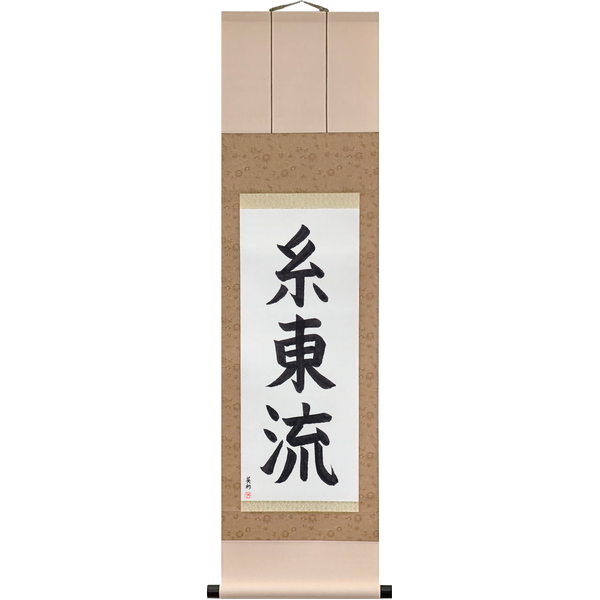
Abstract
糸東流 is a name made of two other names: the first characters of the surnames of Mabuni Kenwa 摩文仁賢和's (1889–1952) two Okinawan teachers, Itosu Ankō 糸洲安恒 of the Shuri tradition and Higaonna Kanryō 東恩納寛量 of the Naha tradition, read shi and tō, and 流, a school. The dates given for the naming run from 1931 to 1939, but Mabuni's own book of October 1934 styles him a master of 剛柔流, announces a book under the name 摩文仁流, and speaks of my school without naming it; the earliest dated print reported to give 糸東流 as his is the Butokukai's register of ranks of April 1941, and Funakoshi Gichin names the Shitō-ryū of Master Mabuni in 1943. The English books, from 1963, read the two characters as two founders, and from 1979 give Mabuni an earlier name, Hankō-ryū, half-hard style, which has no Japanese witness and which the earliest English telling of it, of 1976, gives instead to the naming of Miyagi Chōjun's 剛柔流.
Overview
The sense. A proper name, the name of a school of karate. The Japanese dictionaries on kotobank have no entry for it; it is mentioned in the 世界大百科事典's article on karate, which divides the art's forms into a quick, light kind and a plain, heavy kind and says 前者は松濤館流,糸東流,和道流(首里手系)に属し,後者は剛柔流(那覇手系)に多く見られる, the former belong to Shōtōkan-ryū, Shitō-ryū and Wadō-ryū (of the Shuri line), the latter are found mostly in Gōjū-ryū (of the Naha line) [1]. The Japanese Wikipedia counts it among the four great styles of karate, with 松濤館流, 剛柔流 and 和道流 [2].
The words. 糸 is thread, 東 is east, and 流 is a flow, a current, and in the arts a school, a line of teaching handed down. Read as words, the three characters say nothing: the name is made of initials. 糸 is the first character of 糸洲, Itosu, and 東 the first of 東恩納, Higaonna, the surnames of Mabuni's two teachers; a chronology of 2004 co-written by Mabuni's son Kenzō 摩文仁賢三 says it was 糸洲、東恩納の二人の頭名字から命名, named from the initial characters of the surnames of the two men, Itosu and Higaonna [3], and every account agrees [4][5]. Neither teacher's name is read the way the style name reads it: 糸 is ito in Itosu and 東 is higa in Higaonna, and in the style name the two characters take their Sino-Japanese readings, し and とう, shitō [5]. Itosu was a master of the Shuri line and Higaonna (1853–1915) of the Naha line [4][6], and Mabuni studied with both [4][7]. The name records that the style joins the two.
The text in English. The style came into English as a sound, Shito-ryu, in the 1960s, and the English books glossed the name by its teachers from the first [8]. The designs are sold as Shito-Ryu; the modified Hepburn of the name is shitōryū.
The historical record
About 1902 and 1908, the two teachers. Mabuni, born in Shuri in 1889, entered Itosu's teaching at thirteen and Higaonna's at nineteen, by the biography of the martial-arts magazine 月刊秘伝 [4]; Andreas Quast, in McCarthy's Bubishi of 2016, has Itosu from 1903 and Higaonna from 1908, on the introduction of his friend Miyagi Chōjun 宮城長順 [7]. He served in the police, and in 1925 was among the founders, with Miyagi and others, of the 沖縄唐手研究倶楽部, an Okinawan karate research club [4].
May 1926, two posts in Okinawa. The national directory of middle-school staff, 『中等教育諸学校職員録』, as of May 1926, lists 唐手、摩文仁賢和, karate, Mabuni Kenwa, on the staff of the prefectural normal school at Shuri, and 實習助手、武、實 摩文仁賢和, practical assistant, martial arts and practice, on the staff of the prefectural fisheries school in Naha [9]. The Japanese Wikipedia gives the fisheries school post from 1924 [10]. In 1926 he was teaching in Okinawa.
1928 to 1930, to the mainland. The tellings differ by a year or two. John Stevens: He joined Funakoshi in Tokyo in 1928, but the next year he moved to Osaka [11]. The 月刊秘伝 biography and Masutatsu Oyama give 1929, Oyama with the Osaka and Kyoto areas [4][12]. Donn Draeger and Robert Smith give 1930, and Nakayama Masatoshi has clubs formed at Ritsumeikan and Kansai universities in 1930 with the arrival of Mabuni and Miyagi [13][14]. Mark Bishop puts him in an Osaka dōjō called the Yoshukan by 1926, on the word of a pupil who enrolled there that year [5]; the staff directory of that May has him in Okinawa [9].
1931, 摩文仁流 (reported). The Japanese Wikipedia says that in 1931 he called his school 摩文仁流, the Mabuni school [10]. The sentence carries no reference, and the biography the article cites on every sentence around it has no 1931 and no 摩文仁流 [4]. The English Wikipedia gives 1931 as the year the style was founded, on a website that no longer answers [15].
October 1934, his own book. Mabuni published three books in 1934 [10]. The third, 『攻防自在 空手拳法 十八の研究』, a study of the form Seipai, "eighteen", dated in its colophon 昭和九年十月二十五日, the twenty-fifth of October, survives in a facsimile [16]. Its advertisements style him 日本拳法 空手術教授 剛柔流 拳法師範, professor of karate-jutsu, master of the Gōjū-ryū fist method, and 剛柔流空手拳法大家, authority on Gōjū-ryū karate; they name him instructor at Kansai University and other schools and president of the 大日本拳法關西空手術研究會, the Kansai karate research society; and they give two dōjō in Osaka, one in 西成區鶴見橋 and the 尚進館 in 港區 [16]. The Japanese Wikipedia notes the same style in the advertisements of the two earlier books of that year [10]. The book's list of its series describes its first, second and fourth volumes as 剛柔流, and announces the third as 摩文仁流空手拳法 女子護身術, Mabuni-ryū karate: self-defense for women, for two forms of his own composition, 青柳 and 明星 [16]. The first chapter opens 我が流派に於ては必ず、基本型や開手型を行ふ前に豫備運動を行ふ, in my school we always do preparatory exercises before the basic forms and the open-hand forms: a school, and no name for it [16]. In the pages read, the cover, the preface, the contents, the first chapter and the back matter, the book prints 糸東流 nowhere.
1934 to 1939, the dates for the name. The Japanese Wikipedia and the 月刊秘伝 biography say that in 1934 he opened a dōjō in Osaka named 養秀館, Yōshūkan, and took the name 糸東流 [2][4]. The chronology of 2004 puts the 養秀館 in 1934, at 大阪市都島区高倉町, and enters the name twice: under 1935, among the four great styles, 「糸東流」…糸洲、東恩納の二人の頭名字から命名, and under 1939, 糸東流空手道と命名(摩文仁賢和)… 大日本武徳会本部へ「糸東流」登録, named Shitō-ryū karate-dō (Mabuni Kenwa) … registered 糸東流 at the headquarters of the Dai Nippon Butokukai [3]. Bishop writes according to some sources, this was in about 1937 [5]. The Japanese and English Wikipedias both give 1939 for the registration with the Butokukai, the national body that granted ranks in the martial arts [2][15]. No telling opens a document of any of these years. The two dōjō the October 1934 book names are neither of them 養秀館 [16].
1937, the Butokukai register. The Butokukai's printed register of ranks for 1937 lists, under karate, a single 錬士, renshi, a teaching title: 稲垣虎吉, ranked in May 1936 [17]. Its entries for living holders give the date of rank, the year of birth and an address, and no school [17]. Mabuni is not in it.
April 1941, 糸東流 in the register. The register's edition of April 1941, 『大日本武徳會範士教士錬士名鑑』, is not in any open library; a collector's blog of 2016 transcribes its karate pages, and lists among the 錬士 富名腰義珍(松濤館流), 大塚博紀(和道流), 比嘉世幸(剛柔流) and 摩文仁賢和(糸東流) [18]. This blog is the one reference the Japanese Wikipedia gives for Mabuni's rank and for the registration of 1939 [2][10]. It carries a book of 1941, and it transcribes no dates of rank. It is the earliest dated print this history has seen reported to give 糸東流 as Mabuni's school, and it is a register kept by the Butokukai, not a book of his.
December 1943, Funakoshi. Funakoshi Gichin's 『空手入門』, published in December 1943, speaks against the multiplication of styles, recalling a demonstration at the Butokuden in Kyoto some years ago where he did not recognize what he saw as karate, and then names two exceptions. In the Portuguese translation of the English of 1988: Pelo que é do meu conhecimento, os únicos estilos que nos chegaram do passado são o Goju-ryu do Mestre Miyagi e o Shito-ryu do Mestre Mabuni. Nunca dei um nome ao karaté que estudo, as far as I know, the only styles that have come down to us from the past are the Gōjū-ryū of Master Miyagi and the Shitō-ryū of Master Mabuni. I have never given a name to the karate I study [19]. Within a decade of the book of 1934 that does not use the name, Funakoshi treats it as Mabuni's without comment.
1952 and after. Mabuni died in Osaka in 1952 [4]. The name on a book's title page comes late: the earliest book in the National Diet Library's catalogue with 糸東流 in its title is Tani Chōjirō's 『型 谷派糸東流空手道』 of 1979 [20].
The name in English
1963, Edmund Parker and the encyclopedias. The first English book to carry the name reads its two characters as two people: Shito-ryu was developed by two people, Itosou and Kanruo Higaonna. From this style Goju-ryu …, and Shito-ryu and Goju-ryu are almost identical; Goju-ryu being a branch of Shito-ryu [8]. Parker has Mabuni and Funakoshi lifting karate's veil of secrecy together in 1916 [8]. The Encyclopedia International of the same year lists it among the principal Okinawan styles [21].
1967 to 1973, the style arrives. H. D. Plée has Mabuni settle in the Kyoto region where he created the Shitoryu style [22]. Black Belt magazine in October 1967 calls it the least known of major karate styles [23]. Draeger and Smith, in 1969: Funakoshi developed the Shotokan style and Mabuni the Shito style [13]. Fumio Demura, who came to the United States in 1965 to teach it, published Shito-Ryu Karate in 1971, the first English book under its name [24]. Oyama in 1973: Mabuni's school of karate is called the Shito school, while Miyagi's is called the Goju school, and on the next page, Kenwa Mabuni said that the notion of this and that school in karate came from outsiders. The names of karate schools did not come from the so-called schools themselves [12].
1995, Stevens and McCarthy. Stevens: in 1934 managed to open up a small dojo and thereafter publish a variety of pamphlets on his style of karate, the Shito Ryu. The name indicates a blending of the Higaonna and Itosu styles of karate [11]. Patrick McCarthy has Mabuni responsible for bringing together karate-jutsu's two main streams when he created his Shito-ryu tradition [25].
1976 to 1999, Hankō-ryū. The English name hanko-ryu, half-hard style, is first in print, among the books this history has read, in Toguchi Seikichi's Okinawan Goju-Ryu of 1976, and it is not Mabuni's there. Toguchi, a pupil of Miyagi, tells how Miyagi sent his pupil Shinzato to a martial arts convention: Mr. Shinsato, though, had no ready reply when asked the name of his style … Having no choice at all, then, Mr. Shinsato groped for an impromptu name and dubbed his style, hanko-ryu (half-hard style). When Mr. Shinsato returned to Master Miyagi, he told him of the hastily chosen name. The master, finding it quite reasonable, quoted from the Chinese Eight Poems of the Fists … and so Naha-te formally took the name of Goju-Ryu [26]. The Japanese telling of the same event has Shinzato Jin'an 新里仁安 at a demonstration in Tokyo in November 1930, unable to answer, and cites the demonstration's program, where the column for his school is blank; it gives no 半硬流 [27]. From 1979 the English books give Hanko-ryu to Mabuni instead: P. M. V. Morris, This he originally called Hanko-ryu … but later changed [28]; David Mitchell in 1984, a style which he first called Hanko Ryu, or 'Half Hard Way', which he sets beside Miyagi's 'Hard/Soft Way' [29]; and Bishop in 1989, on the word of Uechi Kan'ei, a pupil who enrolled with Mabuni in Osaka in 1926: Mabuni had first called his style Hanko-ryu … Later, in remembrance of his two teachers, he took the Chinese character 'shi' ('ito' in Itosu) and the Chinese character 'to' ('higa' in Higaonna) and combined them to form 'shito', thus Shito-ryu; according to some sources, this was in about 1937 [5]. The English Wikipedia carries Hankō-ryū, or "half-hard style" as Mabuni's first name for the style [15]. No Japanese writing of the name has been found: not in the Japanese dictionaries, the Japanese Wikipedia, the prewar books open in the National Diet Library, or Mabuni's book of 1934.
Today. The name is written in English Shito-ryu, Shito-Ryu or Shitō-ryū. A rendering should keep it a name: thread-east school is what the characters say and not what the name means, and the school of Itosu and Higaonna is what it means.
A reading
The characters are the easy part, and every witness agrees on them: two teachers' initials, read in the sound a reader of Chinese characters would give them, and 流, a school. What the name records is a lineage, the Shuri line and the Naha line in one man, and that is the claim a student makes in wearing it.
The date is the hard part, and I do not think the witnesses let anyone give one year. In October 1934 Mabuni wrote my school and did not name it, advertised himself as a master of 剛柔流, and announced a book of his own forms as 摩文仁流 [16]. 剛柔流 was the name of Miyagi's school, the Naha line that he and Mabuni had both learned from Higaonna [19][7], and in 1934 Mabuni taught under it; 摩文仁流 was the name for what he himself had composed. By April 1941 the Butokukai's register lists him under 糸東流 [18], and by 1943 Funakoshi takes the name for granted [19]. The name was fixed between those dates. The tellings that put it at 1934 and the opening of the 養秀館 give no document, and the book of that October speaks against them without refuting them, since it is silent on the name rather than contrary to it. The chronology his son helped write enters the naming under both 1935 and 1939, and I read that double entry as the record of a name that came into use before it was registered. The registration of 1939 is the date the tellings share, and the register of 1941 is the kind of document that would show it; I have not seen that document, only a transcription of its later edition.
The registers also show why such a name was needed. The register of 1937 gives no school for any living holder; the edition of 1941, as transcribed, gives a school beside every karate name the blog copies [17][18]. Oyama reports Mabuni saying that the names of schools came from outsiders [12]. I read the name as one Mabuni made from his teachers, and as one the Butokukai's forms asked of him: an institution that ranked teachers wanted to know whose line each taught, and a man who taught both lines answered with both names.
Hankō-ryū I do not give characters. Its earliest English telling makes it the answer a Gōjū man improvised when asked his school's name, the answer Miyagi turned into hard and soft [26], and the Japanese record of that day leaves the answer blank [27]. Its later tellings give it to Mabuni, one of them on the word of a pupil who knew him in Osaka [5]. Both could be true, and a half-hard name could have passed between two men who shared a teacher and, in 1934, a school name; but the Mabuni story is the later of the two in print, and no document in Japanese carries the name for either man. I read it as the Gōjū story's before it was Mabuni's.
Notes
- The October 1934 book's reference materials, reproduced from the Okinawan manual 武備志 that Mabuni had from Itosu, carry school names of their own, 昭林派 and 邵靈寺流; they are the manual's Chinese lineages, not names for Mabuni's teaching [16][25].
- Bishop's pupil Uechi Kan'ei received his teaching license in September 1935 from an examination board on which Mabuni sat as president of the Kansai Karate-jutsu Research Association [5], the society the 1934 advertisements give him [16].
- The register of 1937 lists three teaching titles, 範士, 教士 and 錬士, in that order; the karate rank of 1937, and the one the transcription reports for Mabuni, is the third [17][18].
- The date of Funakoshi's 『空手入門』 is its foreword's, by the Shōtōkai, in the edition of 1988, and the Japanese union catalogue gives December 1943 for the book [19][30]; the same edition's cover copy calls its texts writings of a few years before his death in 1957 [19]. The passage on Mabuni is dated here by the book, not by the cover.
- Toguchi sets the convention in Kyoto in 1929, and has Higaonna, who died in 1915, ask Miyagi to go in his place [26][6]; the Japanese telling's program puts it in Tokyo in November 1930 [27].
Sources not seen
『大日本武徳會範士教士錬士名鑑』, 長島孝有 編, 大日本武徳会本部雑誌部, April 1941 (National Diet Library Search, https://ndlsearch.ndl.go.jp/books/R100000136-I1970867909771177689). It is the register the blog transcribes. It would settle the date of Mabuni's rank, and whether its karate entries print 糸東流 in the new form 糸 or the old form 絲.
船越義珍『空手入門』, 国防武道協会, December 1943 (CiNii Books, NCID BC11034068). The Japanese of the passage quoted here in Portuguese would settle Funakoshi's own spelling of the name.
摩文仁賢和・仲宗根源和『空手道入門』, 空手研究社興武館, 1935, and its enlarged edition 『空手道入門 別名・空手術教範』, 京文社, 1938, and 仲宗根源和 編『空手道大観』, 東京図書, 1938, digitized by the National Diet Library (https://dl.ndl.go.jp/pid/3456304 and https://dl.ndl.go.jp/pid/1104139) and served only to readers registered in Japan; the first is reprinted by 榕樹書林 (1996, 2006, 2018). They are Mabuni's books of the years the name is dated to. They would settle whether he used 糸東流 of his own school in print before 1939.
『明治神宮鎮座十年祭 奉納武道形大會要覧』, 1930, the program the Japanese Wikipedia cites for Shinzato Jin'an's blank school. It would settle what the Gōjū story's convention recorded.
綿谷雪・山田忠史 編『増補大改訂 武芸流派大事典』, 東京コピイ出版部, 1978, the reference work the Japanese Wikipedia cites for the style's lineage. Its entry on the style may carry a date and its source.
Gabrielle and Roland Habersetzer, Encyclopédie des arts martiaux de l'Extrême-Orient, 2004, the English Wikipedia's source for the registration of 1939. It would show whether that date rests on a Japanese document.
A reader with access to any of these is invited to write to Takase Studios at Tim@Takase.com.
References
- 「糸東流」, 世界大百科事典 (旧版), in the article 空手, at kotobank. https://kotobank.jp/word/糸東流-1332267
- 「糸東流」, the Japanese Wikipedia, § 歴史. https://ja.wikipedia.org/wiki/糸東流
- 沢勲・摩文仁賢三・樋口豊治・長田眞男「空手道学の略史とITによる手技術と急所の相関モデル」, 大阪経済法科大学論集 88, 2004, pp. 83–121, the chronology at p. 91. https://keiho.repo.nii.ac.jp/records/1921
- 「摩文仁賢和 Mabuni Kenwa – 糸東流空手道」, WEB秘伝 (BAB Japan). https://webhiden.jp/master/mabuni_kenwa/
- Mark Bishop, Okinawan Karate: Teachers, Styles and Secret Techniques, second edition, A & C Black, London, 1999, pp. 105–107; the first edition, 1989, carries the same passage on the name.
- 「東恩納寛量」, 日本人名大辞典+Plus, at kotobank. https://kotobank.jp/word/東恩納寛量-1103091
- Andreas Quast, essay on the manuscripts, § Mabuni Kenwa (A), in Patrick McCarthy, Bubishi: The Classic Manual of Combat, revised and expanded edition, Tuttle, Rutland, Vermont, 2016.
- Edmund K. Parker, Secrets of Chinese Karate, Prentice-Hall, Englewood Cliffs, 1963, p. 55, read in the Internet Archive's full-text index. https://archive.org/details/secretsofchinese00park
- 『中等教育諸学校職員録』 大正15年 (5月現在), 中等教科書協会, 1926, the normal school's list and pp. 929–930, scans 535 and 537. National Diet Library pid 937376. https://dl.ndl.go.jp/pid/937376/1/537
- 「摩文仁賢和」, the Japanese Wikipedia. https://ja.wikipedia.org/wiki/摩文仁賢和
- John Stevens, Three Budo Masters: Jigoro Kano, Gichin Funakoshi, Morihei Ueshiba, Kodansha International, Tokyo, 1995, p. 72.
- Masutatsu Oyama, This Is Karate, translated by Richard L. Gage, revised edition, Japan Publications, Tokyo, 1973, pp. 314–315.
- Donn F. Draeger and Robert W. Smith, Asian Fighting Arts, Kodansha International, Tokyo, 1969, read in the Internet Archive's full-text index. https://archive.org/details/asianfightingart0000drae
- Masatoshi Nakayama, Best Karate, vol. 1, Comprehensive, Kodansha International, Tokyo, 1977, p. 131.
- "Kenwa Mabuni" and "Shitō-ryū", the English Wikipedia. https://en.wikipedia.org/wiki/Kenwa_Mabuni
- 摩文仁賢和『攻防自在 空手拳法 十八の研究』 (空手研究叢書 第二篇), 空手研究社 興武館, Tokyo, 1934, a facsimile: the preface, p. 11; the contents, pp. 16–17; chapter 1, p. 19; the colophon and the advertisements at the end. Internet Archive MabuniSeipaiStudy1934. https://archive.org/details/MabuniSeipaiStudy1934
- 『武道範士教士錬士名鑑』 昭和12年, 大日本武徳会本部雑誌部, 1937, p. 296, scan 160. National Diet Library pid 1055514. https://dl.ndl.go.jp/pid/1055514/1/160
- 「大日本武徳會武道範士教士錬士名鑑」, 「まるふじ文庫」の収集武道書 (Yahoo! ブログ), 25 November 2016, transcribing 『大日本武徳會範士教士錬士名鑑』 of April 1941, at the Wayback Machine. https://web.archive.org/web/20161226055045/http://blogs.yahoo.co.jp/marufujibunko2015/27817398.html
- Gichin Funakoshi, Karatê-Do Nyumon, Editora Cultrix, São Paulo, 1988, the Portuguese of the English of Kodansha International, 1988, p. 30.
- 谷長治郎『型 KATA 谷派糸東流空手道』, 修交会総本部, 1979, in National Diet Library Search. https://ndlsearch.ndl.go.jp/books/R100000001-I47111100336138
- Encyclopedia International, Grolier, New York, 1963, vol. 10, read in the Internet Archive's full-text index. https://archive.org/details/encyclopediainte10newy
- H. D. Plée, Karate: Beginner to Black Belt, Foulsham, Slough, 1967, read in the Internet Archive's full-text index. https://archive.org/details/karatebeginnerto0000plee
- Black Belt, October 1967, read in the Internet Archive's full-text index. https://archive.org/details/black-belt-1967-10
- Fumio Demura, Shito-Ryu Karate, Ohara Publications, Los Angeles, 1971, as registered in the Catalog of Copyright Entries, 1971, and as described in Demura, Nunchaku: Karate Weapon of Self-Defense, Ohara Publications, 1971. https://archive.org/details/catalogofcop197132511l
- Patrick McCarthy, The Bible of Karate: Bubishi, Tuttle, Rutland, Vermont, 1995, "The Impact of the Bubishi on Modern Karate-do".
- Seikichi Toguchi, Okinawan Goju-Ryu: Fundamentals of Shorei-Kan Karate, Ohara Publications, Burbank, 1976, "The Origin of Goju-Ryu". https://archive.org/details/okinawan-goju-ryu-fundamentals-of-shorei-kan-karate
- 「宮城長順」 and 「剛柔流」, the Japanese Wikipedia, with their reference to 『明治神宮鎮座十年祭 奉納武道形大會要覧』 (1930). https://ja.wikipedia.org/wiki/宮城長順
- P. M. V. Morris, The Illustrated Guide to Karate, Van Nostrand Reinhold, New York, 1979, read in the Internet Archive's full-text index. https://archive.org/details/illustratedguide0000morr_s7v5
- David Mitchell, The Official Martial Arts Handbook, Sphere, London, 1984, read in the Internet Archive's full-text index. https://archive.org/details/officialmartiala0000mitc
- 船越義珍『空手入門』, 国防武道協会, 1943, in National Diet Library Search. https://ndlsearch.ndl.go.jp/books/R100000136-I1970867909860261127