

神は偉大 · kami wa idai · God is Great
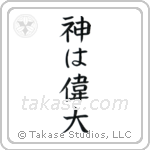
Sold as God is Great · Read kami wa idai, four graphs: god, [topic], outstanding, great · Register a title's: the sentence with its copula left off · Sense one: God is great, in the sense of mighty, not large. The sentence has two homes in Japanese as it has in English: completed, 神は偉大なり is the Japanese for Allāhu akbar; the Japanese Bible says the LORD is great with a different word.
The words
Idai is a Meiji word. The dictionary dates it to 1872 and gives Tsubouchi Shōyō's 1885 essay on the novel as its first use in prose, is its merit not great?; the sense is great by excellence, outstanding, and the page's gloss, mighty or magnificent, not large, is exactly that. The Chinese word is older and wider: a Taiwanese dictionary's second sense is huge, with Xuanzang's elephants in the seventh century, so in Chinese the four characters could be read God is big; in Japanese they cannot. Kami is god and God, the kami of a shrine and the Christian deity in one word, which is every Japanese Christian sentence's ambiguity and not this one's. The four characters as brushed are a headline: every Japanese sentence that says this closes with a copula, and the bare form is how a title or a slogan is written. A Japanese reader completes it without effort.
Where it comes from
In English God is great is the Psalmist's Great is the LORD, and a child's grace, and the usual rendering of the Arabic takbīr, which Wikipedia's page for the phrase lists first. Japanese carries the same double life, and its Bible has always kept to the plain word: the Meiji Psalms of 1887 say the LORD is great with 大, the 1955 Psalms say the Lord is a great God with the same adjective in modern dress, and the 1917 New Testament never uses idai at all. The sentence with idai is Uchimura Kanzō's, read at the page, 1914, under the heading The Great God: the God we worship, Jehovah, is a great God; he is not the god of mere pity the world speaks of… he is surely a stern father. Yanagi Sōetsu answered him five years later, read at the page: the true God is not great; he must be beyond even the comparison of great and small. When we say God is great we are already far from God's meaning. Okakura's satire came home in 1922: Our god is great, and money is his Prophet, the Book of Tea's line on the modern West, Japanesed as 神は偉大である。然し金がその豫言者である. The takbīr entered Japanese with the plain word first, in a church history of 1914, the one phrase 'Allāhu akbar' (God is great) is the life of the religion, and took idai by 1927, when a letter of Lafcadio Hearn's was translated for his collected works: God is great! God is great! I witness that there is no god but God!, the call to prayer as Bilāl sang it. A 1943 study of Indian Islam defines the takbīr as the recitation of the repeated prayer-phrase 神は偉大なり. That is the form the language kept: thirty-five Japanese Wikipedia articles carry 神は偉大なり today, and every one of them is the takbīr, on the flags of Iraq and Afghanistan, in the Saudi anthem, in the call to prayer.
The text in English
The design is a translation of the English sentence, and the Japanese it produces is grammatical, right in its adjective, and headline-shaped for want of a copula. Hepburn and Brinkley give nothing: the word postdates Hepburn's first two dictionaries and the scanned text of the later ones loses it. The register a Christian buyer brings is the Psalm's and the grace's; the register a Japanese reader brings, once the sentence is completed in the mind, is the takbīr's, because that is where the fixed phrase lives. A Japanese Christian would more likely write God is a great one or quote the Psalm; this phrase is what a translator writes for God is great when nothing says which great.
A reading
Signed 典, 2026-09-09. This design translates an English sentence correctly and lands in the other house. The adjective is honest: idai is great in the sense the page gives, and it cannot mean large, which the Chinese word can. The grammar is a title's, and a Japanese reader finishes it without thinking. But the finished sentence has a fixed home in Japanese, and it is not the Psalm. The Bible in Japanese has said the LORD is great with the plain word since 1887, because idai was too new and too secular for the Meiji translators, and their successors kept the choice. The sentence 神は偉大なり belongs to the takbīr, from Hearn's Bilāl in 1927 through a wartime study of Indian Islam to the thirty-five encyclopedia articles that carry it now; a Japanese reader who hears the design completed hears Allāhu akbar. That is not a fault in the design. The English has the same double life, and the English encyclopedia sends God is Great to the takbīr first too. It is a fact the page should carry, because the design is sold under Christian, and a Christian buyer is entitled to know that in the language they are wearing it in, this sentence is the other faith's confession first; that Uchimura, who did say it of Jehovah, said it with a noun, a great God; and that Yanagi answered that before God there is no great and small.
How this was read
By eye: the template; six pages at the National Diet Library's image host, Uchimura's 1914 essay, a church history of 1914, Yanagi's 1919 book, the 1922 Okakura translation, Hearn's collected works of 1927, and the 1943 study of Indian Islam. By text: two dictionary pages at kotobank; the Taiwanese dictionary; the online Japanese-English dictionary; the 1955 Psalms at two verses; the Japanese Wikipedia article on the takbīr and its full-text search; the English Wikipedia's Takbir article and its God is Great page; Okakura's English at the sentence. By OCR: the local harvest archive of 9,873 prewar books on eleven forms, the two Bible typesets, the four shelf dictionaries. Not opened: the 1872 character dictionary and Shōyō's essay; Hepburn's and Brinkley's entries for the word, which the scanned text does not yield; the 1987 and 2018 Bibles at the Psalms; Hearn's English letter behind the 1927 Japanese; the children's grace at its first printing. The full list is in the account.
References
- The account:
research_record_kami_wa_idai_917_2026-09-09.md(every address, the witness table, the not-read list). - 内村鑑三 感想十年 (1914), pp. 150–151 — NDL pid 943876, koma 80.
- 柏井園 基督教史 (1914), p. 310 — NDL pid 943496, koma 165.
- 柳宗悦 宗教とその真理 (1919), p. 228 — NDL pid 944005, koma 128.
- 天心先生欧文著書抄訳 (日本美術院, 1922), p. 97 — NDL pid 970353, koma 58 · Okakura, The Book of Tea (1906), VI Flowers.
- 小泉八雲全集 第9巻 (第一書房, 1927), pp. 176–177 — NDL pid 1188369, koma 92.
- 小川亮作 印度の回教徒 (1943), p. 260 — NDL pid 1040057, koma 143.
- 精選版 日本国語大辞典 and デジタル大辞泉 at kotobank: 偉大; 字通: 偉.
- 明治元訳 旧約 at Psalm 48:1 and 95:3 (1937 printing, NDL pid 1030419); 口語訳 (1955) at Psalm 48:1 and 145:3.
- ja.wikipedia タクビール and the full-text search for 神は偉大なり · en.wikipedia Takbir · en.wikipedia God is Great (disambiguation).
References
- 新撰字解 · 坪内逍遙 小説神髄 (日国) (1872 · 1885) — kotobank 偉大
- 玄奘 大唐西域記 (moedict) (646) — moedict 偉大 ②
- 明治元訳 旧約 (1937 printing) (1887) — pid 1030419 koma 509 · 533, OCR
- 内村鑑三 感想十年 (1914) — pid 943876 k80 pp. 150–151, by eye
- 柏井園 基督教史 (1914) — pid 943496 k165 p. 310, by eye
- 中野天心 逆順論 (1915) — pid 954962 k122, OCR
- 柳宗悦 宗教とその真理 (1919) — pid 944005 k128 p. 228, by eye
- 岡倉天心 欧文著書抄訳 (日本美術院 訳) (1922) — pid 970353 k58 p. 97, by eye
- 国木田独歩 欺かざるの記 (1922 ed.) (1890s) — pid 935812 k138, OCR
- 小泉八雲全集 第9巻 (letter signed エル・ヘルン) (1927) — pid 1188369 k92 pp. 176–177, by eye
- 新潟市立高等女学校 伸びてゆく (1940) — pid 1456616 k226, OCR
- 小川亮作 印度の回教徒 (1943) — pid 1040057 k143 p. 260, by eye
- ストリンドベリ 青書 (宮原晃一郎 訳) (1943) — pid 1132414 k201, OCR
- 口語訳 詩篇 (1955) — wordproject.org (version by wording)
- Okakura, The Book of Tea, VI Flowers (1906) — monadnock.net
- 大辞泉 · 日国 · JMdict 偉大 (current) — kotobank · jisho
- ja.wikipedia タクビール · full-text (current) — WebFetch
- en.wikipedia God is Great · Takbir (current) — WebFetch
- The local archive, eleven forms (to 1960) — search_ndl_archive.py, local_archive_counts.txt