

神の加護 kami no kago God Bless You
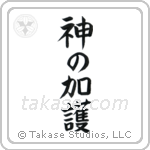
The words
Kago is written 加護, add and protect, and the dictionaries agree on what it means. The 日本国語大辞典 says a buddha or a god adds the power of compassion and helps and protects, and dates it to a court diary of 999; its next citations are a sermon record of 1110 on Amida's vow and the Konjaku tales of about 1120, where a traveler survives a thief because the Three Jewels' 加護 was on him. The 大辞泉 says a god or buddha, by its power, protects and helps living beings, and gives as its example the sentence a Japanese speaker says on parting: 天の御加護がありますように, may Heaven's protection be upon you. The character dictionary gives one word: まもる, protect. No dictionary says bless. The word is the sutras': in the Golden Light Sutra the devas add protection to a king and the goddess of eloquence is asked for it, and the Buddhist doublet 加被 is glossed with nearly the same sentence and dated earlier still, to Saichō's letters of the 820s.
In English the word has been protection since the first dictionary. Hepburn in 1867 gave care, providence, protection (of the gods), with the example kami no kago de tasukaru, to be saved by the gods' protection; Brinkley in 1896 gave divine protection; having aid; providence; Kenkyusha in 1942 gave divine protection and, for 神明の加護に依って, by the protection of God; by God's protection; by the grace of Heaven; every Japanese-English dictionary open today says divine protection. The English word blessing has a different Japanese home. The Bible in Japanese says bless with 恵む and 祝福 and keep with 守る, and in the 1937 typeset of the Meiji and Taishō translations the word 加護 does not occur once. When the Meiji dictionaries translated God bless you! into Japanese they wrote 神の祝福を祈る or 汝が身に幸あれ, not 加護; the one that reached for 加護 did so for God help you!, 神の加護あらんことを, which is the protecting sense exactly.
Where it comes from
The phrase with a god in it is old and Japanese. The Edo storytellers used 仏神の加護, the buddhas' and gods' protection, for a rescue that was not the hero's own doing, and the 八犬伝 of 1814 has the god of Yushima's 加護 was on him; in the public-domain library the phrase is on the shrines' and temples' side for two centuries. The Christian God enters it in the Meiji churches, and he enters it early and without apology. An Orthodox catechism of 1901 says we are made by God, ever receive God's 加護 and God's love, and so should pray to him as our maker, our 加護者 and our lover. A Protestant tract of 1903 says Israel reached Canaan wholly by God's 加護. In 1912 a Congregationalist teacher's manual for the infant class heads its first unit the heavenly Father's 加護 and its fifth lesson God's 加護, which completes the family's protection, and gives the children their maxim: 神樣は皆さんを護つて下さいます, God protects you all (the leaf's spelling; 神様は皆さんを護って下さいます today). By 1926 a Salvation Army commentary on Matthew reads the daily-bread petition as praying for God's 御加護 over the problem of making a living. The army's field code of 1941 asks the soldier to be worthy of the 加護 of the gods. And the sentence the design's English title stands for, 神のご加護がありますように, may God's protection be upon you, has no occurrence at all in the public-domain library, which ends in 1949: it is a postwar convention, and today it is the subtitlers' standard Japanese for God bless you, God help you and God protect you.
Where it is used
Standard, written, plain; no dictionary tags it. The honorific form 神のご加護 is the one heard today and the one in the example sentences; the bare 神の加護 on the scroll is the written form and the older one, the form the Meiji books print. The Japanese reader's first reading of the four graphs is under God's protection, and the same four graphs serve a shrine, a temple and a church: which God is the wall's to say.
The word in English
The house gloss God Bless You keeps the occasion and loses the word. It is the right English for what a Japanese speaker says on parting, and the subtitle dictionaries have settled that equivalence; it is not what the four graphs say, which is God's protection. The gloss of 加護 is protection; bless is the idiom the phrase answers to, not a sense of the word. A rendering must keep the protecting: God keep you is nearer than God bless you, and under God's protection is the plain sense.
A reading
Signed 典, 2026-09-14. This design is exact Japanese and a thousand years old, and its English title is a benediction standing in for a noun. A Christian buyer is not borrowing a Buddhist word: the Japanese church took it for its God by 1901, and by 1912 was teaching it to infants. What the word is not is blessing. The Bible in Japanese has never needed it, because it names the keeping and not the blessing; God bless you is right as the English for the parting sentence the Japanese say with it, and wrong as a translation of it.
How this was read
By eye: the template; Hepburn's 1867 entry at the archive.org page; the 1901 catechism, two pages of the 1912 manual and the 1926 commentary's pages 36–37 at the National Diet Library's image host. By text: two dictionary entries at kotobank and one absence; the Japanese-English page at Weblio; the sutra at CBETA; the 1955 Numbers. By OCR: Hepburn 1872 and 1886, Brinkley 1896 and Kenkyusha 1942 on the shelf, and two English-Japanese dictionaries; the NDL Lab's saved searches on six forms (about 2,600 rows); the local archive of 9,876 prewar books on ten forms; the 1937 Bible typeset; two more church books of 1915 and 1918 at the page. Not opened: the 999 diary, the Konjaku and the Heike at their pages; the Edo prints the Lab dates 1688–1814; the 1903 tract's page image; Hepburn's preface; any Bible after 1955; the Jesuit dictionary of 1603.
References
- 精選版 日本国語大辞典 and デジタル大辞泉 at kotobank: 加護; 加被. 字通: 加護.
- 金光明最勝王経 卷八, CBETA T0665 at T16n0665_p0437c22, p0442b23, p0443b12.
- Hepburn, A Japanese and English Dictionary (Shanghai, 1867), p. 167 — archive.org japaneseenglishd00hepb, leaf n184 · 3rd ed. (Tokyo, 1886), p. 242 · Brinkley, An Unabridged Japanese-English Dictionary (Tokyo, 1896), p. 527 · Kenkyusha's New Japanese-English Dictionary (1942), pp. 757, 1672 · Saito, Idiomological English-Japanese Dictionary (1915), s.v. bless · Kenkyusha's New School Dictionary, s.v. God (God bless you (him)! and God help you!).
- 正教談 詰難弁駁 (正教会事務所, 1901), pp. 110–111 — NDL pid 824709, koma 64.
- 基督教乃由来 (基督教書類会社, 1903) — NDL pid 824316, koma 19.
- 海老沢亮 日曜学校幼稚科教案 (警醒社, 1912), pp. 18–19 and 24–25 — NDL pid 824948, koma 14 and 36.
- 日々の基督 (1915) — NDL pid 911918, koma 71 · 日曜学校幼稚科教科書 (教文館, 1918) — NDL pid 940527, koma 88 · 山室軍平 民衆の聖書マタイ伝福音書 (救世軍出版及供給部, 1926), pp. 36–37 — NDL pid 925880, koma 41.
- 陸軍省 戦陣訓 (1941) — NDL pid 1266774, koma 29.
- 旧新約聖書 引照附 (1937), NDL pid 1030419 — Numbers 6:24 at koma 132; 加護 absent · 口語訳 (1955) Numbers 6:24–26 at wordproject.
- NDL 次世代デジタルライブラリー, saved searches: 神の加護 (1,992) · 神の御加護 (499) · 神の御加護に (113) · 神の御加護を祈 (26) · 御加護がありますように (0) · 加護がありますように (0).
- Weblio 和英 加護: 研究社新和英中辞典, 斎藤和英大辞典, JMdict, 映画・海外ドラマ英語字幕翻訳辞書.