

痛みは体から抜ける弱さ · itami wa karada kara nukeru yowasa · Pain Is Weakness Leaving the Body
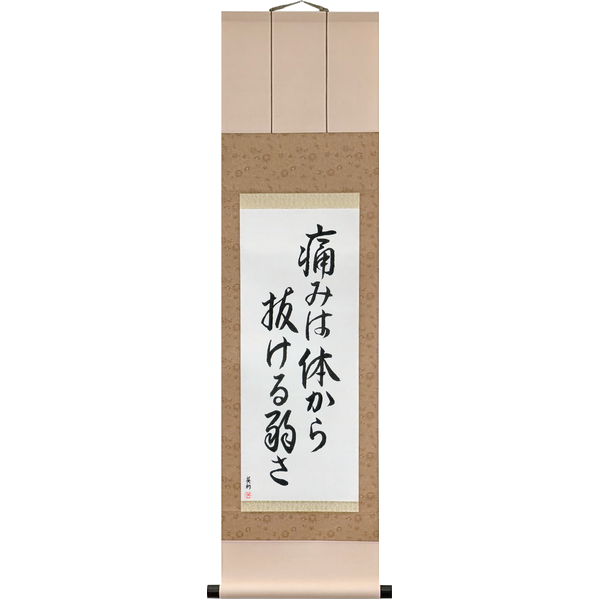
Sold as Pain Is Weakness Leaving the Body · Read itami wa karada kara nukeru yowasa, a sentence with its copula dropped, as a motto drops it · Oldest witness the Marine Corps drill field, in print by 1996 as a favorite DI aphorism; as a slogan, the Corps' own recruiting advertisement of March 1999 · Sense one, the drill instructor's: the pain of training is the weakness going out of you, so it is good.
The words
痛み is pain, the noun from 痛む, and は makes it the topic. 弱さ is weakness, the noun from 弱い. Between them stands 体から抜ける, leaves from the body, a clause that describes the weakness: the whole is pain is the weakness that leaves the body, with the is left unsaid, which is how Japanese writes a headline or a motto. The verb is the one the sentence turns on. 抜ける is what comes out of something it was inside: the dictionary's second sense is 中に満ちていたり含まれたりしていたものが外へ出る, what filled or was held inside goes out, with air from a tire and the smell from fish as examples; its fourth is a force or a habit going out of a person, 疲れが抜ける, the tiredness leaves, 腰が抜ける, the strength goes out of the hips. The English leaving is the same picture, and Japanese has it ready-made, so the slogan lands without strain. The particle is から, from; the scroll brushes it, and the sentence needs it.
A history, from the earliest witness
1996. Steven Zeeland, The Masculine Marine (Haworth Press). The earliest print found. An interviewed Marine recites a favorite DI aphorism: "Pain is weakness leaving the body," and the book's author repeats it as something taught at boot camp. A drill instructors' saying, already a favorite, before it was anyone's slogan. [5]
March 1999. Leatherneck, vol. 82 no. 3. The Marine Corps made the saying an advertisement. A full-page recruiting ad, PAIN IS WEAKNESS LEAVING THE BODY. THE CHANGE IS FOREVER, with the marines.com address, runs in the Marine Corps Association's own magazine from this issue through October 2006, in 24 issues of it that the archive's index holds, and in the two magazines a seventeen-year-old reads, Scholastic's New York Times Upfront (2003-04-18, 2006-04-24) and the FFA's New Horizons (1999 on). The ad names no author. [archive.org sim_leatherneck_1999-03_82_3 and the later issues, OCR highlights; the page numbers are not derived, the scans being lending-only.]
October 1999. Swim News, no. 253. Sport took it in the same year: a swimmer's column under the title Pain is Weakness Leaving the Body. High-school yearbooks carry it from 2001. [archive.org swimnewsn253, OCR.]
2004. Stephen F. Tomajczyk, To Be a U.S. Marine (MBI). The saying in a drill instructor's mouth, answering a recruit: PAIN? Well that's GOOD! Pain is weakness leaving the body. [archive.org tobeusmarinetobe00sfst_0, highlight; ISBN 0760317887.]
2011. Karl Marlantes, What It Is Like to Go to War (Atlantic Monthly Press), p. 16. A Marine officer of the Vietnam war on what carried him: I was in situations where any reasonable person would have quit, but I had become a Marine and Marines aren't reasonable people. Quitting is unthinkable and pain is just weakness leaving the body. The sentence is quoted with its page by a Navy chaplain's 2014 paper, which calls it the Marine warrior's ethos and asks whether an ethos that never admits weakness is why Marines do not ask for help. [Marlantes through LCDR Troy K. Todd, "Good to Go!": Marines, Combat, and the Culture of Silence, 2014-05-13, DTIC ADA610215, footnote 51 (the 2012 Grove reprint, p. 16), read at the archive's text; Marlantes's page not opened; ISBN 9780802119926.]
April 2012. Men's Health, vol. 27 no. 3. SEAL instructor aphorism: Pain is just weakness leaving the body. By now every service claims it. [archive.org sim_mens-health_2012-04_27_3, OCR.]
2015. Keith Trotter, 100 Small Steps (Morgan James). The attribution appears in print with a date: "Pain is weakness leaving the body" —Lt. General Lewis B. "Chesty" Puller, USMC, (c. 1955). Nothing supports the name or the year; see the next section. [archive.org 100smallstepsboo0000trot, highlight.]
2022. Lyle Jeremy Rubin, Pain Is Weakness Leaving the Body: A Marine's Unbecoming (Bold Type). A Marine's memoir takes the line as its title and turns it against itself. The same month, a Marine Corps Recruit Depot graphic calls it, simply, a Marine Corps phrase. [archive.org painisweaknessle0000lyle, metadata, ISBN 9781645037095; dvidshub.net graphic 23046, 2022-12-14.]
By 2010. The scroll. The house's Japanese, 痛みは体から抜ける弱さ, is dated by its earliest design file to 2010-08-25. No Japanese source carries the sentence. One competitor sells the identical string today; in December 2012 that competitor's page offered the slogan in Chinese only, so the Japanese there is later than the house's, and either copied from it or arrived at independently, which the record cannot separate. [The design file, file date; orientaloutpost.com, the 2012-12-07 Wayback snapshot and the live page.]
The sense across time
The drill instructor's sense is the only one, and it is a reframing: the pain you feel in training is not damage but weakness on its way out, so welcome it. Everyone who repeats the line means that, and the differences are in tone. The recruiting ad means it as a promise (the change is forever); Marlantes means it as the thing that kept him alive; the chaplain means it as the thing that keeps Marines from asking for help; the memoirist means it as the lie he was told; the joke books turn it inside out (Pain is not weakness leaving the body, it's just pain); the gym means it as the house's page does, hardship as strength earned. A buyer who is a Marine already knows which of these it is for them.
What is not a source
Chesty Puller. Lieutenant General Lewis B. Puller (1898–1971), the most decorated Marine, is named as the author on every quotation site and in the 2015 book above, with a year, c. 1955, that has no document behind it. The 1999 advertisement does not name him; the 1996 book does not; Marlantes does not. In everything opened, the line has no author, and Puller's name is attached to it only in the 2010s, which is what a legend looks like. The claim is scoped to the archive's full text, which is the instrument used; a Marine Corps record not on the archive could move the date, and none was found.
The text in Japanese, and the English behind it
This history runs the usual way round in reverse: the text is English and the Japanese is the translation. The English has one form, with just sometimes inserted (pain is just weakness leaving the body, Marlantes and Men's Health), and the recruiting ad's line added the change is forever after it. The Chinese a competitor sells, 疼痛就是衰弱離你而去的時候, pain is the moment weakness departs from you, is a paraphrase.
Today. The Japanese, 痛みは体から抜ける弱さ, is the house's, made for Takase Studios by 2010; the same string on a competitor's page is later. What a rendering must keep is the verb: 抜ける, the thing that was inside going out, which is the whole image of the English; and the particle から, without which the Japanese is not a sentence.
A reading
A barracks saying, not a proverb: no author, no date before a book of 1996, and a general it is hung on who never said it in anything I could open. The Marine Corps made it a slogan in 1999 and it has been every service's since. The Japanese is ours and it is right: 体から抜ける is what tiredness, poison and air do in Japanese, so the sentence reads as Japanese and not as a translation, and the missing copula is how a motto is written on a wall. I would sell it as the Marines' line and put the year on the page. The one defect I found is not on the scroll but in a store row that still lacks the particle. Signed, 典, 2026-09-08.
Notes
The store's two rows for this design disagreed with each other until 2026-09-07: the catalogue row read 痛みは体抜ける弱さ, without から, while the design's own slug spelled karada-kara-nukeru. The scroll settles it, から is brushed, and the catalogue row was corrected; the whole_designs row is not yet. The archive's metadata date on a magazine is the run's first year, not the issue's, so three hits it dates 1967, 1981 and 1982 are not witnesses (The Malahat Review no. 162 is a 2008 issue) and are left out above.
How this was read
By eye: the scroll's template, S0041SSVB4A, for the particle. By text: the Navy chaplain's paper at the archive's open text, which carries Marlantes's sentence and its page; the Ministry dictionary's entry for 抜ける at kotobank; the competitor's page today and in the Wayback Machine of 2012. By OCR highlight, from lending-only scans the archive will not show whole: Zeeland 1996, the Leatherneck advertisements, Swim News 1999, the Upfront and FFA issues, Tomajczyk 2004, Men's Health 2012, Trotter 2015; each is the search engine's snippet of the page, not the page. By search: the archive's full text, 1,795 hits on the English (2026-09-08), the first 150 dated; the NDL Lab on the Japanese, zero, which for a postwar phrase means nothing. Not opened: any of those books at its own page; the Marine Corps' own record of the 1999 campaign; any Japanese page with the sentence other than the competitor's. A reader's AI can open the DTIC text, kotobank and the Wayback addresses; the lending-only scans it cannot.
References
- The scroll (ours), template S0041SSVB4A, by eye (design file 2010-08-25; PSDs 2016-08-07 (file dates)) — takase-images/templates/scrolls/sayings/S0041SSVB4A-…-template.jpg
- cultural_works 995 (ours) (corrected 2026-09-07) — cultural_works.csv id 995
- whole_designs 483 (ours) (uncorrected) — whole_designs.csv:483
- The live page (ours) (2026-09-08) — curl 200
- Steven Zeeland, The Masculine Marine: Homoeroticism in the U.S. Marine Corps (1996 (Haworth; Routledge reissue)) — archive.org masculinemarineh0000zeel (highlight; ISBN 9781560249825) ↩
- Leatherneck, vol. 82 no. 3, and 23 later issues to Oct 2006 (March 1999) — archive.org sim_leatherneck_1999-03_82_3 (OCR highlight; page not derived)
- Swim News no. 253 (October 1999) — archive.org swimnewsn253 (OCR)
- FFA New Horizons (1999) — archive.org ffanewhorizons4751999unse (OCR)
- The New York Times Upfront, vol. 135 no. 13 (2003-04-18) — archive.org sim_new-york-times-upfront_2003-04-18_135_13 (OCR)
- Stephen F. Tomajczyk, To Be a U.S. Marine (2004 (MBI; ISBN 0760317887)) — archive.org tobeusmarinetobe00sfst_0 (highlight)
- Karl Marlantes, What It Is Like to Go to War, p. 16 (2012 reprint) (2011 (Atlantic Monthly Press; ISBN 9780802119926)) — through Todd 2014, DTIC ADA610215, footnote 51 (TEXT)
- Men's Health, vol. 27 no. 3 (April 2012) — archive.org sim_mens-health_2012-04_27_3 (OCR)
- LCDR Troy K. Todd, "Good to Go!" (2014-05-13) — archive.org DTIC_ADA610215 djvu.txt (TEXT)
- Keith Trotter, 100 Small Steps, Book 1 (2015 (Morgan James)) — archive.org 100smallstepsboo0000trot (highlight)
- Lyle Jeremy Rubin, Pain Is Weakness Leaving the Body: A Marine's Unbecoming (2022 (Bold Type; ISBN 9781645037095)) — archive.org painisweaknessle0000lyle (metadata)
- DVIDS graphic 23046 (2022-12-14) — dvidshub.net (TEXT)
- orientaloutpost.com (2012-12-07 snapshot; live 2026-09-08) — Wayback; live (TEXT)
- デジタル大辞泉, 抜ける (current) — kotobank (TEXT)
- The archive's full text (2026-09-08) — be-api fts
Books Cited
The books this article cites. Buying one supports its author.