

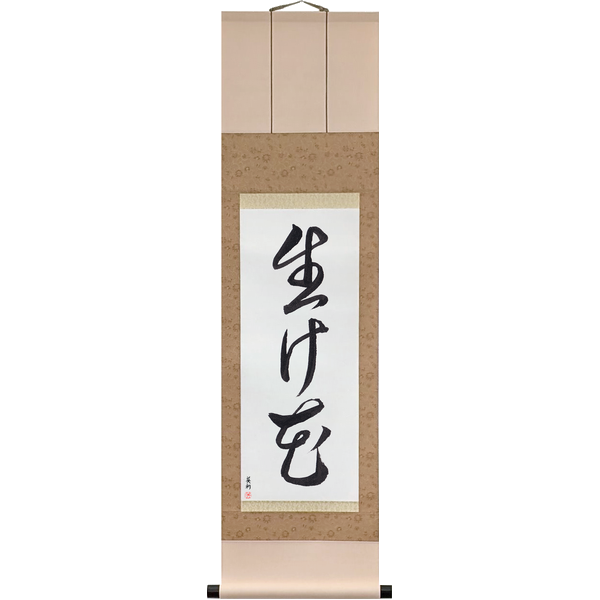
生け花 ikebana Flower Arrangement
This is a philological study of the word 生け花 (ikebana), following it from a name for flowers set in a vase in a seventeenth-century print, through the Edo arguments over its characters, into English as a flower kept alive and then living flower.
Abstract
生け花 is 生ける, to keep alive, and 花, flowers: branches and flowers cut and kept alive in a vessel of water. The word is first known in a print of the 仙伝抄, a manual of flower setting printed in movable type between 1615 and 1644 whose colophon claims a line of transmission from 1445, where it is another name for flowers set in a vase and not yet the name of an art. Through the Edo period and into Meiji it named one kind of arrangement beside 立花 and 投入, and writers disagreed over whether to write it 生花, 活花 or 插花; when it became the general name of the whole art, as it mostly is today, no source read here settles. In English it entered as Hepburn's a flower kept alive by putting in water in 1867, was called the art of arranging flower-vases in 1875, and was Brinkley's living flower by 1902, and the move from a flower kept alive to a flower that looks alive is the one English made.
Overview
The sense. A standard word, the name of an act, a thing and an art at once. The 精選版 日本国語大辞典 defines いけ‐ばな【生花・活花】 as 木の枝や草花などを切りとり、枝葉の形をととのえて、花器にさすこと。また、さしたものや、その技術、方式。華道, cutting branches or flowers, shaping their branches and leaves, and setting them in a flower vessel; also what is so set, and the technique and its method; kadō, and its note on usage says that the word is sometimes used of one method among others, beside 立花 and 投入, 現在では、それらの総称として用いられることが多い, but today it is mostly used as the general name for all of them [1]. The English flower arrangement covers the act and the art, and says nothing of keeping anything alive. The Japanese word covers the act, the arrangement made and the art, and has also named one historical style. For the art as a discipline of self-cultivation Japanese has a second word, 華道 or 花道, which the same dictionary calls a general name for every kind of いけばな, 江戸時代、儒教の影響で精神修養的な面が強調されて生じた語, a word that arose in the Edo period when, under Confucian influence, the side of spiritual training came to be stressed [2]. A study of 2023 puts the difference this way: 華道 is the name of the culture seen as 精神修養や求道的な側面, spiritual training and the seeking of a way, and いけばな is 花をいける行為全般、及びその作品, the act of setting flowers in general, and the works it makes [3].
The words. 生け is the continuative form of the verb 生ける, and the dictionaries take the word's sense from it: ( 「いけ」は、生かしておく意の「いける」の連用形から ), いけ is from the continuative of いける, meaning to keep alive [1]. デジタル大辞泉 explains the verb the same way, 《「生きる」に対して「生かす」の意。花などを生かしておくというところから》, the causative of 生きる, to live; from keeping flowers and the like alive, and gives its senses as setting flowers in a vessel, planting, keeping alive, and 生き返らせる, bringing back to life [4]. The sense to keep alive is the verb's oldest, in the 蜻蛉日記 of about 974; the sense of setting flowers is dated by the 精選版 日本国語大辞典 from a lecture of 1563 [4]. 花 is read ばな in the compound. The word has several spellings: 生け花 and 活け花, 生花 and 活花, いけ花, and 插花 or 挿花 read いけばな. Two of them are also read otherwise: 生花 is せいか, fresh flowers, and, in the Ikenobō school, しょうか, the name of a style of the later Edo period that the encyclopedia says was at first called いけはな [5][6].
The text in English. Hepburn's dictionary of 1867 enters IKE-BANA with the characters 插花, a flower kept alive by putting in water [7]. Brinkley's dictionary of 1896 is the first to define it as an art, the art of floral arrangement [8]. JMdict gives ikebana; Japanese art of flower arrangement for the word, and lists 生花 and 活花 as the same word, and again as せいか, fresh flower, natural flower [9].
The historical record
1542, the 池坊専応口伝. The flower teaching of Ikenobō Sen'ō 池坊専応, which survives only in copies, the best known carrying a colophon saying that Sen'ō handed it on in his own hand in 1542 [10]. Its preface does not use the word. It speaks of the act with the verb さす: 瓶に花をさす事いにしへよりあるとはきゝ侍れど、それはうつくしき花をのみ賞して、草木の風興をもわきまへず、只さし生たる計なり, I have heard that setting flowers in a vase has been done since ancient times, but that was only admiring beautiful flowers, with no sense of the charm of plants and trees; they were merely set in and kept alive [10]. The flowers are already kept alive, 生たる, but the art's name here is 花をさす, setting flowers.
1563, the 玉塵抄 (reported). A lecture on a Chinese rhyming encyclopedia, which the 精選版 日本国語大辞典 gives as the first use of いける for setting flowers: すみえの画軸に白い椿の花、水仙花、梅と三を花瓶にいけたをかいた, on an ink-painted scroll were painted three, a white camellia, narcissus and plum, set in a flower vase [4].
1615–1644, the 仙伝抄. The first known witness of the word itself, in a manual of flower setting. The book's origin is unknown; movable-type prints of it appeared from the late sixteenth and early seventeenth centuries, and its colophon traces a line of seven holders from a secret copy said to have been handed on in 1445 to Ikenobō Sen'ō in 1536, a claim some scholars doubt [11]. The National Diet Library's copy is an undated movable-type print that its catalogue places in the Genna or Kan'ei years [12]. In the entry on the hanging vase it reads 時のちやはんの物をつり花ひんと用たつる事ありとも花ハいけはなともいふ, even when an everyday thing of the moment is used and set up as a hanging vase, the flowers may also be called ikebana [12]. The verb beside it is 立つる, to stand up, the word of 立花. いけはな is one more name for flowers set in a vessel, not the name of an art. The 精選版 日本国語大辞典 cites this line as the word's first use and dates it 1445, the colophon's first link [1]; the print that carries it is at least a century and a half later.
1643, the 新増犬筑波集. Matsunaga Teitoku 松永貞徳's book of haikai, where a verse reads いけ花のいけやうしらぬおもはゆや, oh, the embarrassment of not knowing how to set いけ花 [13]. Setting flowers is here a skill a person of taste is expected to have, and the verb いける stands beside the noun.
About 1725, the 骨董雑談. A scholar's complaint, quoted in the Meiji encyclopedia 古事類苑 under 插花, names, at p. 826: 其いけ花といふを以て插花といひ、或は活花とし、生花とす、ともに名稱通せず, they take what is called いけ花 and call it 插花, or write 活花, or 生花, and none of these names is proper, and 名目を云ふには瓶花といふべし, if a proper name is wanted it should be 瓶花, vase flowers, since the Chinese books on the subject call it that [14]. The 精選版 日本国語大辞典 dates the work to about 1725 [15]. On the same page the dictionary 倭訓栞 says いける 插花をいふは、生るの義也, いける, said of setting flowers, means to keep alive [14]. By the early eighteenth century the word was common enough to have three rival spellings.
1769, the 古田流生花独稽古. A self-teaching manual of flower setting, whose section 生花文字の解, on the characters of ikebana, gives the first explanation known of the spellings: 夫いけ花は山野池苑をいとはず、草となく木となく切とりて水を揚げさせ、其のち花器へうつしてながめ来れり。しかるをいけ花の文字、世にまちまちなり。正花を折て活る事ゆへ、いけ花といふときは生の字よろし。又花をいけるといふときは活の字通用たるべし。正花をおりていきかへすといふこゝろなり, ikebana takes plants and trees from mountain, field, pond or garden alike, cuts them, lets them draw up water, and then moves them to a vessel to be looked at. Yet the characters for いけ花 vary in the world. Since it is breaking a living flower and bringing it to life, when one says いけ花 the character 生 is right; when one says 花をいける, the character 活 may serve. The sense is: break off a living flower and bring it back to life [16]. The noun takes 生 and the verb 活, and the word's sense is given in a phrase, bring back to life.
1780, 通笑's 憎口返答皈. A comic picture book, making fun of fussy arrangers: ためつすがめついけばなではなくてしにはな〻り, turned this way and that, it is not ikebana, living flowers, but shinibana, dead flowers; and なげいれといふはちよつとかるくいけるをしやうくわんす, what is called nageire prizes setting them in lightly [17]. The joke needs a reader who hears いけ as living, and 立花, いけ花 and なげいれ appear on the same page as separate kinds.
1871, the 語彙. The dictionary of the Ministry of Education's compilation bureau, 文部省編輯寮, which the 精選版 日本国語大辞典 dates to 明治四年 [18]. A manuscript draft in the National Diet Library enters いけばな/立花より出て花を瓶中に插事を學ぶ枝をいふ瓶水にて生し置儀なり, branched off from 立花, the study of setting flowers in a vase; a branch kept alive in the water of a vase, and quotes the 仙傳抄's line as 花ハいけばなともいふ [19]. The dictionary explains the word as one practice that came out of 立花.
1893, the 日本大辞書. Yamada Bimyō 山田美妙's dictionary: いけ·ばな …(生け花=活け花)草木ノ枝ナドヲ花器ニ挿シ、水デ活ケル一種ノ手ワザ。本ハ立花カラ分カレタモノ。枝ヲ色色ノフリニタメテ造ル, setting branches of plants and trees in a flower vessel and keeping them alive with water; one kind of handwork, originally a branch of 立花; made by training the branches into various shapes, with a quotation from Saikaku 西鶴 [20]. In 1893 いけばな is still one kind among several.
1959, an arranger looking back. Tsujii Kōshū 辻井弘洲 (1883–1963), an arranger of the 嵯峨御流 school, as quoted in a study of 2023: 江戸末期から明治の終わりにかけて、いけばなといえば流儀花(生花など)で、床におくことを目的として発達してきた, from the end of Edo to the end of Meiji, いけばな meant the school arrangements, 生花 and the like, developed to be placed in the alcove [3]. After that, in his account, the free styles 盛花 and 瓶花 spread through the house [3]. A lecture of 2013 says of the late Edo style that it was called 生花 and that 後にこの「いけばな」の用語は日本の花芸術の総称となりました, later this word いけばな became the general name for Japan's art of flowers, and gives no date [6].
What is not a source. The year 1445 that the dictionary prints beside the 仙伝抄 is the first link in the book's colophon, not the date of a witness, and the colophon itself is doubted [11][1]. 華道 is a different word with a different history: the dictionary dates 花道 from a book of 1688, and it names the art as a way of training, not the flowers [2]. The 瓶花 of the Chinese books, which the 1725 writer preferred, is the name of a Chinese genre and not the ancestor of the Japanese word [14].
The word in English
1867, J. C. Hepburn, A Japanese and English Dictionary, p. 134. IKE-BANA, イケバナ, 插花, n. A flower kept alive by putting in water; and just above it, IKE,-ru,-ta, イケル, 活, or 生, t.v. To keep alive. Hana wo —, to put flowers in water so as to keep them alive [7]. The earliest known English print of the word. Hepburn's gloss is the dictionary sense, and his characters are 插花, the spelling the 1725 writer complained of.
1872, the second edition, p. 160. The same entry, by putting in the water [21].
1875, The Japan Weekly Mail, 27 February, p. 181. An unsigned column of notes on Japanese pastimes: Ike-bana is the art of arranging flower-vases or holders. The methods and ceremonies are so numerous that a class of men make it their profession, and often in former time made a competence by going from house to house and teaching the art [22]. The earliest known English print to call ike-bana an art.
1886, Hepburn, third edition, p. 195. IKEBANA イケバナ 插花, A flower kept alive by putting in the water [23]. The hyphen is gone; the gloss is unchanged.
1896, F. Brinkley, An Unabridged Japanese-English Dictionary, p. 422. Ikebana, いけばな, 生花, 插花, n. The art of floral arrangement (one of the polite accomplishments in Japan); also flowers so arranged [8]. The first English dictionary to define the word as an art, and the first to write it 生花. On the same page Brinkley enters Ikaru, 被生, to be put in the water and kept alive (as a plant in a vase) [8].
1899, Lafcadio Hearn, In Ghostly Japan, "Incense", p. 30. The young lady of pre-Meiji days was expected to acquire three especially polite accomplishments,—the art of arranging flowers, (ikébana), the art of ceremonial tea-making [24]. The word is written ikébana, with an accent on the e.
1902, Brinkley, Japan: Its History, Arts and Literature, vol. III, p. 9. The name applied to it, ike-bana, or "living flower," explains at once the fundamental principle of the art; namely, that the flowers must be so arranged as to suggest the idea of actual life,—must look as though they were growing, not as though they had been cut from their stems [25]. The earliest known English print of the gloss living flower. It is not Hepburn's sense: Hepburn's flower is kept alive in water, and Brinkley's is arranged to look alive. Brinkley builds a principle of the art on a gloss of its name.
Etymonline. The online etymology dictionary dates English ikebana to 1901, from ikeru "to keep alive, arrange" + hana "flower," without a source [26]. The date may be that of Brinkley's set, whose volumes the catalogues date 1901–02, though the third volume, which carries the passage, is copyrighted 1902; the word had in any case been in English dictionaries since 1867 [25][7].
Today. JMdict: ikebana; Japanese art of flower arrangement [9]. The design is sold as Flower Arrangement (ikebana), the house's title, which gives the English name of the art and the Japanese word; this history renders the word flowers kept alive, because that is what its two parts say and what every dictionary from 1867 on takes it to mean. A rendering should keep both: the word names the art, and it says that the flowers are alive.
A reading
The word is older than the art it names. In the 仙伝抄 print いけはな is an alternative name for flowers set in a vessel, beside the verb of 立花 [12]; in 1643 it is a skill a person of taste should have [13]; in the dictionaries of 1871 and 1893 it is one practice, a branch of 立花 [19][20]; and an arranger born in 1883 remembered it as the name of the school styles until the end of Meiji [3]. At every date read here it is one name among several, and the dictionaries of today say that it is now mostly the general name [1]. When that happened I cannot say from these witnesses, and the one study of the question is out of reach (below). I expect it happened in the twentieth century, as the free styles spread and the old distinctions lost their weight; that is my expectation, not a finding.
What the word meant is clearer, and the sources agree more than the spellings do. 生ける is to keep alive, and いけばな is flowers kept alive, in the 倭訓栞, in the dictionaries of 1871, 1893 and today, and in Hepburn's English of 1867 [14][19][20][1][7]. But the 1769 manual already says more: 正花をおりていきかへす, break off a living flower and bring it back to life [16]. That is a teacher's reading, and it turns the cut into a death and the vase into a revival. The comic writer of 1780 relied on the same hearing when he called over-worked branches dead flowers [17]. Brinkley's living flower of 1902 belongs to this line and not to Hepburn's: he makes the name a principle, they must look as though they were growing [25]. English took over the teacher's reading and made it the definition. Both are in the word. The dictionary sense is modest: a cut flower kept alive in water. The teachers' sense is larger: the arranger gives back to the cut branch the life it had on the hill. I read the modest sense as the word's meaning and the larger one as what the art has made of it, and I think the art has earned it.
Notes
- The 語彙 and the 日本大辞書 both print the headword voiced, いけばな, and the 語彙 quotes the 仙傳抄 line with the voicing, where the movable-type print writes いけはな without the mark [19][20][12].
- The online transcription of the 古事類苑 reads 華いけ花といふを以て at p. 826, where the printed page reads 其いけ花といふを以て [14].
- Hepburn wrote the word 插花 in all three editions, the spelling the 1725 writer rejected; Brinkley in 1896 is the first of these English dictionaries to put 生花 first [7][23][8].
Sources not seen
大塚真三「花道名称考」1–3, 麗沢大学紀要 19–21 (1975–1976), pp. 1–28, 101–118 and 71–92; digitized by the National Diet Library (pids 13792303, 13792305, 13792279) and served only inside the library. The one study of the names of the art known to exist, it would settle when いけばな became the general name of the art rather than of one kind.
A reader with access to any of these is invited to write to Takase Studios at Tim@Takase.com.
References
- 「生け花」, 精選版 日本国語大辞典, at kotobank. https://kotobank.jp/word/生け花-30316
- 「華道」, 精選版 日本国語大辞典, at kotobank. https://kotobank.jp/word/華道-45542
- 塩野敬子「華道の近代化における花形の成立と意義 -池坊「生花新風体」・「立花新風体」誕生を中心に-」, いけ花文化研究 11, 2023, pp. 38 and 65. https://doi.org/10.57290/ikebana.11.0_35
- 「生ける」, デジタル大辞泉, 精選版 日本国語大辞典, at kotobank. https://kotobank.jp/word/生ける-431656
- 「生花」, 日本大百科全書 (北條明直), at kotobank. https://kotobank.jp/word/生花-85533
- 笹岡隆甫「いけばな」, 日本香粧品学会誌 37(3), 2013, p. 183. https://doi.org/10.11469/koshohin.37.181
- J. C. Hepburn, A Japanese and English Dictionary; with an English and Japanese Index, American Presbyterian Mission Press, Shanghai, 1867, p. 134, s.v. IKE-BANA. Internet Archive japaneseenglishd00hepb. https://archive.org/details/japaneseenglishd00hepb
- F. Brinkley, An Unabridged Japanese-English Dictionary, Sanseidō, Tokyo, 1896, p. 422, s.v. Ikebana. Internet Archive cu31924082117288. https://archive.org/details/cu31924082117288
- 生け花, JMdict, at jisho.org. https://jisho.org/search/生け花
- 「池坊専応口伝」, 改訂新版 世界大百科事典 (岡田幸三), with the preface quoted under 【いけばな】, at kotobank. https://kotobank.jp/word/池坊専応口伝-1145480
- 「仙伝抄」, 改訂新版 世界大百科事典 (水江漣子), 日本大百科全書 (北條明直), at kotobank. https://kotobank.jp/word/仙伝抄-1180346
- 『仙伝抄』, movable-type print, undated, 元和–寛永年間, scan 11. National Diet Library pid 2532151. https://dl.ndl.go.jp/pid/2532151/1/11
- 松永貞徳『新増犬筑波集』, 1643, scan 41. National Diet Library pid 2541201. https://dl.ndl.go.jp/pid/2541201/1/41
- 『古事類苑』 遊戯部 十三 插花, 名稱, p. 826, quoting 骨董雜談 中 and 倭訓栞 中編二, at the International Research Center for Japanese Studies. https://ys.nichibun.ac.jp/kojiruien/index.php?遊戲部%2F插花
- 「挿花」, 精選版 日本国語大辞典, at kotobank. https://kotobank.jp/word/挿花-89149
- 古来庵松堂『古田流生花独稽古』, preface 明和六 (1769), scan 5. National Diet Library pid 2536956. https://dl.ndl.go.jp/pid/2536956/1/5
- 通笑『憎口返答皈』, 1780, scan 14. National Diet Library pid 9892450. https://dl.ndl.go.jp/pid/9892450/1/14
- 「語彙」, 精選版 日本国語大辞典, sense ②, at kotobank. https://kotobank.jp/word/語彙-1310826
- 文部省編輯寮『語彙』, manuscript draft, scan 55. National Diet Library pid 2540190. https://dl.ndl.go.jp/pid/2540190/1/55
- 山田美妙『日本大辞書』, 1893, scan 9. National Diet Library pid 992943. https://dl.ndl.go.jp/pid/992943/1/9
- J. C. Hepburn, A Japanese-English and English-Japanese Dictionary, second edition, American Presbyterian Mission Press, Shanghai, 1872, p. 160, s.v. IKE-BANA. Internet Archive japaneseenglishe00hepb_0. https://archive.org/details/japaneseenglishe00hepb_0
- The Japan Weekly Mail, 27 February 1875, p. 181, "Fu So Mimi Bukuro. A Budget of Japanese Notes. Pastimes." Internet Archive jwm-bound-1875. https://archive.org/details/jwm-bound-1875
- J. C. Hepburn, A Japanese-English and English-Japanese Dictionary, third edition, Maruya, Tokyo, 1886 (the 1888 printing), p. 195, s.v. Ikebana. Internet Archive japaneseenglishe00hepbuoft. https://archive.org/details/japaneseenglishe00hepbuoft
- Lafcadio Hearn, In Ghostly Japan, Little, Brown, Boston, 1899, "Incense", § IV, p. 30. Internet Archive cu31924014202687. https://archive.org/details/cu31924014202687
- F. Brinkley, Japan: Its History, Arts and Literature, vol. III, J. B. Millet Company, Boston and Tokyo, copyright 1902, "Refinements and Pastimes", p. 9. Internet Archive japanitshistorya03brinuoft. https://archive.org/details/japanitshistorya03brinuoft
- "ikebana", Online Etymology Dictionary. https://www.etymonline.com/word/ikebana