

五輪の書 · gorin no sho · The Book of Five Rings, and 二天一流 · niten ichiryū · the Niten school
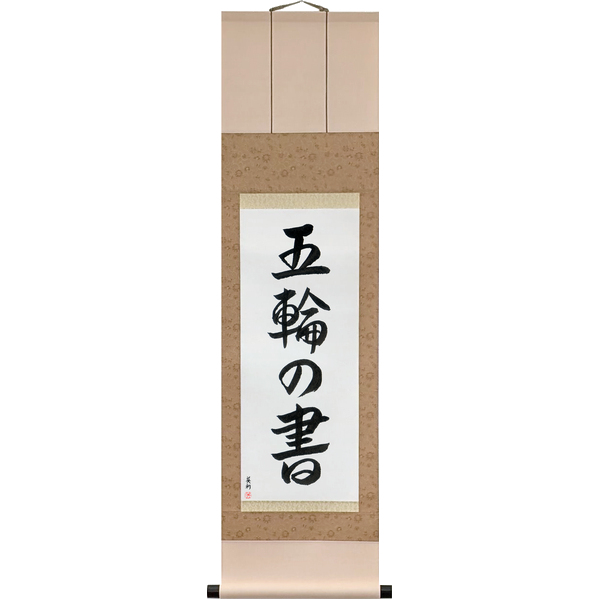
Sold as Book of Five Rings and Two Heavens One Style, two scrolls · Read gorin no sho; niten ichiryū · Oldest witness for the school's name, Musashi's own memorandum of 1641, where it is 二刀の一流, the two-sword school; for the book's title, the 1776 biography that calls it 五倫の書 and 五輪の卷, since the book never names itself · Sense the title of the five scrolls Miyamoto Musashi wrote in a Kumamoto cave in his last two years, named for the Buddhist five elements, and the name of the school of two swords they teach, which took his own name 二天 after his death
The words
Two names, and the first thing to know about each is that it is a name. 五輪 is a Buddhist word before it is anything else: the five 輪, wheels or rings, are the five 大 that make up the world, 地・水・火・風・空, earth, water, fire, wind and void, and the oldest dictionary of Japanese gives the word that sense first, with a citation of 1296 (五色五輪の形も、五仏の智よりあらはる). The same five stack up in the five-ringed stūpa 五輪塔 that stands in every old graveyard, and the same word, by a newspaper man's coinage after the 1936 Berlin games, is what Japanese now calls the Olympics. の is of, 書 a writing. Gorin no sho is the writing of the five rings, and the rings are the five scrolls, each named for one element. The dictionaries head the book 五輪書, without the particle; the scroll writes 五輪の書 with it, which is how the two editions that gave the text its modern readers printed the title, in 1915 and 1939, so both forms are right and a buyer who meets the other has not met a mistake.
二天一流 is three words, not four. 一流 is one word, a school, this school: Musashi writes 此一流, 我一流, 一流の道 all through the text, and every school of the sword is a 流. 二天, two heavens, is a rare and mostly Buddhist compound (the sun and moon devas; two of the four heavenly kings), but here it is not a compound at all: it is Musashi's own name, the 号 he signed his paintings with and the name on the stele his son raised. So niten ichiryū is the Niten school, the way one says the Yagyū school; it does not describe a technique. The English Two Heavens One Style reads the four characters one at a time, which is what the tradition has done since 2002 and what the page does, and it is fine as a title so long as the buyer knows it is a name.
A history, from the earliest witness
1641. Miyamoto Musashi, 兵法三十五箇条, the memorandum for Lord Hosokawa Tadatoshi. The thirty-five articles Musashi presented to his patron in the second month of 1641 open by naming the school: 兵法二刀の一流、數年鍛鍊仕處、今初て筆紙にのせ申事, the two-sword school of strategy, which I have trained in for years and now for the first time set down on paper. This is the oldest dated text in which Musashi names his school, and the name is 二刀, two swords. [17][16]
Before 1657. Hayashi Razan, the inscription on Musashi's portrait. The Confucian scholar of the shogun's court wrote a Chinese eulogy on a portrait of Musashi, quoted in the 二天記 and in 1909 from Razan's collected writings: 劒客新免玄信、每一手持一刀、稱曰二刀一流, the swordsman Shinmen Genshin holds a sword in each hand and calls it the school of two swords as one. The 二天記 says Musashi had the portrait painted when he left Edo and asked Razan for the words. Again 二刀. [12]
1643 to 1645. Miyamoto Musashi, the five scrolls. The preface, as every copy gives it: 兵法の道、二天一流と號し、數年の鍛鍊の事初て書物に著さんと思ふ、時に寛永二十年十月上旬之比、九州肥後の地岩戶山に登り、天を拜し觀世音を禮し、佛前に向ひ、生國播磨の武士新免武藏藤原玄信年積て六十, the way of strategy I call the Niten school, and I mean now for the first time to set down in a book what I have trained at for years; in the first ten days of the tenth month of 1643 I climbed Mount Iwato in Higo, bowed to heaven, paid reverence to Kannon, faced the Buddha, I, Shinmen Musashi Fujiwara no Genshin, a warrior born in Harima, sixty years old. The Water scroll opens the same way, 兵法二天一流の心、水を本として. But when the Earth scroll comes to explain the name, the name it explains is the other one: 此二つの理を知らしめん爲めに、二刀一流といふ也, to make known the use of these two [swords] it is called the two-sword school, and the Fire, Wind and Void scrolls each open 二刀一流の兵法. The book also never calls itself 五輪書. What it says is 此兵法の書五卷に仕立つる事, why this book of strategy is made in five scrolls: 五つの道を分ち、一まき一まきにして、其理を知らしめんが爲に、書き顯す也 … 地水火風空として五卷に書き顯す, I divide the way in five and write it scroll by scroll so its reasons can be known … as earth, water, fire, wind and void, in five scrolls. The colophons are dated the twelfth day of the fifth month of 1645, a week before the received date of his death; the 1909 typeset reads the thirteenth, and the two typesets address the scrolls to different pupils. No copy in Musashi's hand survives, and the oldest dated copy is the one his pupil Terao Magonojō made for a pupil of his own in 1667. [18][17][16]
1654. Miyamoto Iori, the stele at Kokura. Nine years after the death, Musashi's adopted son raised a stone whose title reads 兵法天下無雙播州赤松末流新免武藏玄信二天居士碑, and whose text says 武藏玄信號二天 … 爲二刀兵法之元祖也, Musashi Genshin, styled Niten … was the founder of two-sword strategy. On the stone, 二天 is the man and the art is 二刀. The text was printed in 1716 in the first history of Japanese martial arts, copied into an Edo painters' dictionary, and printed again in 1909, where the title reads 二天道樂居士. [17][11]
1776. Toyota Kagehide, 二天記, the Kumamoto biography. Compiled over three generations of the Toyota family from what Musashi's surviving pupils told the grandfather, and the source of most of what is told about him. Its editorial note says the book was filled out 五倫の書等の中より, from the Book of the Five 倫 and the like, with the Confucian 倫 for 輪; its account of the death says 寺尾勝信に五輪の卷、同信行に三拾五ケ條の書を相傳也, to Terao Katsunobu he passed on the five-ring scrolls and to Nobuyuki the thirty-five articles; and of the school it says simply 二天一流と稱するなり. It also records where the name 二天 came from: 立田山泰勝寺二世の僧春山和尙に綠り、道號を二天道樂と號す, through the monk Shunzan of Taishōji he took the Buddhist name Niten Dōraku. These are the oldest names for the book that were opened. [12]
1790 and 1793. The other names. A Kansei-era survey of sword schools calls Musashi's 武藏流圓明流とも云, the Musashi school, also called the Enmei school, and says he 改て新に工夫し二刀の一流を立たり, thought it out afresh and founded a two-sword school; a memorial stone of 1793 quoted in 1909 calls it 二刀兵法圓明一流. Enmei, 円明, is the name the dictionaries say Musashi used first, in his youth. [17]
1883 to 1892. The Kumamoto han school's roster. When the Ministry of Education gathered the old domain schools' records, Kumamoto's 時習館 listed its sixteen instructors of the sword by school, and two of the names are Musashi's: 二天流兵法二、二天一流兵法三, two of the Niten school, three of the Niten Ichi school. By the end of the shogunate, 二天 had been the school's name for two centuries, and it was taught under both spellings in the town where the book was written. [15]
1909. The Miyamoto Musashi Memorial Society, 『宮本武蔵』. The first modern biography prints the whole text of the five scrolls as its ninth chapter, 第九章五輪書, from a copy then in a Kumamoto family's hands, and this is the earliest print of the title 五輪書 the National Diet Library's index finds. The same year's first separate edition was titled 二刀一流剣道秘要, the two-sword school's essentials of the way of the sword. [16]
1915 and 1939. The two editions a reader could buy. The 武術叢書 of 1915 prints the text under the running title 五輪の書 with the particle, collated from two pupils' lines, and its editor notes 本書は『五輪の卷』とも云へり, this book is also called the five-ring scrolls, and that 圓明流とは宮本武藏の二天一流の別名にして、後世に至りて名づけられたるものなり. The 1939 教材社 edition, sold for sixty sen as 五輪の書 : 原本, is the form the scroll brushes; it is a typeset, not a facsimile, and it drops the preface and the colophons. [17][18]
Today. The dictionaries: 五輪書, a book of the martial way of the early Edo period, five scrolls, by Miyamoto Musashi, composed about 1645, also called 五輪の巻; 二天一流, a school of swordsmanship founded by Miyamoto Musashi; at first called the Enmei school, and after Musashi's death renamed 二天一流 by his pupil Terao Kumanosuke Nobuyuki; also 二刀一流, 二天流, with the book's own preface given as the word's first occurrence. The Japanese encyclopedias add that the renaming was about 1666, from the master's Buddhist name 二天道楽居士. [kotobank, 精選版 日本国語大辞典 and 日本大百科全書, text]
The sense across time
The book has one sense and the school's name has a history. The five scrolls are what they say they are, a swordsman's account of his way in five parts named for the five elements, and nobody has read the title otherwise. What has moved is the name of the school. In Musashi's lifetime and for a decade after, every dated witness says two swords: his own 1641 memorandum, Razan's inscription, his son's stone. The book he wrote says both, two swords five times and 二天 twice, and it survives only in copies made after the pupil who is credited with the renaming had taken over the school. The dictionaries hold both facts in one entry, that the preface is the first occurrence of 二天一流 and that the name was given after his death, and do not reconcile them; the reconciliation, if one wants it, is that the preface as we have it is a pupil's copy. Since the seventeenth century the school has been 二天一流 and nothing else, in Kumamoto, in Fukuoka, in Echigo, in the han school's roster and on the scroll.
What is not a source
Musashi's other texts are not sources for these two names but neighbors: the 独行道, his twenty-one articles of 1645, has its own history in this Library and is not re-read here. The Zen and Buddhist reading of the five elements is a frame the encyclopedias put around the title, not a source for it; the text itself says it borrows no old words of Buddhism or Confucianism. The English explanations of 二天 as two swords raised to the sky are the translators' guesses and are named as such below. The Olympic 五輪 descends from the book's title by a newspaperman's choice in 1936 and is not a witness to it.
The text in English
1974. Victor Harris, A Book of Five Rings, Overlook Press, New York. The first English, and the title every later one keeps. Harris writes the school Ni Ten Ichi Ryu and explains, Niten means "Two Heavens", said by some to allude to his fighting attitude with a sword in each hand held above his head; he heads the naming section The Name Ichi Ryu Ni To (One school—two swords), which is right, and grounds the title in the "Go Dai" (Five Greats) of Buddhism … the five elements which make up the cosmos. His pupil's name is wrong throughout: Teruo Nobuyuki in the introduction and Teruo Magonojo at the colophons, for Terao 寺尾, and Nobuyuki 信行 is the brother, not the man the scrolls are addressed to. [25][26]
1993. Thomas Cleary, The Book of Five Rings, Shambhala, Boston. Cleary renders the school the Individual School of Two Skies, reading 一流 as individual and 天 as sky, and the naming section Naming This Individual School "Two Swords", with Two Swords in One in the text; his note says the book is more properly titled in English The Book of Five Spheres. [27]
2002 and 2004. William Scott Wilson, The Book of Five Rings (Kodansha International, 2002) and The Lone Samurai (Kodansha International, 2004). Wilson's is the rendering the scroll carries: Having trained myself daily in the Two Heavens, One Style, I now take brush to paper, quoted in his biography from his own translation, which was not opened. The biography has a chapter, The Concept of the Five Rings in Esoteric Buddhism, that reads the title as the Buddhist word. [28]
2004. Kenji Tokitsu, Miyamoto Musashi: His Life and Writings, translated by Sherab Chödzin Kohn, Shambhala, Boston. Tokitsu calls the book "Writings on the Five Elements" (Gorin no sho), popularly known as The Book of Five Rings, and the school School of the Two Heavens United, or School of Two Swords Raised to the Heavens Becoming One, offering the two swords raised toward the sky as the sense of 二天. [29]
2016. David K. Groff, Five Rings: Miyamoto Musashi's Art of Strategy. Groff keeps both names as the text has them, Ni Ten Ichi Ryu ("Two Heavens One Style") and Ni To Ichi Ryu ("Two Swords One Style"), and notes that both occur. [30]
2018. Alexander Bennett, The Complete Musashi: The Book of Five Rings and Other Works, Tuttle. The most recent scholarly translation says what this history says: he refers to it mostly as Nitō Ichi-ryū (School of Two Swords as One), and it was at the very end of his life in Kumamoto that the school became "School of Two Heavens as One"; that the title was given by two later men of Kumamoto, Nagaoka Naoyuki and Toyota Masakata; and that the five elements point to Buddhist doctrine without that being Musashi's intention. He renders the fifth scroll Ether. [31]
Today. JMdict: 五輪書, The Book of Five Rings (martial arts treatise by Miyamoto Musashi, 1643); 二天一流, style of classical Japanese swordsmanship involving use of two swords. The house titles are the tradition's: Book of Five Rings is Harris's without his article, and Two Heavens One Style is Wilson's and Groff's, against Harris's and Bennett's Two Heavens as One, Cleary's Two Skies and Tokitsu's Two Heavens United. A rendering of the school's name must keep 一流 as one word, school, and may keep Two Heavens only as a name; a rendering of the title must keep the five, and rings is what fifty years of English have agreed on for 輪.
A reading
Both scrolls brush the right form. 五輪の書 with the particle is the title of the edition a Japanese reader has held since 1939 and of the collection that printed the text in 1915; 二天一流 is the school's name in every dictionary and on every dojo's door since the seventeenth century. What the buyer should know, and what the pages do not say, is what the sources say plainly: the title is not in the book, which calls itself five scrolls, and the school's name on the scroll is not quite the name Musashi used of it in his own hand, which was two swords. 二天 was the man. The book says both, and the book survives only in his pupils' copies. I read 二刀一流 as Musashi's word and 二天一流 as the school's, and I would not change the scroll, because the school is what a buyer is naming, and the school has been Niten for three hundred and fifty years. The English titles I would leave alone too. Book of Five Rings is not a translation of the Buddhist word but it is what the book is called; Two Heavens One Style splits a word in two, and the page's character-by-character gloss does the same, but as a title it does no harm once the reader has been told it is a name. Signed, 典, 2026-09-07.
How this was read
By eye: the two template files. By OCR layer at the National Diet Library's page API, every Japanese quotation above: the 1939 教材社 edition (pid 1071527, komas 2, 7, 8, 12, 22, 35, 41, 42), the 1915 武術叢書 (pid 945805, komas 5, 42, 107, 123, 127, 129, 130, 134, 135, 139, 142), the 1909 biography (pid 992019, komas 57, 62, 63, 80, 82, 85, 97, 103, 108, 120), the 1910 肥後文献叢書 (pid 766733, komas 94, 95, 101, 102), the 1892 education records (pid 809556, koma 115) and the Edo painters' dictionary (pid 2551785, koma 77); the text of any of these is at lab.ndl.go.jp/dl/api/page/
References
- Template M1042SSVC5A () — takase-images (by eye)
- Template M1059SSVC3A () — takase-images (by eye)
- 宮本武蔵『兵法三十五箇条』 (1641) — 1915 武術叢書 pid 945805 koma 123, OCR; 1909 pid 992019 koma 63, OCR
- 宮本武蔵『五輪書』序 (1645 (copies from 1667)) — 1915 pid 945805 koma 127, OCR; 1909 pid 992019 koma 97 (巖殿山), OCR; absent from 1939 pid 1071527
- 『五輪書』地之巻 此兵法の書五卷に仕立つる事 (1645) — 1939 pid 1071527 koma 7, OCR
- 『五輪書』地之巻 此一流二刀と名付くる事 (1645) — 1939 koma 8, OCR; 1915 koma 129 (此二つの利を知らしめんために、二刀一流と云也); 1909 koma 103
- 『五輪書』水之巻 (1645) — 1939 koma 12, OCR; 1915 koma 130; 1909 koma 108
- 『五輪書』火 · 風 · 空之巻 (1645) — 1939 komas 22 · 35 · 41; 1915 komas 134 · 135 · 139 · 142; OCR
- 『五輪書』colophons (1645 · 1667) — 1915 komas 135 · 142, OCR; 1909 koma 120, OCR; none in 1939
- 林羅山, 武藏像賛 (羅山文集) (before 1657) — 1909 koma 85, OCR; 1910 肥後文献叢書 pid 766733 koma 102, OCR; the 文集 not opened
- 宮本伊織, the Kokura stele (1654) — 本朝武芸小伝 (1716) in 1915 pid 945805 koma 42, OCR; 扶桑名画伝 manuscript pid 2551785 koma 77 (classical), OCR; 1909 koma 80 (二天道樂居士), OCR ↩
- 豊田景英 校『二天記』序 · 凡例 · 本文 (1776 (安永丙申)) — 1910 pid 766733 komas 94 · 95 · 101, OCR ↩
- 三上元龍『撃剣叢談』 (1790) — 1915 pid 945805 koma 107, OCR
- A memorial stele, 寛政5 (1793) — 1909 koma 57, OCR
- 文部省『日本教育史資料』熊本 時習館 (1892 (reports from 1883)) — pid 809556 koma 115, OCR ↩
- 宮本武蔵遺蹟顕彰会『宮本武蔵』金港堂 (1909) — pid 992019 komas 97 · 62 · 82, OCR ↩
- 吉丸一昌, 解題 in『武術叢書』 (1915) — pid 945805 koma 5, OCR ↩
- 『五輪の書 : 原本』教材社 (1939) — pid 1071527 komas 2 · 42, OCR ↩
- 精選版 日本国語大辞典 () — kotobank.jp/word/五輪書 · 二天一流 · 五輪 · 二天 · 円明流 (text)
- デジタル大辞泉 () — kotobank (text)
- 改訂新版 世界大百科事典 (中林信二) () — kotobank.jp/word/五輪書 (text)
- 日本大百科全書 (渡邉一郎) () — kotobank.jp/word/二天一流 · 五輪書 (text)
- JMdict () — JMdict_e.gz (text)
- ja.wikipedia 五輪書 · 二天一流 () — api extracts (text; reported, unsourced in the extract)
- Victor Harris, *A Book of Five Rings*, Overlook Press (1974) — IA bookoffiverings00miya, fts snippets; ISBN 0879510188; amazon.com/dp/0879510188 (200) ↩
- Harris, Bantam (1982) — IA bookoffiveringsg00miya; ISBN 055322509X; amazon.com/dp/055322509X (200) ↩
- Thomas Cleary, *The Book of Five Rings*, Shambhala (1993 (2005 printing)) — IA bookoffiverings0000miya_g5e4; ISBN 1590302486; amazon.com/dp/1590302486 (200) ↩
- William Scott Wilson, *The Lone Samurai*, Kodansha International (2004) — IA lonesamurailifeo0000wils; ISBN 477002942X; amazon.com/dp/477002942X (200) ↩
- Kenji Tokitsu, *Miyamoto Musashi: His Life and Writings*, Shambhala (2004) — IA miyamotomusashih0000toki; ISBN 1590300459; amazon.com/dp/1590300459 (200) ↩
- David K. Groff, *Five Rings* (2016) — IA fiveringsmiyamot0000miya; ISBN 9780785834007 (ASIN not checked) ↩
- Alexander Bennett, *The Complete Musashi*, Tuttle (2018 (2020 printing)) — IA completemusashib0000miya; ISBN 9784805316160; amazon.com/dp/9784805316160 (200) ↩
- The house: catalogue, pages, blog (2026) — etl/data; takase.com (text)
Books Cited
The books this article cites. Buying one supports its author.