

夫婦円満 · fūfu enman · a marriage round and full
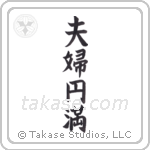
Sold as Marital Bliss · Read fūfu enman · Register standard modern Japanese, the language of the wedding toast, the fortune slip and the character reference; not in the national dictionaries, which list its two halves · Sense a husband and wife in harmony, their life together round and full, without a corner to catch on · Oldest witness the novels of 1905 · Signed 典, 2026-09-07.
The word
夫婦 fūfu is husband and wife, a Chinese compound in Japanese since the ninth century. 円満 enman is round and full: a Buddhist word first, for merit that lacks nothing, then for a face that is full, then for a state of things without defect, and last, in the novels of the 1900s, for a person or a household that is without corners, 穏やか, easy and unruffled. The 精選版 日本国語大辞典's first citation for that last sense is 小栗風葉 in 1905: 家庭の幸福とか、夫婦間の円満とか云ふものは, what is called the happiness of a home, or harmony between husband and wife. The compound 夫婦円満 has no entry of its own on the dictionary site that serves the major dictionaries; JMdict gives matrimonial happiness; happy marriage. The English bliss is warmer than the Japanese, which is a word for a marriage that works, not one that transports; harmony is the nearer word, and the page's gloss of 円満 as perfection; harmony is right on the second half. The prewar books write it 夫婦圓滿 with the old forms; the design uses the modern ones, and they are one word.
Where it is used
The Diet Library's earliest is 徳田秋声 in 1905: 御夫婦圓滿で、且つ御一家御案業とあつてこそ, only if the couple is harmonious and the whole house at peace in its work, said of what a family marriage is for. Then the places the word has lived since. A 1916 book on gemstones: carnelian 夫婦圓滿を保證す, guarantees marital harmony. A 1932 fortune almanac, for those born in the eleventh month: 共息災なり夫婦円満なり, you will be free of illness and harmonious in marriage. A 1937 guide to Shimane, advertising shrine weddings at Izumo: 神前結婚擧式を行へば夫婦圓滿で離婚がないとて益々增加の趨勢にあり, since a wedding before the god there means a harmonious marriage and no divorce, they are more and more in demand. A 1933 biography of a prime minister and a 1936 novel use it as a character reference, known for filial piety and a harmonious marriage. The count of books using it jumps in the 1930s, and 横光利一 gives a character the line in 1938: 夫婦圓滿といふことより、豪いことはないと思ふんだ, I have come to think there is nothing greater than a harmonious marriage. It is a wish and a report, never a saying with an author. Its sister is 家庭円満, a harmonious home, born in an advertisement of 1902 and given a headword in a dictionary of new words in 1919; the older words for the same wish are grander and classical, 琴瑟相和 the lute and zither in tune from the Book of Songs, 偕老同穴 grow old together, share one grave, and 比翼連理 wing to wing, branch to branch from 白居易.
The word in English
JMdict: matrimonial happiness; happy marriage. The house's Marital Bliss is its own, made for Takase Studios, and it is a little warmer than the Japanese, which is closer to a happy, harmonious marriage. A rendering must keep the two persons and the roundness; harmony carries the roundness better than bliss does.
A reading
A word of about 1905, without a source text and without a dictionary entry of its own, and none the worse for either: it is the phrase a Japanese fortune slip, a shrine and a wedding guest all use for the state a marriage should be in, round and full and with no corner to catch on. The page calls it a four-character idiom; it is a four-character compound, plain modern Japanese, and the classical idiom for the same wish is 比翼連理, which belongs beside it on any wedding shelf. The design is right and the page needs nothing changed. If a buyer wants the wish every Japanese guest would write on a wedding card, this is the word.
How this was read
By eye: the template L5026SSVB3A. By text at the address: the Diet Library's full-text index on six forms with the compound pulled whole and counted by year (the text of a leaf is at lab.ndl.go.jp/dl/api/page/
References
- 小栗風葉, 青春 (1905–06) — 日国 円満 ④ 初出, reported
- 徳田秋声, 少華族 下編 (1905) — pid 886721 koma 77, OCR
- 鈴木敏 編, 寳石誌 (1916) — pid 954689 koma 68, OCR
- 高島易斷所, 御重寶 昭和8年 (1932) — pid 2535558 koma 37, OCR
- 斎藤実伝 (1933) — pid 1224211, by highlight
- 島根県案内誌 (1937) — pid 1120780 koma 46, OCR
- 横光利一, 春園 (1938) — pid 1229236, by highlight
- 結婚前後の修養 (1940) — pid 1282243 koma 37, OCR
- JMdict (current) — jisho, text
- kotobank (2026-09-07) — text