

独立独歩 · dokuritsu doppo · Self-Reliant
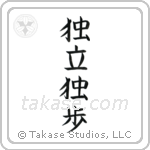
Sold as Self-Reliant · Read dokuritsu doppo, four graphs: alone, stand, alone, walk · Register plain praise; a school motto; a word twelve-year-olds are tested on · Sense two: to act on what one believes without leaning on anyone; and, older, to have no equal.
The words
The word is two words doubled. Dokuritsu, standing alone, is what Laozi called the Way, which stands alone and does not change, and what the Book of Changes asks of the superior man, who stands alone and is not afraid. Doppo, walking alone, has three senses in the national dictionary: to walk by oneself, as Bashō did under heaven and earth in 1687; to be without peer, as a preface of 905 says of the poet Hitomaro, who walked alone between past and present; and to act on one's own. Put together they mean, in the dictionaries' words, to act on what one believes without leaning on others, with the example the spirit of dokuritsu doppo; and, second, to have no equal. The four-character dictionary says to think and judge for oneself and walk the road one believes in. The synonym list runs standing on one's own feet, self-made, single-handed, the lone fight, the lone wolf, the outsider, which is where this catalogue's Lone Wolf link comes from. English self-reliant is Emerson's word, and it says the first sense exactly and the second not at all.
Where it comes from
The four characters together are Japanese. The Chinese corpora have no such string, though they have the parts and a cousin: the Book of Rites praises the scholar who stands apart and walks alone, with a different first word. Japan's own older compound is dokuritsu dokkō, stand alone, go alone, which a lecturer of the Kiyohara school wrote down in 1530 to explain Zhuangzi's odd man, the one who is odd among men and matched with Heaven: he is the unpaired one; he stands and walks alone; he pairs with no one. That form was Fukuzawa's own preference and, to the middle of the twentieth century, the commoner of the two in print. The form on this design, with walk, is first found, so far as the library of prewar books reaches, in the mouths of Zen lecturers of the 1880s, not quoting the canon but explaining it. A commentary of 1888 on Hongzhi's verses glosses the verse's walking alone through the world as standing and walking alone under heaven, with no one to shoulder him, in a bright and clear state; a commentary of 1890 on the Blue Cliff Record uses it for the capping phrase on Deshan, who looked round the hall, said no, no, and walked out: what spirit, reaching to heaven. Within four years the same four characters were in the civic prose of the age: an educator in 1892 on the person who, like the people under the sage kings, thinks everyone stands and walks alone; a budō manual of 1895 on the swordsman who, with Saigō's let the slanderers slander and Sakuma Shōzan's let the mockers mock, stands and walks alone and is not shaken by praise or blame; a jōruri master in 1898 telling the young Kido Takayoshi that one more push and he could perform on his own. Fukuzawa, whose independence was the word of the age, used it of himself in his autobiography of 1899 in the sentence the national dictionary chose: a nation's independence springs from its people's independent spirit … I resolved to be indifferent to everything, settled my mind on dokuritsu doppo alone, and had no wish to cling to the government or to lean on officials. The word rose through the 1910s and 1920s to its peak in the 1930s, when a newspaper applied it to the nation itself, and came through the war into the postwar spelling, where a 1948 book uses it of Lincoln's self-taught rise. The novelists have it in 1947 and 1972; the dictionaries now head this form and make the older one its cross-reference.
The text in English
No nineteenth-century dictionary carries the four characters. Hepburn's dictionaries have doppo, to walk out alone; to be alone in talent or ability, above all others, and Brinkley's gives it three senses, going alone; independence; preeminence, with the example the first gentleman under heaven, one excelled by none. For self-reliant Hepburn offered relying on oneself, and for independent the word dokuritsu itself. The English word has its own history: Emerson's essay Self-Reliance of 1841, Trust thyself and Insist on yourself; never imitate, and Smiles's Self-Help, which reached Japan in 1870 as the book that taught a generation the word hitori-dachi, standing on one's own. The modern dictionaries make the equation this catalogue uses: Kenkyūsha's self-reliance, the online dictionaries' self-reliance; self-help, the thesaurus's self-direction, autonomy, self-sufficiency; Saitō's dictionary of 1928 turns it into English idiom, to look out for oneself, fight for one's own hand, sail on one's own bottom. Japanese today uses the word as praise with no edge: a junior high school in Gamagōri has it as its motto, a television portrait of the calligrapher Sakaki Bakuzan took it as its title, and a hundred Japanese Wikipedia articles carry it, for villages, companies, performers who had no master.
A reading
Signed 典, 2026-09-08. This is a Meiji word made of two ancient ones, and the join is Japanese. China had both halves for two thousand years, Laozi's standing alone and the canon's walking alone, and never set them side by side; a Japanese lecturer did it first for Zhuangzi in 1530 with go as the second word, and Zen lecturers of the 1880s did it with walk to say what the old verses meant by a man with no one at his shoulder. That is the word's second sense, and the older one. The first sense, the one this page sells, belongs to the age that needed it: when Fukuzawa wrote that a nation's independence springs from its people's, the same four characters became the plain word for a person who leans on no one, and the national dictionary chose his sentence to date it. The English self-reliant is Emerson's word, and the modern dictionaries' equation, and it is right for the first sense and silent on the second. A buyer who means I stand on my own has the living word exactly; a buyer who means I have no equal has a different word. The design is exact and the reading stands. The page's gloss is the dictionaries' first sense in its own words, and its Lone Wolf link is the dictionary's own synonym; what it does not tell the buyer, and this history does, is that the word is a hundred and forty years old, that its older sense is the peerless one, and that Fukuzawa said it of himself. No question for Eri.
How this was read
By eye: the template; six pages at the National Diet Library's image host, the Zen commentaries of 1888 and 1890, the 1892, 1895 and 1898 books, and an undated Zen lecture. At the column: the Hongzhi verse and the Blue Cliff capping phrase in the Taishō canon through CBETA's API. By text: five dictionary pages at kotobank; Fukuzawa's autobiography and An Encouragement of Learning at Aozora; the Chinese Text Project for the null, the Book of Rites, Laozi, the Changes and Zhuangzi; the four-character dictionary, Weblio, the Japanese and English Wikipedia searches. By OCR: the local harvest archive of 9,873 prewar books on thirteen forms, with the Fukuzawa collected works, the 1876 and 1892 witnesses for the older form, and the 1897 to 1948 witnesses; the four shelf dictionaries. Not opened: the 1530 commentary at the leaf; the 1899 first edition; Kunikida Doppo's pen name, which is not asserted here; the Library's own index, which waits on Tim's run. Every address is in the account, marked by eye, at the column, OCR or text.
References
- ctext, pre-Qin/Han and post-Han, for 獨立獨步 and 獨立獨行 (—) — ctext.org searches
- 老子 25 (字通's source for 独立) (—) — ctext, 2 paragraphs
- 易 大過 象傳 (日国's source for 独立) (—) — ctext.org/book-of-changes/da-guo
- 礼記 儒行 · 孔子家語 儒行解 (—) — ctext, 特立獨行 2
- 荘子 大宗師 (the 1530 commentary's text) (—) — ctext.org/zhuangzi/great-and-most-honoured-master
- 古今和歌集 真名序 (日国) (905–914) — kotobank 独歩
- 宏智正覚 頌, 從容録 第三十五則 洛浦伏膺; 萬松 評唱 (c. 1150; 1224) — T48n2004_p0251a17–18 · p0251b11–12, CBETA API
- 圜悟 著語, 碧巌録 第四則 德山挾複子 (c. 1125) — T48n2003_p0143b06, CBETA API
- 清原国賢書写本 荘子抄 二 (日国) (1530) — kotobank 独立独行
- 学談雑録 (日国) (c. 1716) — kotobank 独立
- 中島勝義 編 俗夢驚談 (1876) — pid 783427 k33, OCR
- 白鳥鼎三 宏智禅師頌古接觜録 (1888) — pid 823560 k58 p. 52, by eye (particles OCR)
- 本高 碧巌録耳林鈔 (1890) — pid 823482 k15, by eye (wording OCR)
- 巌本善治 吾党之女子教育 (1892) — pid 808102 k5 p. 3, by eye
- 山田美妙 新式節用辞典 (1892 · 1895) — pid 2938260 k195 · 993764 k192, OCR
- 隈元実道 武道教範 (1895) — pid 1086788 k25 pp. 10–11, by eye
- 日常行為の法則 (1897) — pid 757990 k76, OCR
- 福沢諭吉 福翁百話 (1897 (1907 printing)) — pid 1082748 k191, OCR
- 洒々道人 編 洒落文庫, 木戸孝允浄瑠璃稽古 (1898) — pid 882521 k86 pp. 156–157, by eye
- 望月小太郎 鶯渓演説集 (1898) — pid 898213 k31, OCR
- 福沢諭吉 福翁自伝 (日国 初出) (1899) — Aozora 1864; 全集 pid 979057 k299, OCR
- 桑谷定逸 富豪の面影 · 内田魯庵 社会百面相 · 新仏教徒同志会 将来之宗教 · 北海道立志編 · 大町桂月 わが筆 (1902–1905) — pids 758220 k74 · 886646 k146 · 814917 k193 · 778717 k341 · 889319 k126, OCR
- 中村勝麻呂 井伊大老:真面目の人 (undated (author d. 1944)) — pid 1875095 k57 pp. 104–105, by eye
- 福沢全集 続 第4巻 (時事新報) (1934) — pid 1078065 k205, OCR
- 徳富蘇峰 書窓雑記 (1930) — pid 1174280 k122, OCR
- 坂口安吾 青鬼の褌を洗ふ女 (四字熟語を知る辞典) (1947) — kotobank 独立独歩
- 新島繁 時代の青春 (1948) — pid 1062378 k124, OCR
- Hepburn 1867 · 1886 () — papers/ OCR, lines 11291 · 157189 · 147797
- Brinkley 1896 () — papers/ OCR, lines 31629–31 · 31183
- 研究社 新和英中辞典 · JMdict · 斎藤和英 · WordNet (Weblio; gokanji.db) (current) — ejje.weblio.jp/content/独立独歩 · gokanji.db 1456100
- Emerson, Self-Reliance (1841) — en.wikipedia.org/wiki/Self-Reliance
- jitenon · ja.wikipedia full-text (current) — yoji.jitenon.jp · ja.wikipedia.org search
- The local archive, thirteen forms (to 1962) — search_ndl_archive.py, local_archive_counts.txt