

知足 chisoku Be Satisfied
This is a philological study of the word 知足 (chisoku), following it from the 老子 and the Buddhist 遺教経 through Kūkai, Dōgen and the tea books, the four characters 吾唯知足 from a Chinese seal to the stone basin at Ryōan-ji, and both into English.
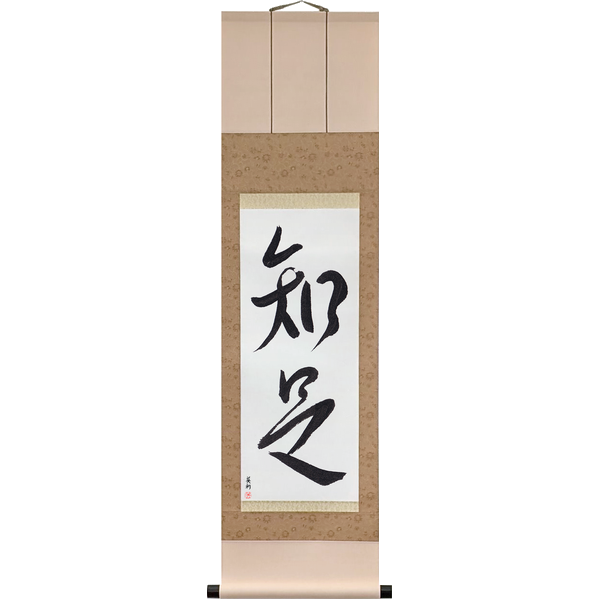
Be Satisfied (chisoku) on a traditional Japanese Scroll by Master Eri Takase.
Abstract
知足 (chisoku), knowing what is enough, is a Chinese word with two homes. The Japanese dictionaries derive it from the 老子, he who knows what is enough is rich; the Buddhist canon carries it in the 遺教経, the Buddha's last instruction to his monks as Kumārajīva translated it, where it is the second of eight practices, and Dōgen's last chapter sets out those eight. Its first known use in Japan is in Kūkai's own hand in 797. The four characters 吾唯知足 set round one shared 口, known in the West from the stone basin at Ryōan-ji, are a Chinese seal design printed in Japanese seal books by the early eighteenth century; the basin's gift by Tokugawa Mitsukuni is the temple's tradition, and no document is known for it.
Overview
The sense. A word of Chinese origin, in the standard dictionaries. デジタル大辞泉: 《「老子」三三章の「足るを知る者は富む」から》みずからの分をわきまえて、それ以上のものを求めないこと。分相応のところで満足すること, from the 老子, chapter 33, "he who knows what is enough is rich": to know one's own measure and seek nothing beyond it; to be satisfied with what befits one [1]. 精選版 日本国語大辞典: 足ることを知ること。自分の持ち分に満足し安んじて、欲張らないこと, knowing what is enough; being content and at ease with one's own share and not grasping for more [1]. Both give a second sense, 知足天, the Chinese translation of Tuṣita, the fourth heaven of the realm of desire and the dwelling of Maitreya, which shares the characters and nothing else [1][2]. The native reading of the phrase is 足るを知る, taru o shiru [3], and the four-character 知足安分, knowing what is enough and resting in one's lot, carries the same sense as a maxim [4]. The everyday Japanese word for satisfaction is 満足 (manzoku), which the English-Japanese dictionaries give beside 知足 under content [5][6]; 知足 is the narrower and older word, the satisfaction that comes from knowing a limit.
The words. 知, to know; 足, in this compound not the foot but 足る, to be enough, as the 字通 glosses it: 足るを知る [1]. The reading is ちそく, chisoku. The compound is a verb and its object, to know enough, used as a noun; the dictionaries' senses turn on that grammar, since what is praised is a knowing, not a having.
The text in English. The Meiji dictionaries render it through content: Hepburn in 1872 gives Chisoku naru for CONTENTED [7], and in 1886 chisoku for CONTENTMENT [5]; Brinkley in 1896 heads it Knowing how to be satisfied; contentment; satisfaction [8]; Kenkyūsha in 1939 gives Contentment; content [9]. Of these only Brinkley keeps the knowing. JMdict carries 知足 only as a name, with no English gloss for the common word [10].
The historical record
Warring States period, the 老子, chapters 33, 44 and 46. The source the dictionaries name. Chapter 33: 知人者智,自知者明。勝人者有力,自勝者強。知足者富, he who knows others is wise, he who knows himself is clear; he who conquers others has strength, he who conquers himself is strong; he who knows what is enough is rich [11]. Wang Bi 王弼 comments 知足自不失,故富也, he who knows what is enough does not lose himself, and so he is rich [12]. Chapter 44: 知足不辱,知止不殆,可以長久, know what is enough and you will not be disgraced, know where to stop and you will not be endangered, and you may last long [13]. Chapter 46: 禍莫大於不知足;咎莫大於欲得。故知足之足,常足矣, no calamity is greater than not knowing what is enough, no fault greater than the wish to acquire; so the enough of knowing enough is always enough [14]. In the 老子 the word is a ruler's and a person's safety as well as their wealth.
c. 402–412, the 遺教経, translated by Kumārajīva 鳩摩羅什. The sutra the Zen school counts among its three founding texts [15], the Buddha's last instruction before his death. Among the monk's duties: 於四供養知量知足, in the four requisites, know the measure, know what is enough [16]. Then the passage the Japanese tradition quotes:
汝等比丘,若欲脫諸苦惱,當觀知足。知足之法,即是富樂安隱之處。知足之人,雖臥地上猶為安樂;不知足者,雖處天堂亦不稱意。不知足者雖富而貧,知足之人雖貧而富。
Monks, if you wish to be free of every suffering, contemplate knowing what is enough. The way of knowing enough is the place of wealth, joy, peace and ease. One who knows enough is at ease lying on the bare ground; one who does not is not content though he dwell in heaven. One who does not know enough is poor though rich; one who knows enough is rich though poor [16]. Here the word is a monk's practice with the four requisites, food, robes, bedding and medicine, and a state that practice reaches. The sutra's rich man who is poor stands beside the 老子's man who knows enough and is rich.
797, Kūkai 空海, 聾瞽指帰, his own draft of the 三教指帰. The earliest Japanese use the 精選版 日本国語大辞典 cites [1]. In Kūkai's hand, as the facsimile of 1935 reproduces it, of the mendicant who goes out to beg: 乘知足意捧鉢直征, riding on the thought of knowing enough, he holds up his bowl and sets straight out [17]. The volume's own typeset transcription reads the same characters [18]. From its first Japanese appearance the word belongs to the mendicant.
900, Miyoshi Kiyoyuki 三善清行, a letter to Sugawara no Michizane 菅原道真. A warning to the minister to step down, dated 昌泰三年十月十一日: 伏冀知其止足、察其榮分, I humbly hope you will know where to stop and what is enough, and see the limit of your honors [19]. The word is 止足, not 知足: the two clauses of the 老子's chapter 44 folded into one. It is the 老子's political sense, advice to a man at the top of the court.
1253, Dōgen 道元, 正法眼蔵, 八大人覚. The chapter sets out the eight awarenesses of the 遺教経, and its colophon dates it to the first month of 1253. His disciple Ejō 懐奘, copying it in 1255, wrote that this draft is the last instruction of the late master [20]. The second: 二者知足(已得法中受取以限、稱曰知足), the second is knowing what is enough (taking within limits from what one has already gained is called knowing enough), and the sutra's passage follows whole [21]. The print of 1885 sets 富樂安穩之處, where the Taishō text of the sutra reads 安隱 [21][16].
1283, Mujū 無住, 沙石集. A collection of Buddhist tales that holds both sources at once. From the 老子: 老子猶イヘリ罪ハ可欲ヨリ大ナルハナク禍ハ不知足ヨリ大ナルハナシ, even Laozi said that no sin is greater than desire and no calamity greater than not knowing enough; and from the sutra: サレバ経ニハ。知足ノ人ハ地ノ上ニ臥セドモ安楽也。不知足ノモノハ。天堂ニ處スレドモ心ニカナハズ, so the sutra says that one who knows enough is at ease though he lie on the ground, and one who does not is not content though he dwell in heaven [22].
1648, Lin Xiyi 林希逸, 老子鬳斎口義, with the reading marks of Hayashi Razan 林羅山. The Song commentary through which Edo readers met the 老子. On chapter 33: 知足者富:無不足則常有餘也, he who knows enough is rich: with nothing lacking there is always more than enough [23].
1690, 頭書徒然草絵抄, an illustrated commentary on the 徒然草. 少欲知足の行とて出家しても少欲ありて堂れりとしるをは仏もほめたもふ也, the practice called few desires and knowing enough: even one who has left the world keeps a few desires, and the Buddha praises knowing that one has enough [24]. 少欲知足, few desires, knowing enough, the first two of the eight, is the form in which the word most often travels.
1707–1735, Ikenaga Dōun 池永道雲, 一刀万象, a seal book. The earliest known print of the four characters 吾唯知足 as one design: a round seal, printed in red, with 五 above, 隹 to the right, 止 below and 矢 to the left, the square hole at the center completing each as 吾, 唯, 足 and 知, I only know enough [25]. The collection was printed in two parts, the first in 1707–1709 and the second in 1735 [26].
1841, Sone Sunsai 曽根寸斎, 古今印例, a manual of seal carving. The same round seal, under the head 錯綜假借, interlaced and borrowed forms, captioned 吾唯知足 and 明 徐君重, Xu Junzhong, Ming [27]. The manual credits the design to a Chinese carver of the Ming dynasty.
1905 and 1920, the tea books. Tanaka Senshō 田中仙樵, 茶禅一味: 侘人にて物足らぬ道具を愛し、小欲知足に安ぜ, a man of wabi loves utensils that fall short, and rests in few desires and knowing enough, and 茶は、質素にして儉なる小欲知足を主義とすれば, since tea takes as its principle a plain and frugal few-desires-knowing-enough [28][29]. Okuda Shōzō 奥田正造, 茶味, of Rikyū: 小欲知足を根底として一を二に働かし, on a ground of few desires and knowing enough, he made one thing do the work of two [30].
1909–1943, the four characters as a coin. A book of word games of 1909 prints 吾唯知足 among its 合文字, characters sharing a part, to be read with the 口 at the center [31]. In 1910 the haiku poet Kawahigashi Hekigotō 河東碧梧桐, in the journal of his travels, describes a piece his host had made himself: 吾唯知足といふ景山公の石印を模したものであるさうな, said to be copied from Lord Keizan's stone seal reading 吾唯知足; Keizan is Tokugawa Nariaki 徳川斉昭, a lord of Mito [32]. A book of 1916 gives the design to Kūkai: 弘法大師は吾唯知足と四字を並べ一つの口を通用せしめて錢の形になし, Kōbō Daishi set the four characters 吾唯知足 in a row, let one 口 serve all of them, and made them into the shape of a coin [33]. In 1942 and 1943 two books of wartime moral instruction reject the motto as 小乘的, small-vehicle, and 個人主義的自己滿足, individualist self-satisfaction [34][35]. No description of Ryōan-ji printed before 1950 is known to mention the basin or the four characters.
2002 to the present, Ryōan-ji's own account of the basin. The temple's site in 2002, on the basin in the garden of its tea room 蔵六庵: 中心の口を共有すれば、『吾れ唯足ることを知る』と成り、知足のものは貧しといえども富めり、不知足のものは富めりといえども貧し、という禅の格言を謎解きに図案化された無言の悟道である。このつくばいは水戸光圀公の寄進によるものと伝えられている, sharing the 口 at the center, it reads "I only know enough"; it is a silent enlightenment, the Zen maxim that one who knows enough is rich though poor and one who does not is poor though rich, made into a riddle; this basin is said to have been given by Lord Mitsukuni of Mito [36]. By 2012 the site credits the maxim to the Buddha, 釈迦が説いた, and the gift reads 徳川光圀の寄進とされる, it is held to be the gift of Tokugawa Mitsukuni [37]. The Japanese Wikipedia added the donor in 2005, with no source [38]. The maxim the temple quotes is the 遺教経's [16]. Tokugawa Mitsukuni 徳川光圀 was a lord of Mito; the temple states the gift as tradition, and no document is known for it.
1989, Yoshikawa Isao 吉河功, 手水鉢 庭園美の造形, a study of stone basins. The specialist's account makes the Ryōan-ji basin the model of its type: 「龍安寺形」の本歌として特に著名であり、模刻も多い, especially famous as the original of the "Ryōan-ji type", with many copies, and suggests that it may reflect the taste of the tea master Kanamori Sōwa 金森宗和: 金森宗和好みの可能性もある [39]. On the motto: 「知足」ということは、すでに『老子』に…それが後世に禅の精神としても取り入れられたのであった, knowing enough is already in the 老子 … and it was later taken up as the spirit of Zen as well [39]. He does not name Mitsukuni.
What is not a source. The Ryōan-ji basin is the most famous object carrying the four characters and is not the word's source: the word is Chinese and a thousand years older, and the design is a Chinese seal pattern printed in Japan before any known tie to the temple [25][27]. The attribution of the design to Kūkai in 1916 is a legend with no earlier witness [33]. 遅速 (chisoku), slow and fast, is a different word with the same sound, which the English dictionaries list beside it [9]. 知足院, a temple name and the name by which the regent Fujiwara no Tadazane is known, and the haikai poet Shimosato Chisoku 下里知足 carry the characters as names.
The word in English
1848, S. Wells Williams, The Middle Kingdom, volume 2. The earliest known English of 老子 33: He who knows when he has enough is rich [40].
1868, John Chalmers, The Speculations on Metaphysics, Polity, and Morality, of "the Old Philosopher," Lau-Tsze. The same sentence for chapter 33, and for chapter 44 He who knows when he has enough, suffers no disgrace [41].
1891, James Legge, The Texts of Taoism, Sacred Books of the East, volume 39. Chapter 33: He who is satisfied with his lot is rich [42]. Legge gives the sense of the word and drops the knowing.
1959, David H. Engel, Japanese Gardens for Today. The earliest known English mention of the basin, a plate caption: designed to resemble the face of an old Japanese coin. (Ryoan-ji, Kyoto.) [43]. It names neither the characters nor a donor.
1961–1962, the Brooklyn Botanic Garden, Plants & Gardens, volume 17. Unusual basin at Ryoanji has shape of old Oriental coin [44].
1962, Martin Hürlimann, Kyoto. The English edition of a German book of 1961: The inscription "Ware tada taru o shiru" means roughly: "The knowledge that … [45]. The earliest known English giving the characters their Japanese reading.
1963, D. C. Lau, Tao Te Ching. Chapter 33: He who knows contentment is rich; chapter 44: Know contentment / And you will suffer no disgrace [46]. Lau keeps the knowing and makes its object a feeling.
1968, Obata Chiura, Through Japan with Brush and Ink. Engraved on the basin is a four character motto: Ware tada taru-o shiru, meaning: "I know only satisfaction" [47].
1973, Takakuwa Gisei and Asano Kiichi, Japanese Gardens Revisited. Ryoan-ji has a water basin traditionally believed to be the gift of Mito Mitsukuni [48]. The earliest known English naming the donor, and it names him as tradition.
1986, Robert Borgen, Sugawara no Michizane and the Early Heian Court. Kiyoyuki's letter of 900 in English: It is my hope that you will know contentment and recognize your proper status; Borgen adds that Kiyoyuki employed the same phrase—"to know contentment"—that Michizane had used three years earlier, and that the phrase was adopted from Lao-tzu [49]. The letter's word is 止足 [19]. Know contentment renders the 知足 half of it and leaves out 知止, knowing where to stop, the half that tells a minister to retire.
1986, Peter Matthiessen, Nine-Headed Dragon River. The basin's legend "I learn only to be contented." [50].
1989, Yoshikawa Isao, Chōzubachi, the English captions. The four characters can read "Ware tada taru o shiru," or "I know only enough." The basic design was known in ancient China and was eventually brought to Japan, where it came to be used for chozubachi [39].
2008, Nishijima Gudō Wafu and Chodo Cross, Shōbōgenzō, volume 4. Dōgen's chapter: 2) To know satisfaction. (To take within limits from among things already gained is called "to know satisfaction.") [20].
Today. JMdict carries no English gloss for the common word [10]. The design is sold as Be Satisfied, an imperative; the Japanese is a noun made of a verb and its object, knowing what is enough, which is how this history renders it. A rendering should keep the knowing, which Brinkley, Lau and Nishijima keep and contentment alone loses, and should not make 吾唯知足, the basin's I only know enough, the meaning of the two characters, which are older than the four and say less.
A reading
The word has three lives and the tradition keeps all of them. In the 老子 it is a teaching about safety and wealth: the man who knows enough is not disgraced, not endangered, and rich [11][13][14]. In the 遺教経 it is a monk's discipline with his bowl and his robes, and a place he arrives at, 富樂安隱之處 [16]. In Japan it is both from the start, Kūkai's beggar monk setting out on it in 797 [17] and Kiyoyuki's warning to a minister in 900 [19], and it is the tea room's in the modern tea books [28][30]. Calling it the Zen word names one of the houses it lives in. Zen keeps the 遺教経 and Dōgen's last chapter sets out its eight [15][20], but the dictionaries' source is the 老子 [1].
I read the knowing as the center of the word, and the older English as closer to it than the newer. Williams's knows when he has enough and Brinkley's knowing how to be satisfied keep a judgment that is made and can be made again [40][8]; contentment names a feeling that arrives. The 遺教経 says the same by putting the rich man who does not know enough beside the poor man who does [16]: what differs between them is not what they hold but what they know about it.
The basin is a separate story, and a later one. The four characters round a shared 口 are a Chinese seal design that Japanese carvers printed from by the early eighteenth century [25][27], and they turn up afterward in a book of word games, as a lord's seal and as a coin [31][32][33]. That the Ryōan-ji basin is old and was given by Mitsukuni is what the temple says, in the temple's own words of tradition [36][37]; the specialist on stone basins names instead the taste of the tea master Kanamori Sōwa, and not Mitsukuni [39]. A buyer who hangs 知足 hangs the two characters of the 老子 and the sutra; the basin is one of the places those characters have been, and the most beautiful.
Notes
- The 1253 chapter's 安穩 and the Taishō 安隱 are one word in two forms of its second character, peace and ease [21][16].
Sources not seen
- 吉田浩志「石造文化財の新たな視点 命石をめぐる(第1回)龍安寺石燈籠・知足の手水鉢:石燈籠=終戦後、手水鉢=江戸前期」, 『庭』 no. 245, 建築資料研究社, 2021, pp. 120–123; the CiNii record at https://cir.nii.ac.jp/crid/1524232505979694336. Its title dates the Ryōan-ji basin to the early Edo period; its argument would show on what evidence, and whether any document names the donor.
A reader with access to any of these is invited to write to Takase Studios at Tim@Takase.com.
References
- 「知足」, デジタル大辞泉, 精選版 日本国語大辞典, 字通, at kotobank. https://kotobank.jp/word/知足-565925
- 「知足天」, 精選版 日本国語大辞典, at kotobank. https://kotobank.jp/word/知足天-325348
- 「足るを知る」, デジタル大辞泉, at kotobank. https://kotobank.jp/word/足るを知る-686656
- 「知足安分」, デジタル大辞泉, at kotobank. https://kotobank.jp/word/知足安分-565927
- J. C. Hepburn, A Japanese-English and English-Japanese Dictionary, Maruya and Trübner, 1886, English-Japanese part, p. 810, s.v. CONTENTMENT.
- Ernest Mason Satow and Ishibashi Masakata, An English-Japanese Dictionary of the Spoken Language, third edition, revised by E. M. Hobart-Hampden and H. G. Parlett, 1904, p. 184, s.v. Content. Internet Archive englishjapanesed00satouoft. https://archive.org/details/englishjapanesed00satouoft
- J. C. Hepburn, A Japanese-English and English-Japanese Dictionary, second edition, American Presbyterian Mission Press, 1872, English-Japanese part, p. 38, s.v. CONTENTED. Internet Archive japaneseenglishe00hepb_0. https://archive.org/details/japaneseenglishe00hepb_0
- F. Brinkley and others, An Unabridged Japanese-English Dictionary, Sanseidō, Tokyo, 1896, p. 130, s.v. Chisoku. Internet Archive cu31924082117288. https://archive.org/details/cu31924082117288
- Takenobu Yoshitarō, ed., Kenkyusha's New Japanese-English Dictionary, American edition, Harvard University Press, 1942, photolithographed from the printing of 1939, p. 157, s.v. chisoku.
- 知足, JMdict and JMnedict, at jisho.org. https://jisho.org/search/知足
- 『老子』第三十三章, at the Chinese Text Project, with James Legge's translation of 1891. https://ctext.org/dao-de-jing#n11624
- 『道德經』 王弼本, 第三十三章 with Wang Bi's commentary, at the Chinese Wikisource. https://zh.wikisource.org/wiki/道德經_(王弼本)
- 『老子』第四十四章, at the Chinese Text Project. https://ctext.org/dao-de-jing#n11635
- 『老子』第四十六章, at the Chinese Text Project. https://ctext.org/dao-de-jing#n11637
- 「遺教経」, デジタル大辞泉, 精選版 日本国語大辞典, 改訂新版 世界大百科事典, at kotobank. https://kotobank.jp/word/遺教経-144537
- 鳩摩羅什 譯『佛垂般涅槃略說教誡經』 (遺教経), Taishō 12, no. 389, p. 1111a01 and p. 1111c05–c10, at CBETA. https://cbdata.dila.edu.tw/stable/juans?work=T0389&juan=1
- 空海『聾瞽指帰』, 797, in 『弘法大師真蹟全集』 第7帖, 平凡社, 1935, scan 9. National Diet Library pid 1119932. https://dl.ndl.go.jp/pid/1119932/1/9
- 『弘法大師真蹟全集』 第7帖, 平凡社, 1935, the typeset transcription, p. 4, scan 36. National Diet Library pid 1119932. https://dl.ndl.go.jp/pid/1119932/1/36
- 三善清行「奉菅右相府書」, 昌泰3年 (900), as quoted from 本朝文粋 巻七 in 『古事類苑』 第31冊, 神宮司庁 編, 古事類苑刊行会, 1927, p. 400, scan 213. National Diet Library pid 1874251. https://dl.ndl.go.jp/pid/1874251/1/213
- Gudo Wafu Nishijima and Chodo Cross, translators, Shōbōgenzō: The True Dharma-Eye Treasury, volume IV, BDK English Tripiṭaka, Bukkyō Dendō Kyōkai and Numata Center for Buddhist Translation and Research, 2008, chapter 95, Hachi-dainingaku, pp. 318 and 321–322.
- 道元『正法眼蔵』 八大人覚, 大内青巒 校, 鴻盟社, 1885, p. 781, scan 413. National Diet Library pid 823075. https://dl.ndl.go.jp/pid/823075/1/413
- 無住『沙石集』 巻九, an undated Edo print, scan 12. National Diet Library pid 2599587. https://dl.ndl.go.jp/pid/2599587/1/12
- 林希逸『老子鬳斎口義』, 林道春 (羅山) 句讀, 豊興堂, 正保5年 (1648), chapter 33, scan 46. National Diet Library pid 2539547. https://dl.ndl.go.jp/pid/2539547/1/46
- 『頭書徒然草絵抄』, 元禄3年 (1690), scan 32. National Diet Library pid 2536039. https://dl.ndl.go.jp/pid/2536039/1/32
- 池永道雲『一刀万象』, leaf 地之八, scan 44. National Diet Library pid 2554212. https://dl.ndl.go.jp/pid/2554212/1/44
- 「一刀万象」, the work record, 国書データベース, 国文学研究資料館. https://kokusho.nijl.ac.jp/work/992938
- 曽根寸斎『古今印例』, 岡田屋嘉七 ほか, 天保12年 (1841), scan 46. National Diet Library pid 2538742. https://dl.ndl.go.jp/pid/2538742/1/46
- 田中仙樵『茶禅一味』, 光融館, 1905, scan 93. National Diet Library pid 823364. https://dl.ndl.go.jp/pid/823364/1/93
- 田中仙樵『茶禅一味』, 光融館, 1905, scan 96. National Diet Library pid 823364. https://dl.ndl.go.jp/pid/823364/1/96
- 奥田正造『茶味』, 成蹊学園出版部, 1920, scan 64. National Diet Library pid 937840. https://dl.ndl.go.jp/pid/937840/1/64
- 海賀変哲『日本文学遊戯大全』, 博文館, 1909, scan 113. National Diet Library pid 861671. https://dl.ndl.go.jp/pid/861671/1/113
- 河東碧梧桐『三千里』, 金尾文淵堂, 1910, scan 188. National Diet Library pid 889062. https://dl.ndl.go.jp/pid/889062/1/188
- 新家実次郎『社会に封する医師の警告』, 求光閣書店, 1916, scan 34. National Diet Library pid 935057. https://dl.ndl.go.jp/pid/935057/1/34
- 中野八十八『和魂』, 清水書房, 1942, scan 44. National Diet Library pid 1039584. https://dl.ndl.go.jp/pid/1039584/1/44
- 中野八十八『憂国の志士』, 清水書房, 1943, scan 182. National Diet Library pid 1039497. https://dl.ndl.go.jp/pid/1039497/1/182
- 龍安寺, 「蔵六庵・つくばい」, the temple's site as captured on 3 June 2002, at the Wayback Machine. https://web.archive.org/web/20020603070447/http://www.ryoanji.jp:80/tukubai.html
- 龍安寺, the grounds guide, as captured on 6 December 2012, at the Wayback Machine. https://web.archive.org/web/20121206062845/http://www.ryoanji.jp:80/smph/guide/grounds.html
- 「龍安寺」, Japanese Wikipedia, revision of 3 May 2005. https://ja.wikipedia.org/w/index.php?oldid=2012521
- 吉河功『手水鉢 庭園美の造形』 (Chōzubachi: Stone Basins), グラフィック社, Tokyo, 1989, plate 128 and its caption. Internet Archive chzubachiteienbi0000yosh. https://archive.org/details/chzubachiteienbi0000yosh
- S. Wells Williams, The Middle Kingdom, volume 2, 1848. Internet Archive in.ernet.dli.2015.83160. https://archive.org/details/in.ernet.dli.2015.83160
- John Chalmers, The Speculations on Metaphysics, Polity, and Morality, of "the Old Philosopher," Lau-Tsze, 1868, chapters 33 and 44. Internet Archive speculationsonm00laogoog. https://archive.org/details/speculationsonm00laogoog
- James Legge, The Texts of Taoism, part 1, Sacred Books of the East 39, Clarendon Press, Oxford, 1891, p. 75.
- David H. Engel, Japanese Gardens for Today, Charles E. Tuttle, 1959, plate 194. Internet Archive japanesegardenfo0000davi. https://archive.org/details/japanesegardenfo0000davi
- Brooklyn Botanic Garden, Plants & Gardens, volume 17, 1961–1962. Internet Archive plantsgardens1719unse. https://archive.org/details/plantsgardens1719unse
- Martin Hürlimann, Kyoto, Thames and Hudson and The Viking Press, 1962, translated from the German edition of Atlantis Verlag, 1961. Internet Archive bwb_S0-BLV-701. https://archive.org/details/bwb_S0-BLV-701
- D. C. Lau, translator, Lao Tzu: Tao Te Ching, Penguin Books, Harmondsworth, 1963, chapter 33, p. 92, and chapter 44.
- Chiura Obata, Through Japan with Brush & Ink, Charles E. Tuttle, Rutland, Vt., 1968. Internet Archive throughjapanwith0000obat. https://archive.org/details/throughjapanwith0000obat
- Gisei Takakuwa and Kiichi Asano, Japanese Gardens Revisited, Charles E. Tuttle, Rutland, Vt., 1973. Internet Archive japanesegardensr00taka. https://archive.org/details/japanesegardensr00taka
- Robert Borgen, Sugawara no Michizane and the Early Heian Court, Harvard East Asian Monographs 120, Council on East Asian Studies, Harvard University, 1986, p. 276.
- Peter Matthiessen, Nine-Headed Dragon River: Zen Journals 1969–1982, Collins Harvill, London, 1986. Internet Archive nineheadeddragon0000matt. https://archive.org/details/nineheadeddragon0000matt