

悪戦苦闘 · akusen kutō · Desperate Fight
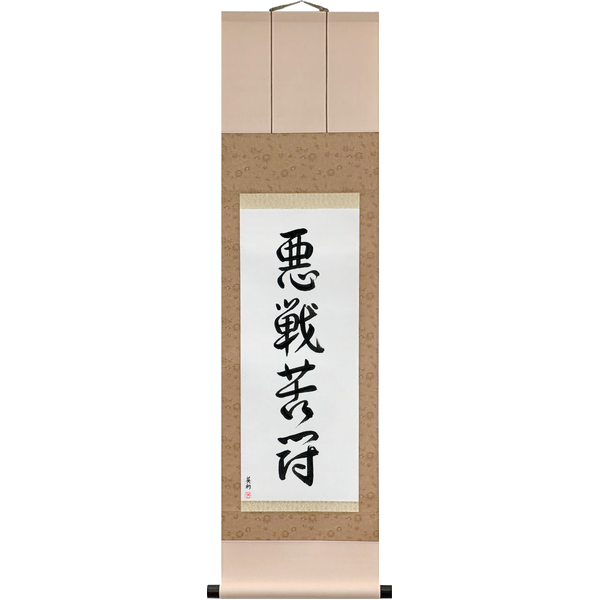
Sold as Desperate Fight · Read akusen kutō · Oldest witness a political history of 1903, on a party that fought the House of Peers · Made in Japan, in the Meiji thirties, from two old Chinese words of battle · Made common by the Russo-Japanese War histories of 1906 · In school by 1912, in a reader's glossary · In Chinese by 1925.
The words
悪戦 is a hard-fought battle. In the 三國演義, 馬超 says of 許褚, of all the hard fighters I have seen, none matches Xu Chu, a true mad tiger, and a fierce battle is the stock phrase of the Chinese adventure novels; in Japan it is 馬琴's, a chapter title of the 八犬伝: Genpachi alone fights hard against the crowd. 苦闘 is a bitter struggle, and older: the 隋書 says of a general's landing on 流求 in 610 that from the hour of the dragon to the hour of the sheep the bitter fight did not let up, and 元稹 uses the word of making poems and of a game of go. Together the four characters mean, in the dictionary's words, to fight a very hard fight against a strong enemy, and then to strive, suffering, in a hard situation. The two halves are Chinese; the four-character word is Japanese, and it is young.
A history, from the earliest witness
1903–1904. A Diet, and a sickbed. The oldest firmly dated print of the word is political. Tokutomi Sohō, writing in 1903 on the Katsura cabinet and its enemies, says that the adversary they fought so bitterly in the last Diet now sits calmly in the cabinet's chair, with the air of a man wondering which way the wind of the world blows. A year later a memoir of three years spent lying ill uses the word of the patient himself: the sick man who has fought his desperate fight against the demon of illness and the demon of discontent, his sword broken and his arrows spent, is fated to die with his castle for a pillow. The figurative use is as old in print as the word. [近時政局史論 1903, pid 783011 koma 81; 仰臥三年 1904, pid 833199 koma 37; both by eye]
1906–1909. The war's word. The histories of the Russo-Japanese War, published in 1906, use it as a formula: a desperate fight, and the enemy at last fell back; a desperate fight, and the enemy's position was barely taken. A women's reader of the same year shows the returned army at the emperor's review, living soldiers who faced the war with Russia in desperate fighting and bitter assault, no panorama but the men themselves. The regimental and prefectural war records of 1907 put it in soldiers' obituaries, and by 1909 a biographical dictionary is telling a death of 1894 in the word of 1906. The National Diet Library's full-text index has five books before 1905 and seventy in 1905–09; then the curve climbs every five years to its wartime peak, 1,053 books in 1935–39. [新女訓 1906, pid 757311 koma 125, by eye; 日露大戦史 1906, pid 774444, OCR]
1906–1911. Everyone else's word. In the same years the word is used of a shipping war (三菱 against the Pacific Mail, in a 1906 history), of a whaling boat against the whale (1907), of a lifetime against every hardship and sorrow on the ghastly battlefield of life (a self-help book, 1907), of a poor childhood, an election (1908), a husband's working day (a household manual, 1908), and illness again (嘉納治五郎, 1910: to pass one's days in a desperate fight with the demon of illness). In 1910 Sōseki called himself a man of hard fighting in the arena of the struggle for existence, and in 1911 a Buddhist reformer titled his memoir 悪戦.
1912–1925. The schoolroom, and the dictionaries. In 1912 a glossary to a middle-school reader defines it for the whaling lesson: to fight a bad, painful fight; the same year a teachers' syllabus lists it as vocabulary for writing a battle narrative in the literary style. The 大日本国語辞典 of 1916 gives it as the example under 苦闘; the 大字典 of 1917 brackets it under 悪戦 with the 三國演義 as the half's source; the 新式大辞典 of 1925 gives it its own bracket, a hard and painful war. The 日国's first citations, 谷崎 and 芥川, are 1918. In 1925 a retelling of the 太平記 writes the word into the fourteenth century, which is how a Meiji word comes to feel ancient. [中学国文教科書字解 1912, pid 868521 koma 13; 大字典 1917, pid 950498 koma 455; both by eye]
1925 onward. Into Chinese. The four characters appear in Chinese in a 1925 strike manifesto, in 蔣介石's 1926 preface to a military-academy yearbook and his 1937 diary of the Xi'an incident, and in speeches to 1958; nothing earlier. As with 適者生存, the word went from Japan into Chinese.
The sense across time
The dictionaries say the word began as a battle and was later extended to effort. The books say otherwise: the first witness is a Diet fight, the second a sickbed, and the war histories come after; by 1910 business, poverty, illness, an election and a whale are all in print. What the war did was not to give the word its meaning but to give it its currency, and the war register never left: it was taught to schoolchildren as battle-narrative vocabulary, and its peak is the wartime one. The word has always been two things at once, a battle and a struggle, and the figurative reading is its own first decade, not a later softening.
What is not a source
Not a Chinese idiom: no book before 1900 carries the four characters, and Chinese has them only from 1925. Not the 太平記: the one Edo leaf the index matches for the half is kuzushiji I did not verify, and the 1925 book that puts the whole word in the 太平記's mouth is a retelling. Not a samurai maxim: it was born in a Diet and a sickroom and raised by the war histories. Not a proverb: it is a word, and it takes する.
The text in English
The English trail is one lineage. 斎藤秀三郎's 1918 dictionary glosses a hard fight as 苦戦, 悪戦苦闘; his 1928 edition, under fight against odds, gives the sentence the catalogue still carries: We had to fight against heavy odds, 我等は優勢の敵を受けて悪戦苦闘した, beside There is no fighting against such odds. 研究社's 1929 English-Japanese dictionary reaches for it to render wrestling as a hard struggle. The later 和英: to be hard pressed; fight against heavy odds (斎藤和英); fight desperately [against heavy odds]; struggle hard (研究社, whose example is He has attained his present position after a long and hard struggle); to fight desperately against someone (EDR); fighting with his back against the wall (the sentence corpora); hard fighting; hard struggle; fighting against heavy odds (JMdict). The catalogue's Desperate Fight is 研究社's adverb made a noun, and Fighting Against Heavy Odds is 斎藤's 1928 sentence by way of JMdict. [熟語本位英和中辭典 1928, pid 1699960 koma 209, by eye]
A reading
Sell it as a word for someone in the thick of it, because that is what it has meant from its first year: a Diet fight, a sickbed, a whaling boat, an election, a business war, a poor childhood. Desperate Fight is a fair lead and Fighting Against Heavy Odds the better one, because it says what the word says, that the fight is being fought, not lost. The story for the page is the two halves: the 三國演義's word for a hard-fought battle and the 隋書's word for a fight that ran from morning to afternoon without letting up, joined by a Meiji generation and made everyone's by the war. The page's gloss of 苦闘 as agonizing should go; it is a bitter struggle. The scroll's modern glyphs are right for a reader today; the pre-war 惡戰苦鬪 is a real second design for the buyer who wants the Meiji look. 典, 2026-09-07.
How this was read
By eye: the template file; six pages at the scan, from the 1903 political history to Saitō's 1928 dictionary, one of them cropped on its OCR line box. By text at the address: the National Diet Library's full-text index on the word, pulled whole and classed by year and subject, with the classical facet for the word and for each half; every hit to 1908 at the page by OCR; the local harvest's 670 books for the dictionaries and textbooks; kotobank for three entries; the 隋書, the 三國演義, the Tang poems and the seven Chinese uses at zh.wikisource; the English through EDRDG and Weblio. Not read: the 1918 novels the 日国 cites; the war histories and the 1916–25 dictionaries at the scan (OCR only); the 太平記 leaf by eye; 研究社's 和英 at its own page. Every address is in the account.
References
Each witness is cited in the account above, at the frame or entry where it was read. A linked list follows when the record for this text is completed.