

和道流空手道 wadōryū karatedō Wadoryu Karate-Do
和道流空手道 (wadōryū karatedō) is the karate of Ōtsuka Hironori 大塚博紀. In 1956 he said the name began on a form for a rank, where he wrote 和道流 in haste. His federation dates the name a decade earlier.
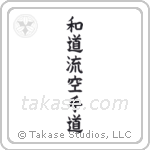
Abstract
和道流空手道 names the karate of Ōtsuka Hironori 大塚博紀 (1892–1982), a master of jūjutsu who learned karate from Funakoshi Gichin 船越義珍, Mabuni Kenwa 摩文仁賢和 and Motobu Chōki 本部朝基. 和 is harmony, and in 1956 Ōtsuka said it is also yawara, the soft art of jūjutsu. The witnesses read here date the name to 1929, 1934, 1937, 1938, March 1939 and about 1940; a collector's notes on a register of April 1941 give it, and it stands in print in a book of 1944. In the 1956 interview Ōtsuka said the name began on a form: applying to the 大日本武徳会 for a rank, he had to write a school's name, and wrote 和道流 in haste.
Overview
The sense. A proper name, the name of a style of karate and of jūjutsu. The Japanese Wikipedia calls 和道流 大塚博紀が創始した空手道と柔術の流派, the school of karate and jūjutsu that Ōtsuka Hironori founded, and counts it among the four great styles, with 松濤館流, 剛柔流 and 糸東流 [1]. jisho.org gives it as Wadō-ryū, in an entry drawn from Wikipedia rather than from JMdict, and no dictionary read here carries 和道流空手道 whole [2]. The 世界大百科事典 mentions 和道流 in its article on karate, among the styles of the 首里手 line [3].
The words. 和 wa, in the デジタル大辞泉's entry for the character, is 争いごとがなく穏やかにまとまる, to come together peaceably, without strife, and やわらいださま, softened, at ease; やわら is among its readings in names; the 日本国語大辞典 gives わ【和】 first as やわらぐこと。おだやかなこと, softening; calm, and second as 互いに仲よくすること, being on good terms with one another [4]. The federation of his line gives his own poem on the word, 武の道はただ荒事とな思ひそ 和の道究め和を求む道, do not think the martial way mere rough work: it is a way that masters the way of 和 and seeks 和 [5]. やわら is also a word for jūjutsu, and it was written with this character: the 日本大百科全書 calls やわら 柔術の俗称, a common name for jūjutsu, and says it was also written 和, 柔和, 弥和羅, 和術 and 和儀; the デジタル大辞泉 gives, under 柔, 武術・武道の一。やわら。「柔術・柔道」, one of the martial arts; yawara; as in jūjutsu, jūdō [6]. 道 dō is a way. 流 ryū is a current, and in the arts a school, a line of teaching handed down. 空手道, karatedō, is 空手, karate, and 道, a way. The Okinawan art was written 唐手, Tang hand, and already read karate; the preface to Funakoshi's first book, of 1922, writes 空手術, the art of the empty hand [7]; the spelling spread in Tokyo from about 1929, when the karate club at Keiō University, with Funakoshi as its teacher, took 空 in the sense of the Heart Sutra's emptiness [8]; and a roundtable held by an Okinawan newspaper in 1936 proposed that the name be unified as 空手 [9]. As an ordinary word, 空手 is empty-handed, cited from sermons of 1586–99 [10].
The text in English. The name came into English as a sound: the English Wikipedia heads its article Wadō-ryū, writes Wado-ryu in its notes, and parses the name as Wa, harmony, dō, way, and ryū, school or style [11]. The modified Hepburn is wadōryū karatedō.
The historical record
1922 to 1929, the teachers. Ōtsuka, having mastered the jūjutsu of 神道揚心流 and 為我流, learned karate from Funakoshi, Motobu and Mabuni, and added the body movement of the swordsmanship of 柳生神影流 [1]. The Japanese Wikipedia's life of him has him call on Funakoshi in July 1922, go to Mabuni for forms in 1928, and study with Motobu from 1929 [12]. A karate primer of 1951, in the passages read, names Funakoshi and Motobu as his teachers, not Mabuni, with the jūjutsu of 神道楊心流, written so (snippet view) [13].
1929 and 1934, the federation's dates. The 和道流空手道連盟, the federation of his line, says: 和道流は、初代大塚博紀先生…によって昭和9年に創始された, Wadō-ryū was founded by the first master Ōtsuka Hironori in 1934, and 和道流の名乗りは、昭和4年、「日本古武道振興会」の設立と共に、その入会時に称したのが始まりである, the name Wadō-ryū was first used in 1929, when he joined the 日本古武道振興会 at its founding [5]. The Japanese Wikipedia gives 昭和9年, 1934, as the style's year, and has Ōtsuka open a dōjō, the 大日本空手道振興倶楽部, in 1934 [1][12]. The English Wikipedia gives two founding dates: 1929, when Hironori Otsuka first began to teach Karate to others at Tokyo University, and 1938 [11]. The society's own founding is told three ways. The Japanese Wikipedia's life of Ōtsuka has him launch the 日本古武道振興会 in 1929, 同年、大塚は日本古武道振興会を発足させた [12]. Its article on the society has it formed in February 1935 around 松本学, a member of the House of Peers [14]. And the society's fiftieth-anniversary volume of 1985 has its founders' meeting on 3 January 1935 at the 芝紅葉館, and the society formed 昭和十年二月, on the third by one of its pages (snippet view) [15].
1937 and 1938, 神州和道流空手術. The society's volume of 1985, on Ōtsuka: 昭和十三年に流祖祭が行なわれたがその折に名称を神州和道流空手術として登録した。日本で空手に流名が付けられた最初のものである, a 流祖祭, a festival for the founders of the schools, was held in 1938, and on that occasion he registered the name 神州和道流空手術; it was the first school name given to karate in Japan [15]. Its volume of 1990 prints 昭和十二年, 1937, in the same sentence [16]. Both are read in snippet view. The Japanese Wikipedia's article on karate gives a different order: Motobu named his school in the Taishō era, Miyagi Chōjun named 剛柔流 in 1931, and Ōtsuka's 神州和道流空手術 followed in 1938, after 小林流, 糸東流 and 神道自然流 [8]. Its life of Ōtsuka has him receive the rank 錬士 in karate from the 大日本武徳会 in July 1938, and says that he named his school 神州和道流空手術, changing it the next year to 和道流, citing the 和道流八十年史 of 2016, p. 47 [12]. The English Wikipedia has him register the style with the Butokukai in 1938 under the long name, soon shortened to just "Wado-Ryu" [11].
March 1939, 和道流. A dialogue of 1986 between the karateka 儀間真謹 and 藤原稜三, read only in snippet view, with the speakers not always told apart, gives a sequence of names with dates: a body whose name the window garbles as …本空手道振武会 (昭和十三年二月), 和道流 (昭和十四年三月), 全日本空手連盟 (昭和二十九年五月), 和道会 (昭和三十九年四…, where the window ends) [17]. The same pages say that 和道流 submitted its technical syllabus to the headquarters of the 大日本武徳会 in March 1939, 和道流が、昭和十四年三月・大日本武徳会本部に提出した技術体系; that its forerunner was the 『大日本空手道振武会』; that, with the subject cut off, 登録の直前までは、『神州和道流空手術』などと…, until just before the registration, something such as 神州和道流空手術, where the window breaks off; and that the applications registering the karate schools' names, 和道流 among them, were submitted by the end of March 1940 [17].
About 1940, in Ōtsuka's words. The first issue of the magazine 『月刊空手道』, of 1956, carries an interview with Ōtsuka, read in snippet view [18]. Asked whether 和道流, read by its letters, means 柔術的空手, a jūjutsu-like karate, he answers 左様、そのようにも解釈されます, yes, it can be read that way too. Then he tells how the name came: 昭和十四、五年頃武徳会の流祖祭があつて … 練士号を貰うのに申込書に、流祖と流名を記さなくてはならぬので、そこで速成で和道流と書いて出しました … 武徳会へ提出の書類の都合で、流名がきまつたと言う訳です, around 1939 or 1940 there was a founders' festival of the Butokukai … to receive the rank of renshi one had to write the founder and the school's name on the application, so I wrote 和道流 in haste and handed it in … so the school's name was settled by the papers for the Butokukai. The interviewer adds 流名をつけるべくしてつけたのではなくてその時の必要にせまられて, not a name given by design, but one the need of the moment pressed on him, where the window breaks off. Earlier in the interview Ōtsuka says 和は"やわら"であつて、武道の根本精神は和にあります, 和 is yawara, and the root spirit of the martial way is 和, and that the purpose of 武 is to stop strife, and more, to bring about peace [18].
1941 and 1944, the name in print. A collector's notes on the Butokukai's register of ranks, published on 29 April 1941, give 空手術錬士之部に大塚博紀(和道流), among the renshi in karate, Ōtsuka Hironori (和道流); the notes do not show whether the school names in parentheses are the register's own, and the same list glosses another man as later renamed [19]. A book of 1944 on the warrior's code of 大道寺友山 thanks, among others, 和道流空手術開祖大塚博紀, Ōtsuka Hironori, founder of 和道流 karate-jutsu; among the first sixty hits of the National Diet Library's full-text search for 和道流, sorted oldest first, it is the oldest whose text speaks of karate (snippet view) [20]. The one earlier hit that might have been, in a library's list of new books of 1942, is the text layer reading across three titles in neighboring columns, 昭和天覽試合, 劍道讀本 and 二刀流を語る, as the page image shows [21].
1951, 和道会. The karate primer of 1951 says that Ōtsuka 柔術の特長を加味されて和道流と命名し、和道會本部を芝におき, named it 和道流, adding the strengths of jūjutsu, and set the 和道会's headquarters in Shiba (snippet view) [13].
1964, a cooperating body. When the All Japan Karatedo Federation was formed in 1964, 和道会, for 和道流, was among the cooperating bodies at its center, with the bodies of 松濤館流, 剛柔流 and 糸東流 [8].
Today. The name is written in English Wado-ryu and Wadō-ryū [11].
A reading
和道流 is a name made of a word, and Ōtsuka gave the word two readings: harmony, the spirit he said the martial way rests on, and yawara, the jūjutsu he brought to karate. The dates in the record run across a decade, and they are not all dates of one thing. 1929 and 1934 are the federation's and the encyclopedias' dates for the teaching, the dōjō and the society; 1937 and 1938 are the society's volumes' dates for a long name registered at a 流祖祭; March 1939 is the dialogue's date for 和道流 and for the syllabus it sent the Butokukai. The witnesses nearest the event are a collector's notes on a register of April 1941 that give the short name and Ōtsuka's own account, fifteen years on, of a rank application that asked for a school's name. I read the name as written down between 1938 and 1940 to meet the Butokukai's paperwork, which is how its founder told it, and the earlier dates as the line's memory of when the teaching began. The society's volumes' first school name given to karate in Japan does not hold against the Japanese Wikipedia's own sequence, which has 剛柔流 named in 1931.
Sources not seen
『和道流八十年史』 (和道流八十年史編纂委員会, 2016), which the Japanese Wikipedia cites for 神州和道流空手術 and the change of 1939. It would show which year the school's own history gives for the name.
The 1956 interview, the society's volumes of 1985 and 1990, and the 1986 dialogue at the page. Each is read here only in the National Diet Library's snippet view, served outside Japan as short windows of text; the pages would give the speakers, the full sentences and what the dialogue's sequence of names is drawn from.
The Butokukai's register of ranks of April 1941 itself, read here only in a collector's transcription, and the register of 1937 that the same collector transcribed.
A reader with access to any of these is invited to write to Takase Studios at Tim@Takase.com.
References
- 「和道流」, the Japanese Wikipedia. https://ja.wikipedia.org/wiki/和道流
- 和道流, at jisho.org (Wadō-ryū), an entry marked Wikipedia definition, drawn from DBpedia and not from JMdict, searched 13 October 2026; 和道流空手道 returns the same entry, and kotobank has no headword 和道流空手道 (404). https://jisho.org/search/和道流
- 「和道流」, 世界大百科事典(旧版), in the article 空手, at kotobank. https://kotobank.jp/word/和道流-1442547
- 「和」, デジタル大辞泉 (漢字項目) and 精選版 日本国語大辞典, at kotobank. https://kotobank.jp/word/和-448360
- 和道流空手道連盟, 「和道流の歴史」. https://www.wado-ryu.jp/histor/
- 「柔」, 日本大百科全書 and デジタル大辞泉 (漢字項目), at kotobank. https://kotobank.jp/word/柔-144457
- 富名腰義珍『唐手 琉球拳法』, 武侠社, 1922, the preface by 漢那憲和, scan 13. National Diet Library pid 971654. https://dl.ndl.go.jp/pid/971654/1/13
- 「空手道」, the Japanese Wikipedia, § 歴史, § 空手の表記 and § 流派. https://ja.wikipedia.org/wiki/空手道
- 嘉手苅徹「空手の名称の変遷 ―②「唐手(からて)」から「空手道」への変容―」, 武道学研究 44 Supplement, 2011, p. S22. https://doi.org/10.11214/budo.44.s_22
- 「空手」, 日本大百科全書 and 精選版日本国語大辞典, at kotobank. https://kotobank.jp/word/空手-47195
- "Wadō-ryū", the English Wikipedia. https://en.wikipedia.org/wiki/Wadō-ryū
- 「大塚博紀」, the Japanese Wikipedia. https://ja.wikipedia.org/wiki/大塚博紀
- 大家礼吉『空手道入門 : 図解説明』, 1951, snippet view, National Diet Library pid 2458874. https://dl.ndl.go.jp/pid/2458874
- 「日本古武道振興会」, the Japanese Wikipedia. https://ja.wikipedia.org/wiki/日本古武道振興会
- 日本古武道振興会『日本古武道大会 : 日本古武道振興会創立五十周年記念誌』, 1985, snippet view, National Diet Library pid 12149642. https://dl.ndl.go.jp/pid/12149642
- 日本古武道振興会『日本古武道大会 : 日本古武道振興会創立五十五周年記念誌』, 1990, snippet view, National Diet Library pid 13331214. https://dl.ndl.go.jp/pid/13331214
- 儀間真謹・藤原稜三 編『近代空手道の歴史を語る : 対談』, ベースボール・マガジン社, 1986, snippet view, National Diet Library pid 12144507. https://dl.ndl.go.jp/pid/12144507
- 『月刊空手道』 1(1), 空手時報社, May 1956, the interview with 大塚博紀, snippet view, National Diet Library pid 1823016. https://dl.ndl.go.jp/pid/1823016
- 「大日本武德會武道範士敎士錬士名鑑」, 「まるふじ文庫」の収集武道書 (Yahoo! ブログ), 25 November 2016, transcribing 『大日本武德會武道範士敎士錬士名鑑』 of 29 April 1941 (德 and 敎 as the transcription writes them), at the Wayback Machine. https://web.archive.org/web/20161226055045/http://blogs.yahoo.co.jp/marufujibunko2015/27817398.html
- 大道寺友山 著『大義武士道訓 : 五十六箇条武道初心集』, 1944, snippet view, National Diet Library pid 1039553. https://dl.ndl.go.jp/pid/1039553
- 若松市図書館 編『若松市図書館増加図書目録 昭和12年6月-17年6月』, 1942, p. 54, scan 31. National Diet Library pid 1263323. https://dl.ndl.go.jp/pid/1263323/1/31