

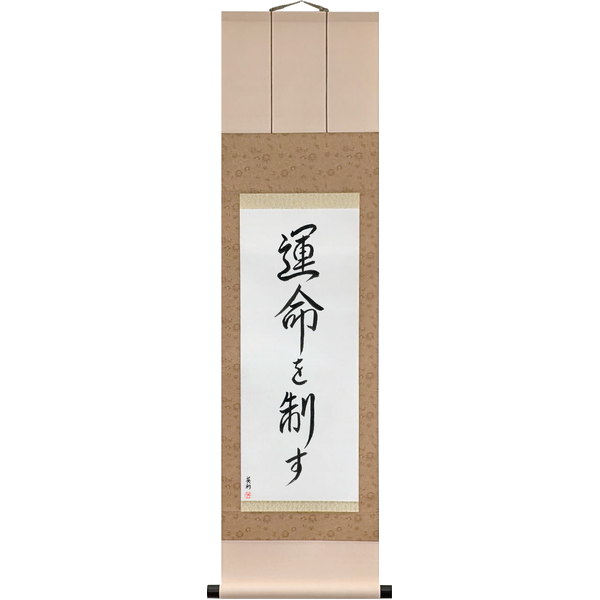
運命を制す unmei wo seisu I Control My Destiny
This is a philological study of the Japanese maxim 運命を制す (unmei wo seisu). It traces the line to three Meiji anthologies of maxims that credit it to Napoleon between 1899 and 1909, and finds that no known French source is behind the attribution.
Abstract
運命を制す, to master one's fate, is a Japanese maxim that survives only inside the compilers' page: three anthologies of maxims for preachers, soldiers and the young print 豪傑は、能く運命を制す, the hero can master fate, and credit it to Napoleon, between 1899 and 1909. No French sentence behind the attribution is known, and the nearest line on Napoleon's own pages says the opposite. The three words 運命を制す are the maxim's last three, with the hero dropped, so that whoever says the line supplies its subject.
Overview
The sense. One sense, and it does not move: fate is something a great man commands, not something he suffers. The collections that print the maxim are books of resolve for preachers, soldiers and the young, and the company they give it, Mencius, Tacitus, 家康, says what kind of sentence they took it for.
The words. Three words. 運命, fate: the dictionaries give 人間の意志を超越して人に幸、不幸を与える力, the power beyond human will that deals out fortune and misfortune, and the word is in Japanese by 1093 [1]. を marks it as the object. 制す is the classical form of 制する, to control, to govern, to command: the sense the 精選版日本国語大辞典 lists third, おさめる。支配する。意のままにする。意に従わせる, with the 太平記's 先ずる時は人を制するに利有りとて, strike first and you command the other man, as its first example; the modern dictionary's examples run from restraining a crowd to seizing the initiative to laying down a law [2]. The classical ending is the register of an aphorism, and it is the ending the collections print. The line has no subject.
The proverb in English. No printed English is known for this Japanese sentence. The house title, I Control My Destiny, renders the three words with a subject added, and the added subject is the one the maxim's tradition invites.
The historical record
1899. 関貢米, editor, Selected Fine Phrases: Japanese and Chinese Literature (佳句類選:和漢文学), 基文館. An anthology of maxims sorted by theme, each with its author in brackets. Under the heading 英雄, heroes, after Goethe on knowing a hero, Mencius on the great man who keeps a child's heart and an anonymous line on diamonds cutting diamonds, stands ○豪傑は、能く運命を制す、(ナポレオン), the hero can master fate (Napoleon). Three entries on, after one on moving extraordinary things and one defining the hero by his resolve, the same page has 人は時世に制せられ、英雄は時世を制す, men are governed by their times; the hero governs them [3].
1907. A Great Treasury of Preaching Material for Every Buddhist Sect (布教大資林:仏教各宗). Sermon material for priests, with readings printed beside the characters. The same sentence, marked with the same name, sits between a line credited to Tacitus and one on life as foam: 豪傑は能く運命を制す、〇ナポレオン [4].
1909. Precepts for the Cultivation of the Military Spirit (軍人精神修養訓). A soldiers' manual of numbered maxims. After Tokugawa Ieyasu 徳川家康's three watchwords, ending 油斷大敵, carelessness is the great enemy, comes 豪傑は能く運命を制す with (ナポレオン) beneath it, and then a line against haste and small gains. Three collections in ten years print one sentence with one name, and none says where it comes from [5].
Between 1892 and 1946, the words in ordinary prose. The National Diet Library's search returns ninety-three books for 運命を制す [6], and reading the ninety-three excerpts one by one shows what the count is: fifty are the plain verb 運命を制する in plain sentences, where a nursery decides a nation's fate (1892: 兒童の居室は國民の腐敗すると興起するとの運命を制する基礎なり) [7], a battle decides France's (1899, Marengo) [8], a strategic point commands two oceans' (1904: 東西兩洋の運命を制するに足るべき形勝の地點) [9], and the rest are cut before the verb's ending. The maxim with its hero is in three of them. The words were a verb phrase anyone might write, and a maxim only when a compiler set the hero in front and Napoleon beneath.
What is not a source. Napoleon. The name is the compilers' attribution, and no French sentence behind it is known: his pages at French and English Wikiquote, searched for destin, fate and destiny, have nothing about mastering fate; the nearest line on the English page says the opposite: When Destiny has accomplished her purpose in me, a fly may suffice to destroy me [10][11]. Unless a French source turns up, the maxim is Japanese and the name is a Meiji compiler's. The English poem Invictus, with its master of my fate, is the nearest English parallel; it is not the source of the Japanese.
Today. Sold as I Control My Destiny. What a rendering must keep is the verb: 制す is command, not accept and not shape, and the sentence is a claim of mastery. The Meiji sentence says the hero masters fate; the scroll, with its English I control my destiny, says the buyer does. That is not a mistranslation. It is what a maxim is for. The scroll's English supplies I.
A reading
The three words look like a phrase composed from a dictionary, and they are the tail of a maxim that three Meiji collections credit to Napoleon. What cannot be said is that Napoleon said it: the sources give the name and nothing under the name. The classical ending is what makes three words a maxim: with 制する the line would be a verb phrase, and the collections print 制す.
References
- 「運命」, デジタル大辞泉・精選版 日本国語大辞典, at kotobank. https://kotobank.jp/word/運命-35734
- 「制する」, デジタル大辞泉・精選版 日本国語大辞典, at kotobank. https://kotobank.jp/word/制する-545583
- 関貢米 編『佳句類選:和漢文学』, 基文館, 1899, National Diet Library pid 864309, scan 81. https://dl.ndl.go.jp/pid/864309/1/81
- 『布教大資林:仏教各宗』, 1907, National Diet Library pid 818598, scan 601. https://dl.ndl.go.jp/pid/818598/1/601
- 『軍人精神修養訓』, 1909, National Diet Library pid 755230, scan 54. https://dl.ndl.go.jp/pid/755230/1/54
- National Diet Library Digital Collections, next-generation full-text search on 運命を制す, 93 books. https://lab.ndl.go.jp/dl/api/book/search?searchfield=contentonly&keyword=運命を制す
- 『丈夫の本領』, 1892, National Diet Library pid 758326, scan 103. https://dl.ndl.go.jp/pid/758326/1/103
- 『励軍小話』, 1899, National Diet Library pid 843370, scan 48. https://dl.ndl.go.jp/pid/843370/1/48
- 『奮闘的生活』, 1904, National Diet Library pid 782494, scan 13. https://dl.ndl.go.jp/pid/782494/1/13
- "Napoleon", at English Wikiquote. https://en.wikiquote.org/wiki/Napoleon
- "Napoléon Ier", at French Wikiquote. https://fr.wikiquote.org/wiki/Napoléon_Ier