

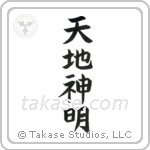
天地神明 tenchi shinmei Gods of Heaven and Earth
天地神明 (tenchi shinmei) names the gods of heaven and earth, all of them at once. Japanese swears by it: 天地神明に誓って, I swear by heaven, earth and the gods. This study follows them from Chinese books and a Buddhist sutra to samurai oaths, the Meiji emperor's oath of 1868, and the mishearing 天地天命.
Abstract
天地神明, tenchi shinmei, is the gods of heaven and earth, all of them called on together, and it lives in one phrase, 天地神明に誓って, I swear by heaven, earth and the gods. The four characters are Chinese, read in Chinese both as heaven and earth, and the spirits and as the spirits of heaven and earth, in a Han philosopher, in classics given to the Han, in a Buddhist sutra and in Tang protests of good faith. In Japan they are in the Taiheiki, the Confucian moralists, a novel's sworn brotherhood of 1791 and the loyalists' letters of the 1860s before the Meiji emperor swore by them in 1868, and an explanation of his oath in 1872 glossed them as the gods of heaven and the gods of the land, as the dictionaries do today. The phrase is plural, and the Christian theologian Ebina Danjō wrote in 1918 that it can be thought of as one impersonal god or as personal gods; in the Agency for Cultural Affairs' survey for fiscal 2018 more Japanese speakers chose a mishearing of the oath, 天地天命, than the original.
Overview
The sense. A four-character phrase that the dictionaries illustrate almost only by one collocation, the oath 天地神明に誓って. デジタル大辞泉 defines it 天地の神々。すべての神々。天神地祇, the gods of heaven and earth; all the gods; the gods of heaven and the gods of the land, with the example 天地神明に誓う, to swear by heaven, earth and the gods; the 精選版 日本国語大辞典 gives 天地の神々。天神地祇 [1]. The 四字熟語を知る辞典 asks the grammatical question the phrase leaves open, whether 天地神明に誓って means by heaven and earth, and the gods or by the gods of heaven and earth. It finds both in the Book of Rites, and then sets the Chinese use aside: the phrase is used chiefly in Japanese, every Japanese dictionary explains it as 天地の神々, and it draws on the image of the eight hundred myriad gods that Japan has always had in heaven and on earth [1]. The bilingual dictionaries give I swear by heaven and earth for the oath and the gods of heaven and earth for the phrase [2].
The words. 天地 is heaven and earth. 神明 alone is a god, the gods: the 大辞泉's first sense is 神。神祇, with this oath as its example, and the 日国's first example is the 続日本紀 for 740, 不孝不忠、違天背地、神明所弃, the unfilial and disloyal, who go against heaven and turn their backs on earth, are cast off by the gods [3]. The 日国 gives 神明 two more senses that matter below: 神のように明晰であること, being clear and bright as a god, and 精神, the spirit [3]. From the late Heian it also named Amaterasu and her shrines, 神明社 [3]. The older word for all the gods is 天神地祇, the gods of heaven and the gods of the land; the 日国's first example for it is the article of the Yōrō code of 718 on the gods the 神祇官 worships, 凡天神地祇者。神祇官皆依常典祭之, in the text the commentary 令義解 preserves, which the same dictionary dates to 833 under 神明 [4][3].
The historical record
The Han and after, Chinese, and read two ways. Of the Chinese witnesses read for this study, the one whose author's date is not in doubt is the philosopher Yang Xiong (揚雄, died 18 CE). In his 法言, asked about 神, he says 潛天而天,潛地而地。天地,神明而不測者也, immersed in heaven it is heaven, immersed in earth it is earth: heaven and earth are numinous and unfathomable, with 天地 the subject and 神明 what is said of it [5]. The military classic 三略 has 端末未見,人莫能知;天地神明,與物推移, where things begin and end is unseen and no one can know it; heaven and earth and the spirits move along with things [6]. The tradition gives the 三略 to the Han, and the dictionaries at kotobank call it a work of the late Han or later, or a later forgery [7]. The alchemical 參同契, given to Wei Boyang of the Eastern Han, has 天地神明,不可度量, which reads as heaven and earth, numinous, cannot be measured as well as the spirits of heaven and earth cannot be measured [8]. The 春秋繁露, given to Dong Zhongshu, says that 天地神明之心, the mind of heaven, earth and the spirits, is something only the sage can see [9]. The 忠經, which the old editions give to Ma Rong of the Eastern Han, heads its first chapter 天地神明章 and says that loyalty 感天地、動神明, moves heaven and earth and stirs the spirits; the catalogue of the imperial library of the Qianlong era (四庫全書總目提要) judges it a Song book under Ma Rong's name [10]. The Book of Rites has the two words as a pair, 禮樂偩天地之情,達神明之德, ritual and music accord with the feelings of heaven and earth and reach the virtue of the spirits, and in the genitive, 昔三代明王皆事天地之神明, the enlightened kings of the Three Dynasties all served the spirits of heaven and earth [11]. Later Chinese commentators on that second passage write it with the four characters, 事天地神明, and the Tang commentary of Kong Yingda has 感天地神明 [12]. By the Tang the four characters are the words a man calls on when his word is doubted: a general's last memorial, 天地神明,實知臣心, heaven, earth and the spirits truly know my heart, and an imperial letter to a Tibetan minister on a broken covenant, 天地神明,豈其可罔, can heaven, earth and the spirits be deceived?, as the Chinese Wikisource gives their texts [12].
The Buddhist canon. The four characters are also in the sutras. The Sutra of Immeasurable Life (無量壽經), in the translation the canon gives to Kang Sengkai of the Wei and a modern encyclopedia to Buddhabhadra and Baoyun in 421, says of the wicked that they 不畏天地、神明、日月, fear neither heaven and earth, nor the spirits, nor the sun and moon, a list the canon's editors punctuate as three [13]. The 增壹阿含經 has a king without an heir who prays 諸山神、樹神、天地神明, to the mountain gods, the tree gods, and heaven, earth and the spirits, for a son [14]. In CBETA's full text of the Taishō canon, the Japanese-authored volumes do not carry the string [13].
The fourteenth century, a Chinese monk printed in Japan. The collected works of the Song monk Qisong (契嵩), 鐔津文集, were printed in Japan in the Nanbokuchō period, and the print says of the emperor Wu of Liang's giving himself to the temple that its virtue is not for ordinary feeling to know: 唯天地神明乃知之耳, only heaven, earth and the spirits know it [15]. The Song anthology 宋文鑑 that this study once called a Japanese print of 1529 is a Ming print, made for the Prince of Jin, and is not a Japanese witness [16].
1368–1375, the Taiheiki. The Taiheiki, put together in the Ōan era by the dictionaries' date [17], tells how the Southern emperor fled the siege at Yawata, and how two arrows struck the sleeve and skirt of his armor and did not go through: 天地神明ノ御加護モ有ケルニヤ, perhaps heaven, earth and the gods protected him, as a printing of 1603 has it [18][19].
1445–46, an encyclopedia. The 壒嚢鈔, compiled by the monk Gyōyo in 1445 and 1446 [20], tells the reader to search out the source of his own mind, for 其本性ハ天地神明聖人賢者ト一点モ違ヘヌ, its true nature differs not a dot from heaven and earth, the gods, the sages and the worthies, in a printing of 1646 [21]. The four characters stand in a list of four.
Before 1550, Kiyohara Nobukata 清原宣賢's lectures on the Nihongi, in a Kan'ei-era manuscript. He speaks of prayer as becoming once more of one root with them: 天地神明同根ニナリ返テ祈ルソ [22].
1604 and 1622, two prints. A printing of the 三略 made in Japan in 1604 marks its reading of the 三略's line: the hyphen-like marks that tie the characters of a word join 天 to 地 and 神 to 明, and none joins 地 to 神, so the line is read as two words side by side, heaven and earth, and the spirits [23]. The Shinchōki, a life of Oda Nobunaga printed in 1622, asks of a portent 是天地神明感スルニ非スヤ, is this not heaven, earth and the gods responding? [24]
About 1676, Kumazawa Banzan 熊沢蕃山, 集義和書. The 日本国語大辞典's first example for the phrase: 君子は主意とする所内に有。天地神明を師友として、人の見聞及ばさる地一念獨知の所におひて戒懼す。是を愼獨と云, the gentleman's purpose is within; taking heaven, earth and the gods as his teachers and friends, he keeps watch over himself where no one else can see or hear, where only he knows his thought. This is called being watchful when alone, read here in a reprint of 1901 [1][25].
1712, Kaibara Ekiken. In his 養生訓 Ekiken writes in one passage that a man shows reverence 天神地祇に對して, toward the gods of heaven and the gods of the land, by guarding his health, and a few lines on, of the rules of the bedroom, 是れ、天地神明の照臨し給ふ所、尤もおそるべし, this is where heaven, earth and the gods look down on us; fear it above all [26]. The two words name one company of gods. In his family precepts, in a print of 1794, he warns his descendants that to follow the Buddhists is to go against 天地神明の道, the way of heaven, earth and the gods, and become 天地神明の罪人, a criminal before them [27].
1791, a sworn brotherhood. In a book of tales of 1791, 可意得談, three men take the oath of Liu Bei, Guan Yu and Zhang Fei in the peach garden for their model, swear to share life and death, and add 若相背に於てハ天地神明の罰を蒙るべし, if we break faith, may we suffer the punishment of heaven, earth and the gods [28]. It is the old form of a Japanese oath, a vow and then the penalty the gods lay on the man who breaks it.
1811, Bakin. In the 拾遺篇 of 椿説弓張月, whose volume is dated 1811 in its colophon, the hero escapes a fire by 天地神明の冥助, the hidden help of heaven, earth and the gods, and the print gives the four characters the reading てんちしんめい in ruby [29].
1854 to 1867, the oath before the Oath. A manuscript account of Kamchatka copied in 1854 has its defenders 天地神明に誓ひ四海心を一にして, swear by heaven, earth and the gods, and become of one heart within the four seas [30]. The papers the assassins of the regent Ii Naosuke carried in 1860, as printed in 1885, carry the sentence 天地神明に誓て疑あるまじ, sworn by heaven, earth and the gods, let there be no doubt [31]. Nakaoka Shintarō wrote to his comrades in Tosa that while other domains acted for the throne theirs alone sat idle: 對天地神明コレヲ何トカ言ハン, facing heaven, earth and the gods, what could we say? [32]. And in 1867 Sakamoto Ryōma invited Sasaki Takayuki, who was ill, to a party with geisha, with the solemn assurance 今日の擧やあへて私しにをいとなむに非ざるなり則ち天地神明の知る所なり, today's affair is no private indulgence: heaven, earth and the gods know it; the joke depends on the formula [33].
6 April 1868, the Charter Oath. The Meiji emperor, fifteen years old by the Western count [34], swore the Charter Oath in the palace hall the government's gazette calls 南殿, in a rite it names 天神地祇御誓祭, the rite of the oath to the gods of heaven and the gods of the land [35]. After its five articles the text turns to the emperor's own words: 我國未曾有ノ變革ヲ爲ントシ朕躬ヲ以テ衆ニ先ンシ天地神明ニ誓ヒ大ニ斯國是ヲ定メ萬民保全ノ道ヲ立ントス, intending a change without precedent in our country, we ourselves, going before the people, swear by heaven, earth and the gods to fix this national course and establish the way of the people's security, and it ends by bidding the people 衆亦此旨趣ニ基キ協心努力セヨ, you too, on this purpose, unite your hearts and strive [36]. A copy in the Diet Library writes the passage 衆ニ先ンジ。天地神明ニ誓ヒ, with テンチシンメイ in ruby beside 天地神明 and チカ beside 誓 [37].
1872, the first gloss found. Four years later a popular explanation of the Oath, cut for the 三嶋神社 in the winter of 1872, explains the phrase: 天地神明に誓ひと有まするハ天神地祇に御誓ひを立させられてと申事で, where it says "swear by 天地神明", that means he made his vow to the 天神地祇, and it gives 天神地祇 the native readings あまつかみ, くにつかみ, the gods of heaven, the gods of the land [38]. No earlier explanation of the phrase is among the books read for this study, and it gives the dictionaries' reading.
The 1870s to the 1940s, in print. In the National Diet Library's full text of its public-domain books, the form 天地神明に誓 is in one book of the 1870s and five of the 1880s, then twenty-six, sixty-four, 219, 233 and 363 a decade to the 1930s; the katakana form 天地神明ニ誓 is in twenty-eight books of the 1870s alone, most of them the Oath and its reprints [39].
1915 and 1918, two Congregationalist preachers. Miyagawa Tsuneteru 宮川経輝 wrote in 1915 that one must not sin 神の前天地神明の前に, before God, before heaven, earth and the gods [40]. Ebina Danjō 海老名弾正, in 1918, in a chapter on theism (有神論) that weighs Japan's many gods against a single impersonal ground: 彼の天地神明といふ言葉も非人格の一神とも考へらるれば、人格の神々とも考へらるゝ, the word 天地神明, too, can be thought of as one impersonal god, or as personal gods [41].
1942, a dictionary for the brush. A dictionary of texts for calligraphy, 揮毫辞典, offers the 三略's line among its texts on war, and glosses it 天神地祇人鬼ノ神々モ有德ノ人カ無德ノ人カニ由ツテ常ニ加被リヲ換ユル, the gods of heaven, of the land and of the dead change their protection according to whether a man has virtue or not [42]. Where the 1604 print read the line as two words, the brush dictionary reads it as the gods.
1975 to 2018, the mishearing. In the Diet Library's full text the mishearing 天地天命, heaven, earth and heaven's decree, first appears as an oath in a book of 1975, and guides to correct usage set it right from 1984 [43]. In the Agency for Cultural Affairs' survey for fiscal 2018 (平成30年度, carried out in February and March 2019), 53.7 percent chose 天地天命に誓って and 32.1 percent the original, 天地神明に誓って; among people in their twenties the mishearing ran to 63.8 percent [44].
What is not a source. 神明 alone came, from the late Heian, also to name Amaterasu and her shrines [3]; that sense belongs to the word standing alone, not to this phrase.
The word in English
1867 to 1888, Hepburn. Hepburn's dictionary has no entry for the phrase in its first, second or fourth edition; under TEN-CHI, 天地, it gives Heaven and earth [45][46][47].
1873, the first English of the Oath found. The Japan Weekly Mail of 8 November 1873 printed a translated memorial on a constitution: The Emperor then prayed to the gods of Heaven and Earth and pronounced an oath containing five clauses [48]. Its next sentence, By this oath we set up as our aim the establishment of the national weal on a broad basis and the framing of a constitution and laws, is a paraphrase of the Oath's heading, and it is the sentence with which de Bary's Sources of Japanese Tradition (2005), citing McLaren's collection of 1914, opens its Charter Oath, in place of the Oath's own closing [48][49][50].
1896, two neighbors. Aston's Nihongi gives the Gods of Heaven and Earth for the older words: Then sacrificing to the Gods of Heaven and Earth, and bringing on our backs the might of the Sun-Goddess, in Jimmu's speech, renders 禮祭神祇 [51][52]. Satoh's Agitated Japan has the 1860 assassins swear before Heaven and earth, gods and men, which renders their 天地神人, not 天地神明 [53][31].
1909, Kikuchi. Kikuchi Dairoku's Japanese Education, lectures given in London in 1907, prints the Oath's closing sentence: Desiring to carry out a reform without parallel in the annals of Our country, We Ourselves here take the initiative and swear to the Deities of Heaven and Earth to adopt these fundamental principles of national government, so as to establish thereby the security and prosperity of the people [54]. Gubbins printed the sentence in 1911, and the Asiatic Society's transactions in 1913, with a note that the translation is that of Baron Kikuchi, slightly modified by J. H. Gubbins [55][56].
1915, Harada. Harada Tasuku, president of Dōshisha, gave a translation he called literal, printed by Griffis in 1915: taking oath before the Divine Illuminance (or deities) of Heaven and Earth [57]. Of the English renderings read for this study, it is the one that weighs 神明 as a word.
1942 and today. Kenkyūsha's dictionary of 1942 gives 天地神明に誓ふ as swear by heaven and earth; call heaven to witness [58], which is where the two languages meet: English too swears by heaven and earth. The modern bilingual sources give the phrase as the gods of heaven and earth [2], and the house title, Gods of Heaven and Earth, is that gloss.
A reading
The four characters are Chinese, and in Chinese they are read both ways: as heaven and earth beside the spirits, in Yang Xiong, the sutra and the 1604 reading marks, and as the spirits of heaven and earth in the Book of Rites and its commentators. Japan took them from the Chinese books and the sutras, and from the Taiheiki on used them for the whole company of witnesses a person can call on: the powers that see what no one else sees, that protect, that punish the oath-breaker. By 1791 they were an oath formula in a storyteller's hands, by the 1860s in the letters of men who meant it, and by 1867 familiar enough for Ryōma to joke with. The Meiji emperor's oath of 1868 made them the national form, and in 1872 a shrine's explanation of that oath read them as 天神地祇, the gods of heaven and the gods of the land. That is how I read the phrase as Japanese says it: the gods of heaven and earth, plural, every god at once. The house title says so. It is not the Christian God's name. Ebina, the Christian theologian who wrote about the word in 1918, offered two readings of it, one impersonal god or personal gods, and the one personal God of his faith is neither.
Notes
Tenchi shinmei is the reading of the 1811 ruby, of the ruby in the Diet Library's copy of the Oath, and of the dictionaries [29][37][1]. Kenkyūsha's dictionary of 1942 writes shimmei by the older rule for n before m [58].
References
- 「天地神明」, デジタル大辞泉・精選版日本国語大辞典・四字熟語を知る辞典, at kotobank. https://kotobank.jp/word/天地神明-578490
- Weblio 英和・和英辞典, 「天地神明」: 研究社新和英中辞典・JMdict. https://ejje.weblio.jp/content/天地神明
- 「神明」, デジタル大辞泉・精選版日本国語大辞典・世界大百科事典, at kotobank. https://kotobank.jp/word/神明-539087
- 「天神地祇」, 精選版日本国語大辞典, at kotobank. https://kotobank.jp/word/天神地祇-578318
- 揚雄, 法言, 問神, Chinese Wikisource. https://zh.wikisource.org/wiki/法言/05 · his dates, 「揚雄」, デジタル大辞泉・精選版日本国語大辞典, at kotobank. https://kotobank.jp/word/揚雄-145877
- 三略, 上略, Chinese Wikisource. https://zh.wikisource.org/wiki/三略
- 「三略」, デジタル大辞泉・精選版日本国語大辞典・世界大百科事典, at kotobank. https://kotobank.jp/word/三略-515058
- 周易參同契, 18章, 晦朔合符章, Chinese Wikisource. https://zh.wikisource.org/wiki/周易參同契/18章
- 董仲舒 (attributed), 春秋繁露, 卷十四, 郊語, Chinese Wikisource. https://zh.wikisource.org/wiki/春秋繁露/卷14
- 忠經, with the 四庫全書總目提要, Chinese Wikisource. https://zh.wikisource.org/wiki/忠經
- 禮記, 樂記 and 表記, Chinese Wikisource. https://zh.wikisource.org/wiki/禮記/樂記 · https://zh.wikisource.org/wiki/禮記/表記
- Chinese Wikisource, full-text search for 天地神明: 陳氏禮記集説補正 卷32, 禮記大全 卷26, 禮記正義 卷48; 令狐彰 遺表; 賜吐蕃宰相尚結讚書. https://zh.wikisource.org/w/index.php?search=%E5%A4%A9%E5%9C%B0%E7%A5%9E%E6%98%8E&fulltext=1
- 佛說無量壽經, 卷下 (T0360), CBETA, line T12n0360_p0276c14. https://cbdata.dila.edu.tw/stable/lines?linehead=T12n0360_p0276c13&after=3 · the translation's date, 「無量寿経」, 日本大百科全書, at kotobank. https://kotobank.jp/word/無量寿経-140923
- 增壹阿含經, 卷三十二 (T0125), CBETA, line T02n0125_p0726c25. https://cbdata.dila.edu.tw/stable/lines?linehead=T02n0125_p0726c24&after=3
- 契嵩, 鐔津文集, 南北朝刊, volume 5, scan 12. https://dl.ndl.go.jp/pid/2543583/1/12
- 宋文鑑, 卷九十五, 晉藩刊, 嘉靖八年 (1529), scan 75. https://dl.ndl.go.jp/pid/2552211/1/75
- 「太平記」, デジタル大辞泉・精選版日本国語大辞典, at kotobank. https://kotobank.jp/word/太平記-91961
- 太平記, 巻第三十一, 南帝八幡御退失事, 冨春堂, 慶長八年 (1603), scan 29. https://dl.ndl.go.jp/pid/8943168/1/29
- 校訂太平記, 博文館, 1906, p. 917, scan 468. https://dl.ndl.go.jp/pid/1885211/1/468
- 「壒嚢鈔」, デジタル大辞泉・日本大百科全書, at kotobank. https://kotobank.jp/word/壒嚢鈔-421709
- 行誉, 壒嚢鈔, 林甚右衛門, 正保三年 (1646), volume 2, scan 75. https://dl.ndl.go.jp/pid/2597263/1/75
- 日本書紀抄, 清原宣賢 講, Kan'ei-era manuscript, scan 71. https://dl.ndl.go.jp/pid/2544852/1/71 · his dates, 「清原宣賢」, デジタル大辞泉・世界大百科事典, at kotobank. https://kotobank.jp/word/清原宣賢-16121
- 黄石公三略, 巻之上, 慶長九年 (1604) 活字印, scan 3. https://dl.ndl.go.jp/pid/2532141/1/3
- 信長記, 巻十一・十二, 太田牛一 輯録・小瀬甫庵 重撰, 元和八年 (1622) print, scan 28. https://dl.ndl.go.jp/pid/2544603/1/28
- 熊沢蕃山, 集義和書, 巻十, in 井上哲次郎・蟹江義丸 編, 日本倫理彙編, 巻之一, 育成会, 1901, p. 432, scan 225. https://dl.ndl.go.jp/pid/1913233/1/225
- 貝原益軒, 養生訓, 巻第四, in 益軒十訓, 下, 至誠堂, 1911, p. 694, scan 51. https://dl.ndl.go.jp/pid/754686/1/51
- 貝原益軒, 貝原先生家訓, 播磨屋新兵衛, 寛政六年 (1794) print, scan 13. https://dl.ndl.go.jp/pid/2536305/1/13
- 湖中突瓢子, 可意得談, 巻之五, 菊屋安兵衛, 寛政三年 (1791), scans 4–5. https://dl.ndl.go.jp/pid/2554806/1/4
- 曲亭馬琴, 椿説弓張月, 拾遺篇下帙巻之二, 平林庄五郎ほか, colophon 文化八年 (1811), scan 50; colophon scan 156. https://dl.ndl.go.jp/pid/2557127/1/50
- 加摸西葛杜加国風説考, 源崇広写, 嘉永七年 (1854), scan 37. https://dl.ndl.go.jp/pid/2539709/1/37
- 植木枝盛, 報国纂録 慷慨義烈, 来々舎, 1885, 浪士懐中封書, p. 廿貳, scan 25 (and p. 廿壹, scan 19). https://dl.ndl.go.jp/pid/783688/1/25
- 宮内省, 殉難録稿 (修補殉難録稿 巻之五十五, 中岡道正), 1933, p. 416, scan 216. https://dl.ndl.go.jp/pid/1874574/1/216
- 岩崎英重 編, 坂本竜馬関係文書, 第一, 1926, p. 358, scan 202. https://dl.ndl.go.jp/pid/1917617/1/202
- 「明治天皇」, 日本大百科全書, at kotobank. https://kotobank.jp/word/明治天皇-16744
- 太政官日誌, 慶応四年, 太政官, scan 36. https://dl.ndl.go.jp/pid/787614/1/36
- 五ヶ條ノ御誓文 (法令全書 慶応四年 第百五十六), Japanese Wikisource. https://ja.wikisource.org/wiki/五ヶ條ノ御誓文
- 御誓文御宸翰三枚御高札御写, undated copy, scan 4 and scan 8. https://dl.ndl.go.jp/pid/773325/1/4 · https://dl.ndl.go.jp/pid/773325/1/8
- 御誓文大意, 三嶋神社藏板, 明治五年 (1872), scan 26 (title leaf scan 2). https://dl.ndl.go.jp/pid/773326/1/26
- National Diet Library, 次世代デジタルライブラリー, full-text searches for 天地神明に誓 and 天地神明ニ誓, by decade. https://lab.ndl.go.jp/dl/
- 宮川経輝, 基督教十講, 北文館, 1915, p. 104, scan 58. https://dl.ndl.go.jp/pid/943567/1/58 · his church, 「宮川経輝」, at kotobank. https://kotobank.jp/word/宮川経輝-139492
- 海老名弾正, 基督教新論, 警醒社, 1918, p. 125, scan 79. https://dl.ndl.go.jp/pid/943957/1/79 · his church, 「海老名弾正」, at kotobank. https://kotobank.jp/word/海老名弾正-14581
- 松崎覚本, 揮毫辞典, 日比谷出版社, 1942 (second edition), p. 312, scan 168. https://dl.ndl.go.jp/pid/1884879/1/168
- National Diet Library Digital Collections, full-text search for 天地天命, oldest first: 三宅忠明, スコットランドの民話, 1975; 江森陽弘, 江森陽弘の作文教室, 1984; snippet view, National Diet Library. https://dl.ndl.go.jp/search/searchResult?keyword=天地天命&fulltext=true&sortKey=ISSUED_ASC
- 文化庁, 平成30年度「国語に関する世論調査」の結果について, 2018, p. 13, 問18(1).
- Hepburn, J. C., A Japanese and English Dictionary, American Presbyterian Mission Press, 1867, p. 468. https://archive.org/details/japaneseenglishd00hepb
- Hepburn, J. C., A Japanese-English and English-Japanese Dictionary, second edition, American Presbyterian Mission Press, 1872, p. 536. https://archive.org/details/japaneseenglishe00hepb_0
- Hepburn, J. C., A Japanese-English and English-Japanese Dictionary, fourth edition, Maruya, 1888, p. 656. https://archive.org/details/japaneseenglishe00hepbuoft
- The Japan Weekly Mail, 8 November 1873, p. 796.
- McLaren, W. W., ed., Japanese Government Documents, Transactions of the Asiatic Society of Japan 42, 1914, p. 8.
- de Bary, Wm. Theodore, et al., eds., Sources of Japanese Tradition, vol. 2, second edition, Columbia University Press, 2005, The Charter Oath.
- Aston, W. G. (trans.), Nihongi: Chronicles of Japan from the Earliest Times to A.D. 697, Kegan Paul, 1896, vol. 1, p. 113.
- 日本書紀, 巻第三, 慶長十五年 (1610) print, scan 5. https://dl.ndl.go.jp/pid/2544342/1/5
- Satoh, Henry, Agitated Japan: The Life of Baron Ii Kamon-no-Kami Naosuke, 1896, p. 139. https://archive.org/details/agitatedjapanlif00satoiala
- Kikuchi, Dairoku, Japanese Education: Lectures Delivered in the University of London, John Murray, 1909, pp. 45–46. https://archive.org/details/japaneseeducatio00kikuiala
- Gubbins, J. H., The Progress of Japan, 1853–1871, Oxford, 1911, pp. 196–197. https://archive.org/details/cu31924023233301
- Transactions of the Asiatic Society of Japan 41, 1913, Introduction, pp. 389–390.
- Griffis, William Elliot, The Mikado: Institution and Person, Princeton University Press, 1915, p. 136 (Harada Tasuku's translation). https://archive.org/details/cu31924023501277
- Kenkyusha's New Japanese-English Dictionary, Takenobu Yoshitarō, ed., Harvard University Press, 1942, p. 1963.