

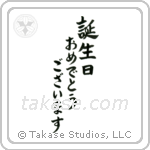
誕生日おめでとうございます tanjōbi omedetō gozaimasu Happy Birthday
誕生日おめでとうございます (tanjōbi omedetō gozaimasu), happy birthday, is the polite congratulation with the day named in front of it. Its おめでとう is cited as a greeting from a kyōgen of the late Muromachi or early Edo period. This study finds the formula without an author, and the whole string in no book in the National Diet Library's full-text search.
Abstract
誕生日おめでとうございます, tanjōbi omedetō gozaimasu, happy birthday, is a spoken formula in the polite register: 誕生日, the day one was born; おめでとう, the congratulation said at New Year and at any happy event; and ございます, the polite verb. Each word is old, the congratulation cited as a greeting from a kyōgen of the late Muromachi or early Edo period, and the formula has no author. The National Diet Library's full-text search finds the whole string in no book.
Overview
The sense. A congratulation, in the polite register, 丁寧語: JMdict gives おめでとうございます as congratulations, marked polite and usually written using kana alone [1]. The English happy birthday is a wish, may it be happy; おめでとう is a congratulation, it is auspicious. The Japanese names the occasion in front of the ordinary congratulation.
The words. 誕生日 tanjōbi: デジタル大辞泉, 人の生まれた日。毎年迎える誕生の記念日, the day a person was born; the yearly anniversary of it; 精選版日本国語大辞典 cites the older reading, たんじょうにち, from a Tōji document of 1443, 当御所御誕生日, and the modern reading from a 人情本 of the mid-nineteenth century, 明後日は姫君さまの、御誕生日(タンジャウビ)のお祝ひ, the day after tomorrow is the young lady's birthday celebration [2]. おめでとう omedetō is おめでたく with the sound change of the adverbial form; 精選版 defines it as 新年や、めでたいことがあった時の挨拶のことば, the greeting at New Year or when something auspicious has happened, and cites it from a kyōgen of the late Muromachi or early Edo period, 『おめでたう存じます』 [3]. Behind it is めでたい, admirable, auspicious, which 精選版 derives from めでる, to love, to admire, and cites from the 竹取物語 of the ninth or tenth century, かぐや姫かたちの世に似ずめでたき事, that Kaguya-hime's looks were beyond compare [4]. ございます is the polite there is of ござる, which デジタル大辞泉 illustrates in that sense from the Jesuits' Amakusa Aesop of 1593 [5].
The text in English. Happy birthday and 誕生日おめでとうございます do the same work, and the Japanese is longer and more formal.
The historical record
1443 to the nineteenth century, the words. 誕生日 is cited from 1443 in the reading たんじょうにち and from a mid-nineteenth-century 人情本 as たんじょうび [2]; おめでたう存じます, the greeting with an older polite verb, from a kyōgen of the late Muromachi or early Edo period [3].
No print of the whole formula. The National Diet Library's full-text search finds 誕生日おめでとうございます, and the older spelling 誕生日おめでたう, in no book [6].
What is not a source. The formula has no author. The English song Happy Birthday to You is not its source: the Japanese is the ordinary congratulation with the occasion named in front of it. The song's melody, Good Morning to All, is attributed to Patty and Mildred Hill in 1893 [7].
Today. JMdict gives the congratulation as polite and usually written using kana alone [1]. What a rendering must keep is the politeness: the whole formula is the polite one, and tanjōbi omedetō alone is the plain form.
A reading
誕生日おめでとうございます is a congratulation rather than a wish: おめでとう says the day is auspicious, where English asks only that it be happy. The words behind it are centuries old, the congratulation a greeting since the kyōgen stage; the formula is what one says, and not a phrase any book in the corpus searched prints whole.
References
- JMdict (EDRDG), 「おめでとうございます」, at jisho. https://jisho.org/search/おめでとうございます
- 「誕生日」, デジタル大辞泉・精選版日本国語大辞典, at kotobank. https://kotobank.jp/word/誕生日-95124
- 「おめでとう」, 精選版日本国語大辞典, at kotobank. https://kotobank.jp/word/おめでとう-222113
- 「めでたい」, 精選版日本国語大辞典, at kotobank. https://kotobank.jp/word/めでたい-396330
- 「御座る」, デジタル大辞泉・精選版日本国語大辞典, at kotobank. https://kotobank.jp/word/御座る-500915
- National Diet Library next-generation full-text search on 誕生日おめでとうございます and on 誕生日おめでたう, searched again 26 September 2026: none. https://lab.ndl.go.jp/dl/api/book/search?searchfield=contentonly&keyword=誕生日おめでとうございます
- "Happy Birthday to You", the English Wikipedia. https://en.wikipedia.org/wiki/Happy_Birthday_to_You